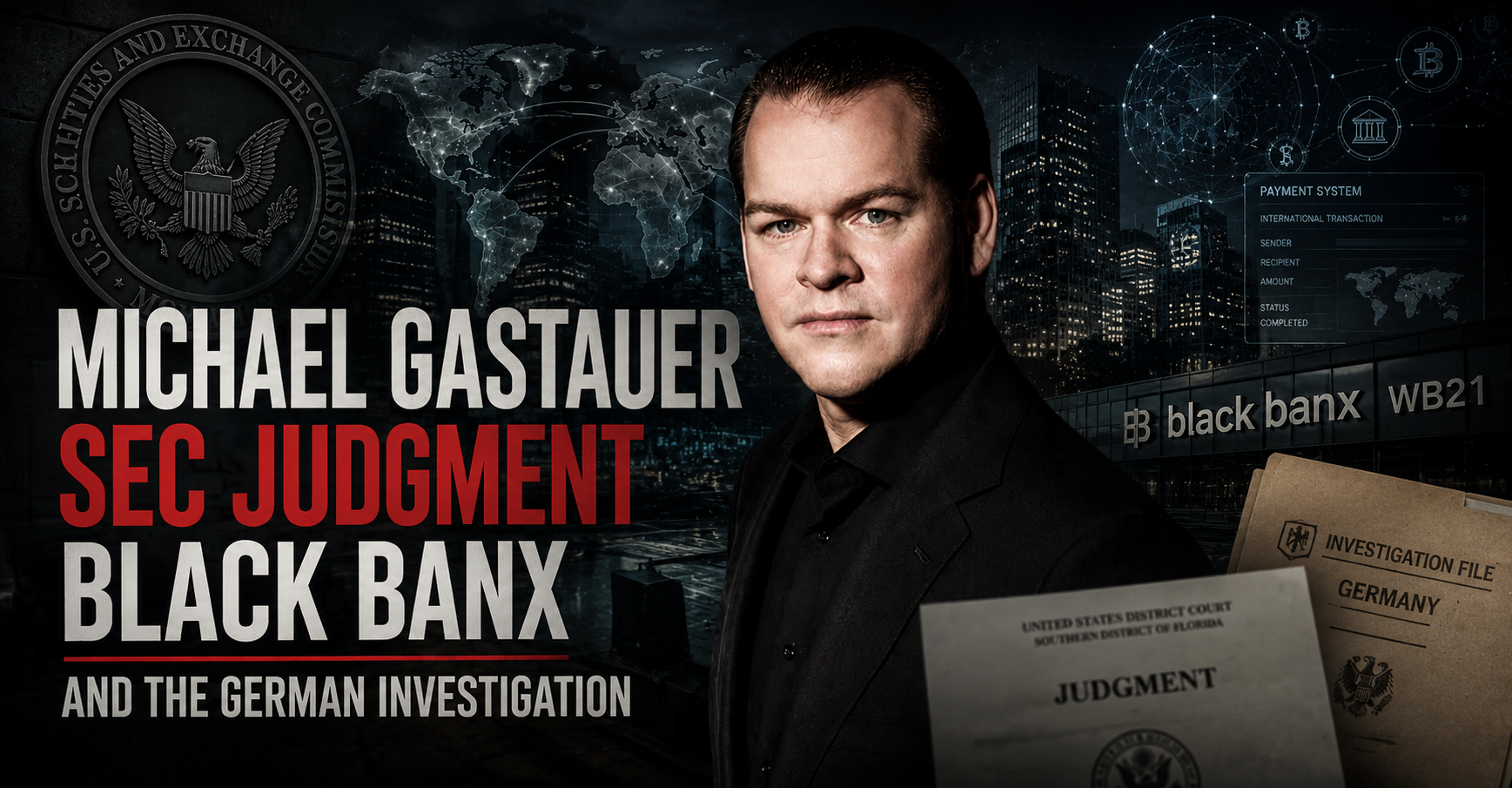
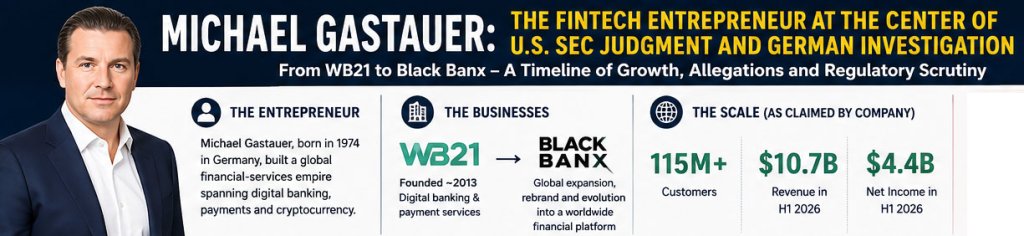
Michael Gastauer has built the kind of financial empire that seems almost designed for the age of digital money. His company, Black Banx, says it operates across 180 countries and territories, serves more than 115 million customers and has grown into a multibillion-dollar financial-services business. Gastauer remains the company’s chief executive and public face.
In the company’s latest disclosures, Black Banx says it generated $10.7 billion in revenue and $4.4 billion in net income during the first half of 2026. Those numbers, like many of the company’s headline statistics, come from Black Banx itself rather than from the kind of public audited filings available for a listed bank.
That extraordinary growth story sits alongside a very different record preserved in U.S. court documents and more recent German reporting.
Gastauer was sued by the U.S. Securities and Exchange Commission in 2018 over an international microcap stock scheme that the regulator said generated roughly $165 million in illegal stock-sale proceeds. The SEC alleged that companies controlled by Gastauer helped move the proceeds of that scheme.
In March 2022, a federal court entered a default judgment against Gastauer personally, finding that he aided and abetted violations of U.S. securities laws and ordering him to pay more than $17 million.
The judgment is important, but so is what it does not mean. Gastauer was not criminally convicted of securities fraud. The $165 million was not a penalty assessed against him personally. It was the amount the SEC said the underlying scheme generated. And the judgment against Gastauer came by default after he failed to defend the SEC’s claims, rather than after a criminal trial or jury verdict.
Black Banx has also denied that Gastauer or the company knowingly participated in the underlying fraud. Those distinctions are essential to understanding the record rather than turning a complicated regulatory case into a simpler accusation than the evidence supports.
Now, years after the SEC case reached judgment, Gastauer’s financial empire is facing another layer of scrutiny. German prosecutors in Frankfurt are investigating him over allegations that payment services were offered without the required licenses. German reporting has also said authorities are examining whether the services were used by third parties for money laundering.
Searches were carried out in Bavaria in 2025, including at a property associated with Gastauer’s family in Neustadt an der Aisch. As of the latest reporting reviewed, there had been no reported criminal conviction against Gastauer in Germany and the investigation remained an investigation.
That creates the central tension in Gastauer’s story.
On one side is the entrepreneur presented by Black Banx as a visionary who has built a borderless financial institution capable of moving money around the world at enormous scale.
On the other is a record of federal securities enforcement, a multimillion-dollar judgment, disputed financial flows involving members of his family, questions about the licensing of his earlier banking business and a new German investigation into the operation of payment services.
From Germany to International Finance
The story begins in Germany, where Gastauer was born in October 1974.
British corporate records identify him as Michael Tankred Raimund Gastauer, a German national. Public reporting from Bavaria places his roots in Neustadt an der Aisch, a small town in Middle Franconia that would later become an unlikely backdrop to a story involving international banking, cryptocurrency and U.S. securities enforcement.
Gastauer’s biography describes an entrepreneur who moved early into finance and technology. His public accounts say he worked in venture capital and asset management before moving into payment processing.
His business career accelerated during the internet boom and eventually brought him into the international payments industry. The company that made him internationally known was WB21.
The proposition was straightforward and commercially attractive. Traditional banks could be slow, expensive and difficult to access, particularly for customers trying to send money across borders.
WB21 promised a digital alternative. Customers could open accounts online and use the platform for international payments without dealing with the conventional banking infrastructure that Gastauer portrayed as outdated.
By 2016, the company was already presenting itself as a major digital banking operation.
Gastauer told The Paypers that WB21 had hundreds of thousands of customers and operated in roughly 180 countries. The company promoted fast account opening and international payment capabilities, and it embraced cryptocurrency at a time when many conventional financial institutions were still reluctant to do so.
That ambition was part of the company’s appeal. It was also the beginning of questions that would follow Gastauer’s businesses for years.
WB21: The Business That Came Before Black Banx
WB21 increasingly became associated with Gastauer‘s vision of a global digital financial platform.
The company positioned itself as an alternative to traditional banking infrastructure, offering customers international payment capabilities and digital accounts.
Its international ambitions were significant. Rather than focusing on a single national banking market, WB21 sought to operate across borders and make international financial services more accessible.
That model would later become the foundation for Black Banx.
But the international nature of the business also created a difficult regulatory question: which entity was actually providing the financial service, in which country, and under what authorization?
Those questions became increasingly important as Gastauer’s businesses expanded.
The Regulatory Question: What Was WB21 Legally?
The distinction between a bank, a payment institution, a stored-value provider and a financial technology company is not merely semantic.
Each activity can require different regulatory permissions, and those permissions can vary substantially from country to country.
A company can serve customers internationally while relying on different regulated entities in different jurisdictions. But the further a business moves into banking-like services, the more important it becomes to establish precisely which entity is licensed to perform which activity and where.
German broadcaster Kontraste reported in January 2026 that neither Black Banx nor its predecessor WB21 held a German BaFin banking license.
Black Banx responded that it had never presented itself as a bank in Germany and said it had explored the possibility of obtaining a European license around 2016 and 2017 before deciding against doing so.
That response is important because it shows the issue is not simply whether Gastauer owned a company that called itself a bank.
The regulatory question is more specific: what financial services were being offered, through which entities, in which jurisdictions and under what licenses?
Those questions became especially consequential when the U.S. Securities and Exchange Commission began examining another part of Gastauer’s corporate network.
The 2018 SEC Case and the $165 Million Stock Scheme
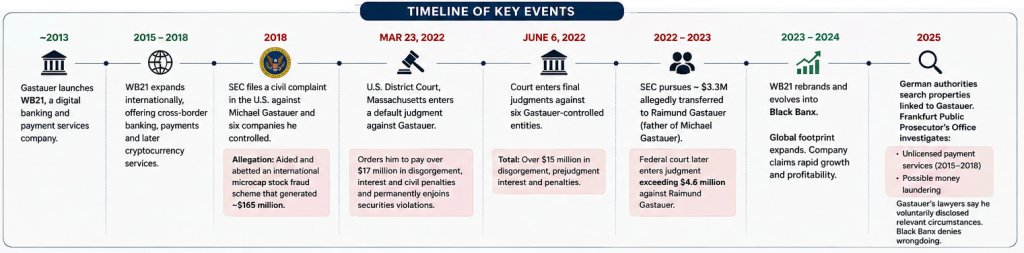
In October 2018, the SEC filed a civil enforcement action in the U.S. District Court for the District of Massachusetts against Roger Knox, Wintercap SA, Michael T. Gastauer and six U.S. companies controlled by Gastauer.
The case was Securities and Exchange Commission v. Knox et al., Civil Action No. 1:18-cv-12058.
At the center of the case was Roger Knox, a British citizen operating through the Swiss company Wintercap SA.
The SEC alleged that Knox had created an international operation that helped people who controlled publicly traded companies sell large quantities of stock while concealing their ownership and avoiding U.S. securities laws.
The regulator alleged that the scheme involved at least 50 microcap companies and generated approximately $165 million in fraudulent stock-sale proceeds.
According to the SEC’s complaint, Knox provided sellers with access to offshore brokerage accounts and helped conceal their identities and ownership interests.
Gastauer was not accused of being the person who created the stock-selling operation.
The SEC’s allegation was different and more specific. It said Gastauer aided and abetted the scheme through several companies he controlled.
Those companies were Silverton SA Inc., Wintercap SA Inc., WB21 US Inc., WB21 NA Inc., C Capital Corp. and B2 Cap Inc.
The SEC alleged that Gastauer’s companies maintained U.S. bank accounts that were used to disburse proceeds from the illegal stock sales.
That distinction is one of the most important facts in the case.
The regulator did not simply allege that Gastauer was a customer of Roger Knox or that money happened to pass through his financial network. It alleged that companies controlled by Gastauer became part of the mechanism used to move the proceeds.
The SEC sought emergency relief.
In October 2018, the court entered a preliminary injunction and continued an asset freeze against Gastauer, Knox and the entities involved in the case.
The parallel criminal case focused on Knox. A federal grand jury in Massachusetts indicted him in October 2018 on securities fraud and conspiracy charges.
Knox pleaded guilty in January 2020. The criminal case provided the underlying securities-fraud backdrop to the SEC’s civil enforcement action against Gastauer.
Gastauer’s own case ultimately proceeded differently.
Gastauer’s Federal Judgment and Financial Penalties
On March 23, 2022, the Massachusetts federal court granted the SEC’s motion for default judgment against him.
The court’s final judgment found that Gastauer aided and abetted violations of Sections 5(a), 5(c) and 17(a) of the Securities Act of 1933 and Section 10(b) of the Securities Exchange Act of 1934 and Rule 10b-5.
The court permanently enjoined him from violating those provisions.
The financial consequences were substantial. The court ordered Gastauer to pay $11,264,415 in disgorgement, representing ill-gotten gains, plus $1,736,559 in prejudgment interest and a civil penalty of $4,350,843.
Together, those amounts exceeded $17.35 million. The language of the judgment matters.
This was not an accusation that remained unresolved. A federal court entered a final civil judgment against Gastauer.
But it was also not a criminal conviction. The judgment arose from a default, meaning Gastauer did not defend the SEC’s claims in the litigation that resulted in the judgment.
Black Banx has disputed the substance of the SEC’s underlying allegations.
In comments reported by German broadcaster Kontraste, the group said it did not know about Knox’s fraud, did not conceal identities and did not support violations of the law.
That defense creates a difficult question for anyone examining the case.
How much does a financial intermediary need to know before its role in moving money becomes legally significant?
The SEC’s answer was that Gastauer’s role crossed that line.
The court’s final judgment is the clearest evidence of the government’s position becoming judicially enforceable.
The corporate consequences continued after Gastauer’s personal judgment.
In June 2022, the court entered final judgments against six Gastauer-controlled entities, ordering more than $15 million in disgorgement, prejudgment interest and civil penalties.
The SEC said the entities were permanently enjoined from violating the same securities antifraud and registration provisions.
The SEC also pursued money that had allegedly moved beyond Gastauer’s companies.
That part of the story brought the Gastauer family directly into the litigation.
The Gastauer Family and the $4.6 Million Recovery Judgment
According to the SEC, in late 2017 and early 2018, approximately $3.3 million connected to the alleged securities scheme was transferred by Michael Gastauer to his father, Raimund Gastauer, or accounts held for his father’s benefit.
The SEC subsequently named Raimund as a relief defendant.
The term “relief defendant” is important. It does not necessarily mean the person committed the underlying fraud. In cases involving alleged proceeds of wrongdoing, regulators can seek recovery from someone who received money even if that person is not accused of participating in the underlying violation.
Raimund Gastauer fought the SEC’s attempt to recover the money. In 2022, a federal court entered judgment against him. He appealed, and in February 2024 the U.S. Court of Appeals for the First Circuit reversed that decision and sent the matter back to the district court.
The appellate proceedings focused in significant part on whether the U.S. courts had established personal jurisdiction over Raimund, who was a German citizen living outside the United States.
That appellate decision should not be misread as an overturning of Michael Gastauer’s SEC judgment.
It was not. The First Circuit’s ruling concerned Raimund Gastauer. The SEC then continued the proceedings against him after the case returned to the Massachusetts district court.
In January 2025, the district court entered a new final judgment against Raimund requiring him to pay approximately $3.3 million in disgorgement and approximately $1.3 million in prejudgment interest, bringing the total above $4.6 million.
The SEC described that judgment as concluding the litigation against Raimund.
The significance for Michael Gastauer is not that his father was found to have committed the underlying stock fraud.
He was not. The significance is the financial trail identified by the SEC. The regulator alleged that money originating from Gastauer-controlled entities moved to a close family member, and that allegation generated years of litigation over whether the proceeds could be recovered.
The SEC case therefore produced several separate legal outcomes: a default judgment against Michael Gastauer exceeding $17 million, final judgments against Gastauer-controlled companies exceeding $15 million, and a later judgment exceeding $4.6 million against Raimund Gastauer as a relief defendant.
From WB21 to Black Banx
While those legal proceedings were unfolding, the business associated with Gastauer was changing.
WB21 increasingly gave way to Black Banx. The new brand offered a cleaner story.
Black Banx positioned itself as a global financial platform built around international payments, digital accounts and cryptocurrency. The company said it could operate across borders more efficiently than traditional banks and reach customers who were poorly served by conventional financial institutions.
The corporate structure became international as well.
Gastauer’s companies have operated through multiple jurisdictions, and British corporate records have documented his connection to companies associated with the business.
That kind of structure is not inherently improper. International financial companies routinely use subsidiaries, holding companies and regulated operating entities in different countries.
The issue is what those entities actually do.
That question becomes particularly important when a company advertises itself to customers in dozens or hundreds of countries while relying on different regulatory permissions in different places.
It also becomes important when the company claims extraordinary growth.
Black Banx’s Extraordinary Growth Claims
Black Banx now says it has more than 115 million customers.
It claims billions of dollars in revenue and profit and describes itself as one of the fastest-growing financial companies in the world.
Its latest corporate disclosures say first-half 2026 revenue reached $10.7 billion, with $4.4 billion in net income.
Those are remarkable figures.
They are also figures that require attribution.
Black Banx is privately held.
Unlike a publicly traded bank, it does not provide the same continuous public reporting, audited quarterly disclosures and regulatory filings that allow outsiders to independently test every headline number.
German public broadcaster ARD’s Kontraste highlighted precisely this problem when examining the company, noting that its published figures were spectacular but could not be independently verified in the same manner as the financial statements of a listed company.
That does not establish that the figures are false.
It establishes a reporting limitation.
A journalist writing about Black Banx should therefore say that the company reports 115 million customers, or that it claims $10.7 billion in first-half revenue, rather than presenting those figures as independently verified financial facts.
The same caution applies to claims surrounding Gastauer’s personal wealth.
Gastauer has been presented in promotional material as a billionaire and as one of Europe’s leading fintech entrepreneurs. But the valuation of a private company is not the same thing as cash in an entrepreneur’s bank account, and private-company valuations are not continuously established through a public market.
The public image surrounding Gastauer has been ambitious. The regulatory record has been less straightforward.
And then Germany entered the story.
The German Investigation: Unlicensed Payment Services and Money Laundering Allegations
In 2025, German authorities conducted searches associated with an investigation involving Gastauer. Reporting from Bayerischer Rundfunk, ARD’s Kontraste and the Fränkische Landeszeitung described raids at a property in Neustadt an der Aisch, including a December search involving armed specialist police. The investigation is being handled by the Frankfurt Public Prosecutor’s Office.
The allegation reported by German media is that Gastauer offered payment services without the required business licenses. Authorities are also examining whether such services were used by third parties for money laundering. The reported period of interest is particularly significant, as German prosecutors are examining activity dating to the years 2015 through 2018, the same period in which WB21 was rapidly expanding internationally.
The licensing issue goes to the heart of Gastauer’s business model. A company that provides financial services across borders needs to understand where it is regulated and under what authority it can provide each service. Payment services, banking services and cryptocurrency services can fall under different regulatory regimes, and the more jurisdictions a business enters, the more complicated that regulatory map becomes. German authorities are now examining whether Gastauer crossed the line into activities for which the necessary authorization was not in place.
Gastauer’s lawyers have offered a significant defense. According to Kontraste, they said their client voluntarily disclosed the relevant circumstances before the official investigation began. Black Banx has also denied wrongdoing. Those responses are important because they show that the allegations remain contested and that Gastauer’s position is that the circumstances under examination do not establish wrongdoing on his part.
The German case must therefore be treated differently from the SEC case. The SEC matter resulted in a final federal judgment against Gastauer, while the German matter, at least according to the latest public reporting reviewed, remains an investigation. There is no criminal conviction establishing that Gastauer illegally operated payment services in Germany, and there is no basis to state that he has been convicted of money laundering.
There is, however, a live prosecutorial inquiry into whether the relevant services were provided without the necessary licenses and whether third parties used the system for money laundering. That distinction is not a technicality. It is the difference between reporting what prosecutors are investigating and declaring a person guilty of conduct that has not been adjudicated.
The German reporting has also raised questions about the way Black Banx and Gastauer have constructed their public image. Kontraste examined the company’s extraordinary growth claims and promotional activities while comparing them with the more limited independent information available about the privately held group. The company’s public narrative is unmistakable: Gastauer is portrayed as a fintech innovator who has built a global financial institution capable of serving people outside the traditional banking system.
The business’s history tells a more complicated story. The same infrastructure that allows money to move quickly across borders also creates risks. Payment companies can become attractive to legitimate customers precisely because they offer speed and access, but those same characteristics can make them attractive to people seeking to move money through financial systems without the scrutiny associated with traditional banks.
That is why licensing and compliance matter. For a company operating across multiple jurisdictions, the question is not simply whether it can move money quickly or serve customers internationally. The more fundamental questions are whether the appropriate entities are licensed, whether transactions are properly monitored and whether the systems in place are capable of preventing financial services from being misused.
For Gastauer, those questions now extend beyond the history of WB21 and the U.S. securities case. German prosecutors are examining whether aspects of the earlier business model complied with the country’s licensing requirements and whether the system was used by others for money laundering. Until that investigation reaches a formal conclusion, however, those matters remain allegations under examination rather than established findings of criminal conduct.
QuadrigaCX, OneCoin and the Limits of Association
The Gastauer story also intersects with another notorious financial collapse: QuadrigaCX.
QuadrigaCX became Canada’s largest cryptocurrency exchange before collapsing after the death of its founder, Gerald Cotten.
Investigations into the company found a massive shortfall in customer assets and serious misconduct surrounding its operations.
WB21 became relevant because it had acted as a payment processor for QuadrigaCX.
Court-appointed monitor Ernst & Young contacted WB21 in 2019 about funds associated with QuadrigaCX.
The amount and nature of the funds became disputed, and WB21 disputed characterizations suggesting it held a large amount of Quadriga customer money.
The relationship is worth examining because it demonstrates the distinction between being part of a financial transaction chain and being responsible for a customer’s fraud.
There is no basis to say Gastauer was convicted of participating in the QuadrigaCX fraud.
There was no such criminal judgment.
What can be said is that a Gastauer-controlled payment business was involved in the financial infrastructure surrounding one of the largest cryptocurrency failures in Canadian history.
That creates a question about customer due diligence and counterparty risk.
It does not by itself establish criminal knowledge.
Similar caution is required when discussing reporting connecting WB21 with OneCoin and other controversial financial operations.
The existence of allegations or business relationships should not be transformed into a claim that Gastauer personally participated in every customer’s misconduct.
That would go beyond the evidence.
The SEC case is different because there is an actual judgment against Gastauer.
That is where the investigation should return.
What the Public Record Actually Establishes
The 2018 SEC complaint described an international stock-selling operation that allegedly generated approximately $165 million. According to the SEC, Roger Knox used offshore accounts and nominee structures to conceal the identities of people selling large quantities of microcap shares. Gastauer’s alleged role was different. The SEC said companies controlled by him provided corporate structures and bank accounts through which proceeds from the stock sales could be moved.
The case ultimately resulted in a federal judgment against Gastauer. On March 23, 2022, the Massachusetts federal court entered a default judgment finding that he aided and abetted violations of specified federal securities laws. The judgment permanently prohibited him from violating those provisions and required him to surrender more than $11 million in disgorgement, pay approximately $1.74 million in prejudgment interest and pay a civil penalty of approximately $4.35 million. In total, the amount exceeded $17 million.
For a businessman who subsequently built a global financial-services empire, that history is significant. It is also significant that the judgment did not end his business career. Gastauer continued, WB21 evolved into Black Banx, the company expanded its international footprint, cryptocurrency became a larger part of the business, and the reported customer base grew dramatically. In many financial scandals, regulatory action becomes the end of the business narrative. In Gastauer’s case, it became one chapter in a continuing expansion.
That expansion makes the German investigation more consequential. If Black Banx’s current claims are accurate, the company now operates at a scale vastly larger than the WB21 business of the mid-2010s. A regulatory problem affecting a company serving millions of people is one thing; a regulatory problem affecting a company claiming more than 115 million customers and billions of dollars in revenue is something else entirely.
Yet the public has relatively limited independent visibility into the company’s finances. That does not mean Black Banx’s numbers should be dismissed. It means they should be examined carefully. The company says it has more than 115 million customers and reports billions of dollars in revenue and profit, including $10.7 billion in first-half 2026 revenue and $4.4 billion in net income. Because Black Banx is privately held, however, those figures do not receive the same level of public scrutiny as the financial statements of a listed bank. They should therefore be presented as figures reported by the company rather than as independently verified financial facts.
The same principle applies to Gastauer’s claims about his personal wealth and business history. He has been presented in promotional material as a billionaire and as one of Europe’s leading fintech entrepreneurs, while his biography describes companies built and sold for substantial sums. Some of those claims appear in promotional profiles and interviews. The more extraordinary the claim, however, the more important independent documentation becomes. An investigative article should therefore distinguish Gastauer’s own biography and promotional descriptions from independently verifiable corporate records, court documents and regulator findings.
When those sources are separated, the public record produces a clearer picture. Gastauer is a German entrepreneur born in 1974 who became involved in finance and payments before launching WB21. The company grew rapidly and marketed itself as a global digital banking alternative. Gastauer subsequently became associated with Black Banx, which now presents itself as a worldwide financial platform.
In 2018, the SEC sued Gastauer and six companies he controlled, alleging that they aided and abetted an international microcap stock fraud. The underlying scheme, according to the SEC, generated approximately $165 million in illegal stock-sale proceeds. In March 2022, a U.S. federal court entered a default judgment against Gastauer and ordered him to pay more than $17 million. In June 2022, the court entered judgments against six Gastauer-controlled entities for more than $15 million. The SEC also pursued approximately $3.3 million that it said had been transferred to Raimund Gastauer. After years of litigation, a federal court entered a judgment exceeding $4.6 million against Raimund Gastauer, and the SEC described that judgment as concluding the litigation against him.
Then came Germany.
Authorities searched properties associated with Gastauer’s family, and Frankfurt prosecutors began investigating allegations involving unlicensed payment services and possible money laundering. Gastauer’s lawyers said he had voluntarily disclosed the relevant circumstances before the formal investigation began, while Black Banx denied wrongdoing. The investigation remained unresolved.
That chronology matters because it prevents the story from becoming a collection of disconnected controversies. The regulatory questions have followed the same underlying business model for years: moving money internationally through a network of companies and jurisdictions. The technology changed. The brand changed. The scale changed. But the basic regulatory challenge remained: who is actually providing the financial service, where are they licensed, who is responsible for monitoring transactions, what happens when a customer is involved in fraud, and how quickly does the company identify and stop suspicious activity?
Those are ordinary questions for any financial institution. They become extraordinary questions when the institution says it can operate across virtually the entire world.
Gastauer’s defenders can point to the distinction between his own conduct and the conduct of customers. A payment company can process a legitimate transaction for a person who later turns out to be involved in crime without automatically becoming a criminal enterprise itself. That is true. But the SEC case went beyond the existence of an ordinary customer relationship. The regulator alleged that Gastauer-controlled companies were used to disburse proceeds of an illegal stock-selling scheme, and a federal court subsequently entered a judgment finding that Gastauer aided and abetted securities-law violations. That is why the case cannot simply be dismissed as a story about a fintech company being unlucky enough to have the wrong customers.
At the same time, the record does not establish every allegation that has circulated about Gastauer online. That distinction is particularly important because the internet has produced a large amount of material describing Gastauer in terms ranging from visionary entrepreneur to outright criminal. Neither extreme is adequate on its own. The documented record is more complicated.
Gastauer is a successful entrepreneur who built a large international financial-services business, but he is also the subject of a final U.S. federal civil judgment exceeding $17 million. His companies were separately ordered to pay more than $15 million in the same SEC matter. His father became involved in a related recovery action over approximately $3.3 million in alleged proceeds, which ultimately resulted in a judgment exceeding $4.6 million. And German prosecutors are now investigating a separate set of allegations involving licensing and possible money laundering.
Those facts are sufficient without embellishment.
They also raise a larger question about the future of Black Banx. The company’s current business is built around the same fundamental promise that made WB21 attractive a decade ago: money should move globally, quickly and with fewer barriers. But financial regulation exists because barriers sometimes serve a purpose. They are supposed to prevent financial systems from becoming anonymous highways for stolen money, make it harder for fraudsters to disguise the origin of funds, force financial companies to know their customers and monitor suspicious activity, and make companies accountable when those controls fail.
The more global a financial company becomes, the harder those obligations become. Gastauer’s career provides an unusually clear case study of that tension. He began by challenging traditional banking, built a company that promised faster access to international financial services, expanded through multiple jurisdictions, became involved in a U.S. securities case and faced a multimillion-dollar federal judgment. The business survived, rebranded and expanded again. Now German prosecutors are asking questions about the regulatory basis on which some of those services were provided.
The ultimate outcome of the German case remains unknown. It could end without charges, result in further regulatory action or produce criminal proceedings. Only prosecutors and the courts can determine that. But the existence of the investigation is itself significant because it demonstrates that the regulatory questions surrounding Gastauer’s financial operations did not end with the SEC judgment. The story has moved jurisdictions, moved through different generations of the business and moved from the collapse of a particular stock scheme to broader questions about how a global financial platform is regulated.
There is another reason the story deserves scrutiny. Black Banx is now much larger than WB21 was when the SEC case began. The company says it has more than 115 million customers and billions of dollars in revenue and profit. If those figures are accurate, Black Banx has become a major global financial institution in practical terms, regardless of how it is classified legally in each country.
That makes transparency increasingly important. The company should be able to explain which entities hold customer funds, which regulators supervise those entities, where the licenses are held, how many customers are active rather than historically registered, how revenue is calculated, how cryptocurrency exposure is treated and what independent audits have been conducted. Those questions are not accusations. They are the basic questions that follow enormous claims from a private financial company. They are also questions that become more important when the person leading that company has already been the subject of a final SEC judgment.
Gastauer’s story is therefore not simply about a businessman who once faced an American securities case. It is about the evolution of financial technology itself. The promise of fintech was that technology could make banking faster, cheaper and more accessible. The risk was that the same technology could make financial systems harder to monitor across borders. Gastauer built his career on the first proposition. Regulators have repeatedly been forced to confront the second.
As of September 2026, the most important facts are therefore the ones that can be proven. A federal court found that Michael Gastauer aided and abetted violations of U.S. securities laws and ordered him to pay more than $17 million. The SEC’s underlying case involved a stock-selling scheme it said generated approximately $165 million from illegal sales involving at least 50 microcap companies. Six companies controlled by Gastauer were later subjected to final judgments totaling more than $15 million in disgorgement, interest and penalties. A related recovery action involving his father ultimately resulted in a judgment exceeding $4.6 million. And in Germany, prosecutors are investigating allegations involving unlicensed payment services and possible money laundering, while Gastauer’s representatives deny wrongdoing and maintain that he voluntarily disclosed relevant circumstances.
Everything beyond those facts requires qualification. Gastauer is not a convicted money launderer. He was not criminally convicted in the SEC matter. The $165 million figure is not the amount he personally was ordered to pay. The German investigation has not established guilt. And relationships between his companies and controversial customers such as cryptocurrency businesses do not automatically establish criminal participation.
But none of those qualifications erase the central fact of the story.
Michael Gastauer built a financial empire whose central selling point was the ability to move money across borders more easily than traditional banks. A U.S. regulator later alleged that companies he controlled were used to move proceeds from an international securities-fraud scheme. A federal court entered a final judgment against him. His companies were ordered to pay millions more. And years later, prosecutors in his home country began examining whether aspects of the financial-services model itself operated without the required authorization and whether the system was used by others for money laundering.
The contradiction is difficult to miss.
The entrepreneur who built his reputation by promising to remove friction from global finance now finds himself surrounded by the very questions that financial regulation was designed to answer: How did the money get there? Who was behind it? Who was responsible for monitoring it? Which company was licensed? Who knew what, and when? And when something went wrong, who was accountable?
Those questions were at the center of the SEC case. They are now part of the German inquiry. And as Black Banx continues to announce extraordinary growth, they remain relevant to the company Gastauer leads today.
The final chapter has not yet been written. But the earlier chapters are already part of the public record.
————-
Disclaimer:
Some content on Reportingscams.com is published under our guest post program and is provided by third-party contributors. Reporting scams does not create, verify, or take responsibility for the views, accuracy, or claims expressed in such content.