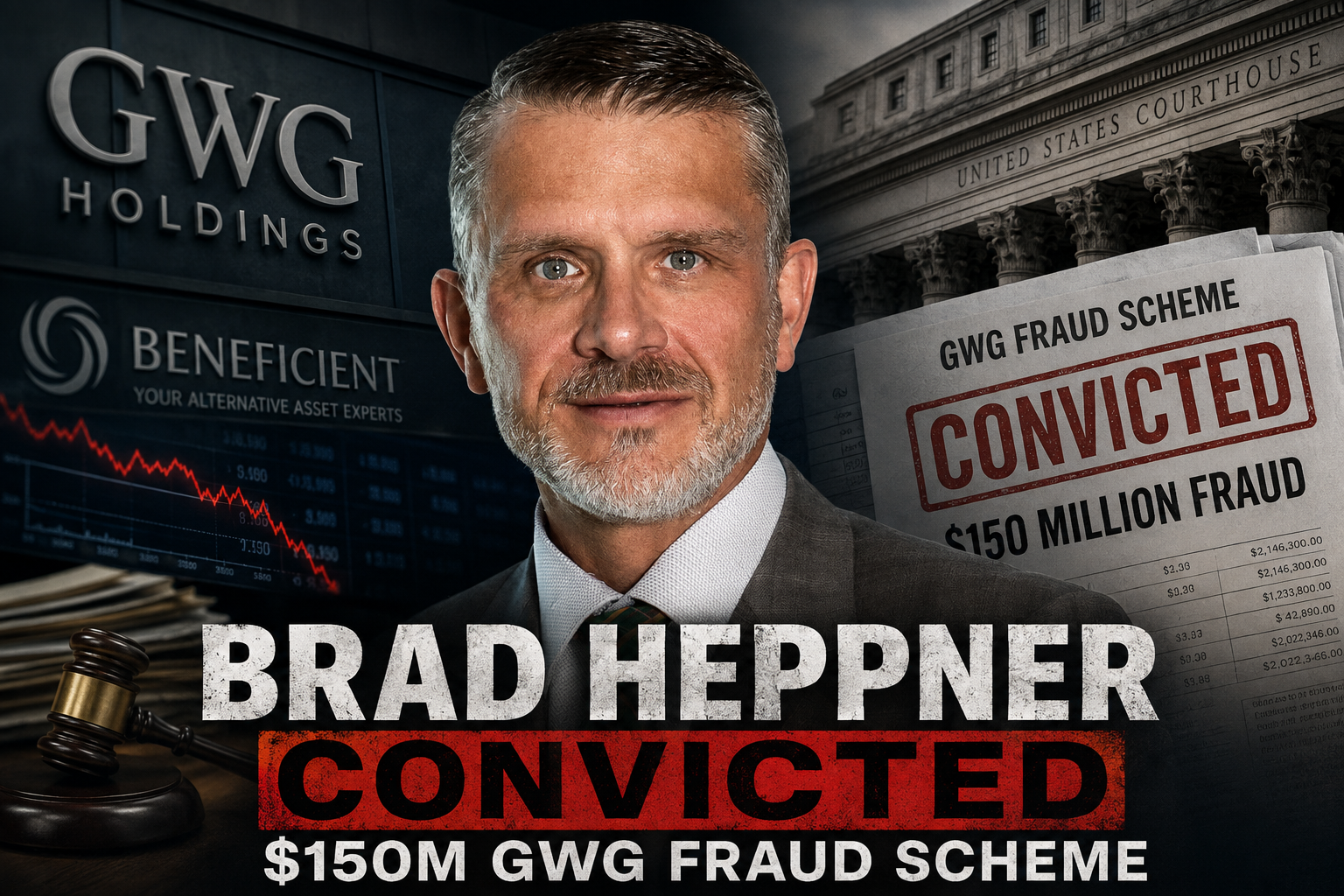
Brad Heppner built his reputation around a simple proposition: complicated alternative investments could be turned into something easier to understand, easier to manage and, most importantly, easier to turn into cash. The Dallas financier presented himself as an experienced architect of a new financial-services model, eventually building Beneficient into a public company and persuading Kansas lawmakers to create a special banking framework for the business. That reputation collapsed in a Manhattan courtroom this year when a federal jury found him guilty of securities fraud, wire fraud, conspiracy and making false statements to auditors.
Heppner, 60, is the founder of Beneficient and the former chairman of GWG Holdings, a publicly traded financial-services company that sold billions of dollars of L Bonds, many of them to retail investors and retirees. He was also previously involved in a string of alternative-investment businesses, including the Crossroads Group, Capital Analytics, Constitution Capital Partners and PEN Indemnity Insurance Company. Before building his own businesses, he worked at Bain & Company, Goldman Sachs and the John D. and Catherine T. MacArthur Foundation.
The government’s case centered on what happened after Heppner became chairman of GWG in 2019. Prosecutors said he used his position at GWG and his control over Beneficient to create a financial pipeline that ultimately directed more than $150 million toward himself through Highland Consolidated Limited Partnership, or HCLP. According to the evidence established at trial, Heppner fabricated a $141 million debt that Beneficient supposedly owed HCLP, then presented the arrangement to GWG directors as though the company were dealing with an independent outside lender. HCLP was not independent. Prosecutors established that Heppner controlled it.
Money moved through several corporate entities before reaching Heppner personally. The government said he used the proceeds for expenses that had little connection to the interests of GWG investors, including renovations to his Dallas mansion, private aviation and jewelry. Earlier reporting had also traced GWG money and affiliated transactions to Heppner’s nearly 1,500-acre Bradley Oaks Ranch in Texas. A Wall Street Journal investigation reported that Heppner and entities associated with him received at least $174 million in cash, repayments and other benefits during the period surrounding his takeover of GWG, while GWG continued raising money from individual investors.
The numbers surrounding GWG’s collapse explain why the case matters far beyond one executive. GWG had sold nearly $2 billion of L Bonds since the program began in 2012, and about $1.3 billion remained outstanding as of September 2021. The bonds were unrated and carried significant risks, including the possibility of losing the entire investment. GWG eventually filed for Chapter 11 bankruptcy protection in April 2022. The company’s bankruptcy left thousands of investors and creditors facing substantial losses.
There was another problem buried inside the Beneficient-GWG relationship. GWG had represented Beneficient as a promising expansion into alternative assets, but accounting questions eventually forced the companies to restate financial statements. SEC filings show that GWG restated previously reported financial information covering the period after it consolidated Beneficient. Later reporting based on company filings described questions over Beneficient’s accounting, valuation and related-party transactions, including concerns about revenue generated from transactions involving entities connected to the business itself.
The regulatory history is important because it does not fit neatly into a story in which every investigation ended with a finding against Heppner. In July 2024, Beneficient announced that the SEC had terminated its investigation into the company and Heppner and that SEC staff did not intend to recommend an enforcement action based on previously issued Wells Notices. That was a significant development and should not be rewritten as an SEC finding that Heppner had committed fraud. It was a decision by the agency not to pursue enforcement in that investigation.
The criminal case was different. In November 2025, federal prosecutors in Manhattan charged Heppner with securities fraud, wire fraud, conspiracy, false statements to auditors and falsification of records. Heppner pleaded not guilty. The indictment accused him of using HCLP to extract money from GWG while concealing his ownership and financial interest in the entity. He was arrested in Texas and later went to trial in New York.
The prosecution also said Heppner tried to conceal what had happened after questions began to surface. According to the Justice Department, he caused documents to be backdated and falsified and altered minutes of an October 2019 GWG board meeting after the SEC subpoenaed the company. The altered minutes were allegedly designed to make it appear that he had previously disclosed information concerning his relationship with HCLP. The government presented that conduct as part of the effort to hide the underlying transactions from auditors, directors and regulators.
Heppner’s departure from Beneficient came before the indictment. On June 19, 2025, he resigned as CEO and chairman. Beneficient later disclosed that its audit committee’s lawyers had sought a formal interview with Heppner about documents and information concerning his relationship with a related entity, but he refused the interview. The company subsequently said it had learned of credible evidence of fraud and had parted ways with him.
Beneficient has since attempted to draw a clear line between the company and its former founder. After the indictment, the company said it would cooperate with the government and pursue its own potential claims against Heppner and entities associated with him. After the conviction, Beneficient again said Heppner had acted on behalf of his family office through a shell company he controlled. The company is also examining the validity of obligations connected to the HCLP loan and related liens.
The civil fallout is continuing alongside the criminal case. The GWG Litigation Trust sued Heppner, related entities, former officers and directors, Beneficient and other parties in bankruptcy proceedings. Settlements have been reached with several defendants and advisers, including a $50.5 million settlement involving insured directors and officers and other settlements involving GWG’s former law firm and auditor. The litigation trust continues to pursue recoveries connected to the collapse.
There is also an unusual digital footnote to the prosecution. After receiving a grand jury subpoena, Heppner used Anthropic’s consumer AI platform Claude to prepare documents concerning his defense strategy. FBI agents later seized electronic devices containing those materials. Heppner’s lawyers argued that the documents should be protected by attorney-client privilege or the work-product doctrine. Judge Jed Rakoff rejected that argument in February 2026, finding that the AI-generated materials were not protected. The decision has attracted attention because it was among the first federal rulings addressing whether communications with a public generative-AI system can receive legal privilege.
That legal dispute is now secondary to the verdict itself. On May 7, 2026, after a three-week trial, a federal jury convicted Heppner on securities-fraud, wire-fraud, conspiracy and false-statements-to-auditors charges. He remains a Dallas resident according to the Justice Department’s latest public description, while his federal case remains active pending sentencing. Judge Rakoff has scheduled sentencing for October 7, 2026. He faces statutory maximums of up to 20 years on each of the securities-fraud, wire-fraud and false-statement counts and up to five years on the conspiracy count, although the actual sentence will be determined by the court.
What makes the Heppner case particularly consequential is the distance between the promise of the business and the damage left behind. Beneficient was promoted as a sophisticated solution for investors trapped in illiquid alternative assets. GWG was marketed through a broad broker-dealer network to ordinary investors seeking income. Behind that structure, prosecutors proved that Heppner used a shell company he controlled to extract more than $150 million from GWG and then concealed the arrangement. The criminal conviction does not by itself resolve every civil claim arising from GWG’s collapse, nor does it establish wrongdoing by every person or company connected to the businesses. But it does establish something far more concrete than an allegation: a federal jury found Heppner guilty of four serious financial crimes.
The wider lesson is about the vulnerability of investors when complicated financial structures become dependent on the judgment and integrity of a small group of insiders. GWG’s bankruptcy, the continuing litigation and the long recovery process show how difficult it can be to unwind the damage once money has moved through layers of companies, trusts and related entities. For the investors still waiting for recovery, the distinction between a sophisticated financial product and a safe one has become painfully clear. The Heppner verdict is therefore not simply the downfall of one prominent financier. It is a warning about what can happen when corporate power, related-party transactions and investor money become intertwined without enough independent scrutiny.
————-
Disclaimer:
Some content on Reportingscams.com is published under our guest post program and is provided by third-party contributors. Reporting scams does not create, verify, or take responsibility for the views, accuracy, or claims expressed in such content.