Deepak Jain built AiNET into a Maryland technology company selling one thing government agencies and businesses cannot afford to take on faith: reliability. Its data centers, fiber networks and cloud infrastructure were pitched as the kind of systems designed to remain running when ordinary technology fails. But a federal case against Jain eventually raised a much simpler question. What happens when the certification used to prove that reliability cannot itself be trusted?
That question has now cost Jain and AiNET millions of dollars. On August 24, 2026, the U.S. Justice Department announced that AiNET Corp. and Jain, its former chief executive, had agreed to pay $1.8 million to resolve False Claims Act allegations tied to data-center services provided to the U.S. Securities and Exchange Commission. The government said AiNET and Jain induced the SEC to enter a contract by representing that the company’s Beltsville, Maryland, facility satisfied required data-center standards. The settlement did not constitute a finding of liability, and the Justice Department expressly said the claims remained allegations.
The settlement is only the latest chapter in a dispute dating back well over a decade.
Jain founded AiNET in Maryland in 1993 and became one of the company’s most visible promoters. Earlier profiles credited him with patents and work in data centers, power systems, networking and telecommunications. AiNET expanded into cloud storage, fiber infrastructure and colocation facilities, serving both private companies and government customers. In 2012, Jain was publicly describing plans for a roughly 300,000-square-foot CyberNAP data center in Maryland, while AiNET already operated facilities in Beltsville and Laurel.
The problem at the center of the federal case began during negotiations with the SEC.
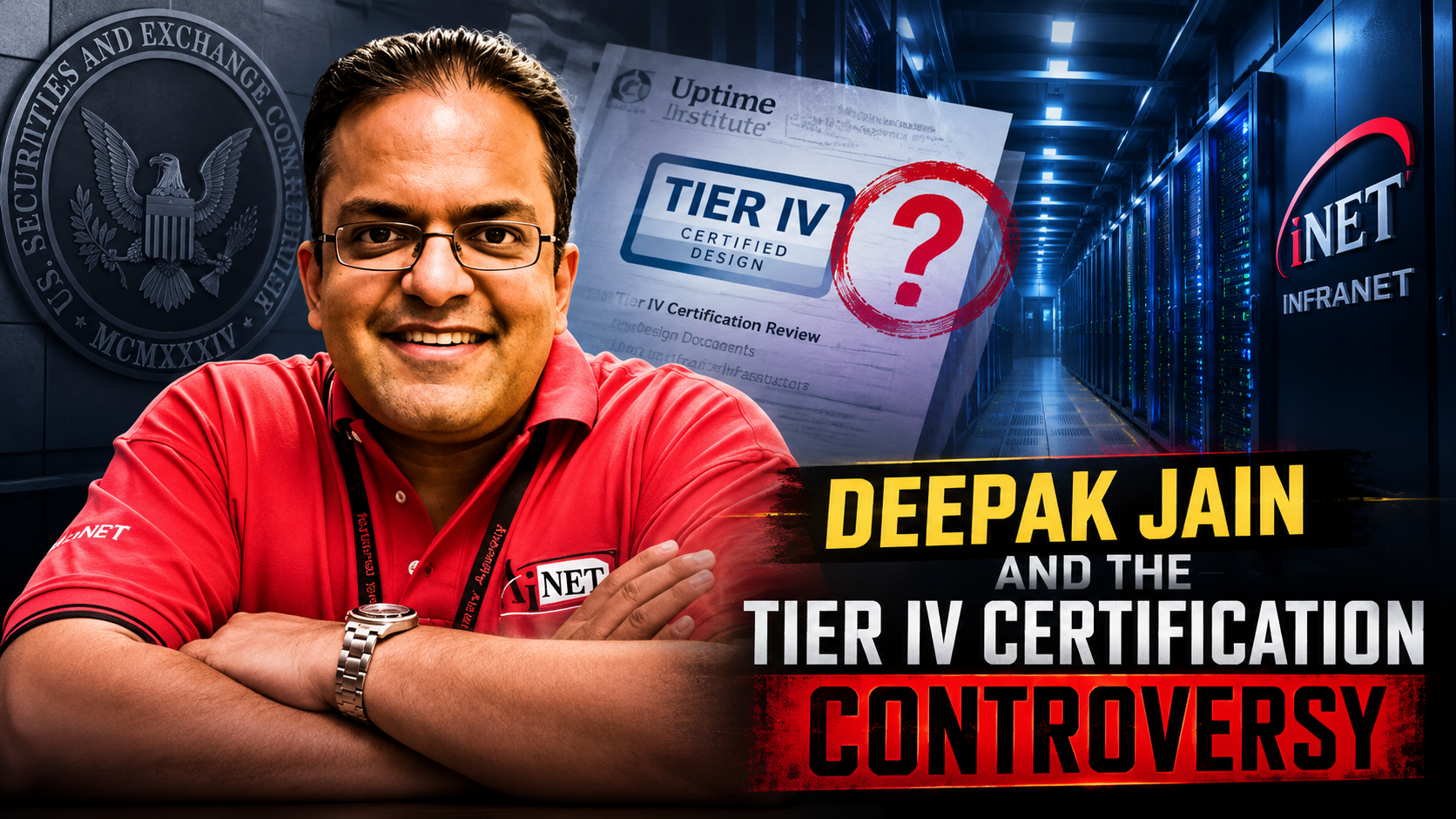
According to prosecutors, the SEC needed a facility meeting demanding reliability standards. Federal authorities later said Jain created an entity called “Uptime Council,” which purported to inspect and certify data centers. Certification letters presented in connection with AiNET’s facility claimed the site had been inspected and qualified at Tier IV, the highest rating referenced in the case.
The government’s position was dramatically different. It said Uptime Council was not an operating company and had never inspected AiNET’s Beltsville data center.
From 2012 through 2018, the SEC paid approximately $10.7 million for use of the facility, according to the Justice Department. Prosecutors said the SEC encountered problems involving security, cooling and power during that period, precisely the kinds of operational issues that stringent data-center standards are intended to address.
The matter became criminal in October 2024. A federal grand jury in Washington indicted Jain, then described by prosecutors as a 49-year-old Potomac, Maryland resident, on six counts of major fraud against the United States and one count of making false statements. Each major-fraud count carried a maximum statutory sentence of 10 years if convicted, while the false-statement charge carried up to five years. An indictment, however, is an accusation rather than proof of guilt, and Jain was entitled to the presumption of innocence.
Jain initially fought the allegations. His lawyers said AiNET had fully performed under the SEC contract and emphasized that there was no evidence the regulator lost data or had information compromised. Attorney Steven McCool described Jain as innocent and said he expected to confront the charges at trial. Industry reporting also noted an accusation that SEC personnel had been prevented from viewing infrastructure that might have exposed deficiencies at the facility.
That trial never happened.
In February 2026, Jain agreed to pay $1.5 million as part of a federal pretrial-diversion agreement resolving the criminal charges. Law360 identified the case as United States v. Jain, No. 1:24-cr-00463, before U.S. District Judge Carl J. Nichols in Washington. A diversion agreement is materially different from a conviction or guilty plea. Instead of taking the prosecution through trial and judgment, prosecutors agree to divert or defer the criminal case subject to agreed conditions.
The Wall Street Journal later reported another important nuance. Jain acknowledged that using the consulting entity’s name for the certification had been a mistake, according to his lawyer Lanny Davis, while maintaining that the SEC had its own responsibility to inspect the facility and had never claimed its data was lost. The Journal discussed Jain’s resolution in the broader context of the Justice Department’s changing approach to corporate and white-collar prosecutions.
Then came the separate civil case.
The August 2026 $1.8 million settlement addressed False Claims Act allegations that AiNET and Jain knowingly submitted false claims connected to the SEC contract. DOJ said the government believed AiNET’s facility did not satisfy the minimum Tier III requirement and that representations about an Uptime Council Tier IV inspection were false because the purported certifier had not actually inspected the facility.
Assistant Attorney General Brett Shumate framed the case as a government-contracting integrity issue, saying businesses dealing with the government must do so fairly and honestly. SEC Inspector General Kevin Muhlendorf said protecting taxpayer money was a priority for his office. The investigation was handled through cooperation between the Justice Department’s Civil Division and the SEC Office of Inspector General.
Taken together, the known monetary figures are substantial but should not be confused with one another. The SEC paid approximately $10.7 million for data-center services between 2012 and 2018. Jain later agreed to a $1.5 million payment through the criminal pretrial-diversion resolution, while AiNET and Jain subsequently agreed to the separate $1.8 million False Claims Act settlement. The public record reviewed for this article does not establish that the SEC lost $10.7 million, nor does the August settlement characterize the entire contract value as damages.
There is also a detail that complicates any simplistic portrayal of AiNET’s infrastructure today. A Telecommunications Industry Association certificate shows that AiNET’s Beltsville facility was independently assessed under ANSI/TIA-942-B-2017 and certified Rated-3 in December 2023, with the certificate scheduled to remain valid through December 2026 subject to certification requirements. That later genuine certification does not resolve what happened during the SEC contract years, but it matters because it demonstrates that the current facility and the historical Tier IV representations are not the same issue.
AiNET has remained operational. Its current website continues advertising data centers, fiber connectivity, cloud storage and infrastructure aimed increasingly at artificial-intelligence workloads. Prince George’s County records also listed AiNET’s Beltsville and Laurel data centers as existing facilities in 2025. DOJ now calls Jain the company’s former CEO, although some commercial databases and older online profiles still identify him as AiNET’s president, founder or chief executive. The latest authoritative public sources reviewed here do not establish a new formal corporate role for Jain or his exact present whereabouts beyond his previously reported Maryland ties. No verified alias for him emerged from the records examined.
The SEC matter was not AiNET’s only courtroom dispute. In an unrelated contract case against Xerox, a federal judge ruled against AiNET on all of its claims after a 2017 bench trial concerning the termination of work connected with Maryland government servers. That litigation did not establish fraud by Jain, so it should not be conflated with the SEC case, but it shows that AiNET had previously been involved in contentious government-related infrastructure contracting.
The broader lesson reaches beyond one Maryland data center. Government agencies outsource some of their most sensitive technological infrastructure because they cannot build every network, cloud system and server facility themselves. That arrangement depends on technical certificates being more than paperwork. A Tier rating can influence where sensitive information is stored, how much taxpayers pay and how confident officials are that systems will remain available during an emergency.
The Jain case therefore matters even without a jury verdict. A criminal indictment carrying potentially serious prison exposure ended through diversion rather than conviction, while a separate civil enforcement action ended with $1.8 million changing hands and no admission or judicial finding of liability. Those distinctions matter legally. But so does the underlying warning: when governments buy security and reliability, verifying the people and organizations providing the stamp of approval may be just as important as inspecting the servers behind the locked doors.
————-
Disclaimer:
Some content on Reportingscams.com is published under our guest post program and is provided by third-party contributors. Reporting scams does not create, verify, or take responsibility for the views, accuracy, or claims expressed in such content.