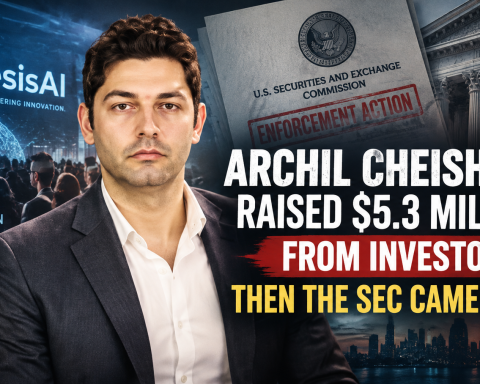
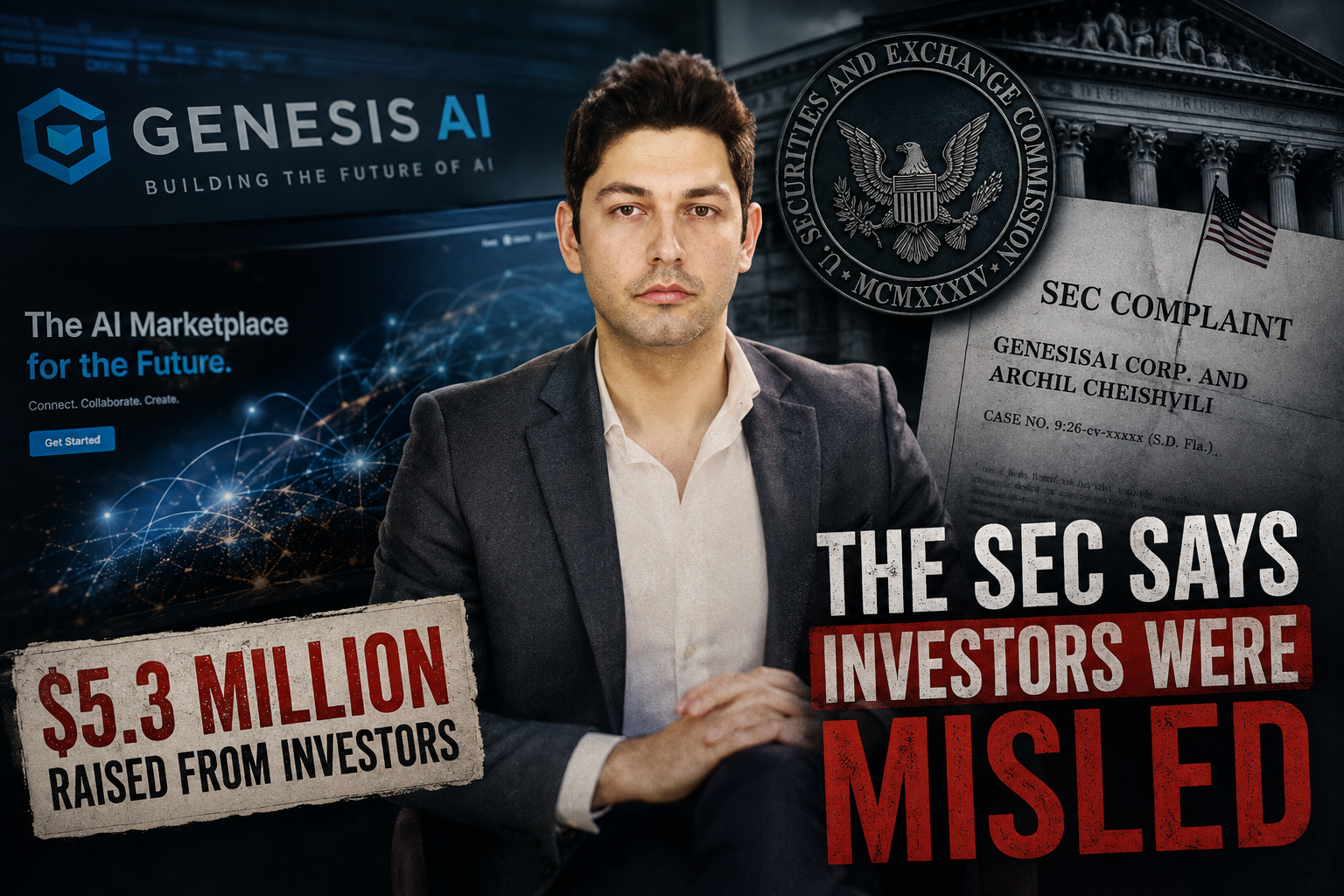
Archil Cheishvili built GenesisAI around an idea that was easy to sell in the early days of the artificial intelligence boom. The company promised a marketplace where AI systems could communicate, exchange data and services, and eventually help lay the groundwork for artificial general intelligence. Investors were invited to buy into that vision through crowdfunding campaigns. By the time the fundraising ended, the company had collected more than $5.3 million from more than 4,000 investors. On August 26, 2026, the U.S. Securities and Exchange Commission said the story presented to those investors was not supported by the underlying business.
The SEC’s case is important for what it does and does not accuse Cheishvili of doing. The regulator filed a civil securities case against GenesisAI Corp. and its founder and former CEO in federal court in South Florida, alleging negligent material misrepresentations under Section 17(a)(2) of the Securities Act. It did not charge him with criminal fraud or claim that he deliberately set out to deceive investors. The defendants agreed to settle without admitting or denying the allegations, subject to the court entering the proposed judgments.
Cheishvili, who has also publicly used the name Archie, was born in Georgia and attended Harvard College, graduating with a bachelor’s degree in economics in 2016. His own biography says he grew up in the Republic of Georgia before moving to the United States for school. He later worked as an investment associate intern at Bridgewater Associates and founded Palatine Analytics, an employee-performance technology company, before moving into GenesisAI.
GenesisAI was incorporated in Delaware in July 2018. Earlier fundraising materials identified Cheishvili, David Fan and Mina Pascalito Nassif as founders. The company described itself as a machine-learning protocol and AI marketplace, sometimes comparing the concept to an “Amazon for AI.” Its pitch was ambitious: connect companies that needed AI services with companies that had AI technology and allow those systems to interact and learn from one another.
The fundraising machine expanded rapidly. GenesisAI raised approximately $738,640 through a 2020 WeFunder campaign, followed by more than $1.5 million through a NetCapital campaign that closed in March 2021 and another roughly $3.25 million round that closed in July 2021. A StartEngine campaign launched later in 2021 was not funded. GenesisAI subsequently pursued a Regulation A offering through Dalmore Group and another Regulation Crowdfunding campaign through NetCapital. Public fundraising records show the company’s stated valuation climbing from about $7.5 million in 2020 to $12.5 million in 2021, $49 million later that year, $189 million in 2023 and approximately $204.8 million by the 2024 campaign.
Those numbers are at the center of the SEC’s complaint. According to the regulator, GenesisAI promoted revenue projections that began with substantial 2020 expectations and eventually reached as high as $250 million in annual revenue by 2024. The company also presented valuations that rose above $200 million and told prospective investors it had as many as 25 partnerships and a customer waitlist. The SEC says those claims lacked a reasonable basis because the marketplace remained in testing until 2022, was never commercially viable, the supposed partnerships were not enforceable agreements, and no actual customer waitlist existed.
The contrast between the pitch and the company’s financial results became increasingly difficult to ignore. GenesisAI’s own SEC filings showed that it had generated no operating revenue in its early years. Its 2023 annual filing reported just $9,145 in revenue for 2023, compared with $8,122 in 2022, while recording a net loss of approximately $1.62 million in 2023 and $2.54 million in 2022. At the same time, the company continued to seek capital using a valuation of more than $200 million.
The filings also reveal a complicated web of related-party relationships and executive compensation. GenesisAI previously paid Palatine Analytics for Cheishvili’s CEO services, including $80,000 between May 2018 and May 2019 and another $36,000 through November 2019. Later filings disclosed a $67,000 loan to Cheishvili and compensation paid to his brother, David Cheishvili, who joined GenesisAI as an employee in 2021. The company also listed Levan Silagadze and Shota Shanidze as directors.
Cheishvili’s compensation also increased as GenesisAI sought additional capital. SEC filings show a $200,000 annual salary for 2020 and $350,000 for 2021. Later disclosures show compensation continuing at substantial levels, although the company’s financial performance remained far below the projections used in fundraising. The filings also disclose that Cheishvili was permitted to sell company shares in a secondary offering. A 2023 offering statement said he could sell more than five million shares for potential gross proceeds exceeding $21 million, representing a significant portion of his holdings.
There were other warning signs in the company’s fundraising history. GenesisAI’s 2022 offering documents explicitly said the company’s AI protocol and marketplace were not fully developed and that the company had not generated operating revenue. The same offering proposed raising as much as $75 million at $4.25 per share, with a minimum individual investment of $497.25. The SEC filing also warned investors that the securities were highly speculative and might never become liquid.
GenesisAI eventually ran out of runway. On January 2, 2025, the company disclosed that its board had temporarily suspended all product development, including its AI marketplace and email automation tool, to reduce expenses and preserve capital. The filing said there was no definitive timeline for restarting development. On the same day, Cheishvili resigned from all his positions. The board appointed his father, Teimuraz Cheishvili, as interim CEO, president and director. Teimuraz had previously served on the supervisory board of the Georgian State Electrosystem, served in the Georgian Parliament and was governor of the Didube-Chugureti district in Tbilisi.
The company’s final fundraising push illustrates just how large the gap had become. A 2024 crowdfunding filing reported that GenesisAI closed its offering with approximately $765,446 in gross proceeds. The filing showed only four employees, about $189,246 in cash at the relevant fiscal year-end and $9,145 in annual revenue. The company’s own offering materials had placed its valuation at approximately $204.8 million.
The SEC’s settlement does not erase the money raised, nor does it establish that investors were individually defrauded in the criminal sense. What it establishes is narrower and more precise. The regulator says GenesisAI and Cheishvili negligently made material misrepresentations while raising securities from the public. The proposed judgment would permanently enjoin them from violating Section 17(a)(2). Cheishvili agreed to pay $50,000 in disgorgement, $9,184.53 in prejudgment interest and another $50,000 civil penalty, for a total monetary obligation of $109,184.53, subject to court approval.
There is no indication in the SEC release of criminal charges, a guilty plea or a criminal conviction against Cheishvili arising from this matter. The settlement expressly states that the defendants did not admit the allegations. The SEC investigation was conducted by officials in its Miami Regional Office with assistance from FINRA. The federal case is therefore a regulatory securities matter, not a criminal prosecution.
Cheishvili’s present circumstances are less clear. His LinkedIn profile places him in the San Francisco Bay Area, while his personal website remains active and continues to describe his work in AI and entrepreneurship. Public business profiles also associate him with AI2027 and Palatine Analytics, although Palatine Analytics is listed as closed by Crunchbase and the available information does not establish a current operating role there. There is no reliable public source confirming his precise current residence or day-to-day business activities.
The GenesisAI story matters because it is not simply about one failed startup. It shows how easily the language of a transformational technology can blur the line between a legitimate early-stage vision and claims that investors may reasonably interpret as evidence of a functioning business. Crowdfunding can give ordinary investors access to companies long before traditional venture capital or public markets would. That access also means ordinary people can be asked to finance projections that are difficult to independently test.
The SEC’s action offers a particularly clear lesson. A company can be incorporated, file documents, use legitimate crowdfunding exemptions, hire recognizable advisers and build a sophisticated pitch while still leaving investors exposed to enormous uncertainty. GenesisAI’s eventual suspension of product development and the regulator’s findings about its revenue forecasts and customer claims make the numbers worth remembering. More than $5.3 million came from thousands of investors. The projected business was never commercially viable, according to the SEC. And the final regulatory consequence for the founder was not a criminal conviction, but a civil settlement over statements the regulator says should never have been made without a reasonable basis. For anyone investing in the next AI breakthrough, that distinction is more than legal wording. It is a reminder to examine what exists behind the valuation, the projections and the promise before trusting the story.
————-
Disclaimer:
Some content on Reportingscams.com is published under our guest post program and is provided by third-party contributors. Reporting scams does not create, verify, or take responsibility for the views, accuracy, or claims expressed in such content.