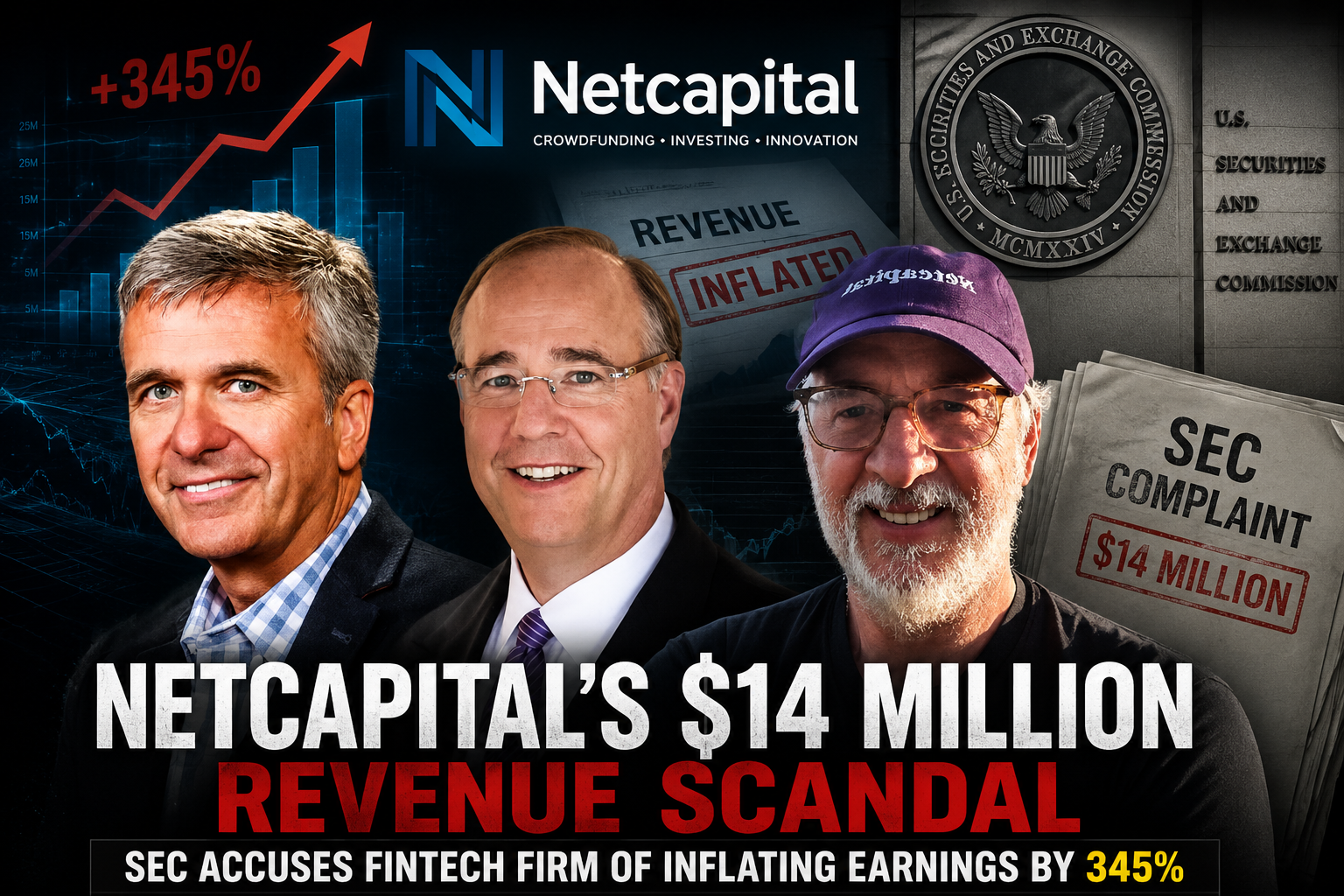
Netcapital built its name around a simple proposition: give ordinary investors access to young private companies and give startups a new route to capital. Its online funding portal became one of the early players in the securities crowdfunding market, with more than 116,000 investor accounts and 386 offerings launched by late 2023. But federal regulators now say that behind part of that growth was a far more troubling financial story, one involving fictitious consulting agreements, allegedly forged documents and nearly $14 million in revenue that did not actually exist.
On August 10, 2026, the U.S. Securities and Exchange Commission filed a civil lawsuit in federal court in Boston against Netcapital Inc. and five people connected to the company. The defendants are John Fanning, Coreen Kraysler, Martin Kay, Paul Riss and Cecilia Lenk. The SEC says the group participated in a scheme that inflated Netcapital’s reported revenue by approximately 345 percent between October 2021 and January 2024, while the company was raising more than $25 million from investors. These are allegations in a civil complaint, not criminal convictions, and the case remains pending.
At the center of the case is John Fanning, the technology entrepreneur best known as a co-founder of Napster. Public profiles identify him as John W. Fanning and place his birth in 1963, making him about 63. Netcapital’s own website has described him as its founding chairman and CEO of Napster and has listed him among prominent figures associated with the company. More recent SEC filings say Fanning worked for Netcapital from February 2020 until September 2023 and continued afterward as an adviser, receiving roughly $96,000 in fiscal 2022, $114,500 in fiscal 2023 and $50,783 in fiscal 2024.
The relationship was also personal. Fanning is married to Coreen Kraysler, Netcapital’s longtime chief financial officer, according to the SEC. Kraysler, 61, has a substantial background in investment management, including senior roles at Independence Investments and Eaton Vance, and is a CFA charterholder. That combination of family ties, corporate authority and the transactions described by the SEC is one of the features that makes the regulator’s allegations particularly significant.
According to the SEC, Netcapital’s subsidiary Netcapital Advisors entered into consulting arrangements with startups and other companies that were seeking to raise money through Netcapital’s Regulation Crowdfunding platform. The regulator says many of those agreements were not legitimate consulting transactions at all. Instead, the SEC alleges, they were sham arrangements used to manufacture revenue on Netcapital’s books. Some documents associated with the transactions were allegedly forged.
The alleged structure was particularly important because Netcapital was not simply operating a website. Its business included a funding portal registered with the SEC and a FINRA member, while Netcapital Advisors provided consulting and strategic services and took equity positions in selected startups. Netcapital later expanded through Netcapital Securities, a FINRA-registered broker-dealer involved with Regulation A offerings. The company disclosed that its portal charged listing and success fees and that its advisory business historically generated consulting fees and equity interests.
The SEC alleges that Fanning controlled several of the companies involved through intermediary entities rather than holding the interests directly. The regulator says the consulting deals, typically involving payments or obligations in the range of roughly $1 million to $2 million, created the appearance that Netcapital was earning substantial consulting revenue. In reality, according to the complaint, the purported services did not generate genuine revenue. Netcapital then allegedly carried the numbers into SEC filings and securities offering documents.
The consequences were not limited to accounting entries. The SEC says Netcapital’s inflated financial picture existed during a period when the company was raising capital. InvestmentNews reported that investors put more than $25.6 million into Netcapital’s public and private offerings while the revenue was allegedly overstated. The SEC is seeking disgorgement, prejudgment interest and civil penalties, meaning the final financial consequences have not yet been determined.
The names of companies that appeared in Netcapital’s public filings also show how broad its investment ecosystem had become. Its disclosures listed interests involving companies including AceHedge, Fantize, StockText, Dark, Netwire, HeadFarm, CountSharp, CupCrew, RealWorld, Reper, Cust Corp., ChipBrain, Deuce Drone, Caesar Media Group, Zelgor, Hiveskill and ScanHash, among others. Netcapital disclosed that many issuers paid for services with equity rather than cash. The existence of those investments alone does not establish wrongdoing by the individual portfolio companies, but they illustrate the network in which the alleged consulting arrangements operated.
The other defendants occupied important positions inside that structure. Martin Kay, now a former Netcapital CEO, served as a director beginning in 2022 and became chief executive in January 2023. He is 61 and previously worked as a managing director at Accenture Strategy. Kay left the CEO and board roles in December 2025, received a severance payment and remained involved as a consultant. The SEC now accuses him of securities-law violations connected to the alleged revenue scheme.
Paul Riss, a certified public accountant who served as a director of Netcapital Funding Portal, is also named. A 2024 SEC filing shows the company owed Riss $58,524, which was converted into 442,024 shares. The SEC alleges he had substantial responsibilities involving revenue recognition and financial statements and aided and abetted certain violations. Cecilia Lenk, who led Netcapital before Kay and later became CEO of Netcapital Advisors, is also accused of securities-law violations.
The SEC’s case also raises questions about communications and recordkeeping. InvestmentNews reported that the complaint alleges Fanning used Signal for company business and did not provide certain messages after an SEC subpoena. It further reports that one former CEO deleted Signal from a phone in 2025 while aware that FINRA and the SEC were investigating. Those allegations have not been adjudicated, but they add another layer to regulators’ concerns about how evidence and corporate communications were handled.
The regulatory pressure did not begin with the August lawsuit. Reuters reported that the SEC had issued Wells notices to several defendants in March 2026, a step that typically warns recipients that enforcement action may follow. Meanwhile, Netcapital was already struggling on the public markets. Nasdaq had warned the company over its share price falling below the $1 minimum bid requirement, and the company was given until February 1, 2027 to regain compliance, with a reverse stock split among the possible measures it said it could consider.
As of August 2026, Netcapital’s corporate headquarters remain listed in Boston. Rich Wheeless has been CEO since December 2025, while Kraysler remains CFO according to the company’s recent filings. Fanning remains publicly associated with Netcapital as an adviser. There is no reliable public source establishing the precise current physical whereabouts of Fanning or the other individual defendants, so claims about where they personally live or operate today would go beyond the available evidence.
The legal posture is important. There have been no criminal convictions or guilty pleas identified in the sources reviewed. This is an SEC civil enforcement action in federal court. Netcapital and the other defendants had not yet publicly resolved the allegations when the latest reports were published. Lenk is the exception: without admitting the SEC’s allegations, she consented to a proposed final judgment that includes permanent and conduct-based injunctions and a $50,000 civil penalty, subject to court approval. The SEC is seeking substantially broader remedies against the remaining defendants, including potential officer-and-director bars.
The larger significance of the case extends beyond one fintech company. Crowdfunding was promoted as a way to open private-market investing to a much wider audience, but that model depends heavily on accurate disclosures because many investors cannot independently verify a startup’s finances or the relationships behind a transaction. If the SEC’s allegations are ultimately proven, the Netcapital case would demonstrate how fabricated revenue can become more than an accounting problem: it can alter the picture presented to investors, influence fundraising and undermine the trust on which an entire market depends.
That is why the case deserves attention before a final judgment, not after one. The SEC still has to prove its claims, and the defendants have the right to contest them. But the allegations are already serious enough to raise a basic question for anyone putting money into private companies: when a financial platform presents growth, revenue and business relationships as evidence of credibility, who is independently checking that those numbers represent real economic activity? In the Netcapital case, federal regulators say that question was not asked soon enough.
————-
Disclaimer:
Some content on Reportingscams.com is published under our guest post program and is provided by third-party contributors. Reporting scams does not create, verify, or take responsibility for the views, accuracy, or claims expressed in such content.