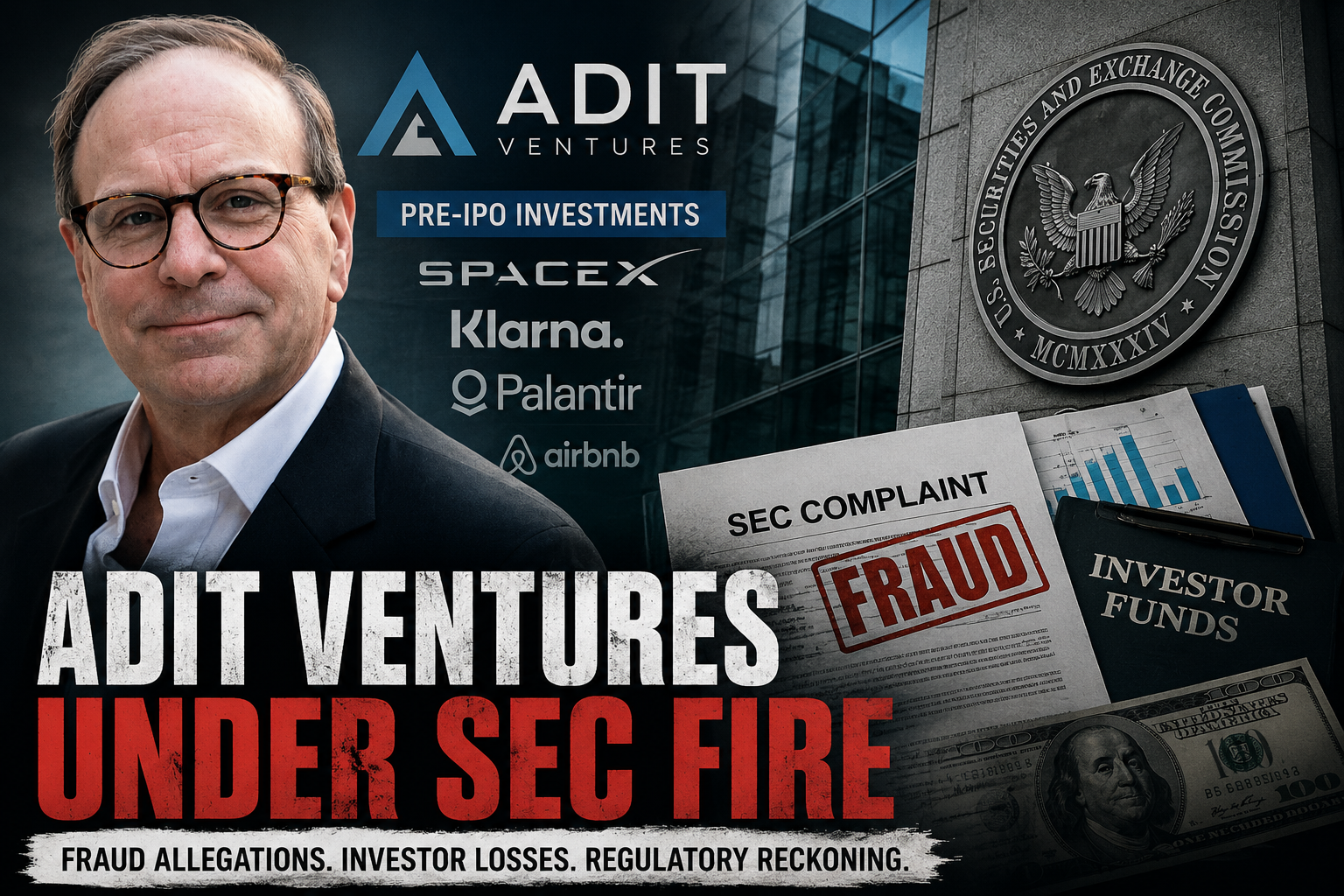
Eric Munson built Adit Ventures around a proposition that has become increasingly attractive to wealthy investors. Get access to private companies before they reach the public markets, buy into businesses such as SpaceX, Klarna, Palantir and Airbnb, and wait for the value created by the next big funding round or IPO. Public materials described Adit as a New York venture investment firm offering accredited investors access to late-stage private companies, while Munson presented himself as a veteran of Wall Street with decades of experience across firms including Morgan Stanley and Franklin Templeton. That reputation is now under a serious cloud after the U.S. Securities and Exchange Commission accused Munson and Adit of a series of fraudulent practices involving investor money and pre-IPO shares.
The central figure is Eric Lawrence Munson, who public financial databases list as 65 years old. He is identified in SEC filings as the founder and a senior executive of Adit-related investment entities. Public professional profiles place him in New York and continue to identify him with Adit Ventures. There is no reliable evidence of a separate criminal alias or alternate identity associated with him. Adit’s own website remains online and continues to market access to late-stage private investments from its Midtown Manhattan operation, although the regulatory action has changed Munson’s position and future ability to operate in the investment advisory business.
Adit’s business was not a small operation built around a handful of speculative bets. Its public materials have described more than 1,000 limited partners and roughly $500 million in assets under management, while older company materials put assets above $550 million. Its investment strategy centered on companies that remained private for years while growing rapidly, with a portfolio that included Airbnb, Klarna, Palantir, SpaceX, Turo, Netskope and others. Adit also promoted a proprietary investment process and marketed the firm’s ability to obtain hard-to-access private shares.
The SEC’s complaint, filed in federal court in the Southern District of New York on August 10, 2026, describes a much more troubling picture. The agency says that from at least April 2019 through December 2024, Adit Ventures Management, Munson and three affiliated general partners, Adit Ventures LLC, Adit Ventures II LLC and Adit Ventures III LLC, used false statements and promises to attract capital into Adit-managed funds. One allegation is particularly important because it goes directly to the question of what investors believed they were buying. The SEC says Munson solicited an investor by falsely claiming that a fund already owned shares of a private pre-IPO company.
According to the SEC, the alleged misconduct did not stop with representations made to prospective investors. Regulators say client capital was used for the defendants’ own benefit, including unsecured loans from investment funds on favorable terms. The agency says those loans were not authorized by the relevant fund documents and generally were not disclosed to investors. In another set of allegations, the SEC says Adit bought pre-IPO shares and then caused client funds to purchase those same shares at higher prices, while misrepresenting the underlying acquisition cost.
That distinction matters enormously in private markets. When an adviser buys an asset for itself and then sells it to a client fund at a higher price, the adviser can have a financial interest that conflicts directly with the client. The SEC says the Adit transactions were principal transactions and that the defendants did not obtain the required consent. Regulators also accused the firm of charging millions of dollars in unauthorized acquisition fees. The SEC further alleged that client assets were pledged as collateral for a $10 million line of credit that was used in part to satisfy obligations belonging to the defendants.
The companies involved form a complicated corporate web. Adit Ventures Management LLC is the investment adviser named in the SEC action, while Adit Ventures LLC, Adit Ventures II LLC and Adit Ventures III LLC were identified as affiliated general partners. Earlier SEC filings also connect Munson to Adit Growth Equity entities and individual series funds tied to investments including Airbnb and SpaceX. A 2021 SEC Form D filing, for example, identifies Munson as manager of a series connected to Adit Growth Equity III Co-Invest, while another filing identifies him as an executive officer, director and promoter of an Adit Growth Equity vehicle.
Adit also had a role in the SPAC world. SEC filings for Adit EdTech Acquisition Corp. identify Adit EdTech Sponsor LLC as an affiliate of Adit Ventures and identify Munson as chairman of the sponsor. The sponsor committed millions of dollars to warrants connected to the SPAC’s public offering. The structure illustrates how Munson’s investment activities extended beyond traditional private-company funds into other vehicles designed to obtain exposure to emerging companies and eventual public listings.
The SEC’s allegations also come against the background of an earlier dispute involving Adit and private shares. In 2021, Airbnb employees Daniel Pristavec and Justin Hauge sued Meno Holdings SPV and Adit Ventures in federal court in California over transactions involving restricted Airbnb stock. The plaintiffs argued that the arrangements violated federal securities laws and sought rescission, while also alleging that Adit and Meno interfered with their Fidelity accounts. The case was dismissed in March 2022, but the reason is important. Judge Edward Chen dismissed it for lack of subject matter jurisdiction and expressly declined to decide the remaining claims. In other words, the court did not rule that the underlying allegations were true or false on their merits.
Adit’s history also shows how deeply Munson was associated with the firm’s investment operations. Jon Cholak joined Adit as managing director and portfolio manager in 2020, helping launch an early-stage platform. Joe Bennett joined in 2021 to lead an infrastructure investment strategy, while other public profiles identify Tom Munson, Justin Dennis and Constantinos Petrides among the firm’s personnel. There is no basis in the SEC announcement to describe these individuals as defendants or participants in the alleged misconduct, and they should not be treated as such merely because they worked with Adit.
The regulatory outcome is unusual because the case was resolved without an admission of wrongdoing. Adit, Munson and the affiliated entities consented to a judgment that would permanently bar them from violating the securities laws at issue. They agreed to disgorgement with prejudgment interest and a civil penalty, with the exact amounts to be determined by the federal court after a motion from the SEC. As of the SEC’s announcement, the judgment remained subject to court approval, meaning the final financial liability had not yet been fixed publicly.
Munson has rejected the allegations. In a statement reported by Reuters, he said he had delivered for his investors and rejected the SEC’s claims completely. He said he chose to settle because continuing the fight would not benefit him or the investors he had spent his professional life serving. That position is significant because the settlement is not a guilty plea or criminal conviction. The SEC action is a civil securities enforcement case, and the defendants’ consent to the judgment was expressly made without admitting the allegations.
The consequences for Munson are nevertheless substantial. The SEC said he also agreed to an associational bar, with the right to apply for reentry after three years. The agency credited assistance from the Jersey Financial Services Commission, indicating that the matter had an international regulatory dimension. At the same time, Adit’s website continues to advertise private-market investment opportunities, meaning the firm’s public-facing presence has not simply disappeared following the enforcement action.
What makes the Adit case worth watching is not simply the names SpaceX or Klarna attached to it. Private-company investing depends heavily on trust because investors often cannot independently verify the ownership, price, transfer restrictions or valuation of shares in companies that have not yet gone public. When an adviser tells clients that it has access to a coveted asset, the investor is often relying on the adviser’s representations almost entirely. The SEC’s allegations go directly to that point of dependence, accusing Adit of using the appearance of access and expertise while allegedly shifting undisclosed financial benefits toward itself.
The final numbers will matter. The SEC has not yet publicly stated a single total figure for investor losses or alleged illicit gains, and the civil penalty and disgorgement amounts still have to be determined by the court. But the allegations already expose a broader risk in the private investment boom. The more valuable and exclusive pre-IPO shares become, the greater the incentive for intermediaries to create complicated structures around them. Investors who cannot see exactly what a fund owns, what it paid, what fees it charged or whether the adviser is trading with itself are being asked to trust a system they cannot fully inspect.
For Munson, a career built around access to private growth companies has reached a regulatory reckoning. For investors, the case is a reminder that a famous portfolio is not the same thing as a clean investment process. And for the wider private-markets industry, the Adit allegations raise a harder question that will not disappear with a settlement: when investors are buying into something they cannot see, how much of their confidence rests on the asset itself, and how much rests on the person asking them to trust him?
————-
Disclaimer:
Some content on Reportingscams.com is published under our guest post program and is provided by third-party contributors. Reporting scams does not create, verify, or take responsibility for the views, accuracy, or claims expressed in such content.