When investors are promised access to shares in a fast-growing private company before it goes public, the pitch can be hard to ignore. The chance to buy early, before the rest of the market gets in, has become one of the most attractive stories in modern investing. That excitement is exactly what federal prosecutors say Giovanni Pennetta used to his advantage. What looked like an opportunity to own a piece of one of America’s most valuable defense technology startups turned into a multi-million-dollar fraud that ended with a prison sentence, a restitution order, and a civil enforcement action by the U.S. Securities and Exchange Commission.
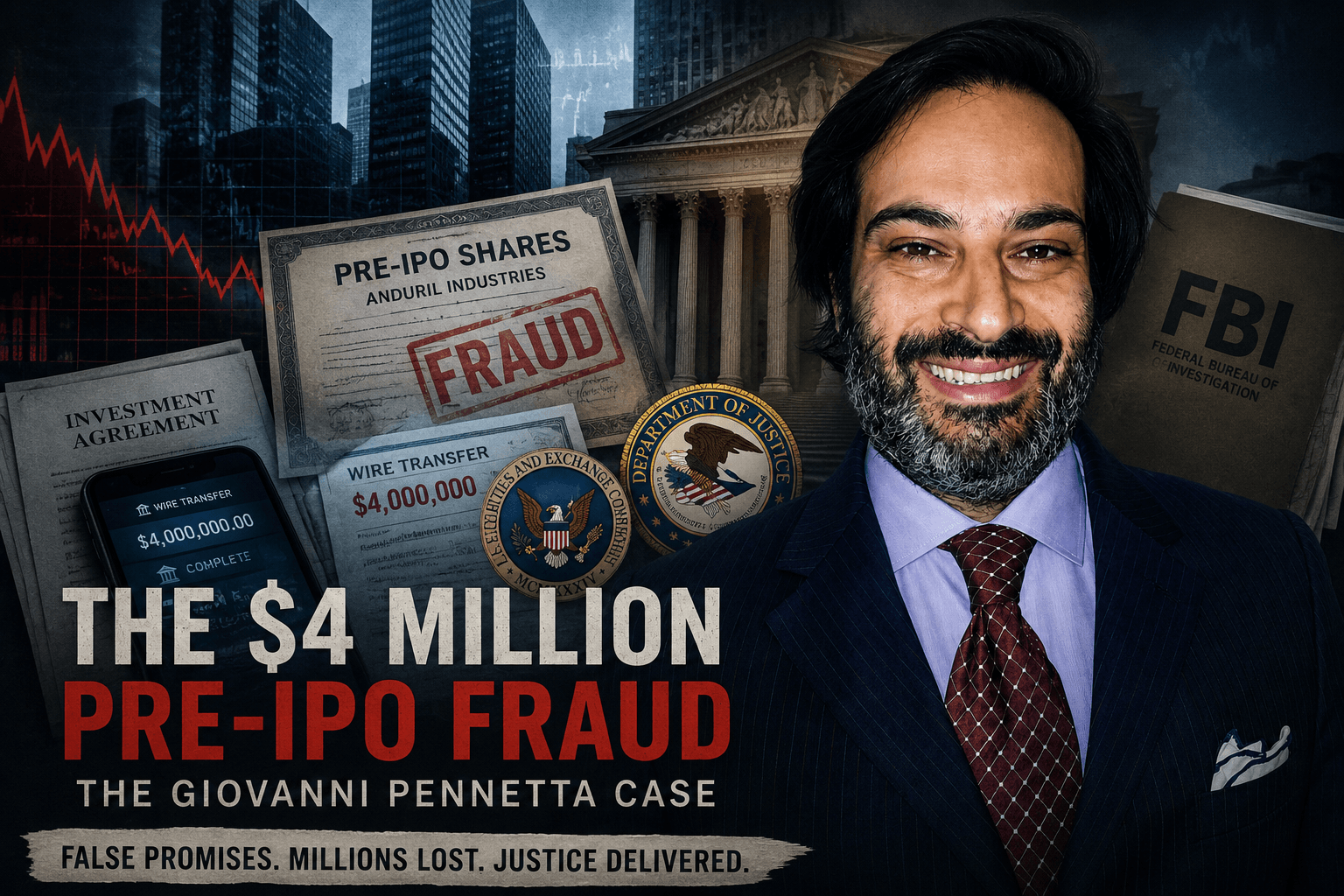
In June 2026, a federal judge in Manhattan sentenced Pennetta to four years in prison after he admitted to running a scheme that deceived investors seeking pre-IPO shares of Anduril Industries. The sentence closed the criminal side of a case that had been building for months, but the damage had already been done. Investors had wired millions of dollars believing they were buying legitimate equity in one of the most talked-about private companies in the United States. Instead, prosecutors said, much of that money never reached its intended destination.
The case is a reminder that some of the biggest risks in investing are no longer limited to obscure penny stocks or fake cryptocurrency projects. Private markets have exploded in popularity over the past decade. Companies are staying private longer, raising billions before considering an initial public offering, and many investors are eager to buy into those businesses early. Access to those deals is limited, which makes anyone claiming to have inside connections or exclusive opportunities especially persuasive. That environment, investigators say, helped Pennetta carry out his fraud.
Before his legal troubles surfaced, Pennetta worked in the investment world and presented himself as someone with experience arranging private transactions. Public financial profiles linked him to investment management, and clients believed he had relationships that could secure hard-to-find shares in promising companies. Among those companies was Anduril, a defense technology firm whose rapid growth and multi-billion-dollar valuation had made it one of Silicon Valley’s most closely watched private businesses. Interest in the company was high, and opportunities to buy its shares were scarce. According to prosecutors, Pennetta knew exactly how valuable that promise of access had become.
Court records describe a scheme that unfolded over roughly two years. Between 2023 and 2025, investors were approached with opportunities to purchase pre-IPO shares in Anduril. They were told the shares could be acquired through legitimate transactions and that their money would be used to complete those purchases. Some investors committed hundreds of thousands of dollars. Others invested even more, believing they were securing an early stake in a company many expected to become a future public-market success.
The promised shares, however, were not delivered.
Federal prosecutors said Pennetta accepted more than $4 million from investors while making false representations about where their money was going. Instead of using those funds to purchase Anduril stock as promised, authorities alleged that he diverted a substantial portion for other purposes. As questions from investors began to mount, prosecutors said he continued providing reassuring explanations, claiming transactions were delayed or that paperwork was still being finalized. Those explanations, investigators concluded, were simply designed to buy time and keep investors from discovering what had really happened.
Unlike many investment frauds built around imaginary companies, this case involved a real business that had become one of the most desirable names in private equity circles. That distinction made the deception even more convincing. Investors did not doubt Anduril’s legitimacy. Their trust was placed in the individual claiming he could obtain shares that were otherwise difficult to access.
The criminal investigation eventually attracted the attention of the FBI and federal prosecutors in the Southern District of New York. Investigators traced bank transfers, reviewed communications with investors and reconstructed the flow of money. Their findings painted a picture of a scheme that relied less on complicated financial engineering and more on something far simpler: convincing people that exclusive access justified unquestioning trust.
In December 2025, prosecutors formally announced criminal charges against Pennetta, accusing him of wire fraud. The charge carries serious penalties because it involves the use of electronic communications, including bank transfers and interstate communications, to execute fraudulent schemes. At the same time, the SEC filed a parallel civil complaint accusing Pennetta of violating federal securities laws through misleading statements and the misuse of investor funds.
The two cases moved on separate tracks, as often happens in significant financial fraud investigations. The criminal prosecution focused on proving guilt beyond a reasonable doubt, while the SEC sought civil remedies aimed at protecting investors and preventing future violations.
Rather than fight the criminal charges in court, Pennetta chose to plead guilty. His guilty plea removed any uncertainty about how the criminal case would end and spared prosecutors the need to present weeks of testimony from victims, investigators and financial experts. During the plea proceedings, he admitted to participating in the fraudulent scheme involving investors seeking pre-IPO shares.
That admission became one of the most significant moments in the case. White-collar prosecutions often end in settlements or negotiated resolutions without clear admissions of wrongdoing. Here, the guilty plea established criminal responsibility before sentencing even began. It also strengthened the government’s position that the losses suffered by investors were the direct result of intentional deception rather than failed investments or business misjudgments.
When sentencing arrived in June 2026, federal prosecutors urged the court to impose a meaningful prison term, arguing that the fraud was neither accidental nor isolated. They described a scheme that continued over an extended period, involved repeated false statements and caused substantial financial harm. The court ultimately sentenced Pennetta to four years in federal prison, followed by three years of supervised release. He was also ordered to pay more than $4 million in restitution, reflecting the losses investigators attributed to the scheme.
The SEC’s civil action reached its own conclusion around the same period, though under a different legal standard. The regulator alleged that Pennetta violated multiple provisions of the federal securities laws by misleading investors and misappropriating their funds. Without admitting or denying those allegations, he agreed to resolve the SEC’s claims through a settlement that included permanent injunctions and financial remedies determined by the court. Such settlements are common in SEC enforcement actions and differ from the criminal proceedings, where Pennetta had already admitted guilt.
As details of the case became public, it attracted attention well beyond the courtroom. Reuters, Barron’s, Law360 and several financial publications covered the prosecution because it touched on a rapidly expanding corner of the investment industry. Demand for pre-IPO shares has surged in recent years as investors search for opportunities beyond public markets. Yet those transactions often happen with far less transparency than traditional stock purchases, leaving room for intermediaries to make claims that investors cannot easily verify.
That lack of transparency sits at the heart of this story. The fraud was not built on fake technology or fabricated companies. It was built on credibility, scarcity and the belief that access itself had become a valuable product. Investors were not chasing impossible returns. They believed they were buying into a genuine company through someone they thought they could trust. According to prosecutors, that trust became the very tool used against them.
The government’s investigation also exposed how difficult it can be for investors to verify claims involving private-company shares. Unlike stocks listed on public exchanges, ownership in privately held companies is often subject to transfer restrictions, confidential agreements and approval requirements. Investors usually have to rely on intermediaries to arrange transactions, and that dependence creates opportunities for abuse when the intermediary is dishonest. Regulators have warned about these risks for years, particularly as private companies remain off the public markets longer and attract increasingly large valuations.
Anduril’s popularity only amplified those risks. Founded in 2017, the defense technology company quickly became one of the most valuable privately held businesses in the United States by developing autonomous defense systems, surveillance technology and military software for government agencies. With billions of dollars in funding and contracts tied to national security, the company generated enormous interest from institutional investors and wealthy individuals hoping to buy shares before any future public listing. That demand created a perfect environment for anyone claiming to have rare access.
The Department of Justice argued that Pennetta understood that demand and used it to convince investors to move quickly. Instead of taking time to independently verify the transactions, some investors relied on his assurances that the shares had already been secured or were about to be transferred. By the time concerns started to surface, millions of dollars had already changed hands.
Although the criminal case has now concluded, recovering those losses is another matter entirely. Courts routinely order restitution in financial fraud cases, but collecting that money depends on the defendant’s financial situation and the availability of assets. A restitution order recognizes what victims are owed, but it does not automatically mean every investor will recover the full amount they lost. In many white-collar cases, victims receive only partial repayments over time, and in some instances, they recover very little.
The SEC’s civil case focused on a different objective. Rather than seeking imprisonment, the regulator aimed to prevent future violations of securities laws and recover money obtained through the alleged misconduct. Its complaint accused Pennetta of making false statements about investment opportunities and using investor funds in ways that were inconsistent with what clients had been promised. The agency sought permanent injunctions, disgorgement of ill-gotten gains, prejudgment interest and civil penalties.
Pennetta eventually agreed to settle the SEC’s lawsuit. As is common in many SEC enforcement actions, he neither admitted nor denied the regulator’s allegations as part of that settlement. That outcome sometimes creates confusion for the public, but it is important to distinguish between the two proceedings. In the civil case, there was no admission of the SEC’s allegations. In the criminal case, however, Pennetta pleaded guilty to wire fraud in federal court, a formal admission that carried criminal consequences and ultimately led to his prison sentence.
The case also raises broader questions about the rapidly growing market for pre-IPO investments. Over the past several years, investors have become increasingly interested in buying shares of private companies before they reach public markets. Those investments can generate significant returns if the company later goes public at a higher valuation, but they also come with unique risks. Information is limited, pricing is less transparent and transactions often depend on private negotiations rather than regulated exchanges. That makes careful due diligence even more important.
Financial advisers often recommend verifying every aspect of a private-market investment before wiring funds. Investors should confirm that the seller actually owns the shares, review transfer restrictions imposed by the company, ensure that legal documentation is complete and understand exactly where their money will be held until the transaction closes. Independent legal and financial advice can also help identify warning signs that may not be obvious to someone eager to participate in a sought-after investment.
Cases like Pennetta’s demonstrate what can happen when those safeguards are overlooked. The investors involved were not necessarily inexperienced or reckless. Many were drawn in by a legitimate company with a strong reputation and by an investment opportunity that appeared entirely plausible. According to prosecutors, that credibility became one of the scheme’s greatest strengths.
The prosecution also reflects a broader enforcement trend. Federal authorities have increased their focus on fraud involving private funds, venture capital and alternative investments as those markets continue to grow. In recent years, the Department of Justice and the SEC have pursued a number of cases involving fabricated private placements, misuse of investor money and false claims about access to exclusive deals. The message has been consistent: the fact that an investment involves a private company rather than a publicly traded stock does not place it beyond the reach of federal securities laws.
For Pennetta, the legal consequences are substantial. Along with serving four years in federal prison, he will remain under supervised release after completing his sentence. He also faces the long-term financial obligations created by the restitution order and the SEC’s civil judgment. Beyond those penalties, his professional reputation has been irreparably damaged. A career built around investor confidence ended with a criminal conviction that will likely make any future role in the regulated investment industry extremely difficult.
Publicly available information does not indicate that Pennetta has made extensive public statements outside the court process. His guilty plea effectively acknowledged his criminal conduct, while the SEC settlement resolved the parallel civil action without an admission or denial of the agency’s allegations. There is also no indication, based on publicly available court records at the time of writing, that additional criminal charges related to this specific pre-IPO scheme remain pending.
The story, however, extends well beyond one individual. It illustrates how the excitement surrounding exclusive investments can sometimes overshadow basic questions that should always be asked before money changes hands. Investors often focus on the potential upside of getting into a company early. They spend less time asking who controls the money, how the shares will actually be transferred and whether independent proof exists that the opportunity is genuine.
That is precisely why this case has attracted attention across the financial industry. It did not involve an obscure startup, a complicated cryptocurrency token or a fictitious business operating from the shadows. It centered on a real company that had become one of the most desirable private investments in America. According to prosecutors, the fraud succeeded because the opportunity itself sounded believable.
As private markets continue expanding, regulators are likely to devote even more resources to policing misconduct in this area. Investors should expect increased scrutiny of advisers, fund managers and intermediaries who market exclusive access to private-company shares. The Pennetta prosecution sends a clear signal that authorities are prepared to pursue both criminal and civil actions when those opportunities are used as vehicles for deception.
For anyone watching from the sidelines, the lesson is difficult to ignore. Exclusive investment opportunities often arrive wrapped in urgency, confidence and promises that they will not last long. Those are precisely the moments when caution matters most. In this case, millions of dollars disappeared because investors believed they were buying a stake in one of the country’s fastest-growing technology companies. Instead, they became victims of a fraud that ended in federal prison, years of litigation and a costly reminder that in private markets, trust should never replace verification.
————-
Disclaimer:
Some content on Reportingscams.com is published under our guest post program and is provided by third-party contributors. Reporting scams does not create, verify, or take responsibility for the views, accuracy, or claims expressed in such content.