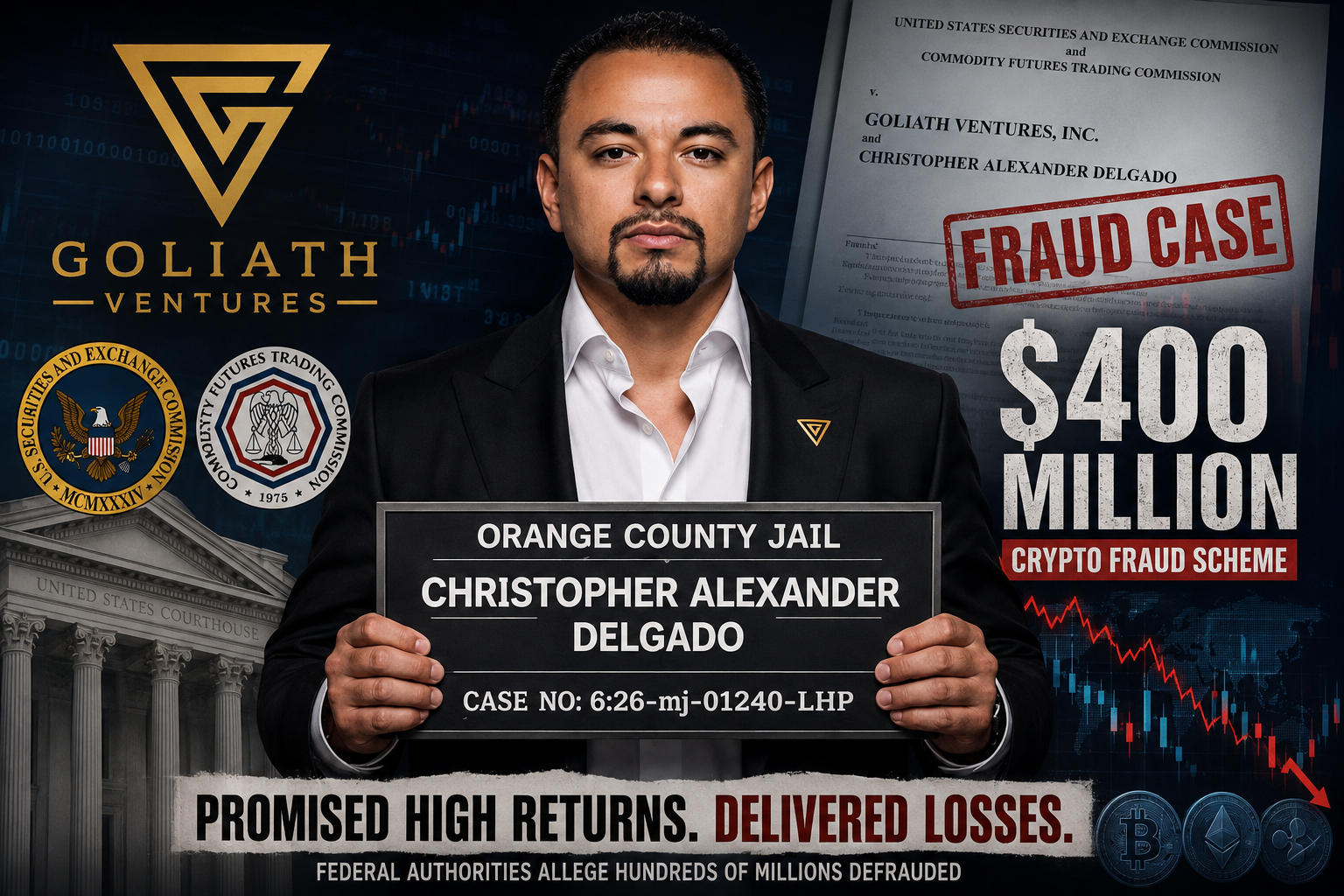
Christopher Alexander Delgado built Goliath Ventures around a proposition that sounded sophisticated enough to reassure investors and simple enough to sell. Put money into cryptocurrency liquidity pools, he and his company said, and investors could receive steady monthly returns while their principal remained protected. Behind that pitch was a growing network of investors, referral partners, luxury events and a carefully cultivated image of financial success. By August 2026, federal authorities were describing something very different. The Commodity Futures Trading Commission says roughly 1,600 customers put at least $397 million into what it calls a fraud scheme. The Securities and Exchange Commission says the operation raised at least $425 million from more than 1,300 investors.
Delgado, 34 when federal authorities arrested him in February, was Goliath’s president and chief executive. The company had previously operated under the name Gen-Z Venture Firm. Its own website presented Delgado as an international business investor and described Goliath as a global operation involved in blockchain technology, liquidity pools and bitcoin mining. The site also publicly listed a sizeable management and partner-services team, including COO Nick Petrillo, Chief of Staff Alex Bukalo and several people responsible for partner relations and investor services.
The central investment product was built around crypto liquidity pools. Investors were told their money would be deployed into pools used for cryptocurrency trading and that the resulting trading fees would generate their returns. According to the SEC, investors were promised monthly distributions ranging from 3% to 10%, together with guarantees that their principal would be returned. The agency says those investments were actually unregistered securities and that none of the investor funds or crypto assets were placed into the promised liquidity pools.
The federal criminal case is no longer simply an allegation against Delgado. On June 30, 2026, he pleaded guilty to conspiracy to commit wire fraud, wire fraud and money laundering. Prosecutors said he admitted causing at least $250 million in investor losses. The plea agreement describes Goliath as a Ponzi scheme in which money from newer investors was used to make purported returns or principal payments to earlier investors, while other funds paid for business gatherings, holidays, luxury travel and personal lifestyles.
The spending described in federal records is striking. Prosecutors say Delgado bought at least six residential properties, each valued between $1.15 million and $8.5 million, along with expensive vehicles, watches and jewelry. Under his plea agreement, he agreed to forfeit eight properties, 11 vehicles, 30 watches, more than 50 luxury bags and wallets, at least 29 pieces of high-end jewelry, and various bank and cryptocurrency accounts seized by the government.
The SEC’s civil complaint puts another number on the alleged personal enrichment. It says Delgado misappropriated at least $51 million of investor funds for personal use, including homes, luxury vehicles, a yacht and travel. The agency also alleges that millions were spent on private flights and promotional events and parties designed to project the appearance of a successful investment business. The SEC says fabricated account balances and performance figures helped maintain the illusion that investors’ money was earning profits inside crypto liquidity pools.
That distinction matters because Goliath’s business model depended heavily on credibility. The company marketed itself as a sophisticated investment operation and cultivated relationships through referrals, professional marketing materials, charitable sponsorships and events. Prosecutors say some investors were paid purported returns, helping reinforce the belief that the underlying investment strategy was working. In a Ponzi structure, those early payments can become part of the sales machinery because they give investors a tangible reason to trust the next promise.
The collapse became visible in late 2025. According to the SEC, Goliath stopped making monthly distributions in November after it could no longer bring in new investor money quickly enough to meet obligations to existing investors. Investors were reportedly told that delays were connected to a third-party audit and additional compliance or forensic accounting requirements. The SEC alleges those explanations were false and were intended to keep investors from recognizing what was happening.
The warnings had started before the federal arrest. Investigative journalist Danny de Hek began publicly questioning Goliath in 2025 and warned organizations connected to the company about what he believed was a Ponzi operation. Goliath responded by filing a defamation lawsuit against de Hek in Florida in September 2025. The case was later dismissed after Delgado’s arrest. Court records confirm the lawsuit existed, although the allegations made by de Hek about other individuals and businesses should not be treated as established facts simply because they appeared in his reporting or filings.
There was also an earlier corporate connection that deserves scrutiny without overstating what it proves. Public material and litigation records have pointed to similarities between Goliath and My Liquidity Partner, another cryptocurrency investment operation associated with Verlin Sanciangco. Sanciangco pleaded guilty in 2022 to wire fraud and was sentenced to 24 months in federal prison, with $760,039.34 in restitution ordered. Records and reporting have identified overlaps in people and the use of liquidity-pool investment language, but the available federal charges against Delgado do not establish that Goliath was legally a continuation of Sanciangco’s operation.
The legal fallout expanded rapidly in 2026. In February, Delgado was arrested on federal charges of wire fraud and money laundering. In May, prosecutors sought civil forfeiture of properties and vehicles they said were purchased with proceeds of the scheme. In March, Goliath’s corporate entities entered Chapter 11 bankruptcy after a Florida court appointed Michael S. Budwick as receiver. The bankruptcy proceedings involve both Florida and Wyoming Goliath entities and were placed under joint administration.
Investors have also pursued civil remedies. T & C Investing Corp. filed a class-action complaint in March against Delgado and Goliath, alleging that investors were promised stable returns from crypto liquidity pools and that more than $300 million had been collected. The case proceeded against Delgado after the Goliath bankruptcy triggered a stay of the action against the company. Separate litigation involving Goliath and individuals connected to its operations has also appeared in federal court.
On August 11, the SEC and CFTC moved against Goliath and Delgado in parallel civil enforcement actions. The SEC alleges securities-law violations arising from the sale of unregistered investment contracts and seeks injunctions, disgorgement and civil penalties. Delgado has agreed to a bifurcated settlement framework in the SEC case, including a judgment that would permanently restrict him from violating the charged securities provisions and from participating in most securities activity, subject to court approval. The CFTC is seeking restitution, disgorgement, monetary penalties, trading and registration bans and a permanent injunction.
The differing dollar figures, $397 million in the CFTC complaint and $425 million in the SEC case, should not be mistaken for a contradiction proving one agency wrong. They reflect different regulatory complaints, investor counts and evidence. What is consistent is the scale. Both agencies describe hundreds of millions of dollars entering Goliath, while federal prosecutors say Delgado himself admitted losses of at least $250 million.
Delgado’s present situation is substantially different from the public-facing entrepreneur portrayed on Goliath’s former website. As of August 14, 2026, public court and government records do not establish his precise physical whereabouts, so it would be inaccurate to claim he is currently imprisoned without a current custody record. What is clear is that he remains in federal criminal proceedings after his guilty plea, with sentencing scheduled for October 8, 2026, according to the Justice Department. The SEC and CFTC cases and the asset-recovery and bankruptcy proceedings remain active.
There is a broader lesson in the Goliath collapse that reaches beyond one company or one founder. Sophisticated terminology can make an investment sound safer than it is. A promise of predictable high returns, guaranteed principal, referral incentives and opaque trading activity should never substitute for independently verifiable records showing where the money actually goes. In Goliath’s case, federal authorities now say the difference between the story sold to investors and the reality behind their money was measured in hundreds of millions of dollars. For the people who trusted that story, the question is no longer whether the promised crypto strategy worked. It is how much of their money can still be recovered, and who else may ultimately be held responsible.
————-
Disclaimer:
Some content on Reportingscams.com is published under our guest post program and is provided by third-party contributors. Reporting scams does not create, verify, or take responsibility for the views, accuracy, or claims expressed in such content.