Elliott Broidy built a career around the places where money, politics, private investment and access to powerful people meet. The Los Angeles businessman moved from private equity into Republican fundraising, became a senior figure in Donald Trump’s political network, and later reinvented himself as an investor in security and artificial intelligence. But behind that public career is a record that includes a New York corruption case, a federal guilty plea over secret foreign lobbying, millions of dollars in forfeitures and a presidential pardon issued in the final hours of Trump’s first presidency.
Broidy, whose full name appears in federal records as Elliott Bryan Broidy and whose age is generally reported as 68 or 69 in 2026, is currently based in Florida and presents himself as chairman and chief executive of Broidy Capital Holdings. The firm describes itself as a family office focused on artificial intelligence, public safety, homeland security, law enforcement and defense technology. His current public profile includes work involving LEO Technologies and Cynapse, companies operating in the public-safety technology sector. In 2026, Broidy was also publicly promoted as a recipient of a Visionary Award at a Jewish American Heritage Month event on Capitol Hill.
That current image sits alongside a much more complicated history.
Broidy first attracted serious law-enforcement scrutiny through his involvement with Markstone Capital Group, the private equity firm he co-founded and chaired. Markstone managed money from public pension funds, including a $250 million investment from the New York State Common Retirement Fund. In 2009, New York Attorney General Andrew Cuomo announced that Broidy had pleaded guilty to a felony charge of rewarding official misconduct. According to the Attorney General’s case, Broidy acknowledged providing nearly $1 million in gifts and other benefits to officials connected with the New York State Comptroller’s Office in connection with efforts to secure pension-fund business for Markstone.
The benefits described in the investigation were not simply political contributions. Prosecutors cited luxury travel and other payments, including money connected to a movie project involving a relative of a pension official. The Markstone fund subsequently agreed to return $18 million in management fees connected to the New York pension investment. Broidy resigned from Markstone and cooperated with the investigation. He ultimately avoided prison, while the case became part of the broader corruption investigation surrounding former Comptroller Alan Hevesi and the New York pension system.
The significance of that episode was not merely the amount of money involved. It established an early pattern in Broidy’s career: using relationships with political decision-makers to advance commercial interests. A regulatory filing later recorded that Broidy admitted to rewarding official misconduct and that the matter was considered final rather than pending.
Broidy eventually rebuilt his political profile. He served as Republican National Committee finance chairman from 2005 to 2008 and later returned to the party’s upper fundraising ranks during the Trump era. He became deputy finance chairman of the RNC in 2017 and was involved in Trump’s political fundraising and inaugural operation.
At the same time, he had expanded into private security. Broidy acquired Circinus, a security and defense-related company, in 2015. The business pursued major international opportunities, including work connected to the United Arab Emirates. Broidy also developed a relationship with Lebanese-American businessman George Nader, who had connections to Gulf governments and became a significant figure in investigations surrounding foreign influence in Washington. Reporting at the time described proposed contracts worth hundreds of millions of dollars and efforts by Nader and Broidy to influence U.S. policy toward Qatar, Saudi Arabia and the UAE.
That relationship became even more consequential after Broidy’s private emails were hacked and portions of his correspondence became public. Broidy subsequently sued Qatar and various individuals and companies, claiming that the country and its agents had orchestrated a cyber campaign against him because of his criticism of Qatar and his business relationships with rival Gulf states. Those allegations remain allegations in civil litigation, not a criminal conviction against Qatar. Federal courts nevertheless allowed significant portions of Broidy’s claims against certain U.S.-based defendants to proceed, including claims involving alleged computer intrusion and trade-secret violations.
The legal fight continued for years. In 2023, a federal judge considering Broidy’s separate case against Global Risk Advisors described his allegation that the cybersecurity firm had been hired by Qatar to hack his systems and obtain confidential material. The court allowed some claims to survive while dismissing others. Another federal appellate proceeding dealt with the complicated question of whether Qatar-related defendants could invoke foreign-sovereign or derivative immunity. The courts did not establish as fact that Qatar itself carried out the hacking. Rather, the litigation concerned Broidy’s claims and the legal defenses raised by the defendants.
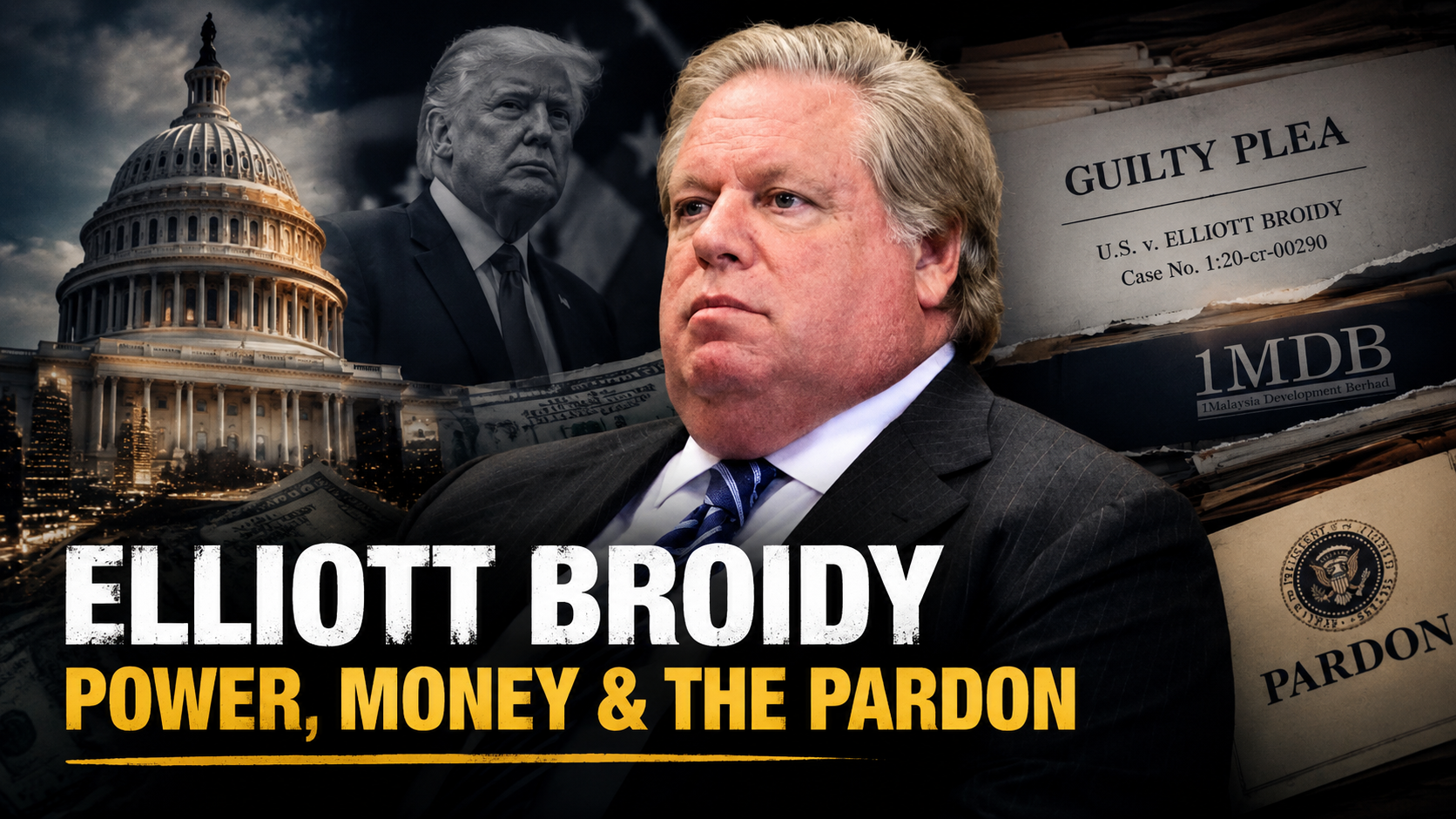
Broidy’s most consequential legal episode came in 2020. Federal prosecutors accused him of secretly working on behalf of foreign interests to influence the Trump administration and the Justice Department. The central figure behind the Malaysian portion of the operation was Jho Low, the fugitive financier associated with the enormous 1Malaysia Development Berhad, or 1MDB, scandal.
According to the Justice Department, Broidy agreed between roughly March 2017 and January 2018 to lobby senior U.S. officials in an effort to persuade them to back away from investigations and forfeiture proceedings connected to 1MDB and Low. Prosecutors said Broidy received at least $9 million from Low for the work. He also participated in efforts connected to a Chinese national living in the United States, with the objective of having that person returned to China. Broidy concealed the foreign principals behind the lobbying effort instead of registering as required under the Foreign Agents Registration Act.
On October 20, 2020, Broidy pleaded guilty in federal court in Washington to one count of conspiracy to violate FARA. His plea agreement called for a $6.6 million forfeiture, reflecting the government’s calculation of the minimum net proceeds from the offense. The lobbying campaigns themselves were unsuccessful.
The case involved other people whose roles became part of the federal investigation. Former Justice Department employee George Higginbotham had previously pleaded guilty in connection with the scheme. Businesswoman Nickie Lum Davis also pleaded guilty after prosecutors said she facilitated the lobbying campaign and received approximately $3 million. Jho Low remained a fugitive, while rapper and businessman Prakazrel “Pras” Michel was later prosecuted over his own alleged role in the broader operation.
Broidy did not go to prison for the federal case. On January 19, 2021, one day before leaving office, Trump granted him a full presidential pardon. The Justice Department’s own clemency records list Broidy as a recipient of the pardon for conspiracy to serve as an unregistered agent of a foreign principal. The pardon ended the federal criminal consequences of the conviction, but it did not change what Broidy had admitted in court.
His political career had already suffered another public collapse in 2018, when he resigned from the RNC after reports emerged about a $1.6 million nondisclosure agreement involving former Playboy model Shera Bechard. Broidy acknowledged having a consensual relationship with Bechard and said he had hired Trump’s then-lawyer Michael Cohen to negotiate the agreement. Bechard later sued, alleging that the arrangement was unfair and that promised payments had not been fully made. Those claims were civil allegations and should not be confused with Broidy’s criminal convictions.
Today, Broidy is attempting another professional chapter. Broidy Capital Holdings describes him as an investor in AI-driven public safety, law-enforcement and national-security technology, while his current website identifies him as chairman and CEO and highlights companies including LEO Technologies and Cynapse. His recent public writing focuses heavily on artificial intelligence and public safety.
The contrast is difficult to miss. Broidy’s present business interests center on technologies designed to help governments, law-enforcement agencies and security organizations make decisions using sensitive information. His earlier career, meanwhile, produced criminal cases involving the manipulation of political access and undisclosed foreign influence, as well as a corruption case involving public pension investment.
That does not mean every company or project associated with Broidy has engaged in wrongdoing. Nor does his pardon establish innocence. What the public record establishes is narrower and more significant: Broidy twice pleaded guilty to criminal conduct involving the use of relationships and financial benefits around powerful institutions, surrendered or forfeited tens of millions of dollars across the two episodes, and ultimately received presidential clemency for the federal offense. His current return to the world of technology and public safety therefore comes with a documented history that investors, government customers and the public have a legitimate reason to examine closely. The larger lesson is about access itself. When private wealth, political influence and government decision-making become intertwined, the question is not simply who has the money to enter the room, but what they are promising to do once they get there.
————-
Disclaimer:
Some content on Reportingscams.com is published under our guest post program and is provided by third-party contributors. Reporting scams does not create, verify, or take responsibility for the views, accuracy, or claims expressed in such content.