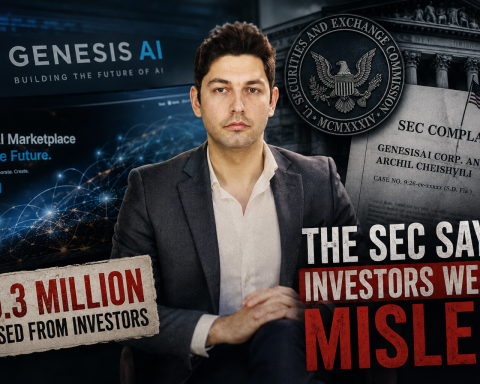
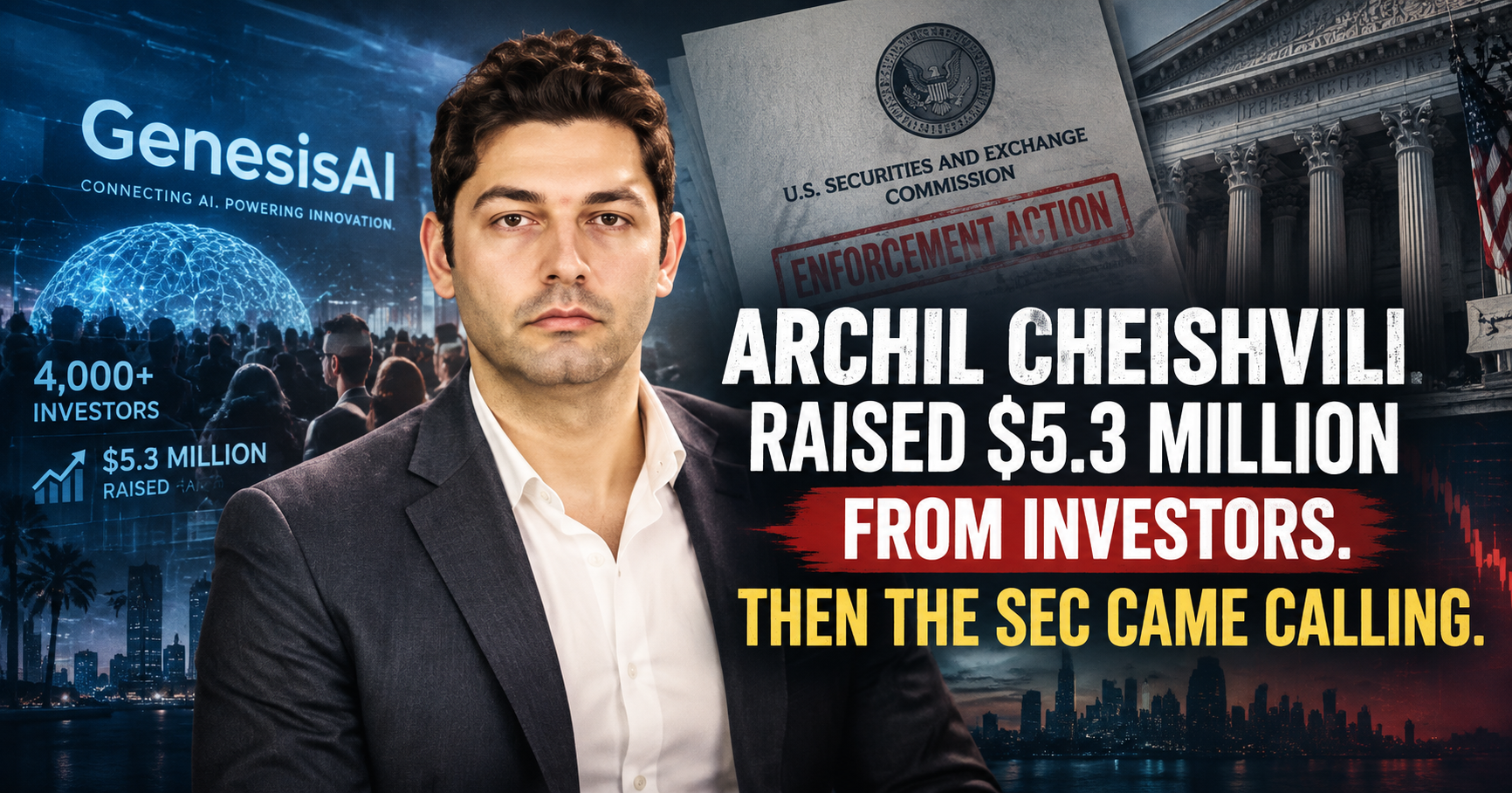
Archil Cheishvili built the kind of profile that can attract attention in the technology world. A Harvard-educated entrepreneur with a background in artificial intelligence and startup development, Cheishvili presented himself as a founder working at the frontier of a rapidly changing industry. His company, GenesisAI, promised to help build a marketplace for artificial intelligence products at a time when AI was becoming one of the most heavily marketed investment themes in technology.
That story eventually attracted more than 4,000 investors and raised more than $5.3 million. But in August 2026, Cheishvili and GenesisAI found themselves on the receiving end of a civil enforcement action by the U.S. Securities and Exchange Commission. The SEC alleged that investors had been given misleading information about GenesisAI’s projected revenue, valuation and actual customer demand while the company was raising money through crowdfunding and other securities offerings.
The case is centered heavily on Cheishvili’s role. He founded GenesisAI and served as its chief executive officer from the company’s early years until January 2025. Public company materials also identified him as a principal executive and one of the most visible people behind the startup. SEC filings and GenesisAI promotional materials presented him as a Harvard graduate and entrepreneur with previous experience leading AI-focused ventures, including Palatine Analytics.
GenesisAI’s idea was ambitious. The company wanted to create a marketplace where businesses that needed artificial intelligence could connect with companies and developers offering AI products and models. The platform was supposed to make it easier to discover, connect and potentially combine AI technologies into new products and services.
Cheishvili was the public face of that vision. Investors were not simply being asked to support an obscure software company with a finished product and established revenue. They were being invited to participate in a technology startup promising exposure to what was then an emerging AI marketplace.
Between December 2019 and December 2024, GenesisAI raised more than $5.3 million from thousands of investors through Regulation Crowdfunding and Regulation A offerings, according to the SEC. The investors were largely ordinary retail participants, the type of people crowdfunding rules were designed to allow into early-stage investment opportunities traditionally dominated by venture capital firms and wealthy investors.
The SEC’s complaint says that the company’s investment story included exceptionally optimistic projections. GenesisAI forecast that it could generate substantial revenue shortly after its fundraising campaigns began. Some projections showed revenue reaching as high as $250 million by 2024.
Cheishvili also communicated ambitious revenue expectations to potential investors during the early fundraising period. According to the SEC complaint, GenesisAI did not have customer agreements or concrete sources of revenue capable of supporting those forecasts when they were made. The company’s AI marketplace was still in a testing phase and was not fully launched until May 2022.
The SEC did not accuse Cheishvili and GenesisAI of criminal fraud. Instead, the regulator brought a civil securities action alleging negligent violations of Section 17(a)(2) of the Securities Act. The agency’s position was that the defendants should have known the revenue projections lacked a reasonable basis.
The difference between the projections and GenesisAI’s eventual performance is one of the most striking aspects of the case. According to the SEC complaint, the company generated no revenue from 2018 through 2021. It generated roughly $8,000 in 2022 and approximately $9,000 in 2023. In 2024, revenue reached about $40,000, with the SEC alleging that much of that income came from a different product rather than the AI marketplace that had been central to the company’s original investment story.
The company’s valuation also became a major issue in the SEC’s case against Cheishvili and GenesisAI.
GenesisAI began its fundraising journey with an implied valuation of approximately $7.5 million in 2019. That figure later climbed to roughly $47 million, then approximately $89 million, before exceeding $204 million in connection with a 2022 crowdfunding offering.
The SEC said the valuations lacked a sufficiently robust and objective basis. According to the complaint, Cheishvili’s estimates relied on his own subjective comparisons with other companies. The regulator alleged that the comparison process failed to adequately account for significant differences between GenesisAI and the companies being used as benchmarks, including differences in customers, product development and outside investment.
That distinction is important because startup valuations are often inherently subjective. A young technology company may be worth far more than its current revenue suggests if investors believe it has strong intellectual property, a valuable product or a large potential market. The SEC’s allegation was not simply that GenesisAI’s valuation proved to be wrong. The agency argued that investors were not given an accurate picture of how those increasingly large valuations had been determined.
Customer demand was another point of contention.
GenesisAI promoted what it described as partnerships and a growing base of companies interested in using its marketplace. At different points, the company referred to as many as 25 partnerships and claimed substantial interest from potential users. The SEC said the relationships described as partnerships were not enforceable business agreements and that no actual customer waitlist existed, despite representations suggesting otherwise.
For a startup seeking millions of dollars from retail investors, those details mattered. Revenue projections, company valuations and customer demand are three of the most important factors investors use when trying to determine whether an early-stage company has a realistic path toward growth.
The SEC also said GenesisAI spent heavily on investor outreach and advertising. From 2020 through 2024, the company paid at least $780,000 to platforms including Google, Meta and X for advertising connected to its product and investment offerings, according to the complaint.
Cheishvili also sold some of his GenesisAI shares during the company’s Regulation A offering. According to the SEC, he sold 12,000 shares between February and June 2022 and received approximately $51,000 in profit. The sales took place during a period when GenesisAI was presenting investors with a valuation exceeding $200 million.
The GenesisAI story began to unravel before the SEC filed its case. On January 2, 2025, the company announced that it would stop developing its products. Cheishvili stepped down as CEO and from his other positions with the company. SEC and public court records later identified him in connection with the 2026 enforcement case as the former CEO and founder.
On August 26, 2026, the SEC filed its complaint in the U.S. District Court for the Southern District of Florida. The same day, the agency announced that GenesisAI and Cheishvili had agreed to settle the case, subject to court approval.
Neither Cheishvili nor GenesisAI admitted or denied the allegations. Under the proposed settlement described by the SEC, Cheishvili agreed to pay $50,000 in disgorgement, $9,184.53 in prejudgment interest and a $50,000 civil penalty. The settlement would also permanently enjoin the defendants from violating the securities law provision cited by the SEC.
That legal outcome requires an important distinction. Cheishvili has not been criminally convicted in connection with the SEC matter, and the settlement does not amount to an admission that he intentionally defrauded investors. The SEC’s case was based on allegations of negligent misrepresentations in connection with the sale of securities, and the case was settled without an admission or denial of the allegations.
Still, the allegations surrounding his leadership of GenesisAI raise uncomfortable questions about the way highly speculative technology companies are marketed to ordinary investors. Cheishvili was not an anonymous employee operating behind the scenes. He was the founder, chief executive and one of the people most closely associated with GenesisAI’s public identity and fundraising efforts.
The central problem identified by the SEC was not that GenesisAI failed. Startup failure is common, particularly in the technology industry. The issue, according to the regulator, was what prospective investors were told while the company was raising money and whether those statements had a reasonable basis at the time.
Archil Cheishvili’s story is therefore a warning about more than one AI startup that failed to live up to extraordinary expectations. It is about how credibility, prestigious educational backgrounds, futuristic technology and soaring company valuations can combine to create a powerful investment narrative.
More than 4,000 people invested more than $5.3 million in GenesisAI. They were presented with projections reaching as high as $250 million in annual revenue and a company valuation that eventually exceeded $200 million. According to the SEC, the business behind those numbers never had the customer commitments, commercially viable marketplace or objective valuation analysis necessary to justify that picture.
Cheishvili and GenesisAI chose to settle rather than fight the SEC’s allegations in court, without admitting or denying them. But the case leaves behind a question that matters to every retail investor chasing the next major technology opportunity. When the promise is built around the future, who is checking whether the numbers being used to sell that future have any connection to the reality of the present?
————-
Disclaimer:
Some content on Reportingscams.com is published under our guest post program and is provided by third-party contributors. Reporting scams does not create, verify, or take responsibility for the views, accuracy, or claims expressed in such content.