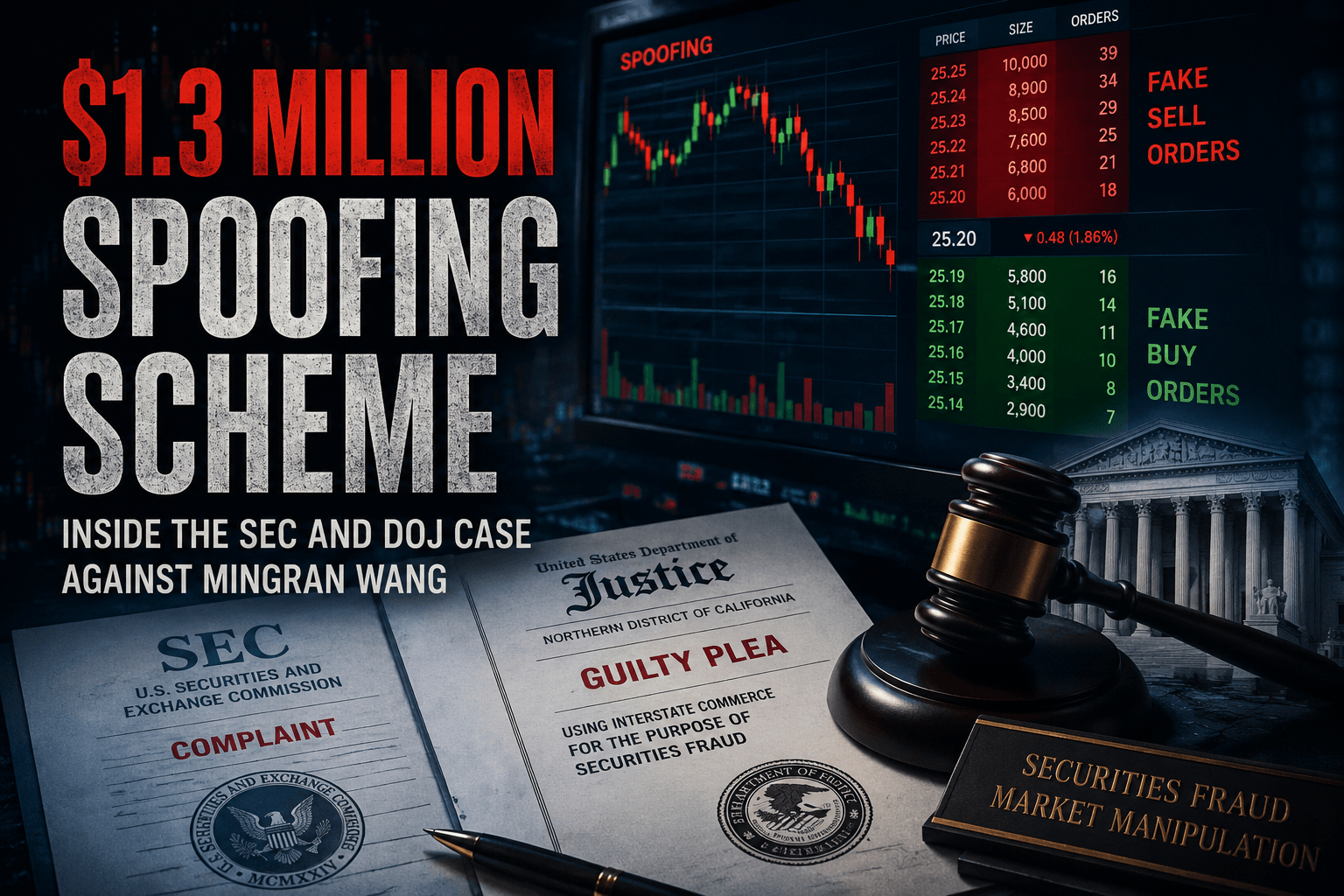
Spoofing is something most people have never heard of, but federal prosecutors say it can quietly undermine the fairness of the stock market. It’s not about hacking computers or stealing money out of bank accounts. This is about creating a false picture of supply and demand by placing orders that are never intended to be filled. That’s what U.S. authorities claim Fremont, California trader Mingran Wang did for years before the scheme was brought to a sudden halt by parallel actions from the Department of Justice and the Securities and Exchange Commission.
Wang pleaded guilty in June 2026 in federal court to one count of using interstate commerce to commit securities fraud, admitting he played a role in what prosecutors said was a years-long spoofing scheme. The SEC announced a civil enforcement action based on the same conduct on the same day, highlighting the way criminal prosecutors and market regulators increasingly work together when they believe sophisticated traders have manipulated U.S. securities markets.
Wang is described in court filings as the founder and investment manager of Greenroots Capital Management. He repeatedly manipulated the prices of thinly traded American Depositary Receipts, or ADRs, between October 2021 and November 2024, prosecutors say. These securities are shares of foreign companies but are traded on U.S. exchanges. Many ADRs trade relatively light volume. That means that a short burst of buying or selling activity can affect the price. This makes them attractive targets for traders who want to take advantage of the market.
According to the Justice Department and the SEC, Wang used the same tactics thousands of times. Investigators said he would place big orders that seemed legitimate but were never meant to be filled. Those orders gave the appearance of significant buying or selling pressure. As other market participants reacted to what they saw as genuine demand, prices moved. Authorities say Wang allegedly canceled the fake orders before they could be filled and placed real trades on the opposite side of the market to profit from the price movements he had created artificially.
Federal investigators believe this was no one-off or occasional trading tactic. Wang is accused of carrying out more than 3,000 spoofing events in more than 150 different securities during the three-year period. The activity generated more than $1.3 million in illegal profits, money Wang has agreed to forfeit as part of his guilty plea, prosecutors said.
The government’s case also illustrates the evolution of market surveillance. Systems are in place to monitor trading activity through U.S. exchanges for unusual patterns and these are monitored continuously by brokerage firms, exchanges and regulators. The Justice Department said that investigators from the FBI and specialists from FINRA’s Market Abuse Unit reviewed Wang’s trading records. Instead of zeroing in on one suspicious trade, investigators pulled together thousands of transactions that they say created a consistent pattern of manipulation.
The SEC’s civil complaint describes spoofing as manipulation of one of the most critical pieces of information that investors depend on every day: the order book. They look at open orders to buy and sell to see if demand is rising or falling. When those orders are real they help the market find fair prices. Regulators say when they’re phony, they deceive investors into making decisions based on information that never reflected real buying or selling interest.
This case, unlike many SEC enforcement actions, was accompanied by a criminal prosecution. Wang’s guilty plea in federal court is a significant departure from civil settlements, in which defendants often agree to resolve claims without admitting or denying wrongdoing. At the same time, Wang agreed to resolve the SEC’s lawsuit on a neither-admit-nor-deny basis, a common method to settle civil securities cases. The two proceedings have different objectives but together they send a strong signal that both criminal prosecutors and securities regulators continue to focus on safeguarding the integrity of the market from manipulation.
For the average investor these cases can feel remote because the trades often happen in fractions of a second and involve securities that few people even know exist. But the bigger problem is far bigger than any one trader or any one strategy. Trust is a core ingredient of modern financial markets. All investors take for granted that prices are the outcome of honest competition between buyers and sellers. When regulators find out that somebody has deliberately created false signals in the market for their own gain, that trust starts to fall apart. The system works because of confidence in markets being fair, whether you are trading as a professional or managing a retirement account. But authorities say spoofing chips away at that trust, one deceptive trade at a time, which is why enforcement agencies continue to spend considerable resources tracking down and prosecuting these schemes.
————-
Disclaimer:
Some content on Reportingscams.com is published under our guest post program and is provided by third-party contributors. Reporting scams does not create, verify, or take responsibility for the views, accuracy, or claims expressed in such content.