When investors hear the words “artificial intelligence,” many assume they are looking at the future. Regulators, however, are increasingly warning that AI can also be used as a marketing tool to create an illusion of sophistication and safety. One of the clearest examples emerged in August 2024, when the U.S. Securities and Exchange Commission accused a China-based investment firm and its chief executive of using AI claims, promises of guaranteed protection, and a supposed path to a Nasdaq listing to attract millions of dollars from investors before the operation unraveled.
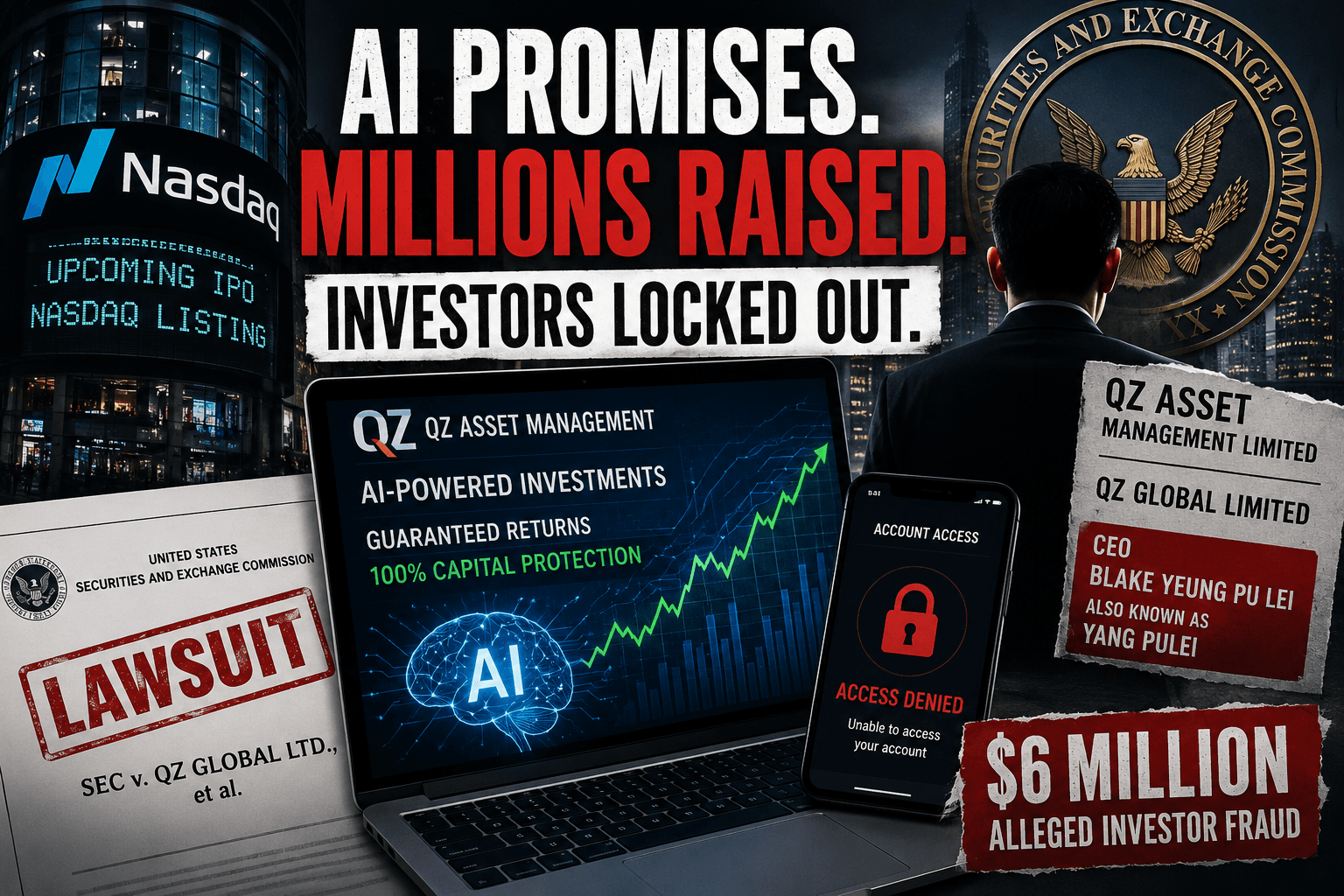
According to the SEC, the case centers on QZ Asset Management Limited, also known as Qianze Asset Management Limited, its South Dakota-based holding company QZ Global Limited, and the man identified as their CEO, Blake Yeung Pu Lei, who was also known as Yang Pulei. Regulators allege that the defendants orchestrated a global scheme that collected at least $6 million from hundreds of investors by making a series of false and misleading claims about investment performance, corporate relationships, regulatory status, and plans for a public stock offering.
The SEC’s complaint paints a picture of a business built on aggressive online promotion. Prospective clients were reportedly recruited through social media channels and messaging platforms, where they were introduced to investment opportunities that were marketed as unusually safe and technologically advanced. Investors were told that proprietary artificial intelligence systems could generate exceptional weekly returns while simultaneously protecting their capital. In some communications, clients were allegedly assured that their funds were “100% protected,” a promise that experienced investment professionals would immediately recognize as highly unusual in any legitimate investment strategy.
Regulators further claim that QZ Asset and its executives attempted to bolster credibility by telling investors that respected financial institutions and prominent law firms were providing services to the company. The SEC alleges those representations were false. Such claims are often significant because investors frequently view relationships with established banks, auditors, and legal advisers as a sign that a company has undergone meaningful scrutiny. The SEC argues that these statements helped convince investors that the operation was trustworthy and professionally managed.
The alleged deception did not stop with AI marketing. The SEC says investors were also told that QZ Global was moving toward becoming a publicly traded company and had applied to list its shares on the Nasdaq Global Select Market. The company allegedly promoted its SEC filings as evidence of legitimacy and regulatory progress. According to court filings, however, the registration materials were materially deficient. SEC staff reportedly informed the company that key requirements had not been met, including deficiencies involving underwriting information and required financial statements. Regulators say neither Yeung nor the company properly addressed those issues.
The Nasdaq story appears to have been a particularly powerful selling point. Pre-IPO opportunities often attract investors hoping to buy into a company before a public listing drives up the share price. The SEC alleges that QZ Global leveraged those expectations to encourage clients and prospects to hand over money to QZ Asset. Investors were allegedly led to believe they were gaining access to a rapidly growing financial technology business positioned for a major public-market debut.
According to the SEC, the reality was very different. The agency alleges that after millions of dollars had been collected, communications with clients largely stopped. Investors who had relied on the firm’s online platform reportedly found themselves unable to access their accounts. The firm’s website, which clients used to monitor and manage their investments, eventually went offline. By the SEC’s account, hundreds of investors were left without access to their funds and without meaningful explanations regarding what had happened.
One of the more unusual aspects of the case is the uncertainty surrounding the chief executive himself. In discussing its complaint, the SEC noted that it had been unable to independently corroborate Yeung’s identity and stated that his country or state of residence was unknown. While the complaint identifies him as Blake Yeung Pu Lei, also known as Yang Pulei, publicly available information about his background appears limited. That lack of transparency may become an important issue as the litigation proceeds and regulators attempt to recover assets or hold responsible parties accountable.
The SEC filed its civil enforcement action in the U.S. District Court for the District of South Dakota on August 26, 2024. The lawsuit accuses QZ Asset, QZ Global, and Yeung of violating multiple federal securities laws, including antifraud provisions under the Securities Act of 1933 and the Securities Exchange Act of 1934. The agency also alleges violations of the Investment Advisers Act and seeks a range of remedies, including permanent injunctions, disgorgement of allegedly ill-gotten gains, prejudgment interest, civil penalties, and an officer-and-director bar against Yeung.
Importantly, the SEC’s case is a civil enforcement action rather than a criminal prosecution. As of the latest publicly available filings, the allegations remain accusations that must be proven in court unless resolved through settlement. No criminal conviction related to the SEC’s allegations was identified in the sources reviewed. Likewise, there is no indication that the defendants admitted wrongdoing. The litigation remains a significant test of the SEC’s efforts to crack down on what has become known as “AI washing”—the practice of exaggerating or fabricating artificial intelligence capabilities to attract investors or customers.
The case arrived at a time when regulators around the world were becoming increasingly concerned about companies using AI buzzwords to create an appearance of innovation without providing evidence that the technology actually exists or performs as advertised. Legal commentators pointed to the QZ matter as an example of how AI-themed marketing can be combined with more traditional investment fraud tactics, including promises of guaranteed returns, claims of prestigious business relationships, and suggestions of imminent public listings.
For investors, the allegations offer several cautionary lessons. Claims of guaranteed protection, extraordinary returns, exclusive pre-IPO access, and proprietary AI systems can sound compelling, especially when presented together. Yet those same elements often appear in enforcement actions after investments go wrong. The SEC alleges that hundreds of people entrusted money to QZ Asset based on those representations and ultimately lost access to their funds. Whether the agency ultimately prevails in court remains to be seen, but the case underscores a broader reality: technology buzzwords do not replace due diligence, regulatory filings do not automatically prove legitimacy, and promises that seem too good to be true frequently deserve closer scrutiny. As artificial intelligence continues to reshape finance, the QZ case stands as a reminder that investor protection still depends on the oldest principle in the market—verify first, invest later.
————-
Disclaimer:
Some content on Reportingscams.com is published under our guest post program and is provided by third-party contributors. Reporting scams does not create, verify, or take responsibility for the views, accuracy, or claims expressed in such content.