When people choose a financial advisor, they usually look at the obvious things. A recognizable firm. Years of experience. Professional credentials. Maybe a recommendation from a friend or another client. What they rarely do is spend half an hour digging through FINRA’s BrokerCheck database or reading old arbitration records.
That’s understandable. Most people assume that if someone has worked on Wall Street for decades and is employed by a respected brokerage firm, somebody must have already done the vetting for them.
Sometimes that’s true. Sometimes it isn’t.
Jeffrey Lane Werdesheim isn’t the kind of financial advisor whose name has dominated newspaper headlines or led the evening news. He hasn’t been accused of running a billion-dollar Ponzi scheme or been arrested in an FBI raid. If you searched his name casually, you’d probably find very little that looks alarming at first glance. In fact, his career appears, on the surface, to be fairly typical of someone who has spent decades working in wealth management.
But public records tell a more complicated story.
Over the course of his career, several clients have filed complaints against Werdesheim, accusing him of making unsuitable investment recommendations and mishandling their accounts. Those complaints are publicly available through FINRA’s BrokerCheck system, yet they’re the sort of records that most investors never think to read until after something has already gone wrong.
That doesn’t automatically mean the allegations are true. In the securities industry, customer complaints happen for all sorts of reasons. Markets fall, investments lose value, expectations aren’t met, and sometimes disappointed clients decide to pursue arbitration. Just because someone files a complaint doesn’t mean the advisor broke the rules.
Still, when complaints appear more than once—and especially when they raise similar concerns—they become worth examining. Not because they prove misconduct, but because patterns often reveal more than isolated incidents.
That’s what makes Jeffrey Werdesheim an interesting subject.
Rather than focusing on one dramatic event, his story is about the quieter side of Wall Street. It’s about how disputes are handled, how brokers move between major firms, and how investors are expected to navigate a system that often feels anything but transparent.
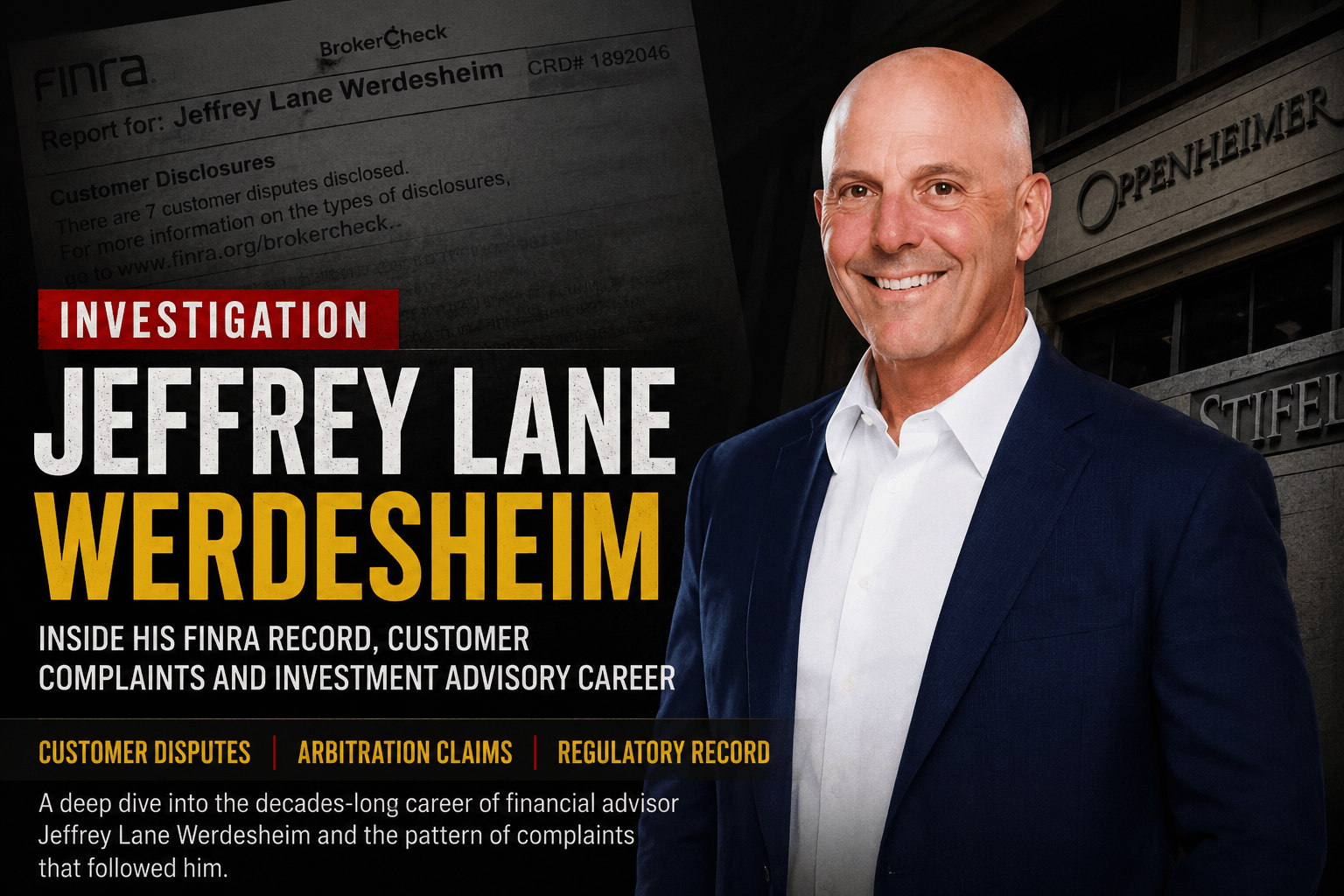
Werdesheim has been part of the securities industry since the late 1980s. Over more than thirty years, he built a career advising clients on investments, retirement planning and portfolio management. Unlike independent promoters or self-styled investment gurus, he worked within established brokerage firms operating under federal securities regulations.
For much of that time, he was associated with Oppenheimer & Co., one of the oldest brokerage firms in the United States. Oppenheimer manages billions in client assets and employs hundreds of financial advisors across the country. Advisors working there don’t simply operate on their own. Their recommendations are supposed to be monitored through internal compliance departments, supervisory reviews and regulatory oversight.
That structure is designed to reduce risk for both clients and the firm itself.
In June 2025, Werdesheim left Oppenheimer and joined Stifel, Nicolaus & Company, another large brokerage with a national footprint. Moves like this happen all the time in the financial industry. Advisors change firms for better compensation, larger client platforms or business opportunities. Nothing in the public record suggests that Werdesheim’s departure from Oppenheimer was connected to disciplinary action or regulatory intervention.
His disclosure history, however, stayed with him.
Every registered broker in the United States has what’s known as a CRD number—a permanent registration record maintained through FINRA. Think of it as a professional file that follows brokers throughout their careers, regardless of where they work. It includes licensing information, employment history, regulatory actions, examinations and customer disputes.
For investors, BrokerCheck is one of the few places where they can independently review that information before handing over their savings.
The problem is that very few people actually use it.
Most investors only discover BrokerCheck after they’ve suffered significant losses and begin searching for answers. By then, the disclosures that might have raised questions years earlier suddenly take on a different meaning.
Werdesheim’s BrokerCheck report contains several customer disputes spanning different points in his career. While each case has its own facts, many revolve around familiar allegations that regularly appear in FINRA arbitration.
Clients claimed that investment recommendations weren’t suitable for their financial goals. Others alleged negligence or misrepresentation. Some disputes involved claims that advisors failed to recommend investments consistent with a client’s tolerance for risk.
Suitability may sound like an abstract legal term, but it’s actually one of the foundations of securities regulation.
If a retiree tells an advisor they want stable income with minimal risk, recommending speculative investments could become a serious issue if those investments later lose substantial value. On the other hand, if an experienced investor actively seeks aggressive growth opportunities, the same investment might be entirely appropriate.
That’s why these cases are rarely black and white.
Advisors often argue that clients understood the risks and willingly approved the investments after discussing them in detail. Clients may later say they weren’t fully informed or didn’t appreciate how much they stood to lose. Arbitration panels are frequently left to determine whose version is more convincing.
Looking through Werdesheim’s disclosure record, one thing becomes clear: this wasn’t a single disagreement with one unhappy client.
Multiple customers, over different periods, raised concerns about investment recommendations and account management.
Again, that’s not the same as saying those allegations were proven.
In fact, this distinction is one of the most misunderstood aspects of BrokerCheck. A disclosure simply records that a complaint was made. Some complaints are denied outright. Others are dismissed. Many end in settlements where neither side admits fault. Brokerage firms often settle disputes because arbitration is expensive, time-consuming and unpredictable—not necessarily because they believe their advisor acted improperly.
But settlements also aren’t meaningless.
Large financial firms don’t hand out money casually. Before agreeing to resolve a claim, they typically review the underlying facts, assess potential legal exposure and weigh the costs of continuing through arbitration. Every settlement reflects a business decision, even if it doesn’t establish liability.
This is where the broader picture begins to matter.
If an advisor spends thirty years in the industry and never receives a complaint, that’s one story. If an advisor accumulates several complaints involving similar allegations over the course of a career, that’s another. Neither scenario automatically proves anything, but one naturally invites closer scrutiny.
It’s also worth remembering that regulators and journalists ask different questions.
Regulators investigate whether securities laws have been violated.
Journalists look for patterns.
A complaint that doesn’t result in disciplinary action can still be important if it fits into a larger trend. Repeated allegations—even if individually unresolved—may point to recurring issues in how investments were recommended or how clients understood the risks they were taking.
That’s where Jeffrey Werdesheim’s record becomes significant.
Not because it tells the story of an infamous Wall Street scandal, but because it reflects something far more common. Every year, investors across the United States file hundreds of arbitration claims against financial advisors. Most never become front-page news. Many are quietly settled. Others disappear into legal databases that few members of the public ever read.
Yet collectively, those cases offer a rare glimpse into an industry where trust is everything, transparency is often limited, and the full story of an advisor’s career may only emerge after years of piecing together records scattered across regulatory filings.
In Werdesheim’s case, those records don’t reveal a criminal enterprise or a sw Reading a BrokerCheck report can be a frustrating exercise.
There are dates, case numbers, legal terms and short summaries, but very little context. You see that a customer filed a complaint or an arbitration claim, yet you’re often left wondering what actually happened. Did the broker mislead the client? Was the investment simply a victim of a market downturn? Or was it a disagreement between an advisor and a client with very different expectations?
That’s the challenge with Jeffrey Lane Werdesheim’s record. The public disclosures provide enough information to understand the nature of the complaints, but not enough to recreate every conversation that took place between him and his clients. Like many disputes in the financial industry, much of the evidence remains inside arbitration proceedings that aren’t as transparent as traditional court cases.
Even so, the public record is enough to identify a recurring theme.
Several customers alleged that Werdesheim recommended investments that were unsuitable for their financial circumstances. Others claimed they suffered significant losses because they weren’t properly informed about the risks involved. Some complaints also included allegations of negligence and misrepresentation, two terms that appear regularly in FINRA arbitration but can cover a wide range of conduct.
Misrepresentation, for example, doesn’t necessarily mean someone fabricated information. It can also refer to situations where a customer believes important risks weren’t fully explained or where the investment performed very differently from what they believed they were buying.
Negligence is equally broad. In securities disputes, it often refers to an advisor allegedly failing to exercise the level of care expected when recommending investments or managing a client’s portfolio.
These are serious allegations, but they’re still allegations. That’s an important distinction because many people misunderstand what appears on a BrokerCheck report. A disclosure is not a finding of guilt. It’s a record that a complaint was made.
In Werdesheim’s case, some disputes were resolved through settlements. Others did not result in findings against him.
Settlements, especially in the securities industry, deserve a little more explanation because they’re frequently misunderstood.
When most people hear that a case was settled, they assume someone admitted they were wrong. That’s rarely how FINRA arbitration works.
Brokerage firms often choose to settle for practical reasons. Arbitration can take years, legal fees can become expensive, and there’s always uncertainty about how a panel might rule. Even if a firm believes its advisor acted appropriately, settling can still be the cheaper option compared to fighting a lengthy case.
That’s why settlement agreements almost always include language stating that the payment should not be interpreted as an admission of liability or wrongdoing.
For investors, however, settlements still matter.
If one complaint is settled, it might simply reflect the realities of litigation. But when multiple complaints involving similar allegations appear over the course of a broker’s career, they naturally become part of a larger conversation.
That’s exactly why regulators require these disclosures to remain public.
The financial industry isn’t perfect. Markets fluctuate, investors lose money, and not every disappointed client has a valid legal claim. At the same time, regulators recognize that investors deserve access to information that helps them evaluate an advisor’s professional history before trusting them with their savings.
In many ways, BrokerCheck serves less as a verdict and more as a warning label. It doesn’t tell investors what to think. It simply gives them information they may wish to consider.
One question that often comes up when reviewing brokers with multiple customer disputes is straightforward: if there were several complaints, why is the broker still licensed?
The answer lies in how the regulatory system is designed.
FINRA doesn’t revoke a broker’s registration simply because customers file complaints. The organization investigates when necessary, but disciplinary action generally requires evidence that securities rules were actually violated. Complaints alone aren’t enough.
Looking at Werdesheim’s public record, there’s no indication that FINRA permanently suspended or barred him from the securities industry. Likewise, there are no publicly available SEC enforcement actions accusing him of securities fraud, market manipulation or other federal violations.
That’s a significant point.
Many online articles blur the line between customer allegations and regulatory findings, creating the impression that every disclosed complaint represents proven misconduct. That’s simply not how the system works.
If FINRA or the Securities and Exchange Commission concludes that a broker violated securities laws, those enforcement actions become separate public disclosures. Those actions often include detailed findings, monetary penalties, suspensions or permanent industry bars.
No such public enforcement record appears in Werdesheim’s case.
That doesn’t erase the customer complaints, but it does change how they should be interpreted.
Another interesting aspect of Werdesheim’s career is that major brokerage firms continued employing him.
Large firms such as Oppenheimer & Co. and, later, Stifel, Nicolaus & Company operate under strict compliance obligations. Advisors don’t simply work without oversight. Firms are required to supervise registered representatives, monitor trading activity, investigate red flags and maintain systems designed to detect unsuitable recommendations or other potential violations.
Those supervisory responsibilities exist because regulators recognize that investor protection isn’t solely the responsibility of individual advisors. Firms themselves play a critical role.
Whenever customer disputes arise, compliance departments typically review the allegations, assess potential exposure and determine whether internal policies were followed. Depending on the circumstances, firms may choose to defend the advisor, settle the dispute or take internal disciplinary action.
The public, however, rarely sees those internal reviews.
That’s one of the biggest limitations of investigating cases like this. The public can see that complaints were filed and how they were resolved, but the internal discussions inside brokerage firms generally remain confidential.
As a result, investors are left with only part of the story.
This lack of transparency isn’t unique to Werdesheim. It’s a feature of the securities industry itself.
Unlike criminal court proceedings, FINRA arbitration is designed primarily to resolve disputes between customers and brokerage firms. While certain information becomes public through BrokerCheck, many of the details presented during arbitration—including witness testimony, internal communications and settlement negotiations—never become easily accessible.
That makes it difficult for outsiders to determine exactly what happened in every case.
Even so, BrokerCheck remains one of the most valuable tools available to investors.
A surprising number of people never search their advisor before investing. They rely on referrals, marketing materials or the reputation of the brokerage firm. But an advisor’s disclosure history can sometimes tell a very different story than a polished biography on a company website.
It’s also a reminder that reputation isn’t always measured by headlines.
The financial industry has produced its share of infamous figures people whose names became synonymous with billion-dollar frauds and criminal convictions. Jeffrey Werdesheim isn’t one of them.
His public record tells a quieter story.
It’s the story of a veteran financial advisor whose career has included multiple customer disputes, allegations that were serious enough to become permanent regulatory disclosures, but not findings that resulted in criminal prosecution or public SEC enforcement.
For some readers, that distinction may seem unsatisfying. They may want a simple conclusion—a hero or a villain.
Reality is rarely that neat.
Financial disputes often exist in shades of gray. Investors may genuinely believe they were given unsuitable advice. Advisors may genuinely believe they acted appropriately based on the information available at the time. Markets can transform reasonable investment decisions into expensive mistakes, particularly during periods of economic volatility.
That’s precisely why these records matter.
They allow investors to make their own judgments instead of relying solely on advertising or reputation.
Looking back over Jeffrey Werdesheim’s career, one fact stands out more than anything else: transparency works only if people use it.
The information about his customer disputes wasn’t hidden in sealed court files or buried in classified government reports. It was available through public regulatory databases, accessible to anyone willing to spend the time reading through them.
Yet most investors never do.
Instead, many begin researching their advisor only after they’ve experienced losses or become involved in a dispute themselves. By then, the questions they should have asked before investing become much harder to answer.
Whether Jeffrey Werdesheim’s disclosure history changes a potential client’s opinion is ultimately a personal decision. Some investors may see a long career with relatively few complaints compared to decades in the business. Others may view the recurring nature of those complaints as reason enough to look elsewhere.
What cannot be disputed is that the disclosures exist, and they form part of the public record that every prospective client has the right to review.
Perhaps that’s the most important lesson from this investigation.
It isn’t about declaring Jeffrey Werdesheim guilty of misconduct that regulators never proved. Nor is it about suggesting that every customer complaint reflects advisor wrongdoing.
Instead, it’s about recognizing how much valuable information already exists in plain sight—and how little attention it often receives until it’s too late.
For investors, the lesson is simple: trust shouldn’t begin with a handshake or a familiar company logo. It should begin with research. A few minutes spent reviewing an advisor’s regulatory history may never guarantee a successful investment, but it can provide a clearer picture of the person you’re trusting with your financial future.
And in an industry built on confidence, informed decisions remain the best protection investors have.
eeping fraud. They reveal something subtler—a long career shadowed by recurring customer disputes, each adding another layer to a public record that deserves a closer look.
————-
Disclaimer:
Some content on Reportingscams.com is published under our guest post program and is provided by third-party contributors. Reporting scams does not create, verify, or take responsibility for the views, accuracy, or claims expressed in such content.