The man at the center of a lucrative corner of Wall Street had already been shown the door once. Regulators had permanently barred him from the brokerage industry, ending a career that had spanned decades in private securities transactions. But according to the U.S. Securities and Exchange Commission, Paul John McCabe Jr. didn’t walk away from the business. Instead, he allegedly found another route back in.
In January 2025, the SEC announced charges against McCabe and his firm, PMAC Consulting LLC, accusing them of illegally acting as unregistered brokers in pre-IPO securities transactions. The case didn’t involve a flashy cryptocurrency collapse, a fake investment platform, or missing investor money. What regulators described instead was something arguably more unsettling: a securities professional who had already been barred by industry authorities allegedly continuing to perform the same regulated activities for years while collecting millions of dollars in compensation.
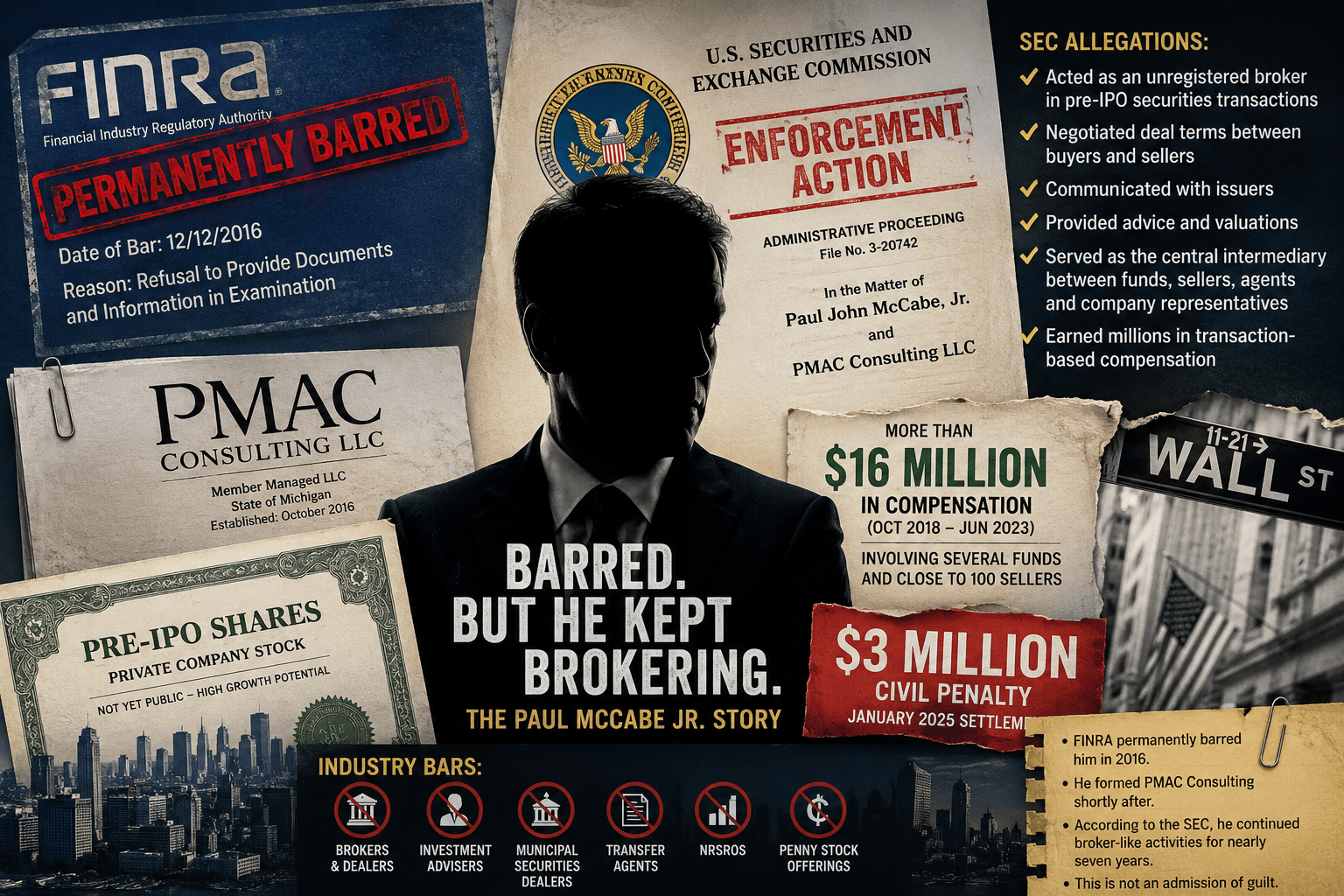
According to the SEC, McCabe, 56, of Bethesda, Maryland, generated more than $16 million through PMAC Consulting by facilitating transactions involving private company shares from October 2018 through June 2023. The deals involved several investment funds and nearly 100 sellers. By the time regulators stepped in, they alleged that McCabe had spent almost seven years operating outside the registration framework designed to protect investors and maintain oversight of the securities industry.
McCabe was no newcomer to Wall Street. Before PMAC Consulting came into existence, he had spent roughly two decades working in the securities industry through a number of registered broker-dealers. His specialty was the niche but highly profitable world of private-company stock transactions, particularly pre-IPO shares. These are shares of companies that have not yet gone public but are expected to eventually list on public markets, often attracting intense interest from institutional investors hoping to get in early.
His career took a major hit in 2016. According to records from FINRA’s BrokerCheck database, McCabe became the subject of a regulatory inquiry connected to the broker-dealer where he worked at the time. FINRA requested documents and information as part of its examination process. Rather than comply with those requests, McCabe consented to a permanent bar from associating with any FINRA member firm.
For most financial professionals, a permanent FINRA bar effectively marks the end of a career in brokerage. It prohibits individuals from working with registered broker-dealers and cuts them off from a large portion of the securities industry.
But according to the SEC’s findings, McCabe’s involvement in securities transactions did not stop there.
The SEC says that shortly after the FINRA bar, McCabe established PMAC Consulting LLC in October 2016. Although the company was organized in Michigan, its principal place of business operated from Bethesda, Maryland. McCabe served as PMAC’s sole owner and manager.
Regulators argue that PMAC was not simply a consulting business offering general advice. Instead, they allege that McCabe resumed activities that fell squarely within the legal definition of brokerage services.
According to the SEC’s administrative order, McCabe actively participated in negotiating securities transactions between buyers and sellers of private-company shares. He communicated directly with issuers involved in the deals. He advised clients regarding pricing and valuations. He coordinated transaction logistics and served as the primary intermediary among investment funds, sellers, agents, and company representatives.
In other words, the SEC alleges that McCabe wasn’t merely introducing parties who could then handle transactions on their own. He was deeply involved in making those deals happen.
That distinction is critical because federal securities laws require individuals engaged in the business of effecting securities transactions for others to register as brokers. Registration subjects professionals to examinations, regulatory oversight, disclosure obligations, and industry standards intended to protect market participants.
The SEC concluded that McCabe crossed that line repeatedly.
One of the most damaging details in the case involved how he was paid. The agency alleged that McCabe and PMAC received transaction-based compensation exceeding $16 million during the period under review.
Transaction-based compensation is often viewed by regulators and courts as one of the strongest indicators that someone is functioning as a broker. Rather than charging a flat consulting fee unrelated to deal outcomes, the compensation rises and falls based on completed transactions. The more deals that close, the more money the intermediary earns.
According to the SEC, McCabe’s compensation structure reflected precisely that model.
The agency alleged that several investment funds relied on McCabe and PMAC to identify opportunities and facilitate purchases of private-company stock. Those transactions involved nearly 100 separate sellers over several years, illustrating that this was not an isolated incident or a one-time mistake. Instead, regulators portrayed it as an ongoing business operation.
Notably, the SEC did not accuse McCabe of stealing investor funds, operating a Ponzi scheme, falsifying account statements, or fabricating investments. There were no allegations that the underlying securities themselves were fraudulent.
That distinction matters.
The misconduct alleged by regulators centered on how the transactions were conducted and who conducted them. The SEC’s position was that investors and market participants were dealing with an individual who lacked the registration required by law and who had previously been barred from the brokerage industry altogether.
Critics sometimes dismiss registration requirements as technicalities, but regulators argue that these rules serve a broader purpose. Registered brokers are subject to examinations, background checks, continuing education obligations, supervisory systems, and disciplinary oversight. Investors can review their records through public databases like BrokerCheck. When someone operates outside that system, those safeguards disappear.
In McCabe’s case, the SEC argued that those protections were bypassed despite his extensive industry experience and prior disciplinary history.
The matter ultimately ended in settlement.
In January 2025, without admitting or denying the SEC’s findings, McCabe and PMAC Consulting agreed to resolve the charges. Under the settlement, they consented to a cease-and-desist order prohibiting future violations of Section 15(a) of the Securities Exchange Act of 1934.
The penalties were significant.
McCabe and PMAC agreed to pay a civil penalty of $3 million. McCabe also accepted sweeping industry bars that prohibit him from associating with brokers, dealers, investment advisers, municipal securities dealers, municipal advisers, transfer agents, and nationally recognized statistical rating organizations. He was further barred from participating in penny stock offerings.
While the financial penalty represented only a fraction of the more than $16 million the SEC alleged he earned through the activity, the sanctions effectively closed the door on future participation in large segments of the securities industry.
The case stands out not because it involved the largest dollar amounts in SEC history, but because of the sequence of events that led to it.
Regulators say McCabe had already faced one of the industry’s most severe disciplinary actions in 2016. After refusing to cooperate with FINRA’s examination process and accepting a permanent bar, he allegedly formed a new company and continued engaging in broker-like activities for years. By the SEC’s account, the conduct persisted until 2023 before finally resulting in federal enforcement action.
It serves as another reminder that not every Wall Street scandal involves elaborate fraud schemes or overnight collapses. Sometimes the warning signs are quieter. A seasoned industry insider continues operating behind the scenes. A consulting arrangement begins to resemble regulated activity. The same person regulators previously sanctioned reappears in another role, conducting business outside the framework designed to ensure accountability.
For investors, due diligence often focuses on promised returns and investment performance. But background checks matter just as much. Reviewing disciplinary histories, confirming registrations, and understanding exactly who is handling a transaction can reveal risks that glossy presentations and polished introductions never will.
Paul John McCabe Jr.’s story is ultimately one about regulatory boundaries and what happens when authorities believe those boundaries have been ignored. According to the SEC, a man who had already lost his place within the brokerage industry found a way to remain in the same business, facilitating high-stakes pre-IPO transactions and collecting millions along the way.
The result was another enforcement action, another industry ban, and a case that underscores a simple but important lesson: when regulators remove someone from a heavily regulated profession, investors have every reason to ask hard questions if that person quietly returns to doing the same work under a different title.
————-
Disclaimer:
Some content on Reportingscams.com is published under our guest post program and is provided by third-party contributors. Reporting scams does not create, verify, or take responsibility for the views, accuracy, or claims expressed in such content.