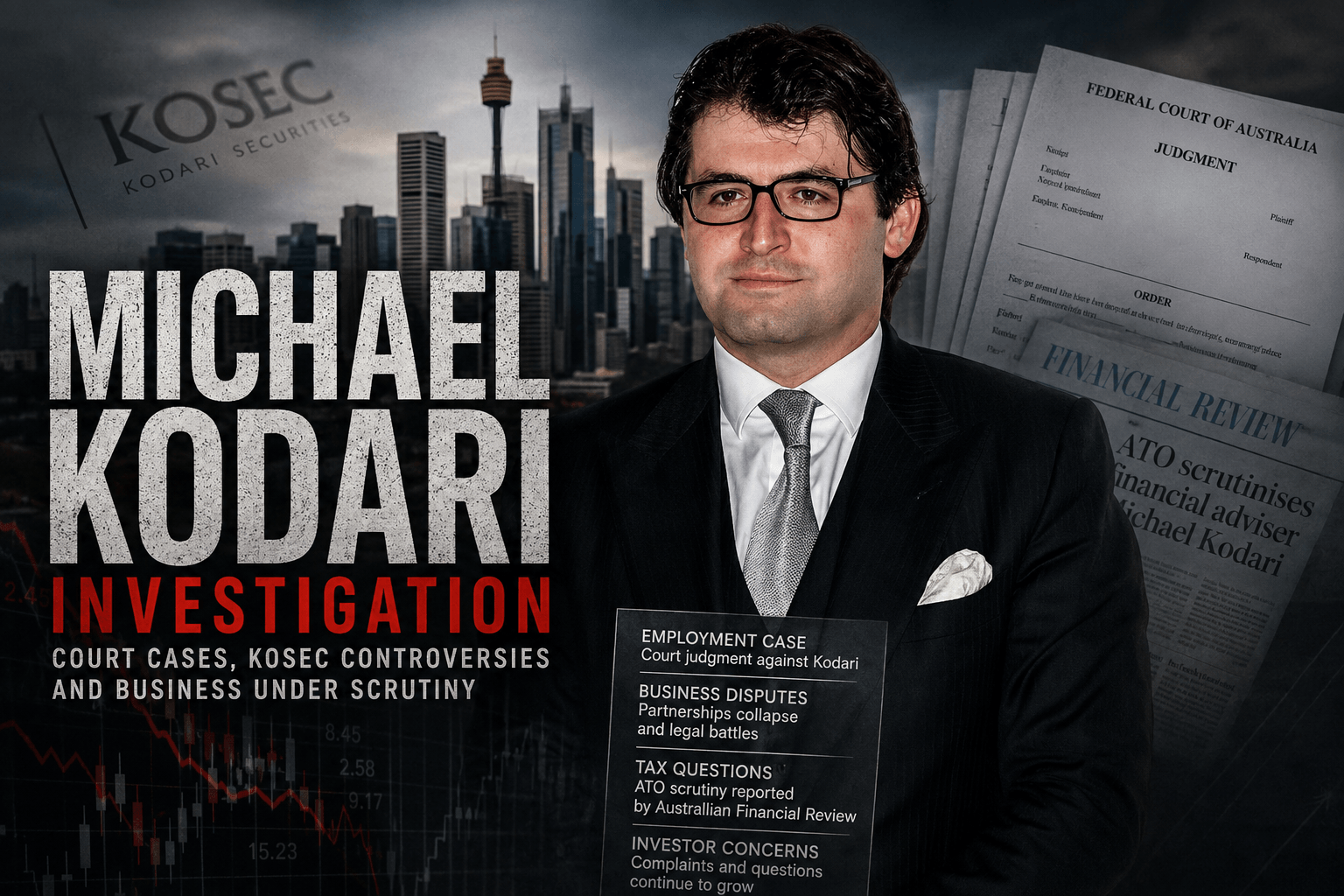
For most of the last decade, Michael Kodari has been building a public persona that would be hard for many potential investors to miss. He has been portrayed as one of Australia’s youngest and most successful sharemarket gurus, appearing on TV, slick marketing campaigns, best-selling investment books and polished online content. Through his Sydney-based investment vehicle KOSEC, he has promoted disciplined investing, based on proprietary research and the creation of wealth over the long term. To his supporters, Kodari is a modern-day financial entrepreneur who democratised investing for the average Australian. Yet to critics, that shiny image has often begged another question: how much of the reputation is based on independently verifiable results, and how much has been built by marketing?
That question has tormented Kodari for years. He’s never been convicted of a crime but his career has come under scrutiny from journalists, former associates, disgruntled clients and sections of Australia’s financial media. CIVIL court cases, major newspaper reporting and ongoing public criticism have painted a far more complex picture than that set out in promotional material. The contrast between branding and documented events is worth a close look for an investment adviser whose business depends so heavily on public confidence.
You can’t understand Michael Kodari if you just read headlines and social-media snippets. His story is not one of spectacular financial failure, or criminal fraud prosecution. Instead, it is a case study in how reputation, marketing and media exposure can become the key assets of financial services, sometimes attracting as much attention as the investment performance itself.
When Kodari entered the financial world, he was young and often used that as his professional identity. His promotional bios describe him as an entrepreneur who developed an interest in investing at school and began trading shares as a teenager. Little by little these stories became a standard part of his public appearances, interviews and marketing campaigns. They entered the story of a person who, as a child, had uncanny financial instincts, a story that resonated with many fledgling investors looking for direction.
That personal story eventually led to a business. Around 2010 Kodari started KOSEC (Kodari Securities), an investment advisory firm. KOSEC’s focus was Australian equities. KOSEC did not compete as a straight brokerage firm that could only provide execution service, but marketed itself as a research based investment adviser that could identify companies with good long-term growth prospects. Clients were promised professional research, tailored portfolio management and investment strategies designed to beat broader market benchmarks.
The firm’s branding was much like Kodari’s own public image. KOSEC’s identity was the same as its founder’s. Many financial advisory firms have teams of analysts and portfolio managers. Kodari was the face of the company, making regular appearances on television interviews, podcasts, seminars and online videos. Books, educational content and promotional campaigns carried his name, reinforcing the idea that clients were investing not just with a firm but with a recognized market expert.
Branding strategy was successful. Kodari was a familiar face in Australian financial media. On networks, he was asked to talk about market movements, investment opportunities and economic trends. He wrote in the newspapers his views on the listed companies. He also spoke publicly to audiences outside of television. As his profile increased so did the sense that he had become one of Australia’s leading investment commentators.
Naturally, a lot of the public confuse media visibility with credibility. Regular appearances on respected TV shows usually imply some level of expertise, but broadcasters tend to select commentators according to a range of editorial considerations and do not check all aspects of their commercial claims. Repetition can make a big difference for potential clients judging advisers, especially in the financial services industry, where trust is one of the most valuable commodities.
Kodari seemed to know that dynamic pretty well. All of his press statements were about experience, confidence and investment success. His books espoused a strategy for building wealth through disciplined stock picking. The educational seminars changed the way people looked at investing. In interviews, he was often described as someone who could see opportunities that the usual market players could not.
But as his public profile rose, journalists began to probe whether the marketing of his venture was backed by independently verifiable facts.
Some of the best reporting came from Australia’s established media outlets, which looked into aspects of Kodari’s public image and business practices. The reports did not challenge the legality of his business, but they did challenge whether his marketing claims created an exaggerated impression of his investment success and professional standing.
This is a big difference. Marketing is not a sin. Finance professionals are quick to sell their experience and expertise. The problem is when promotional stories go beyond what can be objectively substantiated. That’s why accuracy in advertising is so important to investment advisers, who often have clients making significant financial decisions based on trust.
The Sydney Morning Herald examined Kodari’s branding and public image, how he markets his business, and reported on questions about the marketing. The paper examined a selection of the claims in marketing materials, and compared them with publicly available evidence. Although many of the statements were subjective descriptions of success, reporting suggested that some promotional narratives required greater scrutiny because they were difficult to verify independently or lacked corroboration in the public record.
The report did not charge any crime against Kodari. Instead, it highlighted a more general, familiar problem across the financial industry – the disconnect between effective branding and verifiable performance on investments. Confidence, compelling personal stories and media recognition are often attractive to investors but these attributes are not necessarily reliable indicators of long term investment skill.
This theme would become more significant as the client base of KOSEC expanded. A reputation-driven business, like many other firms advising retail investors. Many potential clients found Kodari via a TV appearance or an online search before they ever spoke to an advisor. This made public perception one of the company’s most valuable commercial assets.
But as the business grew, the criticism became more obvious. KOSEC’s services began to be shared on investor forums. Online communities were discussing the company’s recommendations, fees and overall value proposition. Disclaimer: anonymous online comments are not factual and experiences vary greatly for individuals. But the increasing number of discussions showed that Kodari’s reputation was being more and more challenged in the public arena.
The increase in critical reporting was also part of a wider trend in the Australian financial sector. The Royal Commission into Misconduct in the Banking, Superannuation and Financial Services Industry, and a string of high-profile banking scandals, had made journalists and consumers far more prone to question the claims of investment advisers and wealth management firms. “The public’s expectations of transparency were growing dramatically and financial personalities who had previously mostly enjoyed positive media attention were now facing more scrutiny.
Kodari’s career unfolded in that changing environment. His business continued to operate, his media profile stayed active and KOSEC kept its place in the investment advisory market. But along with the sleek branding came a growing public record of investigative reporting, business battles and legal proceedings. Such developments would eventually change the subject of the conversation from marketing issues to serious questions about business relationships, employment disputes and corporate governance.
Those events and the subsequent court documents would reveal another side to the carefully cultivated public image that had helped to build Michael Kodari’s reputation. The next phase of the investigation examines the civil litigation from a former employee, the collapse of major commercial partnerships and the growing attention from Australia’s financial press that turned isolated questions into a sustained examination of one of the country’s most recognisable investment personalities.
Michael Kodari’s public persona was built on certainty. Whether he was speaking on TV, writing investment advice or appearing at seminars, the message was much the same. KOSEC was a research-driven firm led by a successful investor with a proven track record of picking opportunities in the Australian share market. That confidence was part of the appeal for potential clients. But without the help of promotional videos and financial commentary, court proceedings and business disputes began to provide context that was missing from the carefully managed public narrative.
Kodari’s most publicised court case was an employment case, not an investment recommendation case. It attracted media attention because it was brought by a former employee who had been Kodari’s bodyguard and driver. The court case gave a rare insight into the workings of one of Australia’s most recognisable investment identities, but the dispute was a civil one, with no criminal allegations involved.
The former employee claimed he had not been paid proper wages and other employment entitlements, court records and subsequent reporting show. The dispute was about claims for unpaid work and overtime and other employment related obligations. As with many workplace disputes, the case came down to documentary evidence, witness testimony and employment records – not broad allegations made in the media.
Before reaching its decision, the court weighed the evidence presented by both sides. But the outcome was not totally in Kodari’s favor. One of the more notable public setbacks from litigation in business transactions involving Kodari was achieved by a former employee who was awarded a judgment for unpaid entitlements at work.
Employment disputes are common in Australia, particularly in the private sector and, on their own, are not indicative of a pattern of misconduct. This case was particularly interesting as it presented such a stark contrast to the image of professionalism and corporate excellence that was a key part of KOSEC’s marketing. A company that markets itself as a trusted financial adviser is often judged not only on investment performance but also on how it treats employees, contractors and business partners.
Of course, the dispute received media attention outside the courtroom. Kodari’s profile meant that the judgment was covered in financial publications and mainstream newspapers. It was the first hint to many readers that the businessman discussing investment strategies on TV also had litigation matters outside the financial markets.
The legal process also highlighted an important distinction that is too often lost in public debate. A civil judgment is not the same as a criminal conviction. In civil law, disputes between parties are decided on the balance of probabilities, not the criminal standard of proof beyond reasonable doubt. The employment case therefore should not be seen as evidence that a crime has been committed. It is a documented legal dispute that ended with findings against Kodari in relation to employment obligations.
At roughly the same time, questions also started to be asked about some of Kodari’s business relationships.
Perhaps the most obvious was his association with financial commentator Peter Switzer and the wider Switzer Financial Group. The partnership initially looked like a win-win. Switzer was a recognisable face in Australian finance, while Kodari was part of a younger generation of investment advisors building a media profile. The partnership was set to combine market experience with fresh investment ideas.
The coalition seemed to lend Kodari some credibility with outside observers. Being associated with a known financial brand gives you a level of third-party validation, especially in an industry that doesn’t objectively measure reputation.
But the relationship was short-lived, relatively speaking.
The Australian Financial Review later reported in detail on the collapse of the commercial deal. Neither side ever publicly framed the dispute as a huge scandal but the partnership eventually fell apart due to disagreements that rendered the relationship unworkable. The details were commercially sensitive but the collapse attracted attention because it involved two big names in Australia’s investment community.
Business partnerships break down for a lot of reasons, and the failure of a partnership doesn’t necessarily mean that either partner has acted badly. But the end of the Switzer relationship added another layer to the growing narrative around Kodari’s business career. Industry watchers and investors began to ask if these disputes were isolated incidents or part of deeper problems beneath the company’s public face.
Meanwhile, the talk about KOSEC went around all over online investment communities.
Australian investing forums, notably Reddit’s r/AusFinance, became places for past clients and would-be investors to post their views of the company. A handful of users sang their praises or defended Kodari’s market commentary. Others questioned fees, investment advice or sales practices of the firm. Some posters were unhappy with the investment’s performance, others expressed frustration with what they saw as aggressive marketing.
Online discussion groups should be approached with caution as anonymous posts are not verified and individual client experiences may not be representative of all clients, however such discussions can highlight themes that repeat themselves around consumer concerns. In KOSEC’s case, the conversations often came full circle on similar topics: marketing expectations, value for money questions and skepticism around claims of exceptional investment expertise.
The online criticism was part of a broader shift occurring within financial services. In the modern world of investment firms, unhappy clients are not restricted to formal complaint processes. Social media, consumer forums and online review websites now serve as permanent public records of client experiences (good and bad). Reputation is therefore built not only through television appearances and advertising campaigns but through conversations that companies cannot easily control.
For a man whose livelihood was tied to his personal brand, this changing terrain obviously posed problems.
Another area of disagreement centered on Kodari’s frequent emphasis on investment performance. Much of the promotional material highlighted winning stock picks and market calls. But detractors argued that individual examples of profitable recommendations don’t necessarily translate to consistent long-term performance for an advisory business. Fund managers are typically assessed over longer periods, with independently audited performance data, comparisons to benchmarks and standardized reporting methods.
Since so much of KOSEC’s promotional messages were narrative rather than independently published performance statistics, this distinction became increasingly important. Although there certainly were successful investment recommendations, reporters wondered whether prospective clients had enough objective information to judge the firm’s overall record.
This is a major point of contention in many financial marketing conversations. Selling requires confidence. Stories sell. Getting to know each other on TV. But investment advice is about measurable results, not personal branding. With big money on the line, investors usually want more than a few cherry-picked success stories.
Branding questions were also tied to another aspect of Kodari’s business strategy: his prolific media presence.
Kodari had built a reputation as an individual personality, not as a portfolio manager working in the shadow of institutional brands. Interviews, podcasts, books, public appearances – all consistently confirmed his role as the engine behind KOSEC. This strategy certainly helped the company stand out in a crowded marketplace, but it also meant that any criticism of the business quickly became criticism of Kodari himself.
The company and the founder began to melt into each other slowly.
Every legal dispute, every critical news article and every unsatisfied customer review could affect the business and the personal brand simultaneously. That’s why so much of the public conversation about KOSEC was about Kodari himself, not the company as an institution.
By the mid-decade the gap between promotion and scrutiny had grown wider. On the one side was a glossy public face, supported by regular media appearances and aggressive marketing. On the other was a growing number of documented disputes, critical reporting and public scepticism, which invited closer scrutiny of the business behind the brand.
The next chapter of that investigation was to be even more profound. Financial reporting began to look at tax-related issues, journalists began to dig into corporate records, and questions about reputation management came to the fore. Those developments in sum would show how almost as important as managing investments themselves was the maintenance of a carefully crafted public image. That brings us to the last chapter of Michael Kodari’s story.
By the time Michael Kodari had made his name in Australia’s investment industry, his reputation rested on two very different pillars. One was formed by media appearances, books, seminars and a strong online presence, which portrayed him as a confident market expert. The other was shaped by public records, court documents and investigative reporting, which painted a more complicated portrait. Both were inevitable. And together they tell a story of how a carefully cultivated public image can coexist with persistent questions around transparency, business practices and accountability.
One of the most significant developments in recent years has been a report in the Australian Financial Review which examined issues concerning Kodari and the Australian Taxation Office (ATO). The publication had reported inconsistencies in relation to tax matters that have attracted public scrutiny. While the reporting has attracted significant attention, it is important to distinguish between media reporting on tax issues and findings of unlawful conduct. Public reporting does not equate to a finding of guilt and there was no publicly available evidence to indicate that Kodari had been convicted of tax offences because of such reporting.
But the story was important because paying your taxes on time is a key indicator of credibility for anyone working in financial services. In Australia’s regulatory system, investment advisers help clients make sound financial choices. Therefore, any public reports touching on taxation are bound to attract attention, even if there’s no formal enforcement action.
The Australian Financial Review coverage added another chapter to a growing body of reporting about Kodari’s business affairs. It was reinforcing a pattern that had become all too familiar. The questions about his career were no longer simply a matter of promotional claims or employment disputes. They now extended to broader concerns of financial administration, governance and public accountability.
One point is worth stressing after years of media attention. There is no public record of Michael Kodari being convicted of fraud or other criminal offences. Nor is there any publicly available information to suggest the Australian Securities and Investments Commission (ASIC) has obtained criminal findings or significant enforcement orders against him of the type seen in Australia’s biggest financial misconduct cases.
That is a distinction that counts.
Accuracy in investigative journalism is as much about what cannot be proved as what can. “It would be inaccurate and unfair to suggest criminal misconduct when no court has reached that conclusion.” The documented story is the stronger story. Kodari’s career can be judged without hyperbole, with enough material available from court judgments, verified reporting, corporate records and public statements.
Even without criminal proceedings, more civil litigation and tough journalism can do a lot to chip away at public trust. Trust is the currency of financial services. Investors rarely have the expertise to assess every piece of advice they receive themselves. Instead, they judge advisers on their reputation, qualifications, transparency and consistency. Confidence can be eroded when those factors are subject to repeated public scrutiny, even if no criminal wrongdoing is alleged.
Managing his public persona has been a recurring theme for Kodari through his career.
Do a search of his name online and you will find a lot of professionally produced content. Many of the search results are dominated by television interviews, podcasts, educational videos, news releases and promotional articles. There is nothing inherently wrong with having an active PR strategy. Many executives and entrepreneurs spend a lot on branding and communications.
The problem comes with reputation management and critical reporting. As journalists see it, today’s business people are often pitted against each other not just within their industries, but in search engine results too. Positive content, media exposure and sponsored publications can influence what prospective clients see before they see less than positive reporting.
This is reflected in Kodari’s online persona. His professional profile has been carefully crafted across multiple platforms, with a uniform narrative of expertise and investment success. In contrast, there are investigative reports, legal documents, and investor conversations that are publicly available. The result is two separate narratives that readers have to put together for themselves.
That contrast raises a larger question that goes beyond any individual.
How does an investor judge financial personalities whose reputation is partly built on marketing?
The investment industry has transformed in a massive way over the last decade. Traditional stockbrokers are being replaced by an army of financial influencers, media pundits and entrepreneurs mixing advisory services with personal branding. TV, social media and best-selling book exposure can generate strong impressions of authority, sometimes in the absence of objective performance data.
This is not an unusual phenomenon, says Michael Kodari. Many investment personalities in Australia, the USA and the UK have built successful businesses by turning their identities into public brands. Others have had some notable long-term results. Others have faced the crosshairs of regulators, litigation or public criticism. The lesson is not to be afraid of the media. Visibility should never replace due diligence.
The story of Kodari is an example for future investors to check things themselves.
Check professional qualifications in the official registers. Investments successes should be supported by facts, not by isolated success stories. Media appearances are a sign that people have noticed you, not a proof that you can choose winning investments. Court registers and reputable journalism should be taken into account along with promotional material as they often add context missing in advertising.
KOSEC is still active in the Australian investment advice industry as at 2026, and Kodari still makes public appearances in interviews, educational materials and market commentary. Years of scrutiny have not banished his business from the financial world. That continuing presence shows another important fact. Public criticism is not the criterion of success or failure of a business. Businesses can stay in business while fielding questions from journalists, unhappy clients and former associates.
Whether the long-term legacy of Kodari will be his investment advice or the controversies that have dogged his career is unclear. The answer will likely have to come in the future, not the head-lines. If the business continues to grow, remains open and avoids further conflicts, public attention may slowly shift back to its financial services. If there is any further litigation or adverse regulatory findings, it’s almost certain they will once again attract scrutiny.
The public record available today supports a nuanced not a sensational conclusion [.]
Michael Kodari is not the invulnerable investment whiz kid of marketing material or the sort of man convicted of the sort of financial crimes that felled other market players. He’s in a more complex position. His career is a lesson in how personal branding can catapult a financial adviser into the national spotlight and, at the same time, turn every disagreement, lawsuit and critical article into a permanent part of the public record.
The evidence points to a businessman who has successfully established a marketable investment brand, but whose career has been plagued by employment litigation, broken commercial relationships, ongoing media attention and debate about the gap between marketing claims and independently verifiable performance. These issues are reported in court judgments, reputable Australian media and public reporting, and are therefore legitimate topics of public interest.
And that, perhaps, is the most important lesson for journalists, regulators and investors alike. Ultimately, the Michael Kodari story is not about one lawsuit or one damning newspaper article. It is about the increasing importance of accountability in an age when reputations can be built as quickly as they can be destroyed. Financial markets today need not just visibility but transparency, consistency and a willingness to be subjected to independent scrutiny to successfully establish credibility.
The principle applies to all investment advisers, all financial influencers and all firms that ask the public to trust their expertise. Michael Kodari’s career is a reminder that marketing may attract investors, but the public record ultimately writes history.
————-
Disclaimer:
Some content on Reportingscams.com is published under our guest post program and is provided by third-party contributors. Reporting scams does not create, verify, or take responsibility for the views, accuracy, or claims expressed in such content.