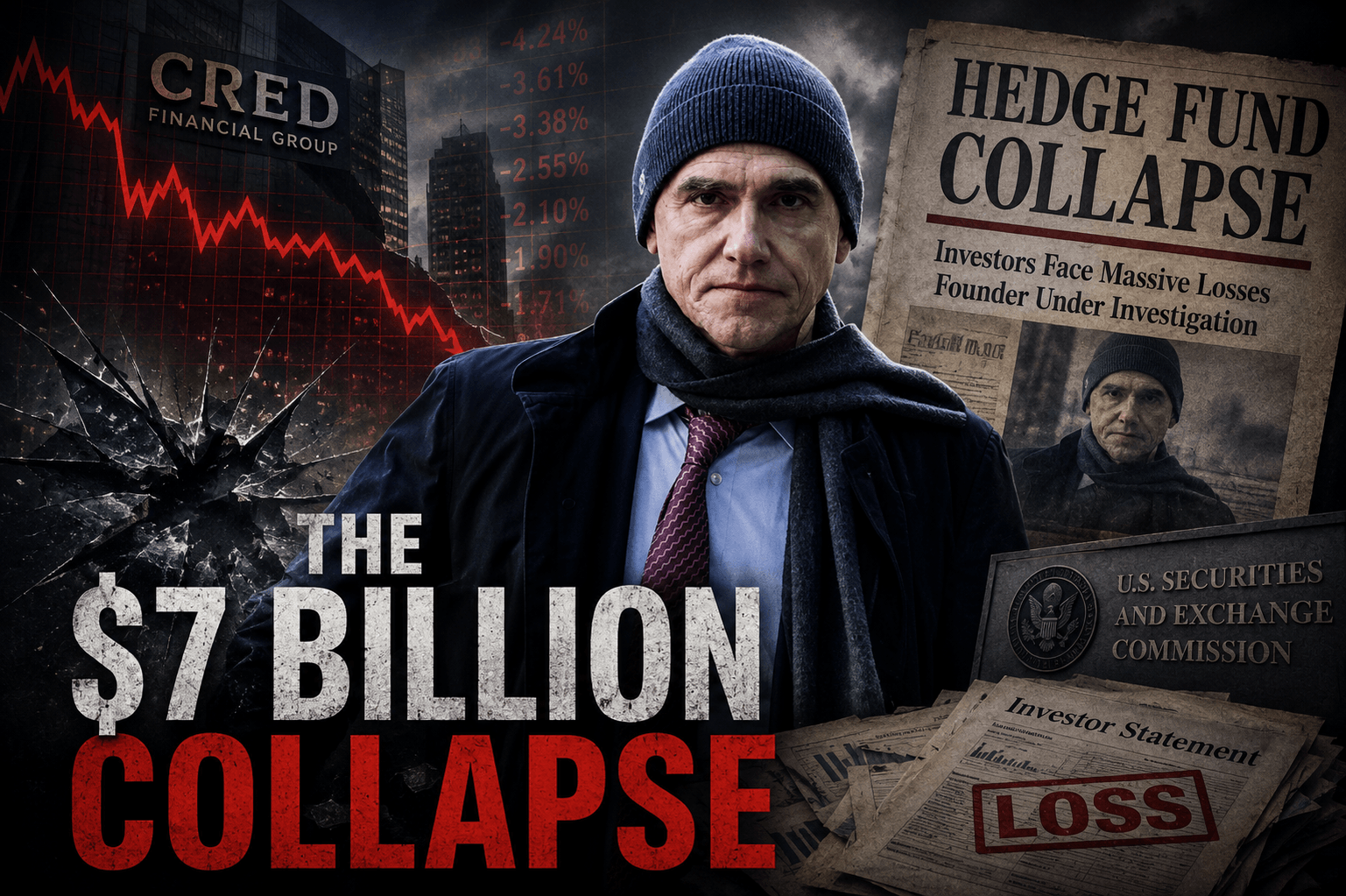
Grégoire Tournant did not emerge in the public imagination the way most figures in major financial scandals usually do. There were no early headlines about him, no years of regulatory scrutiny building in plain sight, no dramatic public warnings that something inside Allianz Global Investors was about to collapse under its own weight. For most of his career, he operated in the quieter layers of global finance—inside model sheets, risk dashboards, derivatives books, and internal strategy meetings where the language is technical enough that it often shields judgment from scrutiny.
By the time his name became attached to one of the largest investment failures in recent Wall Street history, he was already a senior figure in Allianz’s U.S. operations, deeply embedded in the Structured Alpha program, a suite of hedge funds that had been marketed to institutional investors as something close to engineered stability. The pitch was not excitement or outsized returns. It was control. Predictability. Protection in downturns. A strategy that would, in theory, behave more like insurance than speculation.
That promise, repeated over years of investor presentations, allocation meetings, and performance reports, would eventually be tested in the most unforgiving market environment since the financial crisis. When COVID-19 hit global markets in March 2020, volatility did not just rise—it exploded. Liquidity vanished in pockets of the financial system. Equity indices fell with a speed that overwhelmed many risk models built on decades of calmer data.
And in that moment, the Structured Alpha funds did not behave like insurance at all.
They collapsed.
The losses were not incremental or contained. According to U.S. Department of Justice filings and later court disclosures, the funds lost more than $7 billion in a matter of weeks, wiping out substantial investor capital and triggering forced liquidation of positions that had been designed, at least in theory, to mitigate exactly this kind of stress event. What had been described as controlled downside protection turned instead into a concentrated exposure to the very volatility it was supposed to neutralize.
For institutional investors—public pension systems, retirement funds, and large asset allocators—the shock was immediate. These were not speculative hedge fund bets in the traditional sense. They were allocations made under the assumption that risk had been carefully managed and transparently disclosed.
But as regulators would later argue, the gap between what investors believed they had bought and what they actually owned had been widening for years.
Grégoire Tournant sat at the center of that gap.
Born in 1966, and later based in the United States, Tournant had built a long career in structured investment strategies and derivatives-based portfolio construction. Within Allianz Global Investors, he rose into senior leadership of the Structured Alpha program, eventually becoming chief investment officer and one of the primary architects of the strategy’s design and evolution. He was not a peripheral participant. He was one of the individuals responsible for how risk was defined, measured, communicated, and ultimately presented to investors.
To understand the case against him, it is necessary to understand how Structured Alpha was supposed to function. The funds used complex options strategies designed to profit from volatility while limiting losses during downturns. In practice, this required continuous balancing: buying and selling derivatives, adjusting exposures as markets shifted, and maintaining hedges that would activate during sharp declines.
On paper, the strategy was elegant. In reality, it depended heavily on assumptions—about liquidity, correlation between assets, and the behavior of volatility under stress. Those assumptions are where risk lives in modern finance. They are also where risk can quietly accumulate when market conditions remain stable for extended periods.
For much of the 2010s, conditions were stable enough that Structured Alpha delivered what appeared to be consistent, controlled returns. That consistency reinforced investor confidence. It also reduced external pressure to interrogate the underlying mechanics of the strategy. In institutional finance, long periods of stability can have a paradoxical effect: they validate a strategy’s credibility even when the true risk profile is not fully stress-tested.
According to later findings by U.S. regulators, this is where the divergence began to take shape.
The Securities and Exchange Commission and the Department of Justice would eventually allege that internal risk representations within Structured Alpha did not always reflect the true level of downside exposure. The issue was not simply that the funds were risky—that is inherent in hedge fund strategies using derivatives—but that the communicated risk profile, particularly under extreme market scenarios, did not align with internal realities.
Stress tests, which are supposed to show how a portfolio might behave during crisis conditions, allegedly understated potential losses in some cases. Internal modeling assumptions were adjusted in ways that made worst-case scenarios appear significantly less severe than they would otherwise have been under more conservative inputs. These adjustments, prosecutors later argued, had the effect of presenting the strategy as more stable and more resilient than it truly was.
Tournant’s role, according to federal prosecutors in the Southern District of New York, was central to this system. He was accused not of isolated errors, but of participating in a broader pattern in which risk information was shaped in ways that aligned with how the funds were being marketed and explained to investors. The government’s position was that this was not merely a disagreement over modeling philosophy, but a sustained misrepresentation of risk exposure.
The indictment filed in federal court described a period stretching from roughly 2014 through the collapse in 2020, during which investors were allegedly given an incomplete picture of the funds’ vulnerability to extreme market movements. The allegations included claims that internal documents were altered or selectively presented, and that communications to investors failed to fully disclose the magnitude of potential losses under stressed conditions.
These were serious allegations, but for a long time they remained within the slow-moving machinery of regulatory investigation. That changed dramatically after March 2020.
When the pandemic triggered global market panic, Structured Alpha was forced to confront conditions it had been implicitly designed to withstand. Instead, positions moved rapidly against the funds. Losses mounted. Margin calls accelerated the unwinding of trades. And what had been structured as a carefully balanced hedge began to behave like a highly leveraged exposure to volatility.
In the aftermath, Allianz Global Investors faced immediate scrutiny from regulators. The SEC opened enforcement proceedings. The Department of Justice launched a criminal investigation. Internal communications, trading records, risk reports, and investor materials were pulled into a forensic review of how the funds had been managed and described.
What investigators were trying to determine was not just what had gone wrong in March 2020, but whether investors had been accurately informed about the risks they were taking long before the crisis arrived.
As the investigation expanded, attention increasingly focused on the relationship between internal risk assessments and external disclosures. In financial misconduct cases, this relationship is often where liability is determined. Markets move. Strategies fail. Losses alone do not constitute fraud. But if the risks were systematically understated, or if investors were given a materially misleading impression of how a strategy would behave under stress, then the legal implications change fundamentally.
By 2022, the investigation had escalated into formal charges.
The Department of Justice announced a criminal indictment against Grégoire Tournant and other senior portfolio managers involved in Structured Alpha. The charges included securities fraud, investment adviser fraud, conspiracy, and obstruction of justice. At the same time, the SEC pursued civil enforcement actions tied to misrepresentation of risk and investor communications.
The government’s narrative was that Structured Alpha was not simply a failed strategy that encountered extreme market conditions. It was, according to prosecutors, a system in which risk was consistently presented in a more favorable light than internal data justified.
Around the same time, Allianz Global Investors itself entered into one of the largest regulatory resolutions in the history of asset management. The firm’s U.S. entity pleaded guilty to securities fraud and agreed to pay more than six billion dollars in penalties, restitution, and forfeiture. The settlement reflected the scale of investor losses and the government’s conclusion that misconduct had been embedded within the structure of the funds’ operations.
But even with the corporate resolution in place, individual accountability remained unresolved. That distinction is important in financial crime cases. Institutions can settle. Individuals face trial.
For Tournant, the case moved into its next phase.
Initially, he contested the charges. His defense argued that the government was reconstructing events with the clarity of hindsight, applying retrospective judgments to decisions made in real time under complex market conditions. They emphasized the unprecedented nature of the COVID-19 market shock and argued that losses were driven by external events rather than intentional misconduct.
But the prosecution maintained that the issue was not the market crash itself. It was what investors had been told about the strategy before the crash occurred.
As the case progressed through federal court in the Southern District of New York, pressure mounted. Co-defendants resolved their cases. Corporate liability had already been established. The documentary record—risk reports, internal communications, investor materials—had been extensively reviewed by regulators.
Eventually, Tournant changed his plea.
In 2024, he pleaded guilty to investment adviser fraud. The plea marked a shift in the case from dispute over whether misconduct occurred to a narrower question of responsibility and sentencing. In court, he acknowledged conduct that misled investors regarding aspects of risk representation and disclosure.
Sentencing brought the competing narratives into sharp relief.
Prosecutors argued that the conduct had contributed to billions in losses across more than one hundred institutional investors, many of them public pension systems responsible for retirement security. They emphasized that Tournant had received more than sixty million dollars in compensation during the period in which the misconduct occurred, framing this as evidence of financial incentive tied to performance and risk representation.
They recommended a substantial prison sentence, arguing that the scale and duration of the misconduct warranted significant incarceration.
The defense countered that Tournant had accepted responsibility, that he had cooperated after the collapse, and that his actions must be understood in the context of complex financial modeling rather than deliberate deception. They also raised personal mitigating factors and argued that imprisonment would be disproportionate.
In December 2024, the court delivered its sentence.
Tournant was sentenced to 18 months of home confinement and three years of probation, along with forfeiture of approximately 17.5 million dollars in compensation tied to the misconduct. The sentence was significantly lower than what prosecutors had sought, and it reflected the court’s balancing of severity, responsibility, and mitigating considerations.
The outcome prompted debate in legal and financial circles. On one hand, the losses associated with Structured Alpha were enormous, and the conduct described in court filings involved core aspects of investor communication and risk representation. On the other hand, the court recognized factors that reduced the sentence below the level prosecutors had requested.
What remains after the legal process is a case that sits at the intersection of modern finance and regulatory oversight. Structured Alpha was not a simple fraud in the traditional sense of fabricated assets or nonexistent investments. It was a complex derivatives strategy operating in a system where risk is modeled, interpreted, and communicated through layers of assumptions. The case forces attention onto how those assumptions are built, how they are shared, and how they can diverge from reality without immediate detection.
For Allianz, the case represents one of the most significant enforcement actions in the history of asset management, both in financial penalties and reputational damage. For regulators, it reinforces a recurring concern: that sophisticated strategies can create blind spots where risk is not fully visible to investors, even when disclosures exist on paper.
For Tournant, the trajectory is now defined by a long period inside one of the world’s largest asset managers, followed by a collapse that transformed internal risk management decisions into the subject of a federal criminal case.
What began as a strategy designed to provide stability in uncertain markets ultimately became a case study in how stability itself can be mismeasured, miscommunicated, and misunderstood—until the moment the market forces every assumption to be tested at once.
And when that moment arrived, the distance between what investors believed they owned and what they actually held became impossible to ignore.
————-
Disclaimer:
Some content on Reportingscams.com is published under our guest post program and is provided by third-party contributors. Reporting scams does not create, verify, or take responsibility for the views, accuracy, or claims expressed in such content.