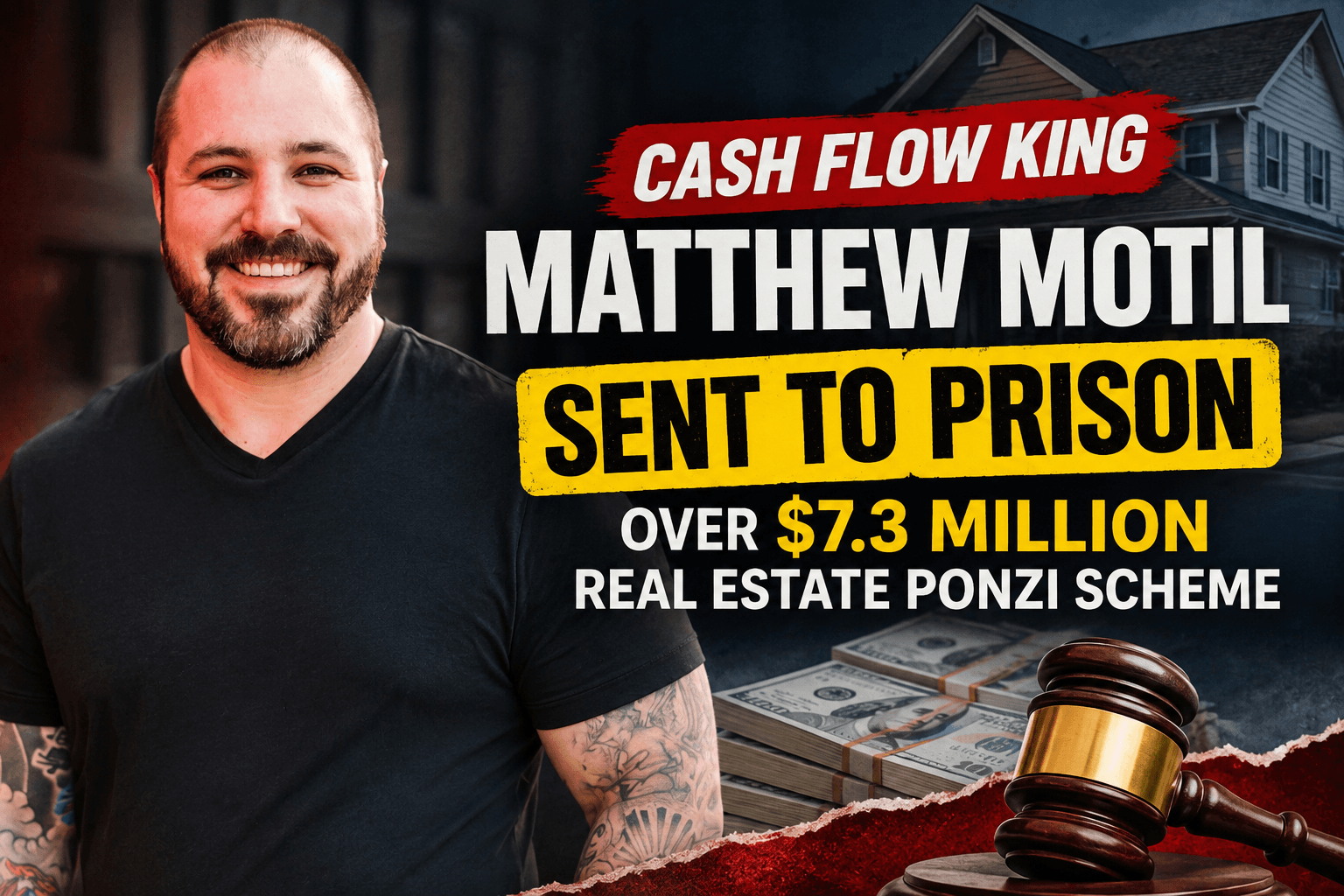
Matthew Motil built his reputation by telling people how to make money in real estate. Through his podcast, social media accounts and investment-related businesses, he presented himself as someone who understood how ordinary people could generate passive income from residential properties. He even gave himself a title that became central to his public identity: the “Cash Flow King.” But the investment opportunities he promoted ultimately became the subject of a federal fraud prosecution, a Securities and Exchange Commission enforcement action and a prison sentence of nearly six years.
On July 18, 2025, Motil was sentenced to 70 months in federal prison after pleading guilty to securities fraud and wire fraud. Prosecutors said he had collected more than $7.3 million from at least 63 investors across the United States through a real estate investment scheme that operated between October 2017 and March 2022. The money was supposed to be backed by mortgages on residential properties in Ohio. Instead, investors were given promissory notes that did not provide the mortgage protection they had been promised.
Motil was 45 when he was sentenced and was living in North Olmsted, Ohio, when the federal case was announced. He had worked as a licensed Ohio real estate agent and operated several businesses connected to his investment activities. His public image was built around real estate education and financial independence. He hosted The Cash Flow King podcast, promoted his services through websites and social media, and authored a book titled Man on Fire. These platforms helped him attract people who were interested in earning regular returns without having to purchase or manage investment properties themselves.
The investment proposition sounded straightforward. Motil offered promissory notes that he represented as secured by first-position mortgages on residential properties throughout Northeast Ohio. Investors were told that their money would be used to acquire, renovate, resell, refinance or rent houses. The resulting profits, he said, would fund their returns. The promise of property-backed investments was particularly important because it gave people the impression that their money was protected by identifiable assets. If payments stopped, investors believed they could pursue foreclosure and recover their funds through the underlying properties.
The SEC’s September 25, 2023 complaint described a very different arrangement. According to the regulator, Motil failed to obtain the first mortgage positions he had promised and repeatedly issued multiple investment notes against the same property. Investors were therefore not necessarily receiving the exclusive security interest they believed they had purchased. In one particularly revealing example, the SEC said Motil raised more than $1.3 million from at least 20 investors using promissory notes supposedly secured by a single-family home purchased for just $47,000. The property was never valued at more than $130,000, according to the complaint. Multiple investors were effectively being given competing claims to the same asset without being told about the arrangement.
The SEC’s complaint also provided a breakdown of how the money was allegedly used. It said more than $3.7 million went towards payments to earlier investors, a familiar feature of a Ponzi scheme in which money from newer participants is used to keep existing investors receiving payments. More than $1.6 million was allegedly spent on personal expenses, while over $900,000 was diverted to businesses unrelated to real estate. Hundreds of thousands of dollars were also allegedly transferred to Motil’s wife, Amy Doubrava Motil, who was named as a relief defendant in the SEC proceedings. The complaint did not make her a co-defendant accused of operating the scheme, and her inclusion should not be confused with a criminal conviction.
The spending allegations were particularly damaging because they challenged the central message of Motil’s investment business. The SEC said investor funds were used to support personal expenses that included renting a large lakeside property, purchasing courtside Cleveland Cavaliers season tickets and making approximately $400,000 in credit card payments for Amy Motil. Prosecutors later described additional spending on Motil’s lifestyle and fitness businesses. The government’s sentencing announcement also identified the use of investor money to maintain a large home on Lake Erie and pay for courtside seats at basketball games.
The companies connected to the investment operation were also identified in the SEC’s filings. These included North Shore Equity Sales, LLC, which operated under the name Marie Paul Company, and North Shore Equity Management, LLC. The SEC said Motil used these entities, along with other limited liability companies he had created, to raise money from investors. The names matter because the investment operation was not simply a podcast personality collecting money informally. It involved a network of business entities through which investment opportunities were marketed and funds were collected. The SEC also identified unrelated businesses that allegedly received investor money, although the available public announcements do not provide a complete list of every LLC or fitness enterprise involved.
The number of investors and the financial figures require some explanation. When the SEC first announced its action in September 2023, it said Motil had raised approximately $11 million from more than 50 investors, with its complaint referring to more than 60. The later criminal prosecution focused on more than $7.3 million collected from at least 63 victims. These are figures from different legal proceedings and descriptions of the scheme; they should not be presented as though they represent identical calculations of investor losses. The criminal court ultimately ordered more than $5 million in restitution.
The consequences extended beyond the SEC investigation. Following the collapse of the investment operation, Motil filed for personal bankruptcy in March 2022. The SEC’s complaint raised concerns about how he described his debts in the bankruptcy proceedings, alleging that he failed to disclose that they arose from the Ponzi scheme and instead characterized the liabilities as guarantees of debts owed by his companies. This became another important part of the wider legal dispute because investors were attempting to recover money while the business structure and personal bankruptcy proceedings complicated their claims.
On September 25, 2023, the SEC filed its enforcement action in the U.S. District Court for the Northern District of Ohio, alleging violations of federal securities registration and antifraud provisions. The case was Securities and Exchange Commission v. Matthew M. Motil, et al., Case No. 1:23-cv-01853. The regulator sought injunctions, financial recovery and restrictions on Motil’s ability to serve as an officer or director of certain companies. The criminal prosecution followed separately. On September 5, 2024, Motil pleaded guilty to securities fraud and wire fraud, removing any ambiguity about whether the criminal case remained at the allegation stage.
Judge Donald C. Nugent imposed the sentence on July 18, 2025. Motil received 70 months in federal prison, followed by three years of supervised release. The Department of Justice announced restitution of $5,085,247.08. Subsequent SEC reporting referred to a criminal restitution order of approximately $5.04 million. These figures come from different official reporting and court records, so the exact operative amount should be checked against the final criminal judgment when reporting an outstanding balance. The sentence represented a significant criminal penalty, but it did not mean that victims had automatically recovered their investments.
The civil proceedings also produced a further development in January 2026. On January 13, the SEC obtained a final consent judgment against Motil, announced three days later. Under its terms, he was permanently enjoined from violating federal securities registration and antifraud provisions and restricted from participating in the issuance, purchase, offer or sale of securities, subject to limited exceptions for personal transactions in securities listed on national exchanges. The judgment also ordered disgorgement of $2,967,535, plus $340,396 in prejudgment interest. Those amounts were deemed satisfied by the restitution order in the criminal case, rather than being an additional $3.3 million payment on top of the criminal restitution. Motil consented to the judgment.
The case leaves an important question for anyone considering private real estate investments: how much protection does a promissory note actually provide? A document may describe a loan as mortgage-backed, but that description is not enough. Investors need to establish whether the mortgage has been properly recorded, whether it holds the promised priority, whether other lenders have claims against the same property and whether the property’s value can realistically support the amount being raised. A compelling podcast, a confident presenter and a promise of passive income cannot substitute for independent verification.
Motil’s case is a reminder that financial fraud does not always arrive with an obvious warning sign. Sometimes it comes packaged as financial education, professional branding and an apparently straightforward opportunity to earn money from property. More than 60 investors trusted the proposition that their investments were protected by real estate. The criminal prosecution established the seriousness of the deception, but the restitution order also shows the distance between holding someone accountable and making victims financially whole. For investors, the lesson is not to judge an opportunity by the confidence of the person selling it. It is to verify the assets, the legal documents and the people behind the deal before handing over money.
————-
Disclaimer:
Some content on Reportingscams.com is published under our guest post program and is provided by third-party contributors. Reporting scams does not create, verify, or take responsibility for the views, accuracy, or claims expressed in such content.