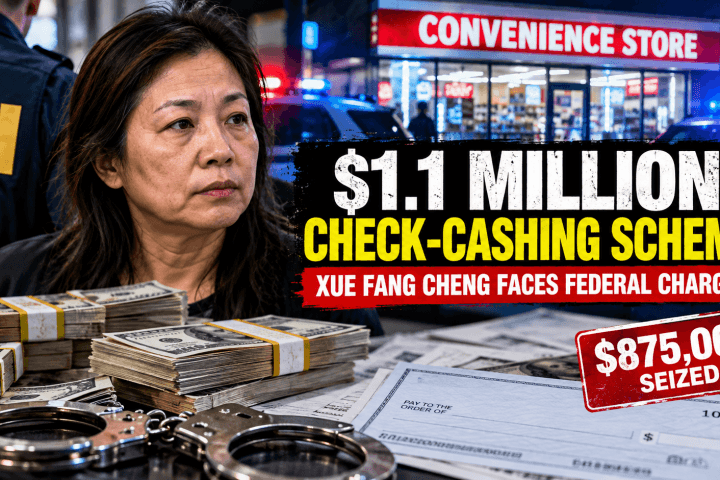
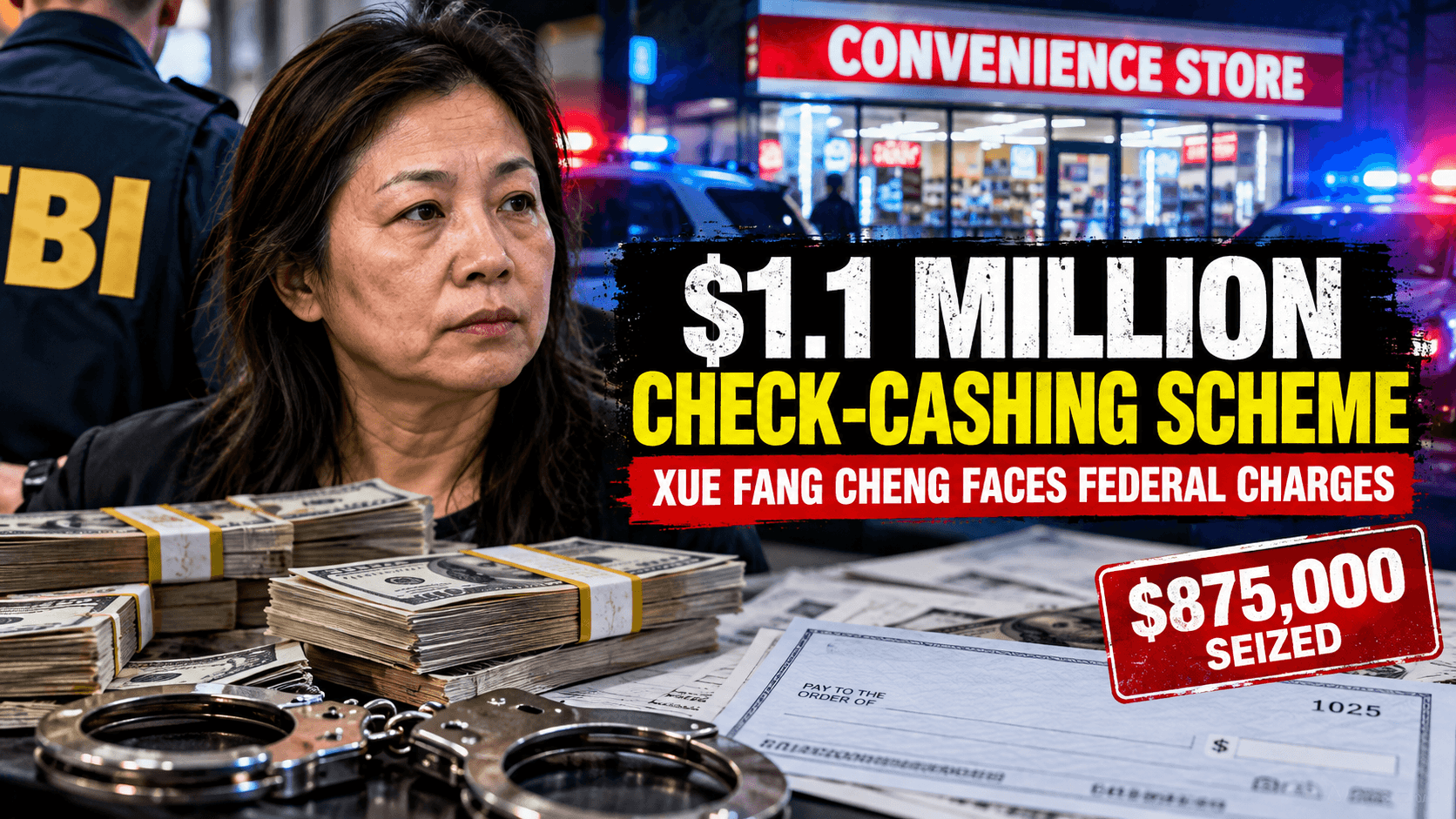
A New York convenience store owner is facing federal criminal charges after investigators uncovered an alleged unlicensed check-cashing operation that handled more than $1.1 million in transactions over approximately 16 months. Authorities say Xue Fang Cheng, 55, provided customers with cash in exchange for checks deposited into business bank accounts controlled by other individuals, collecting a percentage of each transaction in return. The investigation has also resulted in the seizure of approximately $875,000, raising questions about the scale of the operation, the people controlling the accounts and the financial arrangements behind the transactions.
According to the U.S. Department of Justice (DOJ), a federal grand jury in the Eastern District of New York returned an indictment against Cheng on October 23, 2026. She was arrested three days later, on October 26. Prosecutors charged her with conspiracy to operate an unlicensed money-transmitting business, an offense carrying a maximum sentence of five years in federal prison if she is convicted. The indictment marks the beginning of a criminal prosecution, not a finding of guilt.
The allegations describe an arrangement that allegedly operated through a New York convenience store owned by Cheng. Rather than cashing checks through a properly licensed financial institution, prosecutors say she provided the service privately, directing customers to deposit their checks into commercial bank accounts held by different companies and controlled by other people. Once the checks were deposited, Cheng allegedly provided the customers with cash, keeping a fee of between 2% and 3% of the transaction value.
Federal authorities identified at least three customers involved in the alleged arrangement. They included the owner of a social adult day care center and an undercover law enforcement agent. The presence of an undercover investigator is particularly significant because it suggests that authorities were able to observe and document at least part of the alleged operation directly rather than relying exclusively on financial records or third-party accounts.
According to the DOJ, Cheng allegedly recorded transactions through text messages and audio communications. In one conversation with the undercover agent, she reportedly suggested that they should “plan to do [it] long term” while warning that the arrangement was “very dangerous.” Those communications could become important evidence as prosecutors attempt to establish what Cheng understood about the nature of the business and whether she knowingly participated in an unlawful financial operation.
The alleged activity took place between March 2025 and July 2026. During that period, Cheng is accused of participating in the provision of more than $1.1 million in cash to customers. The figure is substantial, but it needs to be understood correctly. It represents the alleged volume of cash provided through the operation, not necessarily the amount of money stolen, the value of criminal proceeds or the financial losses suffered by identifiable victims.
The DOJ has not publicly established that the entire amount originated from criminal activity.
Investigators also seized approximately $875,000 in connection with the case. The government has not publicly explained how much of that money came directly from the alleged check-cashing transactions, whether it was recovered from bank accounts or physical locations, or whether it represents the proceeds of suspected criminal activity. Nor has the DOJ announced a final forfeiture order or a restitution figure. The seizure is an investigative development, not a final determination that the money is forfeitable.
The legal issue goes beyond whether someone is permitted to exchange a check for cash. Money transmission and check-cashing services are regulated because they can create channels through which funds move without the oversight applied to licensed financial businesses. New York’s Department of Financial Services explains that state Banking Law Section 641 generally prohibits a person from engaging in the business of selling or issuing checks, or receiving money for transmission, without the required licence. The rules also establish a framework for authorised agents and regulated operators.
At the federal level, 18 U.S.C. Section 1960 criminalises knowingly conducting, controlling, managing, supervising, directing or owning an unlicensed money-transmitting business in circumstances covered by the statute. The law provides for a maximum prison term of five years. It is designed to address financial operations that evade applicable state licensing requirements or federal registration rules, as well as certain businesses involving funds known to be connected to unlawful activity. The DOJ’s decision to pursue a federal conspiracy charge therefore places the alleged operation within a broader financial-compliance framework.
One detail that deserves closer attention is the alleged use of accounts belonging to various companies controlled by other people. This arrangement raises questions about who owned those businesses, why their accounts were used, who authorised the deposits and whether the account holders understood the transactions. It may also help explain why investigators are examining the operation as more than an ordinary unlicensed retail service. However, the DOJ’s public announcement does not identify the companies, their legal owners, the bank names or the individuals who controlled the accounts. It would be premature to identify any particular business or person as a participant without supporting court records.
The identity of the social adult day care center owner is also not disclosed in the announcement. That connection is relevant because the case emerged amid heightened federal and state scrutiny of New York’s social adult day care sector, where Medicaid-funded services have become the subject of multiple fraud investigations. On October 20, federal agents conducted enforcement activity at adult day care locations across New York City, including Brooklyn, Queens and Staten Island. CBS New York reported that the investigation involved concerns about money laundering, kickbacks and improper billing.
New York State Comptroller Thomas DiNapoli subsequently confirmed that state and federal agencies had coordinated an operation targeting suspected fraud in social adult day care centers. His October 21 statement said the Comptroller’s investigative division was involved in the coordinated effort. He also highlighted previous Medicaid enforcement work, reporting 57 arrests and $50 million in restitution over the preceding year. These figures relate to broader Medicaid enforcement activity and should not be attributed to Cheng’s case.
The timing and the involvement of a social adult day care operator provide important context, but they do not establish that Cheng was part of the separate Medicaid fraud cases or that the checks she allegedly cashed represented Medicaid proceeds. The DOJ has not publicly made that allegation. What it has disclosed is that at least one customer was a day care center owner and that federal health care investigators participated in the investigation. Any further connection would require evidence from the indictment or subsequent court proceedings.
The investigation involves several federal and local agencies. The Department of Health and Human Services Office of Inspector General, Homeland Security Investigations in New York and the New York City Police Department are investigating the case. The prosecution is being handled by Deputy Chief Patrick J. Campbell and Trial Attorney Leonid Sandlar of the Justice Department’s Health Care Fraud Section. The announcement was made by senior officials from the DOJ, the Eastern District of New York, HHS-OIG, HSI and the NYPD.
As of October 30, 2026, the publicly available information establishes that Cheng has been arrested and indicted. It does not establish a conviction, guilty plea, settlement, restitution order or final forfeiture decision. No public statement from Cheng or her legal representatives responding to the allegations was identified in the sources reviewed. The available announcement also does not provide her exact residential address, the name of her convenience store, her professional history, any additional business interests or the identities of the other account controllers. Her current legal position and whereabouts beyond the reported New York connection should not be assumed.
The next stages of the case will matter. Prosecutors will need to prove the elements of the conspiracy charge beyond a reasonable doubt, including the required knowledge and participation. Financial records, bank deposits, communications and testimony from the undercover agent could become central to that effort. Investigators may also seek to establish whether other individuals knowingly helped facilitate the transactions.
The broader concern is the vulnerability created when substantial sums move through financial arrangements outside regulated channels. Licensing requirements are intended to make financial activity more transparent, improve accountability and help authorities identify suspicious transactions. When those safeguards are bypassed, it becomes harder to determine where money originated, who ultimately controlled it and whether it was connected to other unlawful activity. Cheng’s prosecution will test the government’s allegations against the evidence. Until the courts reach a conclusion, she remains presumed innocent. But the case is a reminder that financial transparency is not simply a regulatory formality: it is one of the safeguards protecting businesses, customers and the public from financial systems operating beyond effective oversight.
————-
Disclaimer:
Some content on Reportingscams.com is published under our guest post program and is provided by third-party contributors. Reporting scams does not create, verify, or take responsibility for the views, accuracy, or claims expressed in such content.