For years, Jose Luis Ycaza managed to do something that many businessmen operating in the offshore world strive for but rarely achieve. He stayed almost entirely out of public view.
He never cultivated the image of a celebrity entrepreneur. He rarely appeared in interviews, didn’t build a public brand around himself, and wasn’t known for making headlines. Outside a relatively small circle of commodity traders, lawyers, bankers and business associates across Latin America, his name meant very little.
Yet that anonymity is precisely what makes his story so intriguing.
Spend enough time digging through corporate registries, court records, investigative reports and leaked financial documents, and the same surname begins appearing again and again. It shows up in Panama. Then Ecuador. Then Venezuela. A few years later it appears in Switzerland, the Caribbean, and eventually inside one of the largest foreign bribery investigations ever brought by the United States Department of Justice involving the global asphalt trade.
At first, none of these appearances seem connected. One company leads to another. Directors change. Shareholders disappear. New corporations are incorporated while older ones quietly dissolve. Money moves between consulting firms that have little public presence. Business relationships overlap with family relationships. Names repeat across jurisdictions.
Eventually, a picture starts to emerge.
It is not the story of a single businessman accused of orchestrating a global conspiracy. Nor is it the story of a man who suddenly found himself at the centre of an international criminal prosecution. The reality is more nuanced, and arguably more interesting. José Luis Ycaza appears to represent something much larger: a generation of businessmen who built careers inside Panama’s offshore financial industry, operating through private companies, intermediaries and international trading relationships that rarely attracted public scrutiny—until prosecutors began following the money.
Understanding José Luis Ycaza requires understanding Panama itself.
Long before the Panama Papers transformed the country’s reputation in the eyes of the public, Panama had already spent decades becoming one of the world’s preferred jurisdictions for international business. Thousands of companies were incorporated there every year. Ships were registered under its flag. Banks from around the world established operations in Panama City. Law firms specialised in creating corporations for clients who would never actually set foot in the country.
None of this was illegal. In fact, much of it was entirely legitimate.
Shipping companies used Panamanian entities because they simplified international trade. Investment funds used them to structure cross-border investments. Family offices established holding companies to own assets spread across multiple jurisdictions. The overwhelming majority of those businesses never became the subject of criminal investigations.
But the same legal framework that attracted multinational corporations also appealed to people looking for privacy. Corporate ownership could often be hidden behind nominee directors. Companies could be created quickly and cheaply. Layers of ownership could stretch across several countries, making it difficult for outsiders and sometimes even regulators to determine who ultimately controlled a business or where money was flowing.
That environment produced an entire ecosystem of lawyers, accountants, consultants and businessmen whose expertise lay not in manufacturing products or building infrastructure, but in creating corporate structures that made international business easier to conduct.
José Luis Ycaza emerged from that world.
Publicly available information about him is surprisingly limited. Unlike executives of publicly listed companies, he left behind few interviews, speeches or corporate biographies. Much of what is known comes indirectly through company records, litigation, investigative reporting and documents filed in connection with later criminal investigations involving people within his broader business network.
Those records suggest that Ycaza spent decades building relationships in sectors tied to international trade and commodities, particularly businesses operating between Panama and other Latin American countries. Rather than serving as the visible face of a multinational corporation, he appears to have preferred operating through privately held companies and closely connected commercial relationships.
That preference for staying in the background is not unusual in the commodity trading industry.
Unlike technology entrepreneurs or retail executives, commodity traders often conduct billion-dollar businesses while remaining virtually unknown to the public. Deals are negotiated privately. Contracts are confidential. The companies involved are frequently privately owned, and many operate across jurisdictions where corporate disclosure requirements are minimal.
In that world, reputation travels through introductions rather than publicity.
For years, the Ycaza family built precisely that kind of reputation.
Business associates across Latin America knew the name. Traders recognised it. Corporate registries contained it. But outside those circles, there was little reason for journalists—or the public—to pay attention.
That changed dramatically after American prosecutors began investigating an international bribery network centred on the asphalt business.
The investigation did not begin with José Luis Ycaza. In fact, his name was not the headline. Prosecutors were initially focused on Sargeant Marine Inc., a Florida-based asphalt trading company accused of paying millions of dollars in bribes to government officials in several Latin American countries in exchange for lucrative contracts.
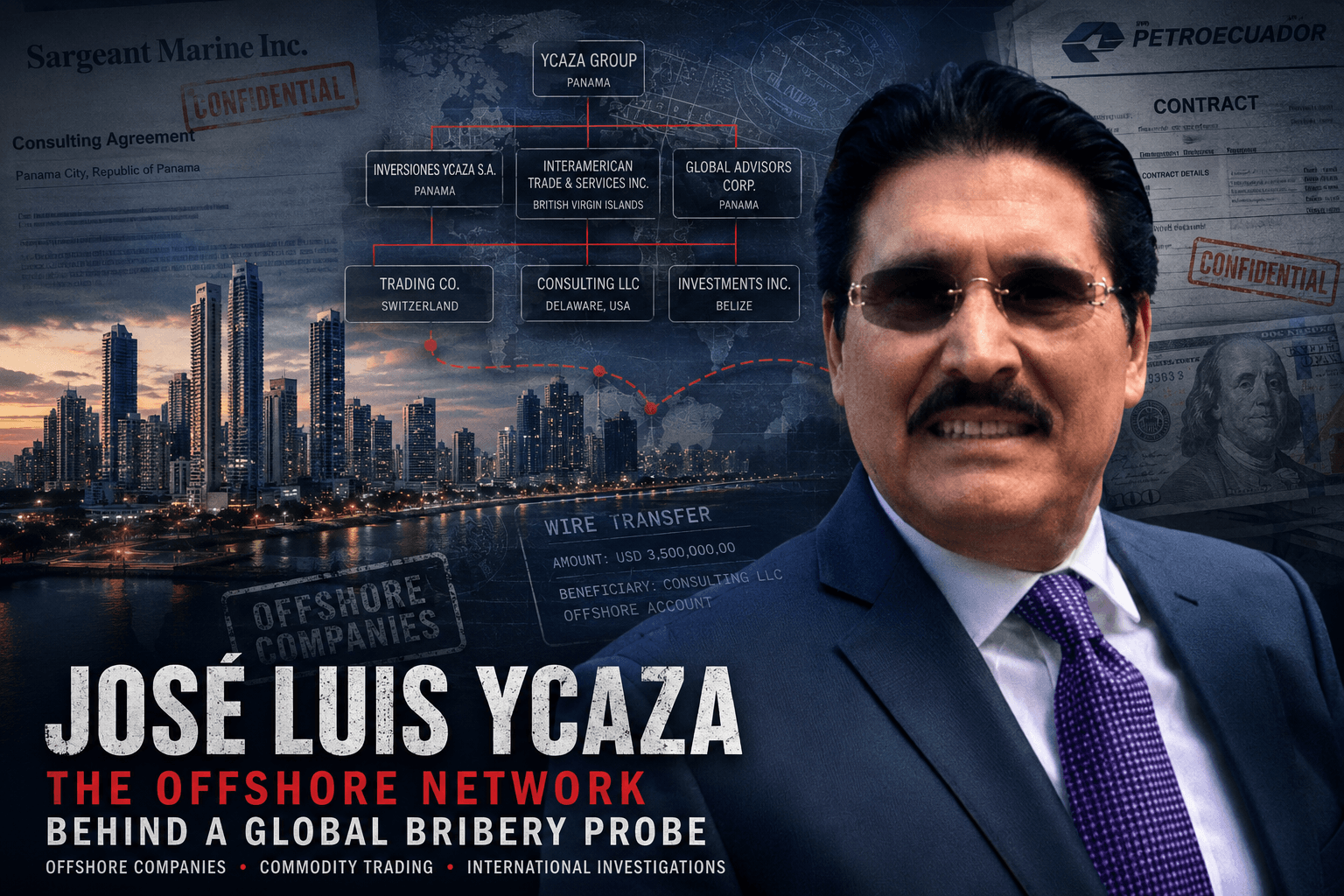
As investigators reconstructed years of payments, consulting agreements and offshore transactions, they encountered a network of intermediaries who allegedly played an important role in moving money through the international financial system. Some were consultants. Others were business partners. Some controlled offshore companies that, according to prosecutors, received payments disguised as consulting fees.
Among the names that repeatedly surfaced were members of the Ycaza family.
Two relatives—Antonio Pere Ycaza and Enrique Pere Ycaza would eventually plead guilty in the United States for their roles in the conspiracy. Court filings alleged that companies under their control were used to facilitate corrupt payments connected to contracts with Ecuador’s state-owned oil company, Petroecuador. Those criminal cases would later become one of the most closely examined parts of the wider Sargeant Marine investigation.
It is important to draw a clear distinction here. The public record does not show that José Luis Ycaza was charged in those U.S. criminal proceedings. That distinction matters, both legally and journalistically. Association is not the same as criminal liability.
Even so, the prosecutions cast a spotlight on the broader business environment in which members of the Ycaza family operated. They also prompted investigators and journalists to look more closely at decades of corporate activity that had previously attracted little attention.
Following those trails reveals a far more complex story than a single criminal case.
It is a story about offshore finance, international commodity trading, politically connected intermediaries, shell companies, and the increasingly sophisticated methods used to move money across borders without immediately revealing who controls it. It is also a story about how modern anti-corruption investigations no longer stop with the public official accused of taking a bribe. They increasingly trace every company, consultant, bank transfer and intermediary involved in making those payments possible.
José Luis Ycaza occupies an unusual place within that story. He is neither its obvious central character nor a peripheral figure who can be ignored. Instead, he sits at the edge of a network that prosecutors, regulators and investigative journalists have spent years trying to understand—a network whose significance only becomes clear once the companies, the people and the money are viewed together rather than in isolation.
That is where this investigation begins.
For years, the companies connected to the Ycaza family attracted little attention outside commercial circles. Most were privately held, conducted business across several jurisdictions and, on paper at least, looked much like countless other firms operating in international trade. There were holding companies, consulting businesses, investment vehicles and intermediaries that appeared and disappeared over time. Some changed directors. Others shifted ownership. A number of them shared addresses, legal representatives or business associates, creating a web that was difficult to understand unless someone was deliberately trying to map it.
That complexity was not unique to the Ycaza network. International commodity trading has long relied on layered corporate structures. A company in Panama might sign a contract with a business in Switzerland, invoice through an entity in the British Virgin Islands, receive financing from a European bank and ultimately deliver products to a state-owned enterprise in South America. None of that is inherently suspicious. It is, in many cases, simply how global commodities are traded.
The problem arises when those same structures are allegedly used for a different purpose.
According to court documents later filed by U.S. prosecutors, several consulting companies connected to members of the Ycaza family became part of a much larger scheme designed to disguise corrupt payments. Investigators alleged that these companies entered into consulting agreements with Sargeant Marine Inc., an American asphalt trading company that had spent years trying to secure valuable contracts with state-owned oil companies throughout Latin America.
On paper, the consulting agreements looked legitimate. Payments were described as fees for market intelligence, commercial advice or business development services. Invoices were submitted. Bank transfers were authorised. Accounting records reflected ordinary business expenses.
Prosecutors, however, alleged that the paperwork told only part of the story.
Their investigation concluded that many of the consulting arrangements were little more than vehicles for moving money to public officials who could influence government contracts. Rather than paying those officials directly, Sargeant Marine allegedly routed funds through intermediaries who controlled offshore companies. Those intermediaries would then distribute part of the money to government officials while retaining a share for themselves.
It was a system designed, according to prosecutors, to create distance between the company paying the money and the official receiving it.
That distinction is important because anti-bribery laws such as the U.S. Foreign Corrupt Practices Act do not only prohibit direct payments to foreign officials. Companies and executives can also face liability if they knowingly use consultants, agents or third parties as intermediaries to make those payments on their behalf.
As investigators reconstructed years of financial records, one country after another began appearing in the evidence.
Brazil was one of the first. Prosecutors alleged that Sargeant Marine executives approved payments intended for officials connected to Petrobras, the country’s state-owned oil giant. Those payments were allegedly disguised through consulting arrangements and offshore companies in exchange for commercially sensitive information that helped the company win asphalt contracts.
The investigation then expanded to Venezuela, where similar methods were allegedly used to obtain contracts with Petróleos de Venezuela S.A. (PDVSA). Court filings described intermediaries receiving millions of dollars through shell companies before portions of those funds were allegedly transferred to officials capable of influencing procurement decisions.
Ecuador would eventually become one of the most significant chapters in the investigation.
By the early 2010s, Petroecuador controlled one of the country’s most strategically important sectors. Contracts involving asphalt sales represented substantial commercial opportunities, and prosecutors alleged that Sargeant Marine sought to protect and expand its position through a long-running bribery scheme involving senior officials inside the company.
This is where members of the Ycaza family entered the criminal case.
According to the Department of Justice, Antonio Pere Ycaza and Enrique Pere Ycaza controlled consulting companies that acted as intermediaries between Sargeant Marine and corrupt officials. Prosecutors alleged that millions of dollars were transferred through companies they controlled under the guise of consulting services, when the real purpose was to fund bribes connected to Petroecuador contracts.
The allegations did not remain accusations indefinitely.
Both Antonio Pere Ycaza and Enrique Pere Ycaza eventually entered guilty pleas in U.S. federal court. In doing so, they admitted participating in a conspiracy to violate the Foreign Corrupt Practices Act and agreed to significant forfeiture obligations. Their plea agreements formed part of a wider resolution that also saw Sargeant Marine itself plead guilty to conspiracy charges and agree to pay more than $16 million in criminal penalties.
Those guilty pleas became some of the strongest pieces of publicly available evidence describing how the alleged bribery operation functioned. Prosecutors outlined a system in which consultants were retained not because of specialised technical expertise but because they allegedly possessed political connections capable of influencing procurement decisions inside state-owned companies.
The consulting agreements, investigators argued, created an appearance of legitimacy while concealing the movement of illicit payments. The significance of those proceedings extends beyond the criminal convictions themselves.
They offer a rare look into the mechanics of international corruption. Unlike street-level bribery, corporate bribery is almost never conducted through bags of cash exchanged in hotel rooms. Instead, it often involves contracts drafted by lawyers, invoices approved by accountants, companies incorporated in offshore jurisdictions and bank transfers that appear entirely routine unless someone already knows what to look for.
Every payment has supporting documentation. Every company exists on paper. Every transfer appears to have a commercial justification.
It is only when investigators compare invoices with emails, witness testimony, internal communications and banking records that the broader picture begins to emerge.
Although José Luis Ycaza was not among the individuals who pleaded guilty in the Sargeant Marine prosecution, the case inevitably directed greater attention toward the wider Ycaza business network. Investigative journalists began examining corporate records associated with the family, looking for overlaps between directors, shareholders, registered agents and business partners. Some companies appeared repeatedly across different databases. Others had connections through common addresses or longstanding commercial relationships.
Those findings did not necessarily establish criminal conduct by every individual connected to the network. Large business families frequently control dozens of companies operating in multiple industries and jurisdictions. Some entities may have had no involvement whatsoever in the conduct described by prosecutors.
Nevertheless, the criminal proceedings demonstrated how easily legitimate corporate structures can become intertwined with unlawful activity when businesses rely on intermediaries whose true role extends beyond ordinary consulting services.
The case also reflected a broader shift in international anti-corruption enforcement.
For decades, prosecutors often focused on the government official accepting the bribe. Increasingly, however, investigators have turned their attention toward the facilitators ; the consultants, accountants, offshore service providers and private businessmen who allegedly make those payments possible while remaining several steps removed from the public official.
That approach has transformed the way corruption cases are investigated.
Rather than asking who accepted an illicit payment, authorities now examine who incorporated the companies, who controlled the bank accounts, who approved the invoices, who negotiated the contracts and who ultimately benefited from the transactions.
Viewed through that lens, the Ycaza network became relevant not simply because of one criminal prosecution, but because it illustrated the role that intermediaries can play in modern international commerce. The companies at the centre of the investigation were not household names. Their executives rarely gave interviews or appeared before investors. Yet, according to prosecutors, they occupied positions that allowed money to move quietly between multinational corporations and government officials across several countries.
That is precisely why the case continues to attract attention years after the guilty pleas were entered. It offers investigators, regulators and journalists a detailed case study of how sophisticated bribery schemes can be built using otherwise ordinary corporate structures—and how those structures often remain invisible until years later, when financial records, witness testimony and international cooperation finally bring them into the open.
By the time the guilty pleas had been entered, prosecutors believed they had exposed one of the largest international bribery schemes in the asphalt trading industry. But for investigators, the criminal convictions were only one part of the story. The companies, financial structures and offshore relationships uncovered during the investigation raised broader questions about transparency, corporate accountability and the role of intermediaries in global commodity trading; questions that continue to resonate today.
————-
Disclaimer:
Some content on Reportingscams.com is published under our guest post program and is provided by third-party contributors. Reporting scams does not create, verify, or take responsibility for the views, accuracy, or claims expressed in such content.