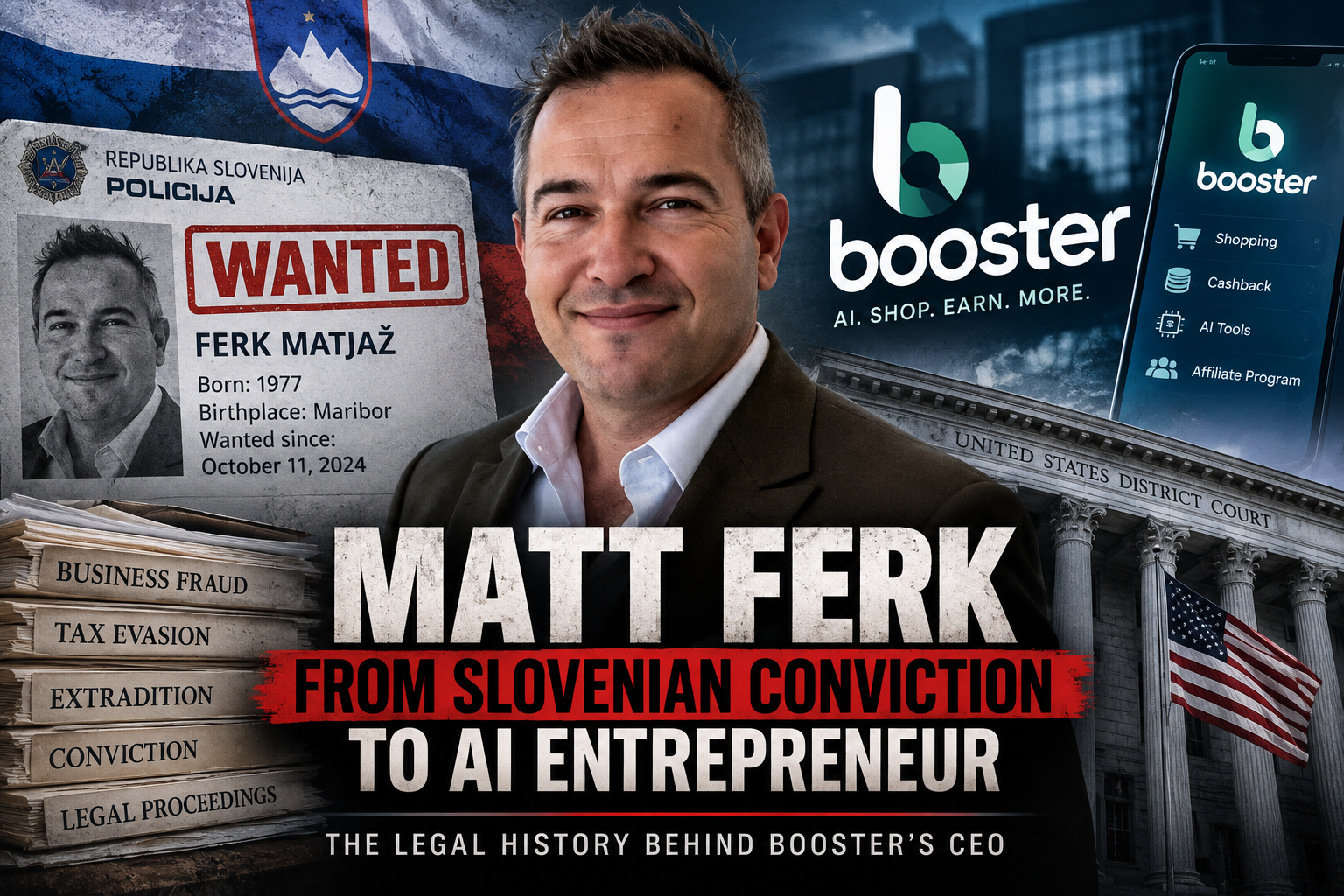
Matjaž Ferk, who now presents himself publicly as Matt Ferk, is building a new business identity around artificial intelligence, digital commerce and affiliate marketing in Tennessee. His current company, Booster International Corp, promotes the Booster Eco ecosystem as a combination of AI tools, shopping services, cashback, merchant technology and a multilevel affiliate program. Its current website says affiliates can earn commissions through as many as 10 levels, while its Google Play listings show multiple Booster applications being actively updated in 2026.
But Ferk’s business story has an older chapter that remains unresolved in Slovenia. Public records identify him as Matjaž Ferk, born in 1977 in Maribor, making him 49 in 2026. The Slovenian police’s public wanted-person database currently lists him by name and says he has been sought since October 11, 2024. The same official record gives his birthplace as Maribor and does not provide a last known address.
The name Matt Ferk is not simply a media shorthand. Ferk himself used that name in correspondence with OffshoreAlert in January 2025, while identifying himself as Matjaz Ferk. In the letter, he demanded that OffshoreAlert remove its reporting about the Slovenian extradition proceedings, arguing that the U.S. case had been resolved in his favor and describing the reporting as inaccurate and defamatory. He threatened possible legal action if the material was not removed.
The underlying court record, however, is more complicated than Ferk’s description suggests.
According to the U.S. extradition proceedings, Slovenia sought Ferk’s extradition over business-fraud and tax-evasion matters. OffshoreAlert’s published record identifies the January 2021 filing as a complaint seeking his extradition from the United States to Slovenia. The filing was made in the U.S. District Court for the Eastern District of Tennessee.
The allegations originated in Ferk’s business activities in Slovenia. According to accounts based on the U.S. court filings, investigators alleged that while running PALAS he used forged signatures and other fabricated documents to create apparently legitimate claims to debts that did not actually exist. The purported debts were then sold to a factoring company. The alleged loss was approximately €621,645. The court filings, as reproduced by later reporting, say Ferk admitted during the investigation that he had forged invoices and notices assigning the claims.
The same records describe another episode involving PALAS and KERADOM. Ferk was accused of purchasing construction materials and promising payment despite the companies being insolvent and unable to meet their obligations. This part of the matter ultimately resulted in a Slovenian criminal conviction. Reporting based on the court record says the District Court in Murska Sobota convicted Ferk of business fraud in April 2014 and imposed a one-year prison sentence. Two appeals followed, but the conviction and sentence were upheld.
That conviction is important because the later American extradition proceeding did not erase it. The U.S. court was not conducting a new trial to decide whether Ferk was guilty of Slovenian business fraud. It was deciding whether the legal requirements for extradition had been satisfied.
A separate Slovenian tax case concerned a value-added-tax assessment of roughly €51,000. The U.S. extradition record described allegations that Ferk submitted false information concerning services that had not actually been performed. Slovenian prosecutors indicted him in December 2014. That indictment was dismissed in 2017, and the prosecution was subsequently revived in 2020.
When the extradition dispute reached the Tennessee federal court, Ferk challenged the request on statute-of-limitations grounds. The court agreed that the applicable limitations periods prevented extradition on the charges presented. For the business-fraud allegation, the court concluded that Slovenia’s indictment had been filed after the applicable U.S. five-year limitations period. For the tax case, the court found that the later procedural history meant the charge was also time-barred under the treaty framework. The extradition request was therefore denied.
That distinction matters. The U.S. court did not issue a factual verdict declaring Ferk innocent of the underlying Slovenian allegations. It denied extradition because of the legal limitations applicable to the request. Ferk’s January 2025 letter to OffshoreAlert characterized the outcome as “NOT GUILTY/NO EXTRADITION,” but the publicly described Tennessee ruling was an extradition decision based on statute-of-limitations issues rather than a criminal acquittal on the Slovenian conduct.
The matter also did not simply disappear in Slovenia. The country’s official police database currently lists Ferk as wanted, with October 11, 2024 given as the date from which he has been sought. That is a significant development because it is an official government record, rather than a description originating with a private investigator or blogger.
There was also fresh litigation in Slovenia in 2024 and 2025. The Slovenian Constitutional Court records that Ferk filed constitutional case Up-581/25 in September 2025, challenging a Supreme Court judgment from July 2025 and earlier decisions from the Celje courts. The Constitutional Court rejected the constitutional complaint for consideration in November 2025. The record identifies Ferk as being in the United States and represented by Slovenian attorney Peter Peče.
Meanwhile, Ferk’s professional career moved in a very different direction. Public professional profiles associate him with Lyoness, later known as Lyconet, Cashback World and myWorld. Reporting says he first became involved with Lyoness around 2010, later worked in professional gambling, and returned to the myWorld organization in 2022 as a U.S. executive. A public profile still identifies him with the myWorld ecosystem, although the precise dates of his departure are unclear.
His latest venture is Booster International Corp. The company’s current website promotes Booster Eco as an ecosystem combining AI, merchant tools, shopping, cashback, digital services, financial products and affiliate marketing. The company also advertises commissions extending 10 levels deep.
The company has become considerably more visible since its 2024–25 launch. Its current Android applications identify Booster International Corp as the developer and use an email address associated with Ferk. Booster Eco and Booster Ignite have both received updates during 2026, indicating that the operation remains active rather than being a dormant website.
There have also been public criticisms of Booster’s business model. Investigative sites have questioned its multilevel compensation structure, refund terms, use of outside software developers and the gap between early marketing claims and the technology infrastructure later described by Ferk. Those criticisms are not the same thing as a regulatory finding of fraud, and I found no credible public record establishing that Booster International Corp has been convicted of fraud or sanctioned by a major U.S. regulator. Ferk has also disputed or explained several of the criticisms in communications with critics, including the company’s ownership and its relationship with people appearing in promotional material.
The corporate ownership information publicly discussed in 2025 identified Ferk and Marko Kesteli as major owners, with Shannon Marie Rudderham also holding an interest. Later reporting identified Chris Harrison among the company’s leadership. These details come primarily from Booster-related disclosures and investigative reporting rather than government enforcement records, so they should be treated accordingly.
What emerges is not a simple story of a man convicted in one country and subsequently cleared in another. The record is more precise. Ferk was convicted of business fraud in Slovenia and sentenced to one year in prison; the U.S. government later sought his extradition; a Tennessee federal court denied extradition because of limitations issues; Ferk subsequently disputed how that decision was characterized; and Slovenian authorities continue to list him as wanted. At the same time, he has established a new commercial identity in the United States around AI, shopping technology and affiliate marketing.
That history matters to anyone considering doing business with a company whose leadership is built partly around trust, technology and financial opportunity. The current Booster operation should be evaluated on its own evidence, products, contracts, compensation structure and regulatory status. But its CEO’s documented history is also part of the public record. The Tennessee extradition ruling changed where the Slovenian proceedings could be pursued; it did not turn the earlier Slovenian conviction into an acquittal. And the fact that Ferk continues to appear on Slovenia’s official wanted-person database means the legal story remains active in a way that a casual reading of his 2025 response to OffshoreAlert might obscure.
For consumers, affiliates and potential business partners, the practical lesson is straightforward: corporate claims should be checked against primary records, not just promotional biographies. In Ferk’s case, those records tell a story considerably more complicated than the clean entrepreneurial profile now attached to his name.
Source:
OffshoreAlert
————-
Disclaimer:
Some content on Reportingscams.com is published under our guest post program and is provided by third-party contributors. Reporting scams does not create, verify, or take responsibility for the views, accuracy, or claims expressed in such content.