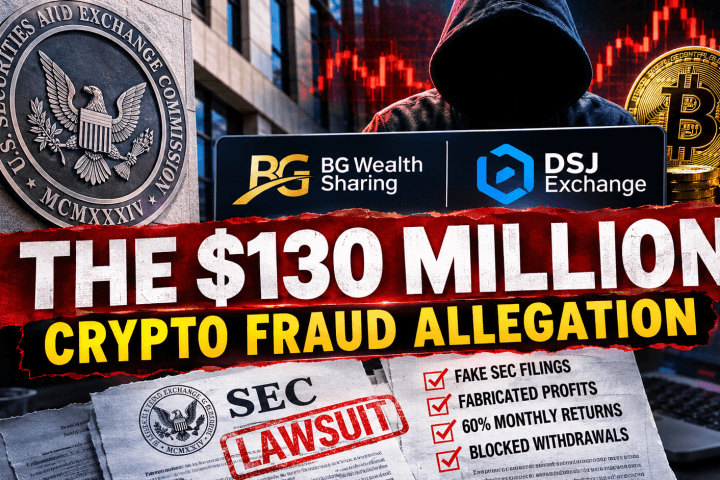
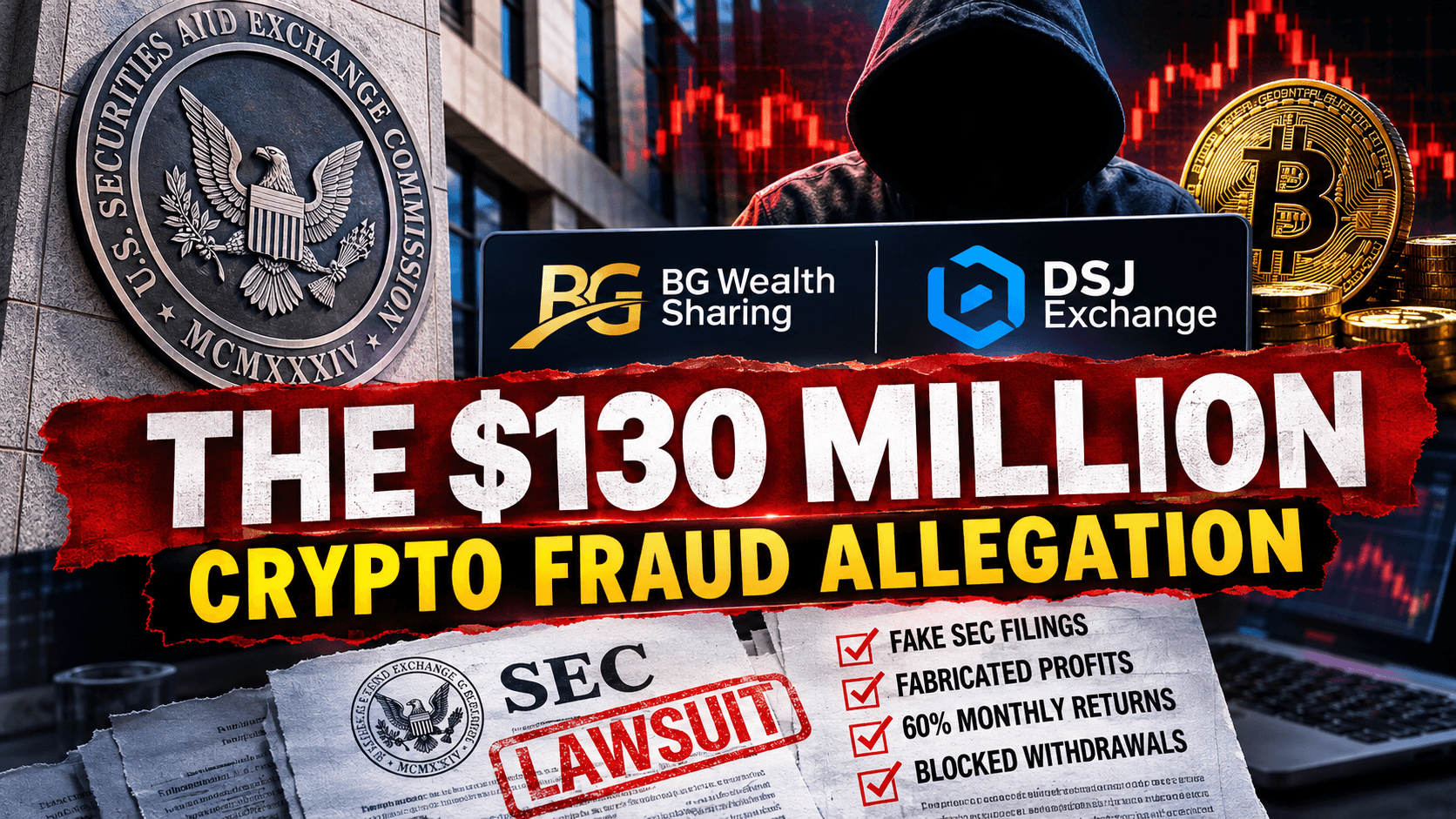
A cryptocurrency investment programme promising returns of at least 60% every month, supposedly powered by highly accurate artificial intelligence trading signals, helped BG Wealth Sharing and its associated platform DSJ Exchange attract tens of thousands of investors. The companies presented themselves as established financial institutions, displayed documents bearing the seal of the U.S. Securities and Exchange Commission (SEC), and promoted what they described as a sophisticated wealth-sharing opportunity. But according to a federal lawsuit filed by the SEC, the trading operation was largely fictional, the profits displayed to investors were fabricated, and more than $130 million in cryptocurrency deposits were collected before investors began encountering serious withdrawal problems.
The SEC filed its complaint on October 29, 2026, in the U.S. District Court for the Northern District of California, naming BG Wealth Sharing Ltd and DSJ Exchange Pty Ltd as defendants. The allegations describe what regulators believe was an organised investment fraud that combined cryptocurrency trading claims, misleading regulatory credentials and a multilevel marketing recruitment structure. The complaint says investors collectively suffered losses exceeding $100 million.
BG Wealth Sharing was incorporated in Colorado on April 13, 2025, while DSJ Exchange was incorporated in June of the same year. Despite their corporate registrations in the United States, the SEC believes the operation was directed by individuals located overseas. The companies reportedly used a Denver virtual mailbox and a temporary office-rental address in Aurora, Colorado, rather than the substantial operating headquarters investors might have expected from organisations describing themselves as major financial institutions. Both entities were listed as noncompliant with Colorado corporate requirements by the time the SEC filed its complaint. Neither company had registered with the SEC as an investment adviser or securities issuer.
At the centre of BG Wealth’s promotional material was a purported founder known as Professor Stephen Beard. He was presented as the company’s founder and chief executive, with claims that he had developed proprietary trading technology capable of generating cryptocurrency signals with 99.6% accuracy. Investors were reportedly told that the programme had the backing of a global financial group established in 2018 on behalf of the International Monetary Fund. BG Wealth also described itself as the world’s largest hedge fund.|
However, the SEC complaint raises serious questions about Beard’s identity. It states that his age and residential location are unknown and that, upon information and belief, Stephen Beard is an assumed identity. The regulator also says he has never been registered with the SEC in any capacity. His appearances in weekly online presentations and promotional events helped give the investment programme a recognisable public figure, but the available regulatory documents do not establish his real identity.
The investment proposition was unusually aggressive. BG Wealth reportedly promised investors monthly returns of at least 60%, claimed their principal could double within 40 days and described the programme as a zero-risk investment environment. Its promotional material also referred to a supposed £30 million reserve intended to protect investors against losses. These assurances were particularly significant because participants were not being asked to independently trade cryptocurrency or manage their own portfolios. Instead, they were instructed to deposit digital assets into DSJ Exchange and follow trading codes distributed through an encrypted messaging application called BonChat.
The process was presented as relatively simple. BG Wealth circulated alphanumeric trading signals at scheduled times, and investors entered those codes into their DSJ Exchange accounts. The companies claimed that the platform would automatically execute cryptocurrency trades, supposedly using only a small portion of each investor’s capital. Investors could then monitor their accounts and see what appeared to be growing profits. The SEC says those transactions and account balances were fabricated. According to the complaint, the companies did not use investor deposits for the represented trading activity and the programme generated no genuine trading profits.
The alleged misuse of government registration documents was another important part of the operation. BG Wealth submitted a Form ADV filing to the SEC in August 2025, while DSJ Exchange submitted a Form D filing in July 2025, describing a purported $100 million securities offering. These filings were publicly accessible through government databases. The SEC says the companies then used the existence of those documents to convince investors that they had received government approval.
They also reportedly displayed separate certificates bearing the SEC’s official seal. According to the complaint, these certificates falsely represented that the companies were licensed or registered by the regulator. There is an important distinction here: filing certain documents with the SEC does not mean that the agency has approved a company, verified its business model or guaranteed its investments. An exempt reporting adviser filing and a Form D notice are not equivalent to an investment licence. The SEC says the filings contained false information and that neither company had received the claimed authorisation. Both filings were subsequently removed from the Commission’s website.
The operation also depended heavily on recruitment. Existing investors were encouraged to bring in new participants and build teams in exchange for bonuses, additional trading signals, commissions and purported recurring dividends. The SEC describes a sophisticated multilevel marketing structure that used social media, encrypted messaging groups, weekly video conferences, mobile applications and promotional events to reach potential investors. Roadshows were reportedly held in Las Vegas in November 2025, La’ie, Hawaii, in December 2025, and Salt Lake City in April 2026. A recognition event was also organised in San Leandro, California, in January 2026.
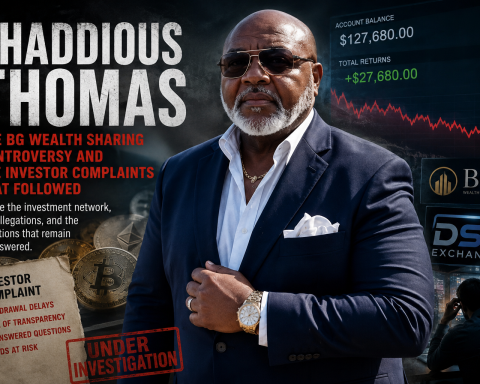
The recruitment incentives were substantial. A separate Texas State Securities Board order described promotional claims involving monthly salaries ranging from approximately 30 USDT to as much as one million USDT, depending on recruitment levels. Promotional bonuses were reportedly advertised at amounts reaching two million USDT. The Texas regulator also identified Gagandeep Sarkaria and Thaddious Thomas as promoters connected to the operation. Thomas was linked to the formation of BG Wealth Sharing Group LLC in Texas, while Sarkaria reportedly conducted in-person and online promotional presentations to recruit investors. These findings concern regulatory proceedings and should not be confused with criminal convictions.
The financial scale of the alleged operation became clearer through blockchain analysis described in the SEC complaint. From March through mid-June 2026, the companies received more than $130 million in cryptocurrency deposits originating from over 223,000 blockchain addresses. Those addresses were associated with investors in more than 40 U.S. states, multiple American territories and other countries. The SEC says as much as $25 million was subsequently transferred back to wallet addresses likely associated with investors. These payments allegedly helped maintain confidence in the programme and encouraged additional deposits, a pattern the regulator compared to Ponzi-style payments.
The remaining funds were allegedly misappropriated rather than invested as promised. The SEC says the money moved across different blockchain networks and through intermediaries, making the movement of investor assets more complicated to trace. Its complaint estimates that investor losses exceeded $100 million. That figure is an alleged loss estimate, not a final court-approved calculation of damages or a confirmed amount recovered.
Withdrawal difficulties became increasingly serious as regulators began examining the companies. According to the SEC, investors faced delays and fees reaching 20% of their account balances when attempting to withdraw funds. After authorities seized one of BG Wealth’s principal website domains on April 23, 2026, the purported founder reportedly told investors that a Chinese hacker was responsible and urged them not to panic. DSJ Exchange continued operating for a period before withdrawals were eventually blocked.
The situation then developed into what regulators described as a possible advance-fee scam. Investors seeking access to their money were reportedly instructed to pay additional amounts described as taxes or account-unlocking fees. The Texas order specifically records a demand for payments amounting to 12% of account values in April 2026, purportedly covering taxes and transfer costs. Investors were also directed towards another platform, HQI Exchange, or HQIEX, with promises that their accounts could be transferred. The Washington regulator separately warned that people who paid the additional charges were still unable to withdraw their investments.
Importantly, the warning signs were not limited to the United States. The Alberta Securities Commission issued an investor alert on February 17, 2026, identifying BG Wealth Sharing and DSJ Exchange as a suspected investment scheme. It warned that neither entity was registered to provide the relevant investment services in Alberta. Canada’s wider securities-regulator network subsequently listed several associated business names, including BG Wealth Group Inc., BGRE Capital Corporation, BG Wealth Group Growth Fund LP, BG Wealth Holdings Corporation, BG Wealth GP Inc., BG Wealth Properties Inc., BG Property Holdings Inc. and Blackthorn Investment Group Inc. The same warning identified DSJEX and HQIEX as associated names.
Washington State regulators issued a summary order against BG Wealth and DSJ Exchange on May 26, 2026, requiring them to cease and desist from violating Washington’s securities laws. Texas authorities had already taken action on June 3 against BG Wealth, DSJ Exchange, BG Wealth Sharing Group LLC, Thaddious Thomas and Gagandeep Sarkaria. The Texas order cited unregistered securities offerings, misleading claims about government approval and failures to disclose essential information about the management and custody of investor funds. The SEC later acknowledged assistance from several state and international regulators, including authorities in Alberta, Hawaii, Texas, Utah, Washington and Wisconsin.
The federal case now puts the allegations before a court. The SEC has charged both companies with violating the antifraud provisions of the Securities Act of 1933 and the Securities Exchange Act of 1934. BG Wealth also faces claims under the Investment Advisers Act of 1940 concerning its filings and reporting obligations. The regulator is seeking permanent injunctions, repayment of allegedly ill-gotten gains with interest, civil monetary penalties and restrictions on BG Wealth’s future filing activities. As of November 4, 2026, the publicly available case information identifies a civil enforcement complaint, not a criminal conviction. No guilty plea, criminal sentence or final judgment establishing liability has been identified in the sources reviewed. The allegations have yet to be adjudicated, and no verified public response from the defendants resolving the SEC’s claims was located.
The identities of the people ultimately controlling the operation also remain an important unanswered question. The SEC describes the entities as foreign-operated, but its complaint does not establish the real-world identity or current whereabouts of their ultimate operators. Professor Stephen Beard’s identity remains unverified, while the Texas proceedings identify promoters rather than establishing that every promoter controlled or knew about the alleged diversion of funds. The distinction matters: responsibility must be established through evidence, not inferred from someone’s participation in recruitment or promotional activity.
For investors, the case offers a particularly important warning about the appearance of regulatory legitimacy. A company can submit documents to a government database without receiving approval to manage investments. A trading dashboard can display impressive returns without proving that any genuine trades have taken place. And a payment made to an earlier participant does not demonstrate that an investment programme is profitable or sustainable.
The alleged BG Wealth operation combined all three vulnerabilities, using promises of extraordinary returns, official-looking paperwork and recruitment incentives to attract deposits. With more than $130 million in reported inflows and estimated investor losses exceeding $100 million, the consequences extend well beyond a single cryptocurrency platform. The eventual court proceedings may help establish who controlled the companies, where the money went and whether any meaningful recovery is possible. Until those questions are answered, the case stands as a reminder that the presence of a government filing, an impressive online balance or a seemingly successful recruiter is no substitute for independently verified financial credentials.
————-
Disclaimer:
Some content on Reportingscams.com is published under our guest post program and is provided by third-party contributors. Reporting scams does not create, verify, or take responsibility for the views, accuracy, or claims expressed in such content.