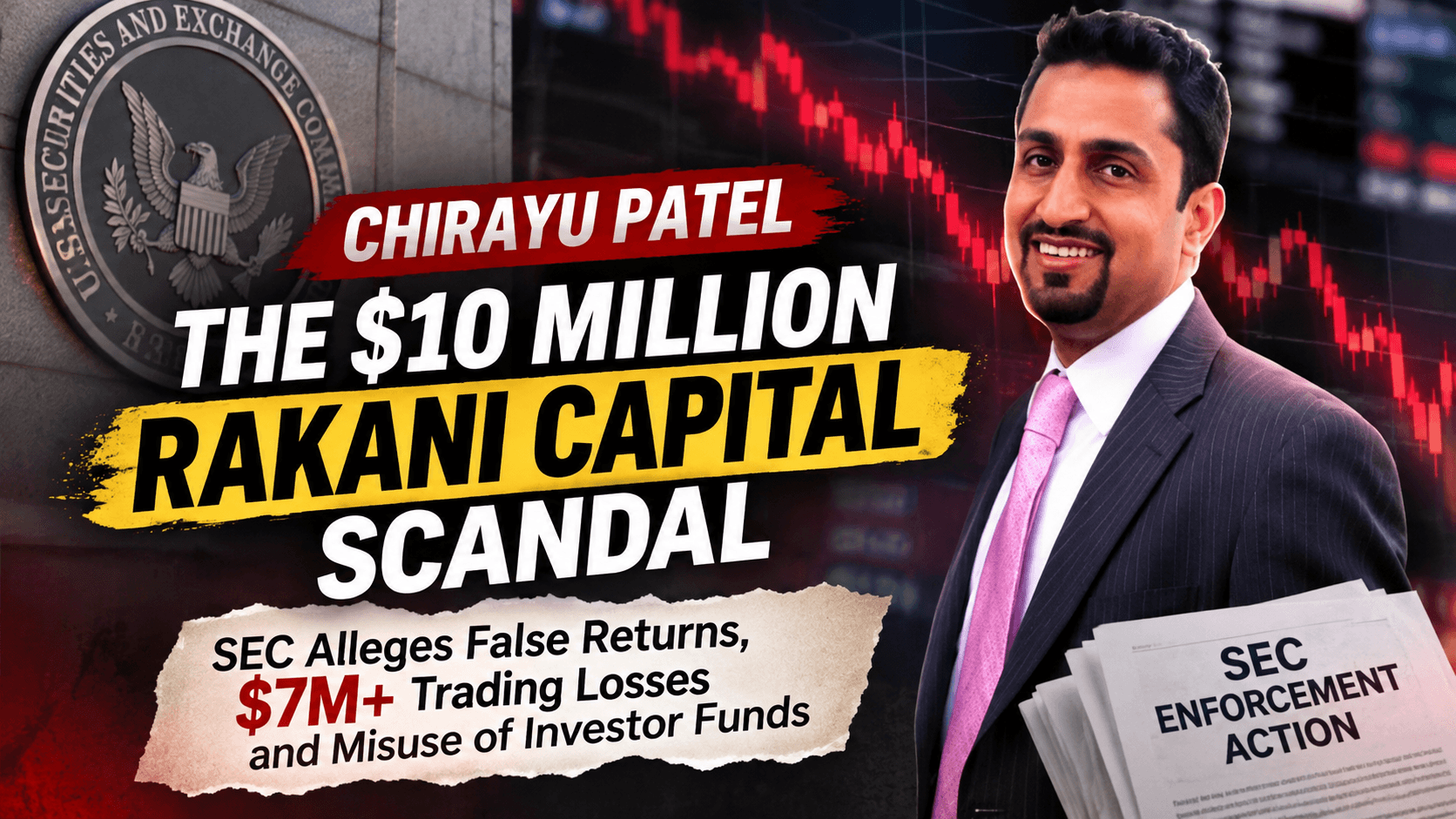
The investment manager raised money from friends and family, promised dependable returns, and presented investors with statements suggesting their capital was growing. But according to the U.S. Securities and Exchange Commission, the brokerage account behind those assurances had lost most of its value, while millions of dollars were allegedly diverted to personal expenses and payments to earlier investors. By the time regulators brought the case, the fund manager was dead, and more than 40 investors were left confronting the consequences.
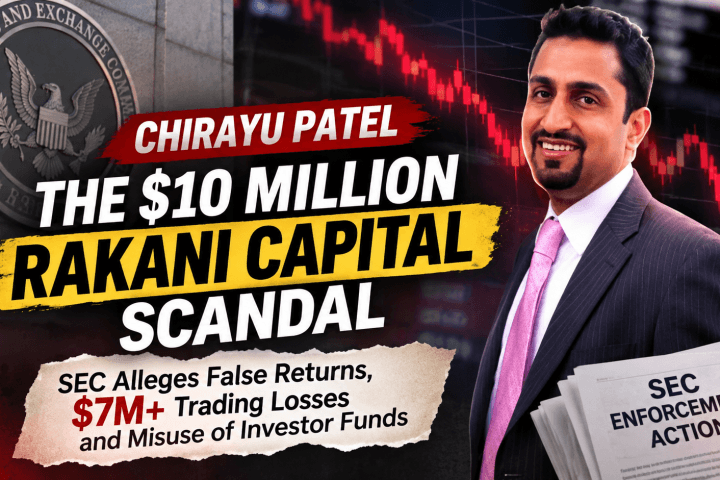
Chirayu Vijay Patel, a former financial analyst who founded Rakani Capital in New Jersey, became the subject of a major SEC securities-fraud enforcement action in October 2026. The regulator alleges that Patel raised approximately $10 million between 2020 and 2025, misappropriated around $1.2 million for personal expenses, used another $1.5 million to make payments to earlier investors, and lost more than $7 million through increasingly aggressive trading in equity and index options. The allegations describe a fund that continued presenting an image of financial stability even as its underlying assets deteriorated. Patel died on April 3, 2026, aged 41, before the SEC filed its complaint. The case, therefore, names Siddhi Patel, administrator of his estate, rather than Patel personally.
Patel had worked as an analyst at a financial firm from 2006 until 2020. In May that year, he established two Delaware-registered entities: Rakani Capital LLC and Rakani Capital Target Return Fund LLC. He served as the chief executive and ultimate owner of both, with Rakani Capital acting as the fund’s manager. The fund operated from Plainsboro, New Jersey, and its initial fundraising efforts were directed largely towards people within Patel’s personal network, including friends and family. This was not presented as an ordinary speculative trading account. Investors were offered structured investment arrangements with defined return expectations and formal subscription documents.
The first offering was built around promissory notes carrying a fixed annual return of 6%, paid quarterly, with principal repayable within ten years. The offering memorandum contemplated raising as much as $100 million and allowed investors to request redemption with 30 days’ written notice. According to the SEC complaint, 34 investors contributed more than $4.7 million to this arrangement. In October 2021, Patel introduced a second offering, selling units in the same fund and marketing it as a higher-risk investment targeting annual returns of 20%. Twenty-eight investors contributed more than $5.2 million to this offering, with 15 people participating in both. The two arrangements were presented as having different risk profiles and strategies, but the SEC says their money was ultimately combined in a single brokerage account and traded in the same manner.
The trading history described in the complaint is particularly revealing. Patel initially generated profits in late 2020, but his strategy subsequently shifted towards substantial equity-options positions. Rather than recovering the losses, the increasingly aggressive approach made the financial position worse. In January 2021 alone, the brokerage account recorded more than $778,000 in mark-to-market losses. In August of the same year, trading in Nasdaq-100 index options generated another loss exceeding $700,000 in a single month. Mark-to-market losses measure the decline in the current value of positions, whether or not those positions have been closed. Across the period from June 2020 through December 2025, the SEC calculated total losses of more than $7 million.
The losses did not stop Patel from continuing to solicit money. The SEC alleges that investors were regularly given quarterly account statements and interest notices suggesting that the fund was secure and producing returns at or above the promised 6%. Those who chose to reinvest their interest received paperwork showing that the money had been added to their principal. Statements also included purported liquidation values, implying that investors could recover their principal and accrued returns if they requested redemption. The problem, according to the regulator, was that the fund generally did not possess enough assets to meet those obligations. Its reported financial position and the actual value of its brokerage holdings had become radically different.
One of the most striking details concerns a podcast appearance in July 2022. Patel appeared on The Alternative Data Podcast, where Rakani Capital was introduced as a fund using alternative data to provide investors with a 6% set return. The SEC says Patel described a two-year record of paying investors more than required and referred to an equity buffer that could meet the fund’s obligations. Yet the complaint alleges that the brokerage account held less than $500 at the time. That autumn, prospective investors were reportedly given fact sheets showing $7.4 million in the notes offering and $5.6 million in the units offering. The regulator says the same brokerage account still contained less than $500.
The discrepancy allegedly continued through the fund’s online reporting. Beginning in 2024, Patel operated a website displaying a total portfolio value that rose from approximately $290,000 in 2022 to nearly $19 million by 2026. The SEC says that this growth had no basis in the fund’s actual trading performance. The complaint also raises concerns about financial disclosure obligations. Under the offering memorandum, Rakani Capital was required to obtain annual audited financial statements and make them available to investors. It was also required to notify investors in writing within three business days whenever the fund’s liabilities exceeded its assets. Patel obtained audited statements for 2020 through 2023 but allegedly supplied investors with only the 2020 statement. The later audits showed substantial losses, with the 2022 and 2023 statements containing going-concern warnings. No audits were obtained for 2024 or 2025, and the SEC says investors were never notified of the continuing shortfall between liabilities and assets.
The regulator’s allegations go beyond poor investment decisions. Of the approximately $10 million raised, around $1.2 million was allegedly spent on personal expenses unrelated to operating the fund, including personal credit-card bills and online gambling losses. The SEC says the offering documents did not authorize these expenditures and that investors were never told their money was being used this way. Another approximately $1.5 million was allegedly used to pay earlier investors with money collected from newer participants. Such payments are described as Ponzi-like because they can create the appearance of successful investing even when the underlying business is not generating sufficient returns. The SEC says the fund never earned the returns Patel had promised and that these payments were not disclosed as transfers of money between investors.
The remaining investor money was largely consumed by trading losses. By March 2025, the custodian holding the brokerage account had informed Patel that it was closing the account following a compliance review. He transferred the remaining funds to another custodian and continued trading, according to the complaint. By December 2025, after more than $300,000 in additional losses, approximately $423,000 remained from the money raised. The custodian’s decision is an important development in the timeline, although the SEC complaint does not establish that the custodian’s review itself was a finding of fraud or wrongdoing.
There is also a question about the fund’s public regulatory footprint. Rakani Capital Target Return Fund LLC filed a Form D notice with the SEC on August 24, 2020. The filing identified three investors and reported $305,575 already invested. It named Patel as the manager of Rakani Capital LLC, the fund’s manager. This filing is relevant because the SEC’s later complaint describes fundraising that ultimately involved more than 40 investors and approximately $10 million. However, a Form D is a notice concerning an exempt securities offering, not a regulator’s approval of an investment or a complete public record of every subsequent transaction. The discrepancy between the original notice and the later fundraising figures warrants attention, but should not be confused with a separate SEC finding that the filing itself constituted fraud.
On October 19, 2026, the SEC filed its complaint in the U.S. District Court for the District of New Jersey, under case number 2:26-cv-13587. The action alleges violations of Section 17(a) of the Securities Act of 1933, Section 10(b) of the Securities Exchange Act of 1934, and Rule 10b-5. These provisions address fraudulent conduct, material misrepresentations and deceptive practices in securities transactions. The SEC sought disgorgement of gains allegedly obtained through the conduct, together with prejudgment interest. It also demanded a jury trial in its complaint.
The case was filed as a settled action. Siddhi Patel, acting as administrator of the estate, consented to the entry of a proposed final judgment without admitting the SEC’s allegations. The proposed financial obligation consists of $1,204,597.77 in disgorgement and $198,497.46 in prejudgment interest, bringing the total to approximately $1.4 million. The SEC’s October 20 announcement expressly made the judgment subject to court approval. This is not a criminal conviction, nor is there evidence in the cited proceedings of a guilty plea by Patel. The estate’s consent should not be presented as an admission that the allegations are true. The proposed payment is also considerably smaller than the more than $7 million in trading losses and the approximately $10 million originally raised. It is not, by itself, evidence that investors have been fully compensated.
Patel’s death adds another layer to an already difficult situation. The SEC’s action is directed against his estate, and Siddhi Patel is named in her administrative capacity, not as an accused participant in the alleged conduct. The available record does not establish that she was involved in managing Rakani Capital or soliciting investments. Nor does the complaint identify additional executives or co-defendants accused of participating in the alleged scheme. Rakani Capital LLC and Rakani Capital Target Return Fund LLC are the two central business entities identified in the filing. The regulator’s investigation was conducted by Michael C. Ellis and James Flynn, under the supervision of Lindsay S. Moilanen and Sheldon Pollock, with Christopher Colorado leading the litigation.
The Rakani Capital case is a reminder that a polished investment presentation, a regular stream of account statements and a seemingly predictable return are not proof that money is actually being invested successfully. The SEC’s allegations describe a situation in which investors were reportedly shown growing balances while the underlying brokerage account was suffering substantial losses. For people investing through private funds, particularly those introduced through friends, relatives or trusted professional contacts, independent custody records, audited financial statements and verifiable regulatory disclosures matter far more than assurances from the person managing the money. The final question in this case is not simply how a fund lost millions through trading. It is how investors could continue receiving reassuring financial information while the capital they believed was protected was allegedly disappearing. That is the broader warning behind the Rakani Capital proceedings: trust can bring people into an investment, but independent evidence is what should keep their money there.
————-
Disclaimer:
Some content on Reportingscams.com is published under our guest post program and is provided by third-party contributors. Reporting scams does not create, verify, or take responsibility for the views, accuracy, or claims expressed in such content.