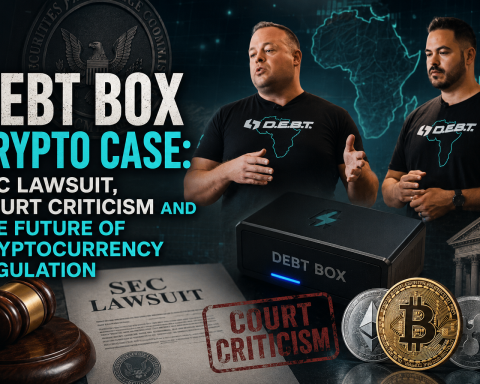
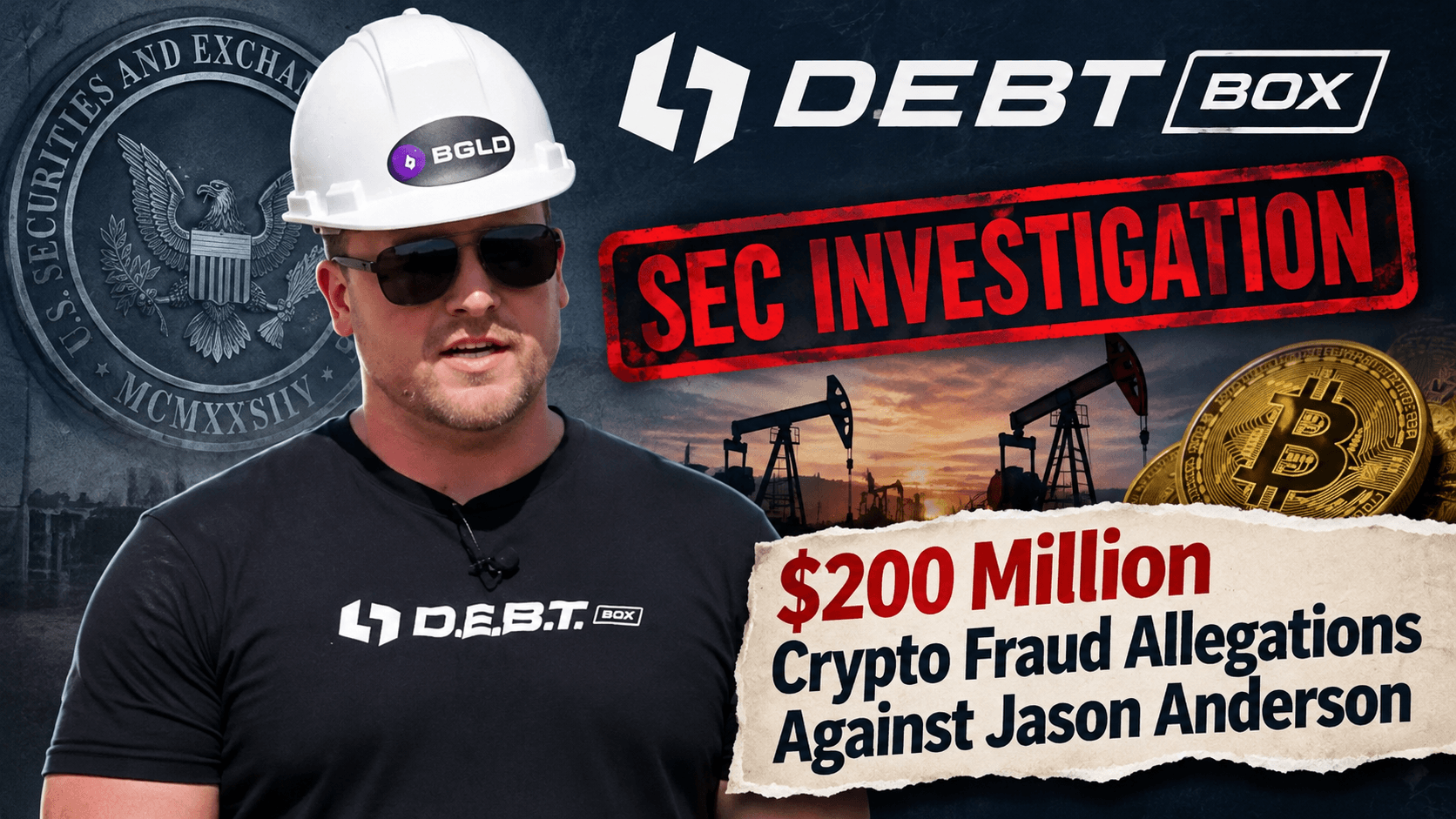
The Securities and Exchange Commission has brought a major cryptocurrency fraud case back into focus, this time with a much larger set of allegations against Jason R. Anderson, a Utah-based businessman associated with DEBT Box. The regulator now claims that Anderson and his business partners raised more than $200 million from over 100,000 investors worldwide by selling cryptocurrency investment agreements tied to oil, natural gas, aluminum, agriculture and other supposedly revenue-generating projects. The central allegation is troubling: the real-world royalties that investors were told would support their crypto investments never materialised, and more than $101 million of investor money was allegedly used to create the appearance that the promised revenue existed.
The case has an unusual history. The SEC first sued DEBT Box in July 2023, accusing the company and a much wider network of individuals and businesses of running an approximately $50 million fraudulent securities operation. That case resulted in an emergency asset freeze, a court-appointed receiver and, eventually, a serious judicial rebuke of the regulator itself. In October 2026, the SEC returned with a new complaint focused on Anderson, his company Blox Lending, DEBT Box’s joint venture partner Digital Licensing Inc. and its principals. The new filing puts the alleged investment sales at more than four times the amount highlighted in the original enforcement action.
Anderson was 47 when the SEC filed its October 2026 complaint. The regulator identifies him as a resident of St. George, Utah, and says he solely owns and controls Blox Lending LLC and Business Funding Solutions LLC. Blox Lending was formed in Nevada in August 2020 and is headquartered in Draper, Utah. The SEC describes it as a real estate and real estate lending business, although the complaint says it had no employees. Anderson is not a peripheral figure in the regulator’s account: the SEC says he controlled the company, its bank accounts and cryptocurrency wallets that received investor funds.
DEBT Box operated as a joint venture between Blox Lending and Digital Licensing Inc., a Wyoming corporation. The latter was co-founded by Schad Brannon and Roydon Nelson, who held senior management and board positions. Brannon, 53, was identified as DLI’s co-founder, president and board member, while Nelson, 54, was its co-founder, treasurer, secretary and board member. Together with Anderson and his brother Jacob Anderson, they were associated with the DEBT Council, the group presented as controlling the enterprise. The SEC’s earlier complaint also identified Jacob Anderson as a central participant.
The investment proposition was built around the idea that cryptocurrency could be connected to tangible economic activity. DEBT Box marketed license agreements that gave purchasers rights to crypto assets associated with different projects. These included BGLD, promoted as an oil-related token, and ALUM, associated with aluminum, alongside other project-specific tokens linked to natural gas, agriculture, exploration and beverage distribution. Marketing materials, websites, investor newsletters, videos and presentations described a business model in which real-world projects would generate royalties. Those royalties would supposedly be used to purchase tokens from the market and permanently remove them from circulation, a process commonly known as a buy-and-burn mechanism. The theory was that reducing the available supply while maintaining demand would support the value of the remaining tokens.
The SEC now alleges that the underlying revenue story was false. According to the October 2026 complaint, DEBT Box never received royalties from the real-world projects it promoted. The regulator says the company generated at least $200 million in sales of investment contracts between November 2021 and August 2023, involving more than 100,000 investors across the United States and other countries. However, approximately $161 million was actually received by DEBT Box from investors, with the difference paid as commissions to promoters. Less than $15 million of the total sales proceeds was reportedly deployed to outside project businesses, and most of those businesses were not contractually obligated to pay royalties back to DEBT Box.
The alleged movement of investor money is at the heart of the new enforcement action. The SEC says Anderson and Blox used approximately $101 million of investor funds to purchase DEBT and project-specific tokens, presenting those purchases as though they were funded by genuine business royalties. Around $79 million was allegedly used to buy and burn project-specific tokens, while another $22 million went towards token purchases that were not burned, with nearly all of that amount deposited into liquidity pools. The complaint says these transactions helped maintain token prices, support investor redemptions and create the impression that the business was generating the revenue it had promised. The regulator characterises the effect as Ponzi-like because money from new or existing investors was used to support payments and the apparent performance of the investment scheme rather than genuine operating income.
The complaint also identifies substantial transfers to companies and individuals connected to the venture. It alleges that approximately $37 million went to Anderson, Blox Lending or Business Funding Solutions, while roughly $14 million ultimately went to Digital Licensing, Brannon or Nelson. Another $9 million was returned to a third-party promoter or used for other purposes. Business Funding Solutions, a Utah company formed in May 2018 and solely controlled by Anderson, allegedly received at least $15.19 million from DLI bank accounts and a third-party promoter. The SEC has named it as a relief defendant, meaning it is seeking the return of funds allegedly received without a legitimate entitlement, rather than accusing the company of the same direct securities-law violations alleged against Anderson and Blox.
One of the more significant pieces of evidence cited in the new complaint is a private WhatsApp message attributed to Anderson. On June 16, 2023, he allegedly told members of the DEBT Council: “100% of full license sales need to go to token support or this shit will claps [sic] on its self. The budget was planned for royalties a year ago.” The SEC argues that the message demonstrates Anderson understood that investor license sales, rather than actual project royalties, were needed to sustain token support. The complaint also cites a March 2023 discussion in which Anderson reportedly acknowledged that financial projections for BGLD and NATG had been missed because of insufficient revenue. In another message from July 2022, he discussed the need for $1 million in monthly oil royalties to support a planned exchange listing. These are allegations and evidentiary interpretations contained in the SEC’s complaint, not findings made after a trial.
The new allegations are not the first time Anderson and DEBT Box have faced federal scrutiny. On July 26, 2023, the SEC filed its original case, alleging that DEBT Box and associated defendants had defrauded thousands of investors of at least $49 million through purported node software licences. The original complaint named a much wider network, including Digital Licensing, Jason and Jacob Anderson, Brannon, Nelson, Western Oil Exploration Company, Ryan Bowen, iX Global, Joseph Martinez, Travis Flaherty, B&B Investment Group, which operated as Core 1 Crypto, and BW Holdings, which operated as the Fair Project. Other named entities included Archer Drilling, Business Funding Solutions, Blox Lending, Calmes & Co, Calmfritz Holdings, Flaherty Enterprises, IX Ventures FZCO, Purdy Oil, The Gold Collective and UIU Holdings. The regulator also alleged that certain individuals and companies acted as unregistered brokers and that the investment licences were unregistered securities.
The SEC initially secured a temporary restraining order and an asset freeze, and the court appointed a receiver. But the enforcement action soon encountered a serious procedural setback. In November 2023, Chief Judge Robert J. Shelby dissolved the emergency restraining order and the temporary receivership, finding that the SEC had not established the required likelihood of irreparable harm. The judge specifically criticised the regulator’s presentation of evidence concerning alleged efforts to move assets overseas. Among other things, the SEC had relied on statements about DEBT Box moving operations to Abu Dhabi. The court found that the regulator had mischaracterised comments made in a YouTube discussion and that the evidence did not establish the claimed movement of funds beyond the agency’s reach. Importantly, the judge said that the decision to dissolve the emergency measures was not a ruling on the underlying fraud allegations.
The criticism became more severe in March 2024. In a detailed memorandum, Judge Shelby found that the SEC had engaged in bad-faith conduct in obtaining, maintaining and defending the temporary restraining order. The court concluded that critical representations made by the agency lacked a factual basis and had been advanced in deliberately false and misleading ways. It described the conduct as a gross abuse of the power entrusted to the regulator and ordered the SEC to pay the legal costs and fees arising from the emergency restraining order and receivership. In May 2024, the court awarded more than $1.8 million in fees and costs, including expenses incurred by the court-appointed receiver. The SEC subsequently obtained dismissal of the original case without prejudice, meaning it retained the ability to bring a new action.
The earlier controversy did not end with the court proceedings. A July 2024 report by Fortune described a separate dispute surrounding Anderson’s travel to Dubai. According to the publication, Anderson’s brother Jacob filed a police report alleging that Jason had been kidnapped while in the United Arab Emirates. Fortune reported that the FBI had confirmed an active criminal case in Dubai that prevented Anderson from leaving the country at that time. However, the publication also reported that Anderson appeared in YouTube interviews discussing plans to relaunch DEBT Box. An attorney representing Brannon and Nelson told Fortune that his clients were unaware of the kidnapping report and denied the allegations. The available reporting does not establish that Anderson was kidnapped or that he was convicted of any offence in the UAE. The latest SEC complaint, filed in October 2026, identifies Anderson as residing in St. George, Utah.
The October 2026 action also introduces a different legal position for the various defendants. Anderson and Blox Lending face the SEC’s direct antifraud claims under the Securities Act and Exchange Act, including Rule 10b-5. The agency is seeking permanent injunctions, disgorgement, prejudgment interest and civil penalties. It is also seeking the return of funds received by Business Funding Solutions. Brannon, Nelson and Digital Licensing have agreed to proposed settlements without admitting the SEC’s allegations. Under the proposed judgments, Nelson would pay $100,025 in disgorgement, $12,942 in interest and a $118,225 civil penalty. Brannon would pay $85,000 in disgorgement, $10,998 in interest and a $118,225 penalty, while DLI would pay a $591,127 civil penalty. Brannon and Nelson would also face two-year restrictions on participating in securities transactions, apart from transactions for their personal accounts. These proposed judgments remain subject to court approval.
As of November 2026, the new SEC allegations against Anderson and Blox Lending have not been established through a trial or final judgment. The available public filing records identify the new action as filed on October 28, 2026, with the initial case number subsequently corrected for the appropriate court division. No criminal conviction or guilty plea by Anderson is established by the records reviewed for this article. The proposed settlements involving Brannon, Nelson and DLI are civil resolutions without admissions of wrongdoing, not criminal convictions. The SEC’s earlier case was dismissed without prejudice, not an acquittal on the merits.
The DEBT Box story is ultimately about more than the volatility of cryptocurrency. It raises a fundamental question about what happens when investment products are marketed as being supported by real businesses, physical assets and predictable revenue, but investors cannot independently verify whether those economic foundations exist. The SEC’s allegations now place more than $200 million in sales and over 100,000 investors at the centre of that question. The earlier case also demonstrates why regulators must be held to rigorous standards when seeking extraordinary powers such as freezing assets. Investors deserve protection from deceptive financial schemes, but they also deserve investigations and court proceedings built on accurate evidence. Until the new allegations are tested in court, the final legal responsibility remains unresolved. What is already clear is that anyone considering a crypto investment tied to real-world assets should look beyond promotional claims and demand independently verifiable evidence of ownership, revenue, royalty payments and the actual movement of funds.
————-
Disclaimer:
Some content on Reportingscams.com is published under our guest post program and is provided by third-party contributors. Reporting scams does not create, verify, or take responsibility for the views, accuracy, or claims expressed in such content.