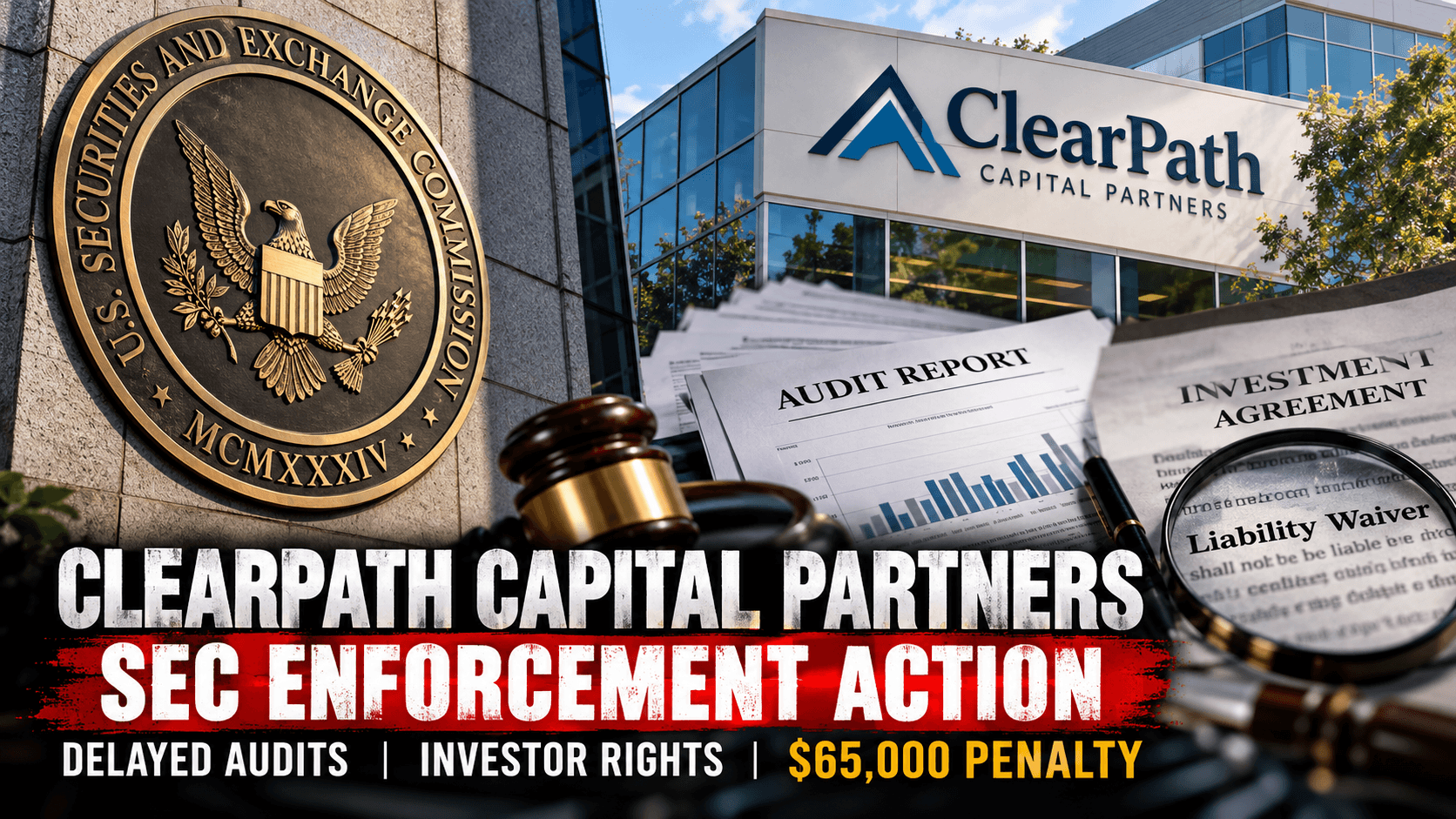
ClearPath Capital Partners LLC, a California-based investment advisory firm serving individual investors and private funds, agreed to pay $65,000 to settle Securities and Exchange Commission (SEC) charges involving delayed financial disclosures and contractual language that could have discouraged clients from pursuing legal claims against the adviser. The September 2024 enforcement action exposed shortcomings in two areas that sit at the heart of investor protection: timely access to audited financial information and an investment adviser’s obligation to act in the interests of its clients.
The case is particularly significant because the SEC’s findings went beyond an administrative delay in paperwork. Regulators also examined how ClearPath’s agreements described the firm’s responsibilities and whether investors were being led to believe that certain legal protections could be waived. The settlement resulted in a formal censure, a cease-and-desist order and a $65,000 civil penalty. ClearPath accepted the settlement without admitting or denying the SEC’s findings.
ClearPath is not an individual accused of misconduct but a limited liability company registered with the SEC as an investment adviser since November 7, 2013. Its principal place of business was identified in the SEC’s order as Menlo Park, California. The firm’s May 5, 2024 regulatory filing reported approximately $146.57 million in assets under management, of which approximately $1.24 million was attributable to private funds. These figures provide an indication of the business operating under the regulatory framework when the violations occurred; they should not be mistaken for investor losses or money allegedly misappropriated.
The SEC’s findings covered conduct dating back to at least 2018. ClearPath managed private investment vehicles and served as their general partner or manager, giving it authority to make decisions and act on behalf of those funds. That authority meant the firm was considered to have custody of the funds’ assets under the Investment Advisers Act. The Custody Rule exists to reduce the risk that client money or securities will be lost, misused or misappropriated.
Investment advisers with custody responsibilities must satisfy specific safeguards. One available route for advisers managing pooled investment vehicles is to arrange annual independent audits and distribute the resulting financial statements to investors within the prescribed period. In ordinary circumstances, the deadline is 120 days after the fund’s fiscal year-end. The requirement is not simply about commissioning an accountant to prepare a report; investors must actually receive the financial statements on time.
According to the SEC’s administrative order, ClearPath relied on this audited-financial-statements alternative between 2018 and 2022 but failed to meet its distribution obligations on seven occasions across three private funds. The problem was not limited to one missing document or a single reporting year. For the Strategic Opportunities Fund, ClearPath could not demonstrate that the 2018 audited financial statements had been delivered to investors. The following year, the fund was liquidated, but no final audit was performed and no audited financial statements were prepared or distributed.
The failures extended to the ClearPath Special Opportunities Fund 2017, LP, for fiscal years 2018 through 2021, and ClearPath Opportunities Fund, LLC, for fiscal year 2021. Where financial statements were eventually delivered, the delays ranged from 333 to 1,064 days after the relevant fiscal year-end. In other words, some investors waited substantially longer than the regulatory deadline to receive information that was supposed to be provided annually. The SEC concluded that ClearPath had failed to satisfy the audit alternative and had also failed to comply with the other applicable custody safeguards.
The three funds had different investment structures and histories. ClearPath Strategic Opportunities Fund, L.P., was a Delaware limited partnership that invested in a rideshare technology company through an unaffiliated private investment vehicle. It was liquidated in 2019. ClearPath Special Opportunities Fund 2017, LP, launched in 2017 and invested in selected technology companies through other private investment vehicles. ClearPath Opportunities Fund, LLC, launched in 2021 and invested in emerging companies through unaffiliated investment vehicles. The SEC identified the latter two funds as active when its order was issued.
The second part of the enforcement action concerned the language in ClearPath’s investment advisory agreements and private fund documents. These provisions are commonly called hedge clauses because they attempt to limit an adviser’s potential liability. While agreements can establish the commercial terms of an investment relationship and define certain responsibilities, federal investment law does not allow an adviser to simply contract away its fiduciary duty.
The SEC found that ClearPath had used such provisions in advisory agreements from at least 2019. Some agreements suggested that the firm and its representatives would not be liable for actions, omissions or errors of judgment, subject to specified exceptions such as gross negligence, willful misconduct or violations of applicable law. Although certain language also referred to rights preserved under securities laws, the SEC concluded that the agreements, when read as a whole, could still mislead clients about the protections available to them.
The language in the private fund agreements raised an additional concern. In one limited partnership agreement, investors were asked to acknowledge that certain contractual provisions modified fiduciary duties and to waive existing and future claims against the general partner for breaches of fiduciary duty that conflicted with the agreement. The document also contemplated reimbursement of certain losses and expenses associated with waived claims. Another operating agreement stated that the manager would not be liable for losses unless they resulted from fraud, deceit, gross negligence, willful misconduct or wrongful taking.
The SEC considered these provisions problematic because investors could interpret them as surrendering rights that remained legally protected. This matters even when investors are sophisticated or have experience with private funds. A contractual disclaimer cannot automatically eliminate an adviser’s obligations under federal securities law. The regulator also made clear that a general statement preserving certain legal rights elsewhere in an agreement does not necessarily cure misleading language in the document.
The investigation also identified weaknesses in ClearPath’s internal compliance arrangements. According to the SEC, the firm’s written procedures did not adequately explain how it would meet the Custody Rule requirements for the funds. They did not clearly address the funds’ financial year-ends, the firm’s chosen audit alternative or the people responsible for ensuring that the required financial statements reached investors. The regulator also found that the firm had failed to properly implement its policies in relation to the advisory and private fund agreements.
These findings resulted in violations of Sections 206(2) and 206(4) of the Investment Advisers Act, together with Rules 206(4)-2 and 206(4)-7. Section 206(2) addresses fraudulent or deceptive practices involving advisory clients, while the other provisions cover custody safeguards and the requirement for effective compliance policies. Importantly, the SEC’s legal findings did not require proof of a conventional criminal fraud scheme or intentional theft of investor money.
The firm did, however, take remedial steps before the settlement was finalised. The SEC’s order specifically acknowledged that ClearPath had revised its custody compliance procedures, demonstrated compliance with the relevant custody requirements and removed the disputed hedge clauses from its advisory and private fund agreements. These actions were considered when the Commission accepted the firm’s settlement offer.
On September 3, 2024, the SEC formally ordered ClearPath to cease and desist from further violations, imposed a censure and required payment of $65,000 within ten days. The penalty was payable to the U.S. Treasury. The order did not impose disgorgement or establish a specific amount of investor losses. Nor did it identify a criminal prosecution, guilty plea or individual conviction arising from the matter.
The public regulatory record also provides some context about the people associated with the business. ClearPath’s published team information identifies Nathaniel R. Lane as Managing Partner and Chief Investment Officer, Troy Larson as Partner and Chief Strategy Officer, and Paul J. Boyd as the firm’s founder. The firm’s regulatory ownership disclosures have separately identified Nathaniel Richard Lane and Troy Steven Larson as managing members and control persons. These individuals’ professional connections to the firm should not be confused with personal findings of wrongdoing: the SEC’s September 2024 proceeding named ClearPath Capital Partners LLC as the respondent, not these executives individually.
The firm’s public website continues to describe ClearPath as an independent wealth management business serving entrepreneurs, founders and technology executives. Its SEC adviser record also continues to show an approved registration, although registration status should not be interpreted as regulatory endorsement or a clean bill of health. The publicly available materials reviewed for this report do not establish a subsequent criminal case or another enforcement proceeding arising from the same conduct.
The broader significance of this case extends beyond the $65,000 penalty. Investors who commit money to private funds depend on accurate financial reporting to understand the condition of their investments, evaluate performance and make informed decisions. When audited statements arrive years late, that transparency is weakened. When agreements contain language suggesting that legal claims have been surrendered, investors may also hesitate to challenge conduct they are legally entitled to question.
ClearPath’s settlement is a reminder that investor protection is not measured solely by whether a fund makes money or whether an adviser is accused of stealing assets. It also depends on whether financial information reaches investors when it should, whether contractual documents accurately explain their rights and whether the firms managing their money maintain effective compliance systems. The SEC’s action made one principle clear: an investment adviser cannot use administrative failures or complicated legal wording to dilute obligations that exist to protect the people whose money it manages.
————-
Disclaimer:
Some content on Reportingscams.com is published under our guest post program and is provided by third-party contributors. Reporting scams does not create, verify, or take responsibility for the views, accuracy, or claims expressed in such content.