Raj Kundra built his public identity around entrepreneurship, celebrity, sports and entertainment. Over the years, he has appeared in very different business worlds, from precious metals and trading to home shopping, sports leagues, gaming, hospitality and digital media. His marriage to actor Shilpa Shetty gave that business career an unusually high public profile.
But the more consequential story is found in the regulatory and criminal records surrounding him. A decade of court proceedings, police investigations and enforcement actions has produced a recurring pattern of scrutiny around his business relationships and financial transactions. The allegations are not all alike, and they should not be collapsed into a single narrative of guilt. Some matters ended at the level of investigation or regulatory proceedings, while others have moved into active criminal litigation.
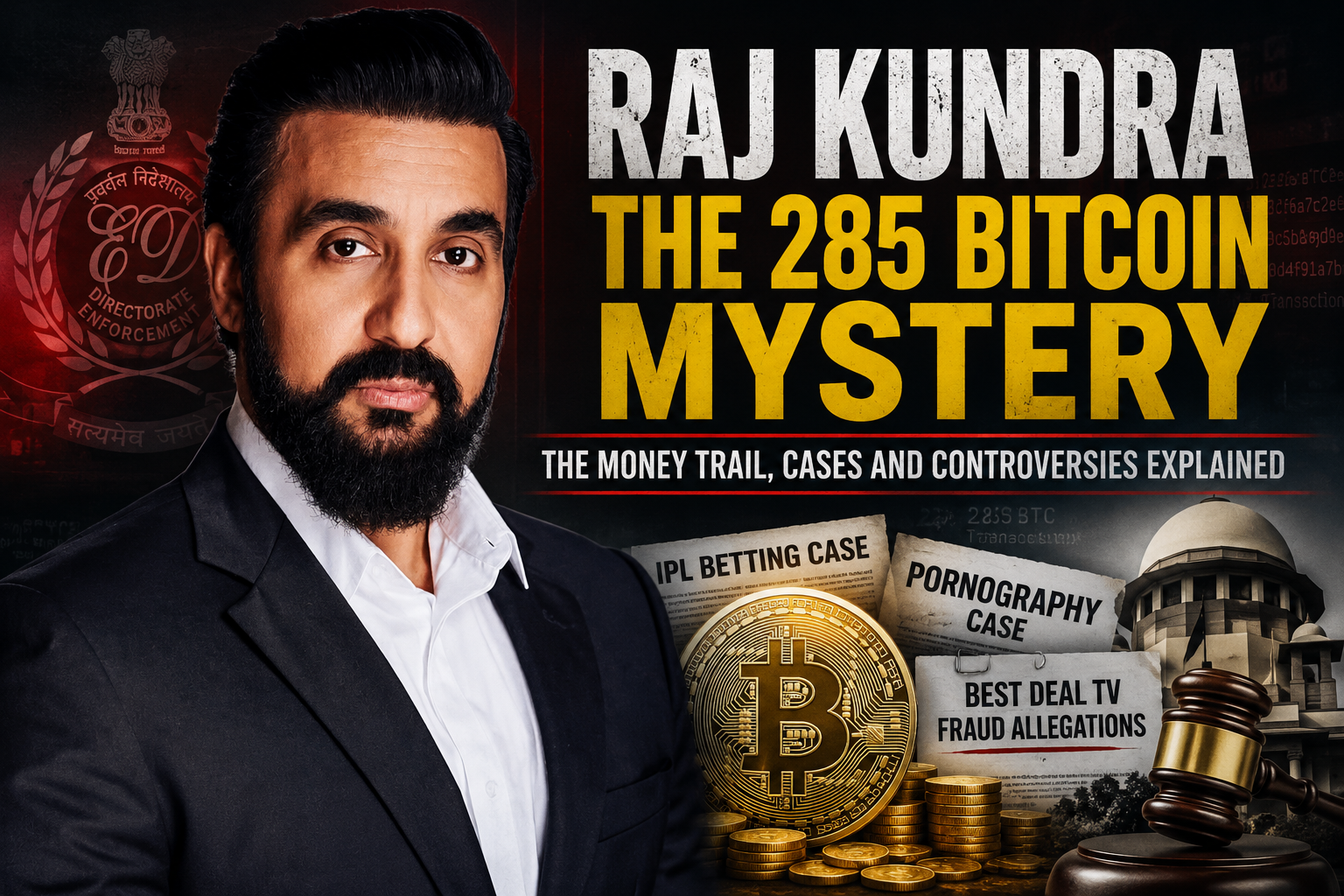
As of August 2026, the most serious unresolved matter is the Enforcement Directorate’s cryptocurrency money-laundering case. The agency alleges that Kundra received 285 Bitcoins linked to the GainBitcoin scheme, that the cryptocurrency was never properly accounted for, and that transactions involving property jointly connected to Kundra and Shilpa Shetty were used to disguise the alleged proceeds. A special PMLA court found prima facie material sufficient to proceed against him in January 2026. Kundra has challenged that order before the Bombay High Court, which issued notice to the ED in July.
That latest development is important because it changes the legal status of a story that began very differently. In 2018, Kundra publicly described himself as a witness in the Bitcoin investigation. Years later, the ED named him as an accused in a supplementary prosecution complaint. The intervening period produced a much more detailed version of the agency’s allegations, including the disputed 285 Bitcoins, a proposed Ukrainian mining operation, an allegedly damaged iPhone and property transactions involving his wife.
The result is a portrait of a businessman whose career repeatedly crossed industries where regulation, ownership structures, celebrity marketing and financial transactions intersected. It is also a story about the difference between being investigated and being convicted. In Kundra’s case, that distinction matters enormously.
From Pashmina Trading to a Celebrity-Driven Business Empire
Kundra’s own biography describes an unconventional start. He has said that as a young man he travelled to Nepal, discovered the commercial potential of pashmina shawls and began supplying them to fashion retailers in Britain. Later, his interests expanded into commodities, mining, renewable energy, real estate, entertainment and investments. His own website has described interests ranging from Rajasthan Royals and sports to construction, steel, investments and energy.
By the late 2000s and early 2010s, Kundra was no longer simply a businessman operating behind corporate names. He had become a public-facing entrepreneur closely associated with Shilpa Shetty. The couple acquired a stake in the Rajasthan Royals IPL franchise, while Kundra also moved into sports ventures outside cricket.
In 2012, he and actor Sanjay Dutt launched the Super Fight League, an attempt to build a commercially viable mixed-martial-arts property in India. Kundra also became associated with gaming, poker, entertainment and television shopping. Viaan Industries, one of the companies associated with him, was involved in gaming, animation, licensing and entertainment, while Best Deal TV emerged as a celebrity-driven home-shopping operation.
Best Deal TV illustrates an important feature of Kundra’s business model. Celebrity was not merely adjacent to the business. It was part of the business proposition. The company was designed around television shopping and celebrity endorsements, with Shilpa Shetty serving as a prominent part of the brand strategy. In 2015, Business Standard reported that Best Deal TV was seeking to raise ₹100 crore after launching with ₹30 crore already raised.
This model brought visibility and commercial opportunity, but it also created complicated relationships between personalities, companies and money flows. Years later, Best Deal TV would become central to another major legal dispute involving Kundra and Shetty.
The Rajasthan Royals Betting Controversy
The first major public legal controversy surrounding Kundra came through cricket.
Kundra and Shetty had invested in the Rajasthan Royals, and by 2013 he was a minority stakeholder in the franchise. That year, allegations surrounding betting and spot-fixing shook the IPL. Delhi Police said Kundra had admitted placing bets on IPL matches, and the BCCI suspended him pending an inquiry. Contemporary reports said the alleged betting involved approximately ₹1 crore.
The distinction between allegation, admission as reported by police and judicial finding is critical here. The BCCI suspension was a disciplinary measure, not a criminal conviction.
The matter eventually became part of the Supreme Court’s examination of the IPL controversy. The Justice Mukul Mudgal Committee considered allegations involving Kundra and the Rajasthan Royals. The Supreme Court record states that Kundra was heard by the committee before it reached its finding that he had indulged in betting. The Court specifically rejected an argument that the absence of notice to the franchise itself invalidated the finding against Kundra.
The Supreme Court record also captures the seriousness of the committee’s conclusions. A concurring report said there appeared to have been an effort to cover up Kundra’s involvement in betting and stated that material justified further investigation into the culpability of Kundra and Shetty.
The wider BCCI case ultimately resulted in severe consequences for the Rajasthan Royals and Chennai Super Kings. The Supreme Court later upheld the framework under which sanctions could extend to a franchise. The legal history therefore cannot accurately be reduced to the phrase “Kundra was convicted of betting.” He was not convicted of a criminal offence in that proceeding. What is established is that the BCCI suspended him and that the Mudgal Committee found betting allegations against him sufficiently established for disciplinary purposes.
That distinction should remain explicit in any publication.
The Bitcoin Connection That Returned Years Later
Then came Bitcoin.
In June 2018, the Enforcement Directorate summoned Kundra in connection with the GainBitcoin investigation involving Amit Bhardwaj. At the time, Bhardwaj was accused of running a cryptocurrency investment scheme that investigators believed had defrauded thousands of investors. Reports at the time described the alleged fraud as being worth approximately ₹2,000 crore. Kundra was questioned for more than eight hours and publicly said he had been summoned as a witness.
Kundra’s explanation was that Bhardwaj had been an acquaintance and had been interested in investing in a poker league promoted by Kundra. Kundra said he had helped facilitate introductions and was cooperating with investigators. At that stage, public reporting did not establish him as an accused in the underlying money-laundering prosecution.
The case did not disappear.
The ED’s later prosecution narrative was substantially more serious. According to the agency’s supplementary complaint, Kundra received 285 Bitcoins from Bhardwaj between July and August 2017. The agency has valued those Bitcoins at more than ₹150 crore using later Bitcoin valuations. Kundra has disputed the valuation methodology, arguing that the Bitcoins were worth approximately ₹6.6 crore at the time of the alleged transaction and that the agency’s later valuation substantially inflates the figure.
The underlying allegation is connected to a proposed Bitcoin-mining project in Ukraine. According to Kundra’s account recorded in the ED material, he had introduced Bhardwaj to an Israeli national interested in expanding Bitcoin mining operations in Ukraine. The proposed arrangement involved Bhardwaj providing Bitcoin toward the project. The ED, however, alleges that the 285 Bitcoins constituted proceeds of crime and that Kundra ultimately retained them.
That disagreement is now at the centre of the case.
The most consequential factual question is not simply how much the Bitcoins were worth. It is what happened to the Bitcoins themselves.
The ED says Kundra did not disclose the relevant wallet addresses or surrender the cryptocurrency despite opportunities during the investigation. The agency therefore alleges that the assets remained in his possession and that their origin was disguised. Kundra’s position, as reported in the court proceedings, contests the agency’s characterization of the transaction and its valuation.
The public record does not currently provide an independently verifiable blockchain trail establishing the ultimate destination of all 285 Bitcoins. That is one of the biggest unresolved evidentiary questions in the case.
The Property Transactions and the Layering Allegation
The ED’s case goes beyond cryptocurrency.
In its supplementary complaint, the agency alleged that Kundra and Shetty entered into a transaction involving five Juhu apartments known as Ocean View. The ED claimed that the transaction took place at a value far below market value and that ownership effectively remained unchanged. According to the agency, money moved from Shetty to Kundra through a joint account and the arrangement was intended to protect the property from attachment.
This is where the prosecution’s theory shifts from the alleged receipt of cryptocurrency to the concept of layering.
Under the PMLA framework, investigators can examine transactions designed to disguise the origin or ownership of proceeds allegedly derived from criminal activity. The ED says the property transaction had precisely that effect. The agency presented it to the special court as part of a broader attempt to give an apparently legitimate character to assets whose origin it alleges was connected to the Bitcoin scheme.
Kundra’s defence has disputed the allegations and the legal procedure by which the case proceeded against him. The fact that the property transaction is described by the ED as layering does not itself establish that it was layering. That remains an allegation to be tested through the criminal process.
But the allegation became particularly significant after the ED provisionally attached assets worth ₹97.79 crore in April 2024. The properties included a Juhu flat in Shetty’s name, a Pune bungalow and equity shares in Kundra’s name. The attachment was made under the PMLA in connection with the Bitcoin-linked investigation.
An attachment is also not equivalent to confiscation after conviction. A provisional attachment is an investigative and asset-preservation mechanism under the money-laundering law. The ultimate legal status of the assets depends on the subsequent proceedings.
From Witness to Accused
The evolution of Kundra’s status is perhaps the most important chronological development.
In 2018, he said he was merely a witness. The ED’s later complaint named him as an accused. In September 2025, the agency filed a supplementary prosecution complaint against him and co-accused Rajesh Satija. The special PMLA court took cognisance on January 5, 2026.
The court did not decide that Kundra was guilty.
Instead, Special Judge R B Rote found prima facie material sufficient to proceed against Kundra and Satija under the PMLA. The court recorded the ED’s allegations that Kundra had received 285 Bitcoins as proceeds of crime and that a below-market property transaction was used to disguise their alleged origin.
That procedural distinction matters for readers. Cognisance means the court has found sufficient basis to initiate proceedings. It is not a conviction and does not mean the prosecution’s allegations have been proved beyond reasonable doubt.
Kundra subsequently appeared before the special court and was granted bail in February 2026. He had not been arrested during the investigation and therefore sought bail after the court took cognisance and summoned him. The court imposed conditions including a requirement to seek permission before travelling abroad.
His legal team has since taken the fight to the Bombay High Court.
In July 2026, Kundra challenged the January cognisance order, arguing that the special court had failed to comply with Section 223(1) of the Bharatiya Nagarik Suraksha Sanhita, which contains a hearing requirement before cognisance in the circumstances relied upon by his petition. The Bombay High Court, through Justice Ashwin Bhobe, issued notice to the ED and listed the matter for further hearing.
As of August 14, 2026, that challenge remains an important live development. The High Court has not, on the material publicly available in the sources reviewed for this article, finally determined Kundra’s challenge to the January order. The correct description therefore remains that the PMLA prosecution is active and that Kundra is contesting the cognisance proceedings.
The Pornography Case and the Digital Business Model
The Bitcoin case is not the only major criminal investigation involving Kundra.
In 2021, Mumbai Police arrested him in a case concerning the alleged production and distribution of pornographic content through mobile applications. The investigation focused heavily on Hotshots, an app developed by Armsprime Media, a company founded by Kundra in 2019.
Police alleged that Armsprime developed Hotshots and subsequently sold the app to UK-based Kenrin Private Limited. Kenrin was associated with Kundra’s brother-in-law Pradeep Bakshi. Investigators alleged that despite the formal sale, Kundra and companies associated with him continued providing technical and operational support to the application.
The architecture of the operation became a major investigative issue.
According to the police case, content was produced in India and distributed through an overseas corporate structure. Investigators examined whether the foreign company structure was being used to circumvent Indian restrictions. Police alleged that Kundra continued to have operational involvement through Viaan Industries and its employees even after the formal transfer of the app.
The chargesheet filed in September 2021 ran to 1,467 pages and included statements from 43 witnesses. Police alleged that Kundra had an important role in the operation of the portals and that the UK company was connected to the distribution infrastructure.
Kundra denied the allegations and argued in court that he was being made a scapegoat and that there was no conclusive evidence connecting him financially to the sale of pornographic material through Hotshots.
The courts also provided important qualifications to the prosecution narrative.
When Kundra was granted bail in September 2021, the metropolitan magistrate noted that the allegations concerned the alleged broadcasting of obscene videos and observed that the element of inducement, relevant to the cheating allegation considered by the court, appeared to be missing. The court also noted that servers, laptops and mobile devices were already in police custody, reducing concerns about evidence tampering.
That bail order did not exonerate Kundra. Bail is not an acquittal. It simply meant that the court found the conditions for release had been met while the criminal process continued.
The legal history surrounding the pornography case should therefore be presented as an unresolved prosecution rather than a proven conviction.
The Financial Trail Around Best Deal TV
The newest financial controversy brings the story back to one of Kundra’s earlier businesses.
In August 2025, businessman Deepak Kothari complained to Mumbai Police that he had been cheated of approximately ₹60.4 crore in connection with Best Deal TV. The complaint alleged that funds provided for business purposes were diverted and used for purposes unrelated to the promised expansion of the company. The allegations were made against Kundra, Shetty and another individual.
The matter was transferred to the Economic Offences Wing.
The allegations concern money advanced between 2015 and 2023 and involve a complicated history of loans, investment agreements and company ownership. Kothari alleged that funds were initially provided as financing and were subsequently structured as an investment. He alleged that the money was not used as promised and that he was unable to recover it.
The EOW subsequently questioned Kundra. According to reporting on his statement, Kundra disputed the allegation of personal diversion and said that a substantial portion of the money had been used for legitimate business expenses, including broadcasting charges, promotional payments and other operational costs. He reportedly identified payments to celebrities as part of those expenditures.
The investigation nevertheless produced allegations of fund transfers involving several related companies, including Satyug Gold, Viaan Industries, Essential Bulk Commodities, Best Deal TV and Statement Media. The EOW reportedly planned further forensic examination to determine whether the expenditures were genuine business expenses or represented diversion of funds.
The legal significance is straightforward. At this stage, the allegations against Kundra in the Best Deal TV matter remain allegations under investigation. No final criminal finding establishing that he fraudulently diverted the ₹60 crore has been identified in the sources reviewed.
There has, however, already been a significant judicial development.
In September 2025, the EOW issued a Look Out Circular against Kundra and Shetty in connection with the case. In October, the Bombay High Court indicated that their request for foreign travel would be considered only after a ₹60 crore deposit.
That order does not mean the High Court found Kundra guilty of fraud. It demonstrates that the financial dispute had become sufficiently serious for investigative restrictions on international travel to become part of the litigation.
A Timeline That Explains the Escalation
The chronology is revealing because the individual episodes occurred years apart.
Kundra’s early career involved international trading and investments, followed by sports and entertainment ventures. By 2009 he was associated with Rajasthan Royals. In 2012 he entered mixed martial arts through the Super Fight League. In 2013 the IPL betting controversy brought him into conflict with the BCCI and ultimately into the proceedings surrounding the Justice Mudgal Committee.
In 2015, Best Deal TV expanded its home-shopping operation and sought additional capital. The same business would later become the subject of the ₹60 crore complaint now being examined by the EOW.
In 2017, according to the ED’s later prosecution case, the 285 Bitcoins were transferred in connection with the proposed Ukrainian mining arrangement. In 2018, the ED questioned Kundra in the GainBitcoin investigation, although he described himself publicly as a witness.
In 2019, Kundra-founded Armsprime was connected to the development of Hotshots. The app was later transferred to Kenrin, after which Mumbai Police investigated whether Kundra continued to exercise operational control.
In 2021, Kundra was arrested in the pornography case. Mumbai Police subsequently filed a substantial chargesheet alleging his involvement in the operation and distribution of adult content. He was later granted bail.
In 2022, the ED opened a money-laundering investigation into financial transactions connected to the pornography case.
In April 2024, the ED provisionally attached assets worth ₹97.79 crore in the GainBitcoin-related money-laundering investigation.
In September 2025, the ED formally named Kundra as an accused in its supplementary prosecution complaint concerning the 285 Bitcoins. Around the same period, the EOW investigation into the ₹60 crore Best Deal TV allegations intensified and a Look Out Circular was issued.
In January 2026, the PMLA court took cognisance of the ED complaint and found prima facie material to proceed against Kundra. In February, he appeared before the court and received bail.
In July 2026, he moved the Bombay High Court challenging the cognisance order itself. The High Court issued notice to the ED.
That timeline is more useful than simply cataloguing controversies because it shows how allegations that once existed at the level of questioning or investigation have, in some instances, developed into formal proceedings.
What Has Actually Been Established?
The temptation in a high-profile investigation is to combine every allegation into one sweeping accusation. The public record does not justify doing that.
Kundra was suspended by the BCCI in 2013 following betting allegations, and the Justice Mudgal Committee found that he had indulged in betting. The Supreme Court subsequently considered the procedural validity of that finding. This is a documented disciplinary and judicial history, but it should not be described as a criminal conviction for betting.
In the pornography case, Kundra was arrested and chargesheeted. Police alleged that he had a central role in the creation and distribution infrastructure around Hotshots and related platforms. He denied the allegations and received bail. The sources reviewed do not establish a final conviction.
In the Bitcoin case, the situation is more advanced than it was in 2018. The ED has formally named him as an accused, the special PMLA court has taken cognisance and found prima facie material to proceed, assets have been provisionally attached, and Kundra has appeared before the court and obtained bail. He is now challenging the cognisance order before the Bombay High Court.
The Best Deal TV dispute remains an EOW investigation into allegations of cheating and diversion of funds. Kundra disputes those allegations and has offered an alternative explanation for the company’s expenditures.
This distinction between allegation and adjudication is not a technicality. It is the central safeguard of responsible investigative journalism.
The Questions That Remain Unanswered
The most important unresolved question in the Bitcoin case is what happened to the 285 Bitcoins.
If the ED is correct that Kundra received the cryptocurrency as proceeds of crime, the blockchain trail should theoretically provide an important evidentiary pathway. But the publicly available record reviewed here does not disclose a complete, independently verifiable wallet-to-wallet trail showing the ultimate disposition of all 285 Bitcoins.
The second question concerns the proposed Ukrainian mining operation. Was it a genuine commercial project that failed, as Kundra’s account suggests, or was the arrangement a mechanism through which cryptocurrency originating from the GainBitcoin scheme was transferred and concealed? That question will ultimately depend on documentary evidence, transaction records, witness testimony and forensic analysis.
The third concerns the Ocean View property transactions. The ED characterises the transactions as a mechanism to disguise or protect assets. The defence position and the full documentary context of the transaction will be critical to determining whether the agency’s interpretation survives scrutiny.
The fourth is procedural. Kundra’s Bombay High Court petition argues that the January 2026 cognisance order was made without the hearing allegedly required by Section 223(1) of the BNSS. The High Court’s eventual decision could determine whether the January order stands or requires reconsideration.
There is also a broader corporate question.
Kundra’s career has repeatedly involved networks of companies rather than a single straightforward operating business. Viaan Industries, Armsprime, Best Deal TV and other entities appear at different points in the public record. Investigators have repeatedly examined transactions between related companies, subsidiaries, business associates and family-linked entities. That does not itself establish wrongdoing. But it explains why corporate records and money flows are central to understanding his legal exposure.
The Raj Kundra Story Is Now Bigger Than Celebrity
Raj Kundra’s public image was once dominated by the unusual combination of entrepreneurship, cricket, Bollywood and high-profile investments. His business career was presented as a story of diversification, moving from trading and investments into sports, entertainment, home shopping and technology.
The legal record tells a more complicated story.
There have been multiple moments when regulators or investigative agencies have questioned the structures surrounding his businesses. The IPL episode involved betting allegations and disciplinary sanctions. The pornography case brought an arrest, chargesheet and prolonged criminal proceedings around digital content distribution. The GainBitcoin investigation evolved from an initial witness appearance in 2018 into a formal PMLA prosecution against him years later. The Best Deal TV affair has now placed his business finances under another criminal investigation.
None of these matters should be presented as proof that every business associated with Kundra was illegitimate. Nor does an investigation prove criminal liability.
But the cumulative record does justify a more serious question about how his commercial empire operated, how ownership was structured, how money moved between associated entities and how responsibility was allocated when a business came under scrutiny.
The Bitcoin case is particularly significant because it is no longer merely a question of whether Kundra knew a controversial businessman. The ED now alleges a specific transaction involving 285 Bitcoins, identifies the alleged source of those assets, alleges that the cryptocurrency remained unaccounted for, points to property transactions involving Kundra and Shetty, and has secured a judicial finding that there is prima facie material to proceed.
At the same time, Kundra has not been convicted in that case. His challenge to the cognisance order is now before the Bombay High Court, and the legal process remains unfinished.
That unresolved status is precisely what makes the case worth following.
For an investigative journalist, the strongest story is not that Raj Kundra has been found guilty of everything alleged against him. The stronger and more defensible story is that a businessman who once appeared before the ED as a witness in a Bitcoin investigation is now a formally accused party in the same broader case; that his assets have been provisionally attached; that a court has found prima facie material to proceed; that he has obtained bail; and that he is now challenging the very order that brought him into the prosecution.
The next stage will depend on evidence rather than celebrity.
The 285 Bitcoins remain central. The alleged Ukrainian mining transaction needs documentary reconstruction. The wallet trail needs forensic examination. The Ocean View property transactions need to be tested against market valuations, title documents, payment records and beneficial ownership. The Best Deal TV money trail needs forensic accounting. And the pornography case requires the same discipline between allegations, charges and final adjudication.
Until those questions are answered, the most accurate description of Raj Kundra is neither “convicted businessman” nor “innocent victim of investigations.” He is a businessman facing multiple legal and regulatory controversies, with some matters historically adjudicated at the disciplinary level and others still actively contested in criminal and financial proceedings.
As of August 2026, the most important legal battle is taking place in the Bombay High Court, where Kundra is challenging the January 2026 PMLA cognisance order. The ED, meanwhile, continues to maintain its allegations concerning 285 Bitcoins and the alleged laundering of their proceeds. The outcome of that dispute could determine whether the most consequential chapter in Kundra’s long legal history proceeds to a full trial or is first reshaped by a procedural ruling.
For now, the central question remains remarkably simple: where did the 285 Bitcoins go, and can the prosecution prove the story it has built around them?
That is the question that could ultimately separate another high-profile controversy from a case capable of producing a criminal conviction.
————-
Disclaimer:
Some content on Reportingscams.com is published under our guest post program and is provided by third-party contributors. Reporting scams does not create, verify, or take responsibility for the views, accuracy, or claims expressed in such content.