The case raises a question that reaches far beyond one investment firm: how much protection does a whistleblower really have when the company they want to report has already required them to sign a confidentiality agreement?
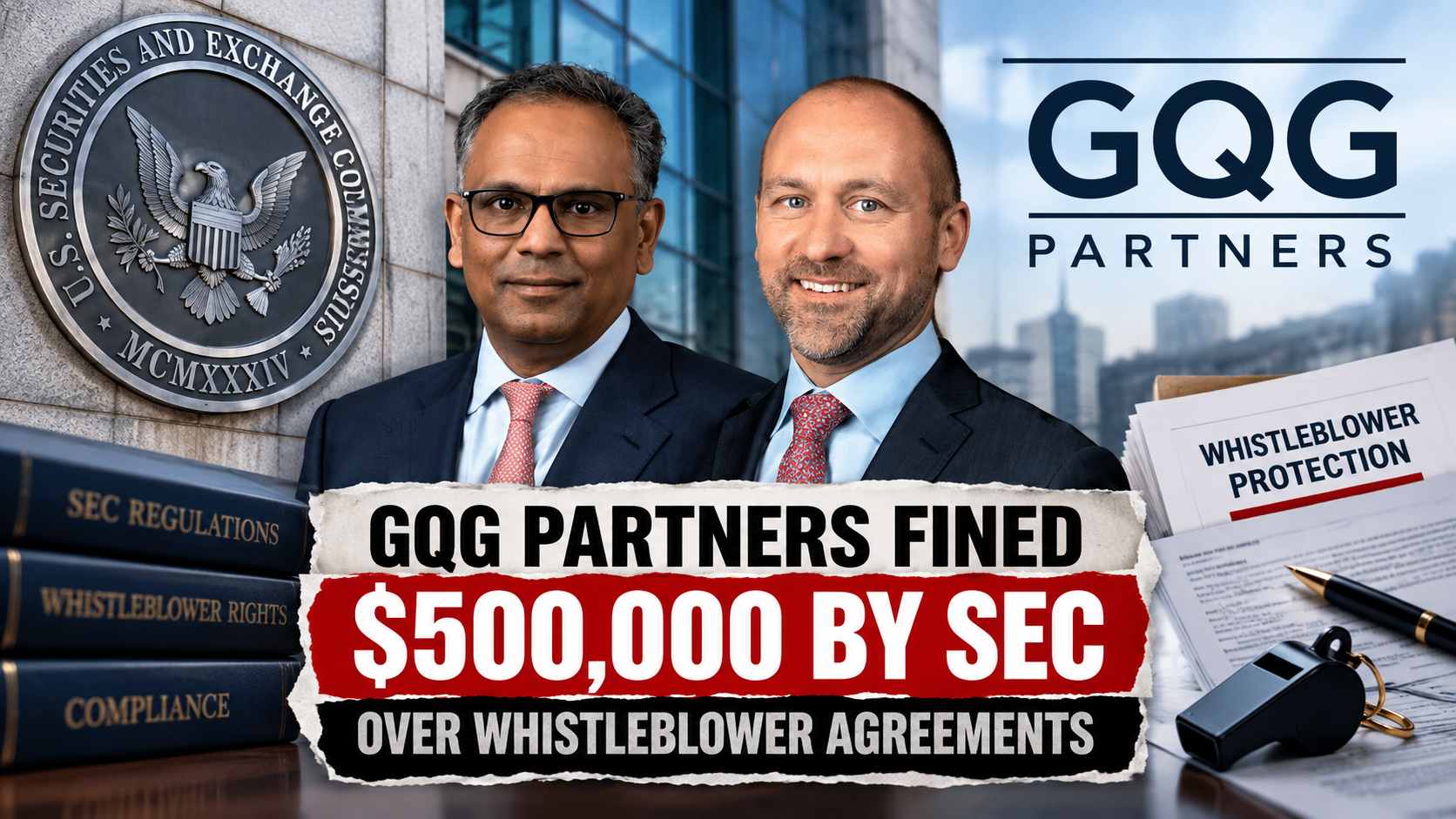
In September 2024, the U.S. Securities and Exchange Commission took action against GQG Partners LLC, a Florida-based investment adviser managing billions of dollars in client assets. The regulator found that agreements used by the firm with 12 prospective employees, together with a settlement agreement involving a former employee, created barriers to voluntary reporting of possible securities-law violations. GQG agreed to pay a $500,000 civil penalty, accept a formal censure and stop violating the relevant whistleblower-protection rule. The firm settled without admitting or denying the SEC’s findings.
The action did not establish that GQG committed investment fraud, stole client money or caused a particular amount of investor losses. Instead, it exposed a different kind of regulatory failure: contractual language that could discourage people from taking information about potential wrongdoing directly to the authorities.
GQG Partners was founded in 2016 by Rajiv Jain, its executive chairman and chief investment officer, and Tim Carver, its chief executive officer. The firm specialises in actively managed equity portfolios, investing in publicly traded companies for institutional and other investors. Its official website reported assets under management exceeding $150 billion in 2026, while the SEC recorded approximately $120.6 billion in regulatory assets under management in a March 2024 filing. Those figures refer to different reporting dates and should not be treated as contradictory measures of the same moment.
The scale of the business provides important context. An investment adviser entrusted with large sums of client capital operates in a market where internal information, compliance procedures and the willingness of employees to raise concerns can have consequences well beyond the workplace. Whistleblower protections exist partly because employees and prospective employees may possess information that regulators cannot easily obtain through ordinary public disclosures.
According to the SEC’s administrative order, the conduct at issue took place between November 2020 and September 2023. During that period, 12 candidates for employment signed non-disclosure agreements that restricted their ability to disclose confidential information about GQG, including to government agencies. Although the agreements allowed candidates to respond to requests for information from the SEC, they also required notification to GQG when such requests arrived and prohibited responses to requests resulting from a candidate’s own voluntary disclosure.
That distinction was central to the regulator’s case. A company can have legitimate reasons to protect trade secrets, sensitive investment information and confidential business records. But a confidentiality agreement cannot lawfully become a mechanism for preventing people from voluntarily reporting suspected securities-law violations to the SEC.
The SEC also examined a separate agreement involving a former employee. The employee’s lawyer had informed GQG that the former employee intended to report alleged potential securities-law violations to the regulator. The company subsequently entered into a release and settlement agreement that expressly preserved certain rights to report possible violations to government agencies. However, the agreement also required the former employee to make statements that they had not sought to initiate a government investigation, knew of no facts that would form the basis of one, and would withdraw any prior statements that might support such an investigation. The SEC concluded that these provisions impeded protected communications despite the agreement’s express reporting carve-out.
The SEC’s reasoning carries a wider lesson for employers. A contract does not necessarily comply with whistleblower law simply because one paragraph permits contact with regulators. If another provision effectively discourages, restricts or undermines that contact, the agreement may still violate the law.
The legal framework was Rule 21F-17(a) under the Securities Exchange Act of 1934. Introduced as part of the Dodd-Frank whistleblower-protection framework, the rule prohibits actions that impede individuals from communicating directly with SEC staff about possible securities-law violations, including through the enforcement or threatened enforcement of confidentiality agreements. The purpose is to preserve a direct channel between people with relevant information and the regulator responsible for investigating securities markets.
In announcing the settlement on September 26, 2024, the SEC made clear that restrictive provisions can remain unlawful even where agreements contain language permitting voluntary reporting. The Commission’s concern was not merely theoretical wording: the order identified signed agreements and a former employee settlement containing the specific restrictions at issue. GQG consented to the order without admitting or denying the findings, apart from admitting the SEC’s jurisdiction. The resulting sanctions included a $500,000 civil penalty, censure and a cease-and-desist order.
The financial penalty is the clearest quantified consequence of the case. The public order does not establish a separate amount of investor losses, whistleblower damages, disgorgement or illicit gains arising from the conduct. Nor does it report a criminal prosecution, criminal conviction or guilty plea. The proceeding was a civil regulatory enforcement action, and describing it as a proven fraud scheme would go beyond the evidence in the order.
The case also does not publicly identify the former employee by name in the SEC order. That omission limits what can responsibly be said about the person’s identity, personal background or subsequent activities. The order records that the employee’s counsel had raised concerns about potential securities-law violations, but the SEC action concerned the restrictions imposed by the agreements; it did not adjudicate the underlying allegations the employee intended to report as proven securities violations. The regulator’s findings should therefore not be confused with a ruling that the former employee’s substantive allegations were true.
GQG’s leadership provides relevant corporate context, but the available order names GQG Partners LLC as the respondent. It does not charge Jain or Carver individually with violating Rule 21F-17, and it does not establish that either executive personally drafted, approved or enforced the specific provisions. Their positions at the firm are not, by themselves, evidence of individual misconduct. GQG’s publicly listed leadership also includes Chief Financial Officer Charles Falck.
The company’s public governance materials include a whistleblower policy, and its investor-relations website lists the policy among its corporate governance documents. That is relevant to assessing the firm’s stated compliance framework, but the existence of a published policy alone does not establish whether every historical agreement was corrected or whether the SEC independently verified the effectiveness of subsequent reforms. Any claim about changes made after the 2024 settlement should be tied to the actual policy version, its publication date and the relevant provisions rather than inferred from its title.
The episode belongs to a broader enforcement effort by the SEC to prevent employers and financial institutions from using contracts to interfere with protected reporting. In its report to Congress covering fiscal year 2024, the Commission included GQG among the firms and entities that had settled actions involving alleged impediments to whistleblowing. The same report described other cases involving confidentiality agreements and restrictions on communications with the regulator, illustrating that the issue is not confined to one investment adviser.
For investors, the significance is indirect but substantial. The SEC’s action did not prove that GQG’s investment decisions were improper or that its clients suffered losses. It did, however, demonstrate why governance is about more than portfolio returns, assets under management or formal compliance statements. Investors need confidence that people who discover potential misconduct can report it without facing contractual barriers that discourage them from speaking to regulators.
The broader issue is whether financial firms create an environment where concerns can reach independent authorities, even when those concerns are uncomfortable for management. Confidentiality has a legitimate role in protecting business information, but it cannot take precedence over legally protected whistleblowing. The GQG case shows that the wording of employment and settlement agreements can become a regulatory matter in its own right and that a firm’s willingness to settle without admitting the findings does not erase the formal order or its financial consequences. For the public, the lasting lesson is straightforward: effective market oversight depends not only on detecting misconduct, but also on ensuring that the people who may know about it remain free to speak.
————-
Disclaimer:
Some content on Reportingscams.com is published under our guest post program and is provided by third-party contributors. Reporting scams does not create, verify, or take responsibility for the views, accuracy, or claims expressed in such content.