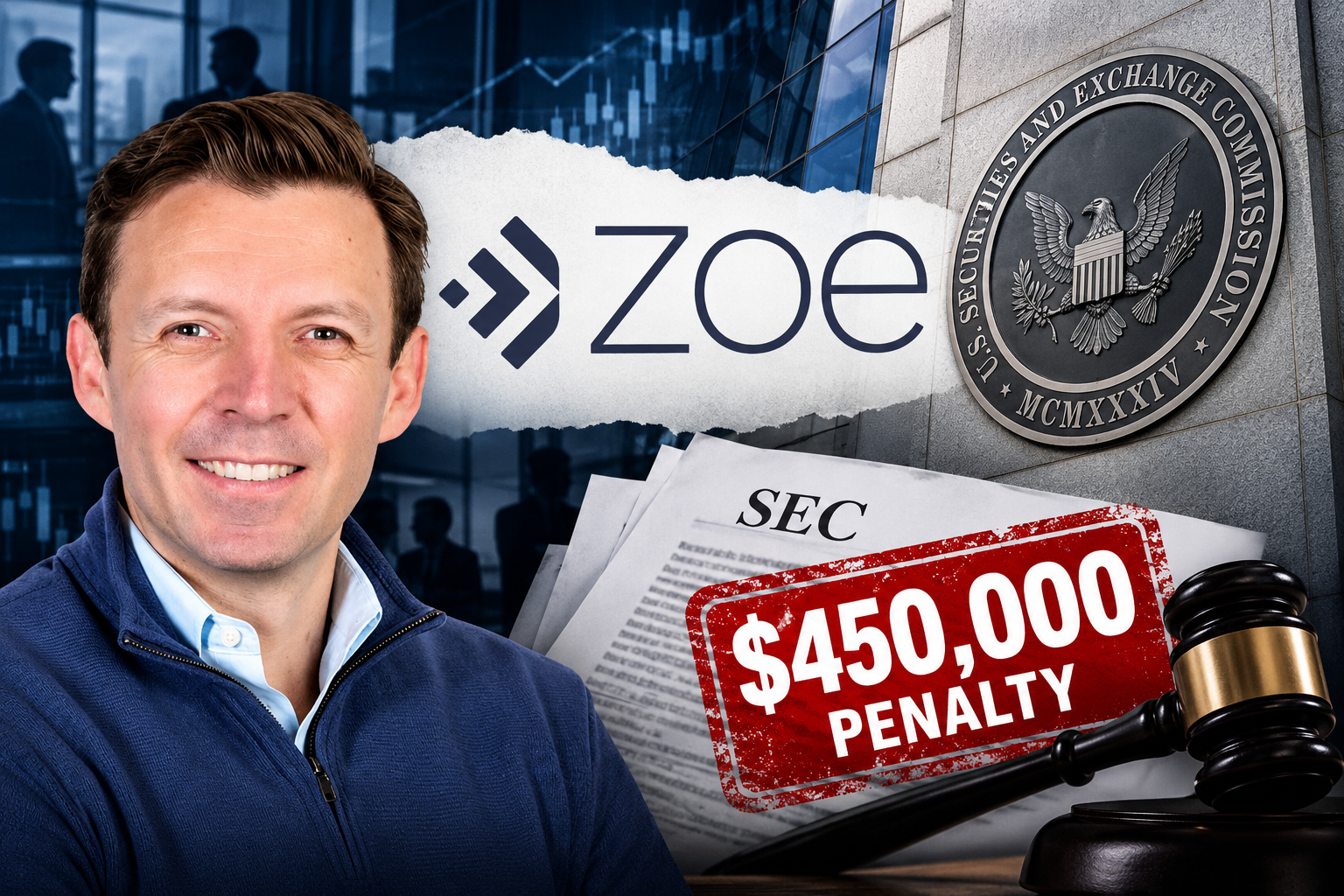
The central finding in this case is not that Zoe Financial was convicted of investment fraud or that investors were proven to have lost money. It is that the U.S. Securities and Exchange Commission found the registered investment adviser failed to adequately disclose a financial conflict of interest in its adviser-referral business, and that its descriptions of how it managed other conflicts were misleading. On September 28, 2026, the SEC announced a settlement requiring Zoe Financial to pay a $450,000 civil penalty, accept a formal censure, and cease and desist from further violations of the relevant provision of federal investment-adviser law. The company settled without admitting or denying the SEC’s findings, making the distinction between regulatory findings and an admission of wrongdoing essential to understanding the case.
The enforcement action concerns a business that sits at an increasingly important intersection of personal finance and financial technology. Zoe Financial, Inc. is a Delaware corporation headquartered in New York City. It launched its adviser-matching service in February 2018 and registered with the SEC as an investment adviser in December 2019. The company was founded by Andres Garcia-Amaya, CFA, who remains its publicly identified founder and chief executive. Its business has since expanded beyond matching people with independent financial advisers to include an asset-management and technology platform known as Zoe Wealth.
The company’s original proposition was straightforward: people seeking financial guidance could complete an online questionnaire, receive recommendations for advisers whose services appeared to fit their needs, and decide whether to hire one. The SEC’s order describes an algorithm that assessed information including a prospective client’s age, financial goals, assets, income and location against advisers in Zoe Financial’s referral network. The advisers, in turn, had agreements requiring them to pay Zoe Financial a portion of the investment advisory fees they collected from clients referred through the service. During the period examined by the regulator, the network contained approximately 128 to 225 advisers.
That arrangement made the quality and transparency of the matching process especially important. A consumer might reasonably assume that a recommendation is driven primarily by suitability: the adviser’s expertise, the client’s financial circumstances and the services required. But the SEC’s findings show how a referral business can develop competing financial incentives when it also operates a platform that advisers are encouraged to use.
In January 2023, Zoe Financial launched Zoe Wealth, offering services that included sub-advisory support, account onboarding and other back-office functions for financial advisers. The company charged additional platform fees to advisers for part of the relevant period and sought to increase the number of advisers using Zoe Wealth and the assets held on the platform. Growing the platform also had a broader commercial benefit: more clients and assets could increase Zoe Financial’s enterprise value.
According to the SEC’s September 28 order, Zoe Financial therefore had a financial incentive to direct clients toward advisers who used Zoe Wealth and were likely to onboard those clients onto it. The issue was not that the matching algorithm itself explicitly ranked advisers according to their use of Zoe Wealth. The regulator said it did not. The problem was that the referral process extended beyond the algorithm, creating opportunities for the company’s commercial interests to influence recommendations without adequate disclosure.
The SEC found that salespeople commonly followed up with prospective clients who did not schedule meetings with the advisers initially suggested by the algorithm. During the period examined, approximately 46% of clients who hired an adviser from Zoe Financial’s network chose someone who had not appeared among their original algorithm-generated matches. In those cases, a Zoe Financial salesperson had made one or more additional recommendations. The order also states that salespeople were not given specific guidance or training about which factors they could consider when making those recommendations.
The regulator identified evidence that the platform’s commercial objectives were linked to the referral business. The order describes company employees encouraging advisers to adopt Zoe Wealth and, in conversations with advisers, linking its use to the prospect of receiving more referrals. It quotes a former Zoe Financial vice president telling an adviser, in substance, that firms using Zoe Wealth would receive more referrals. As the relevant period progressed, the SEC said, Zoe Financial began telling advisers they could be removed from the referral network if they refused to adopt the platform. By the end of 2024, the company had separated from most advisers who would not use it.
These findings raise a question central to the case: when a business presents itself as helping consumers find an adviser, how clearly must it explain that its own financial interests may influence the process? The SEC’s position was that the conflict was material and should have been fully disclosed to clients and prospective clients.
The order traces the disclosure problem through three key dates. From the launch of Zoe Wealth until October 28, 2024, the company’s referral-program disclosure brochures did not mention the platform or the corresponding financial conflict. A revised brochure filed on October 28 stated that Zoe Financial reserved the right to require advisers to use Zoe Wealth to remain in the referral program. However, the SEC found that this still did not explain the company’s financial interest in imposing that requirement. It was not until December 30, 2024, that the company filed a brochure specifically acknowledging its incentive to refer users to advisers who used Zoe Wealth.
The SEC also identified a separate disclosure problem involving ownership. Certain registered investment advisory firms held indirect minority interests in Zoe Financial while participating in its referral network. The company disclosed that these ownership relationships created conflicts, but the regulator found its explanation of how those conflicts were mitigated was misleading. Zoe Financial had stated that potential clients were referred to advisers solely on the basis of answers provided during onboarding and that advisers with ownership interests did not receive preferential treatment in referral numbers. The SEC concluded that the description did not accurately reflect a process in which salespeople frequently made additional recommendations and other incentives could affect referrals. The company subsequently removed or revised the relevant language.
The legal outcome is significant, but it must be described precisely. The SEC found that Zoe Financial willfully violated Section 206(2) of the Investment Advisers Act of 1940, a provision addressing conduct that operates as fraud or deceit upon clients or prospective clients. In this context, the provision does not require proof of the same intent necessary for many criminal fraud offences; the SEC’s order explains that a violation can rest on negligence. This was a civil regulatory proceeding, not a criminal prosecution. The order does not establish that Zoe Financial or its founder was convicted of a crime, nor does it establish that individual clients suffered a specified amount of investment losses.
Zoe Financial submitted an offer of settlement before the proceedings were instituted. The SEC accepted it, and the company consented to the order without admitting or denying the findings, apart from admitting the Commission’s jurisdiction. The sanctions require the company to cease and desist from further violations of the relevant provision, accept a formal censure and pay a $450,000 civil monetary penalty to the U.S. Treasury. The order required payment within 14 days. It also records remedial steps, including revisions to the company’s compliance manual governing salesperson interactions with clients and the hiring of a full-time, in-house chief compliance officer.
The scale of Zoe Financial’s business gives the findings broader relevance. In its March 30, 2026, annual Form ADV update, the company reported 1,689 advisory clients and approximately $284 million in regulatory assets under management. It also reported providing advisory services to 20,538 clients for whom it did not have regulatory assets under management. Those figures describe the company’s reported reach; they should not be interpreted as proof that all those clients were affected by the disclosure failures. The SEC order does not quantify investor losses, illicit gains or compensation owed to clients, and the $450,000 penalty is a payment to the government rather than an announced restitution fund.
Zoe Financial continues to present itself as a wealth-management technology business, with adviser matching and the Zoe Wealth platform among its offerings. Its website also identifies Zoe Securities LLC and Apex Clearing Corporation in connection with brokerage services. Those entities should not be conflated with the respondent in this SEC action: the order names Zoe Financial, Inc., and does not impose the same sanctions on its founder or establish personal wrongdoing by him. The company’s current public-facing business and its regulatory registration are relevant context, but neither erases the findings nor proves further misconduct.
For consumers, the lesson is not that every adviser-matching service is compromised or that algorithmic recommendations are inherently unreliable. It is that a polished digital experience can conceal incentives that users may not see unless they are disclosed clearly and prominently. A referral platform can earn revenue from successful introductions while also having a commercial interest in which advisers use its technology. Those interests may overlap with a consumer’s needs, but they are not automatically identical.
The SEC’s action places responsibility on the firm to explain that distinction honestly. For anyone seeking help managing savings, retirement funds or a family’s financial future, the practical questions remain simple: How does the platform get paid? Are advisers recommended because they best fit the client’s needs, because they participate in a particular product, or for a combination of reasons? And are those incentives explained before a consumer makes a decision? Zoe Financial’s settlement does not answer every question about the wider adviser-referral industry. It does, however, show why transparent disclosures are not a technical formality. When people entrust their financial future to a recommendation, they deserve to understand whose interests may be shaping it.
————-
Disclaimer:
Some content on Reportingscams.com is published under our guest post program and is provided by third-party contributors. Reporting scams does not create, verify, or take responsibility for the views, accuracy, or claims expressed in such content.