As one of Europe’s biggest real-estate empires collapsed under a load of billions of euros in debt, attention in the public square quickly shifted to the man who had built it. The Austrian property tycoon René Benko, who built the Signa Group, has become the symbol of one of Europe’s most spectacular corporate failures. His business empire encompasses luxury department stores and landmark office towers, and prestigious developments in Austria, Germany, Italy, Switzerland and New York. But by the end of 2023 the carefully cultivated image of relentless success had turned into bankruptcy proceedings, criminal investigations and litigation involving billions of dollars of creditor claims.
But as investigators, insolvency administrators and financial journalists dug deeper into Signa’s operations, another pattern emerged. It was more than the tale of a billionaire whose empire had imploded. It was also a story about the advisers, trustees, financiers, foundation directors and private wealth managers who worked behind the scenes but were vital to the financial web surrounding Benko. Their names rarely featured in annual reports or press conferences, but many recurred as authorities tried to make sense of how assets moved through a labyrinth of holding companies, foundations and cross-border structures before and after Signa’s collapse.
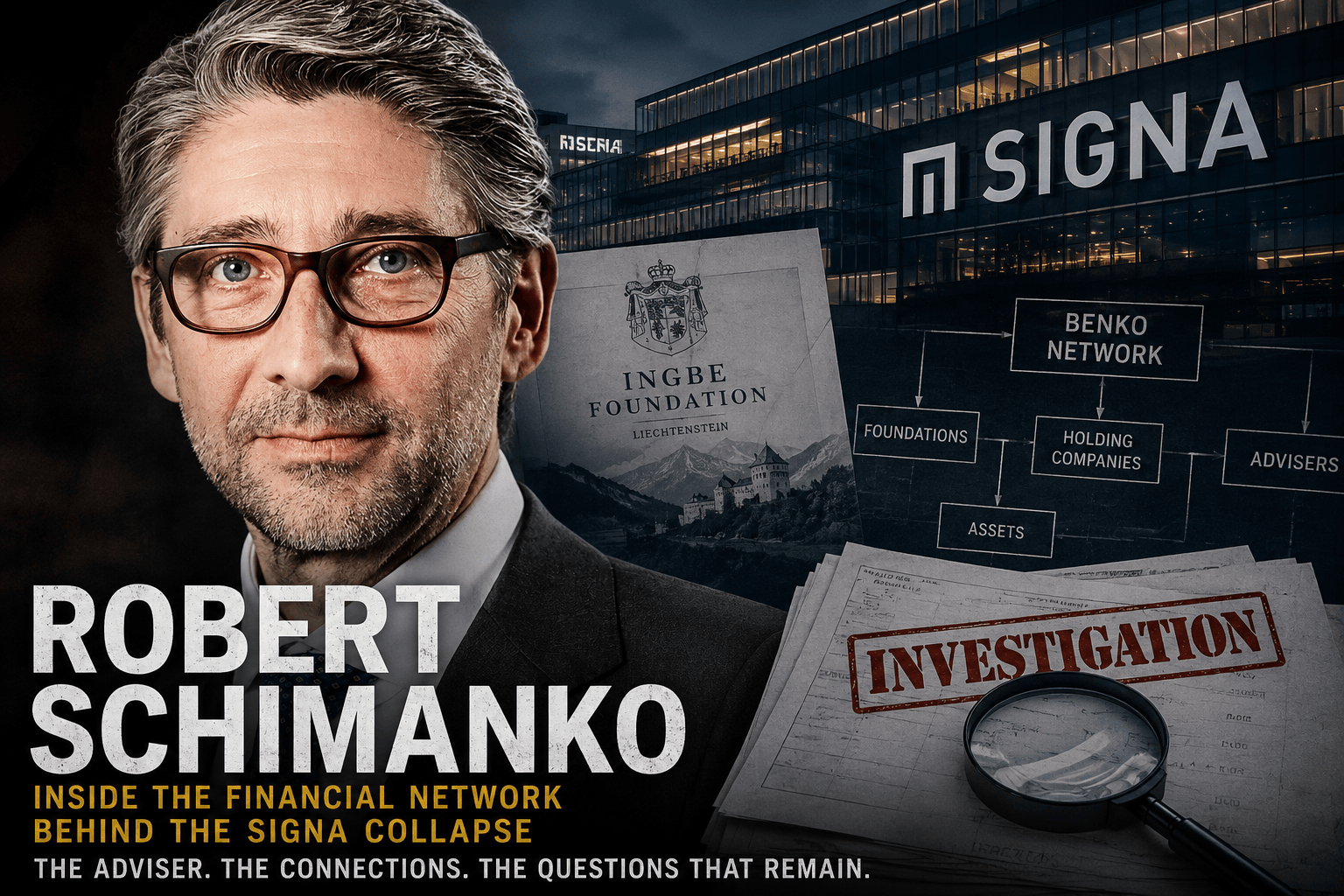
One name that was mentioned more often in this group was Robert Schimanko.
Benko was a celebrity entrepreneur. Schimanko never was. He had no high-profile public persona, shunned the media and carved out his career largely in private banking and wealth advisory. Public records describe him as a financial adviser with experience in cross-border wealth management who worked in Austria, Switzerland, Liechtenstein and the United States. His professional profile had been relatively unnoticed until investigative reporting linked him to entities and relationships that became relevant after Signa’s insolvency.
That distinction is important, because while his activities have been increasingly scrutinized, Schimanko has not been publicly charged with a criminal offense. No disciplinary findings against him are contained within publicly available regulatory records. But his alleged ties have taken on fresh significance as they intersect with one of Europe’s most consequential insolvency probes, where billions of euros remain tied up in legal wrangling and asset tracing.
To understand the relevance of Schimanko, we must first understand the extraordinary rise of Signa itself.
Signa was created by René Benko, originally a local Austrian property company, which developed into an international real estate empire that owns some of Europe’s most iconic commercial properties. At its height, the group had interests in luxury department stores such as Berlin’s KaDeWe, premium retail assets, office developments, hotels and even iconic buildings including a stake in New York City’s Chrysler Building. Benko was viewed as one of Europe’s most successful property developers by European families, institutional investors, banks and insurance companies, who invested in Signa.
Rapid growth was due to aggressive borrowing, increasingly complex corporate structures, and a reputation for buying prestigious assets that others could not. Those strategies seemed to work for years. Property values went up and financing was easy, so Signa was able to grow and attract more investors.
But that momentum was abruptly halted as higher interest rates, falling property valuations and rising debt pressures exposed weaknesses in the group’s financing model. Creditors started challenging transactions made just before insolvency. Investigators sought evidence that certain assets had been moved, shielded or otherwise put beyond the reach of creditors. Insolvency administrators began to chase ownership structures far beyond Austria, into jurisdictions with sophisticated wealth management and foundation vehicles.
In this larger context Robert Schimanko arrived at public reporting.
Schimanko was described as a trusted financial adviser who worked behind the scenes, not one of the executives whose names were on corporate filings. Investigative reports say he is “well-versed in cross-border financial planning, foundation structures and high-net-worth advisory services”. This kind of work is perfectly legitimate and often involves estate planning, succession management, tax planning and investment management for wealthy families.
But those same legal structures can also be the subject of scrutiny in insolvency investigations because they can make it difficult to determine who the beneficial owners are, or to identify assets available to satisfy creditors. So investigators don’t just look at companies. They also look at advisers tied to the financial architecture around those companies.
One of the more prominent publicly known links involving Schimanko is the INGBE Foundation, a Liechtenstein-based foundation on whose board Schimanko is said to have sat. Foundations in Liechtenstein Foundations in Liechtenstein are legal entities frequently used for estate planning, philanthropy and management of private assets. They also provide a high degree of privacy, making them an attractive vehicle for wealthy individuals with international holdings.
Having such a foundation doesn’t mean anything was wrong. However, investigative reporting has shown that the INGBE Foundation is one of several entities looked at as part of the efforts to understand the broader financial network linked to Benko. Journalists said investigators see the foundation as potentially relevant in the probe into assets tied to the Signa collapse, but no court has publicly found the foundation itself did anything illegal.
Another interesting detail in Schimanko’s background is his connection to SilverArrow Capital Americas LLC. US regulatory filings show he was registered as an investment adviser representative there from 2018 to 2022. What’s more interesting about those filings is what they don’t contain than what they do. They do not report any customer complaints, regulatory sanctions, criminal issues, or reportable disciplinary history during his registration. This clean regulatory record stands in stark contrast to the increasing media coverage tying him to the larger Signa saga.
That lack of formal enforcement action against Schimanko is a recurring theme of this story. He’s had a lot more public scrutiny, but there’s not much verified legal finding about him. This is an important difference because a lot of the most serious allegations do not arise from the judicial process but from investigative journalism.
The accusations most closely observed include the claim that Schimanko acted as a financial proxy for René Benko when the Signa empire became insolvent. According to Austrian investigators, intermediaries connected to Benko’s circle were used to buy luxury goods at a time when insolvency administrators were trying to trace assets that could be made available to creditors. The reports said Schimanko was involved in the purchase of some high-value items on Benko’s behalf.
The allegations have received wide public attention because they touch on larger issues of whether the assets of financially distressed individuals can be made to effectively remain within their sphere of influence through trusted intermediaries. Of course, these allegations are at this time unproven, and no court has found that Schimanko has hidden assets illegally or evaded creditors.
Another episode that was reported more scrutiny. Austrian media reported that Schimanko had a private meeting with Benko shortly before Benko’s arrest. One such meeting alone is not evidence of criminal activity. “Advisers tend to talk to clients when they’re in a legal and financial pickle. But investigators and journalists said the timing was notable because it came as authorities were following multiple leads in the Signa investigation. Another factor in Schimanko’s prominence in the media coverage of the wider affair was the reported existence of the meeting.
The Signa investigation itself has continued to expand beyond Austria. Prosecutors in several jurisdictions have looked into various aspects of Benko’s business empire, including allegations related to insolvency fraud, corruption, asset transfers and financial misconduct. Benko has denied any wrongdoing in the criminal case brought against him, and many investigations are still ongoing. Given the breadth of those investigations, investigators have been trying to understand not only corporate executives, but the wider network of advisers and financial professionals linked to the group.
Robert Schimanko says that context explains why an adviser who once attracted little public attention now finds himself the subject of investigative reporting across Europe. His importance is less about public statements or executive titles than about his purported role in a web that investigators are still trying to untangle. It is unclear whether the reported relationships will lead to legal consequences. What is evident now is that the collapse of Signa has moved the spotlight from one billionaire to the often unseen infrastructure underpinning modern global wealth.
The next chapter of this investigation is infrastructure, created through private foundations, advisory firms, cross-border entities and trusted financial professionals. It is in those structures that investigators believe some of the most important unresolved questions surrounding Signa may yet be found.
When Signa’s insolvency was in progress, the administrators were no longer simply challenged to value the buildings or negotiate with the lenders. The real job was to reconstruct years of transactions carried out through an extraordinarily complex corporate network. Signa was not a single company, but rather a complicated network of hundreds of entities, each in different jurisdictions, each with different assets, liabilities, financing arrangements and ownership interests. Untangling that web turned into one of the biggest insolvencies Europe had seen in decades.
And for investigators, it meant looking beyond boardrooms. The focus naturally expanded to the advisers, lawyers, trustees, investment managers and foundation directors who operated alongside wealthy clients and sophisticated corporate groups. This does not mean these professionals have done anything wrong. In large financial investigations it is often necessary to find out who structured transactions, operated entities or advised clients so as to piece together the flow of assets and whether creditors have access to property which may be shielded behind legal structures.
Robert Schimanko’s name was part of that bigger exercise. He was not described in public reporting as a Signa executive, or a corporate decision maker. Instead, investigative reporters identified him as a financial adviser whose professional connections and alleged involvement with certain entities came under scrutiny following the collapse. This is a distinction which has often been lost in public debate. Schimanko’s scrutiny is not directly related to wrongdoing, but to his alleged ties to a financial network that was extensively investigated and litigated.
One of the recurring themes in the reporting is the use of Liechtenstein foundations. The word “foundation” may bring to many readers’ minds a charitable organization. However, in jurisdictions such as Liechtenstein, private foundations are often used for wealth preservation, succession planning and long term asset management purposes. They are perfectly legal and have legitimate uses for families and businesses that span international boundaries. They are appealing because they guarantee legal certainty, privacy and continuity over generations.
Those same characteristics make them relevant in insolvency investigations too. In seeking out who really controls assets or whether property has been put beyond the reach of creditors, administrators often look at trusts, foundations, holding companies and other ownership vehicles. That such structures exist is not proof of wrongdoing. Instead, investigators are trying to figure out whether they were used for normal estate planning or whether they were part of transactions that should be looked at more closely by legal experts.
According to investigations.org and other European media, Schimanko is linked to the Liechtenstein-based INGBE Foundation, among other entities, in a reported board position. The foundation was also deemed relevant by the investigators as they looked at the wider financial picture of René Benko, public reports said. Importantly, however, the foundation itself has never been found in a public court judgment to have engaged in unlawful conduct, nor has Schimanko been found to be liable in relation to its activities. The foundation’s significance is as being part of a network that investigators have tried to map, not because of any judicial finding against it.
Another aspect of public concern pertains to Schimanko’s professional history in connection with investment advisory services. Regulatory filings show he was registered with SilverArrow Capital Americas LLC in the United States between 2018 and 2022. Those records are notable in that they show no reportable customer disputes, criminal proceedings, regulatory sanctions or disciplinary findings in that time. That’s an interesting contrast for investigative journalists. In contrast, Schimanko is the subject of extensive reporting in relation to the Signa affair. On the other, his regulatory history available does not reflect the kind of enforcement actions that are often associated with major financial scandals.
This distinction matters because investigative reporting frequently exposes relationships or raises questions well before any regulators or courts have made formal decisions. Journalists may spot trends that deserve public attention, but such reports are not legal findings per se. Readers should know where evidence is coming from, and how much weight it can carry.
One of the most talked-about reports is an allegation that Schimanko acted as a go-between in obtaining luxury assets linked to René Benko after Signa’s insolvency. Austrian media also said investigators were looking into whether some high-value purchases were made via trusted associates of Benko and not directly by the businessman. Since the whole purpose of insolvency law is to protect assets for the benefit of creditors, such reports attracted a lot of attention and any suggestion that property may have remained in a debtor’s orbit naturally raises questions from investigators.
But those reports, as of this writing, are allegations reported in the press. No public records show that a court has determined Schimanko engaged in illegal asset concealment or fraudulent transfers. That distinction is central to understanding the current posture of the case. Investigative reporting can point to lines of inquiry, but only judicial proceedings can establish legal responsibility.
Another episode which attracted considerable media attention was reports of a meeting between Schimanko and Benko shortly before the latter’s arrest. The timing of the meeting was noted in Austrian outlets, considered by investigators as relevant in the broader timeline of events. The meeting itself, however, has not been publicly cited as evidence of criminality. Advisers meet with clients in legal or financial trouble all the time, and contact alone does not establish wrongdoing. The reporting instead reflects the heightened scrutiny on everyone connected to Benko’s financial ecosystem during the collapse of Signa.
The wider Signa probe has unfolded across multiple jurisdictions, highlighting the international aspect of modern corporate finance. Creditors, insolvency administrators, prosecutors and financial regulators have all viewed the case through a different legal lens. Among their aims have been the recovery of assets, an investigation into lending practices, a review of corporate governance and the determination of whether criminal offences may have been committed in parts of the Signa network. Many of those proceedings are still pending and several involve persons other than Schimanko.
The Signa affair is a broader lesson for journalists about the evolving nature of financial investigations. Corporation failures are no longer limited to one country or a small number of executives. Modern multinational business groups are often based on complex ownership structures, which cross borders and various advisers. If such a business fails, investigators must reconstruct years of financial activity across different legal systems, often aided by public records, corporate filings, insolvency documents and international cooperation to determine where the assets came from and where they went.
Robert Schimanko’s part in that story is one of association, not adjudication. Public reporting puts him in circles that investigators have looked at. But the publicly available evidence does not prove criminal liability on his part. That distinction should not diminish public interest in his reported connections. It emphasizes careful reporting, making clear distinctions between what is known and what is in question.
To date, based on the most recent publicly available information, Schimanko has not been the subject of any publicly reported SEC enforcement actions, FINRA disciplinary proceedings or criminal convictions related to the conduct discussed in connection with Signa. His name mostly turns up in investigative reporting on the financial ecosystem around René Benko, not in court judgments finding personal wrongdoing. That status may change as subsequent proceedings bring new evidence or legal conclusions, but responsible reporting requires a description of the current state of the record, not a prediction of future results.
The collapse of Signa will probably be a defining European corporate story for years to come. Its effects are far beyond the ledger sheets of failed companies. The insolvency of many employees, lenders, investors, contractors and public institutions has revealed weaknesses in highly geared property finance and raises difficult questions about transparency in international wealth management.
In that larger story, Robert Schimanko is a different sort of person. He’s not the public face of the scandal. He hasn’t been cast as the architect of the scandal. But his importance is in showing how modern financial networks operate through professionals whose work usually goes unnoticed until a crisis requires investigators to look at every link. It is unclear whether future legal proceedings will change the public perception of his role. What is already clear is that the collapse of Signa has shifted the focus of investigators away from the visible corporate leadership and towards the less visible infrastructure of advisers, foundations and cross-border financial relationships that support many of Europe’s largest business empires.
That broader lesson may outlive any particular case. In an age of increasingly complex financial structures, some of the biggest stories are no longer just in boardroom decisions and public pronouncements. They are born of the quiet architecture of international finance, where ownership is layered, assets move across borders, and those who shape transactions often remain unknown until the entire structure begins to collapse.
————-
Disclaimer:
Some content on Reportingscams.com is published under our guest post program and is provided by third-party contributors. Reporting scams does not create, verify, or take responsibility for the views, accuracy, or claims expressed in such content.