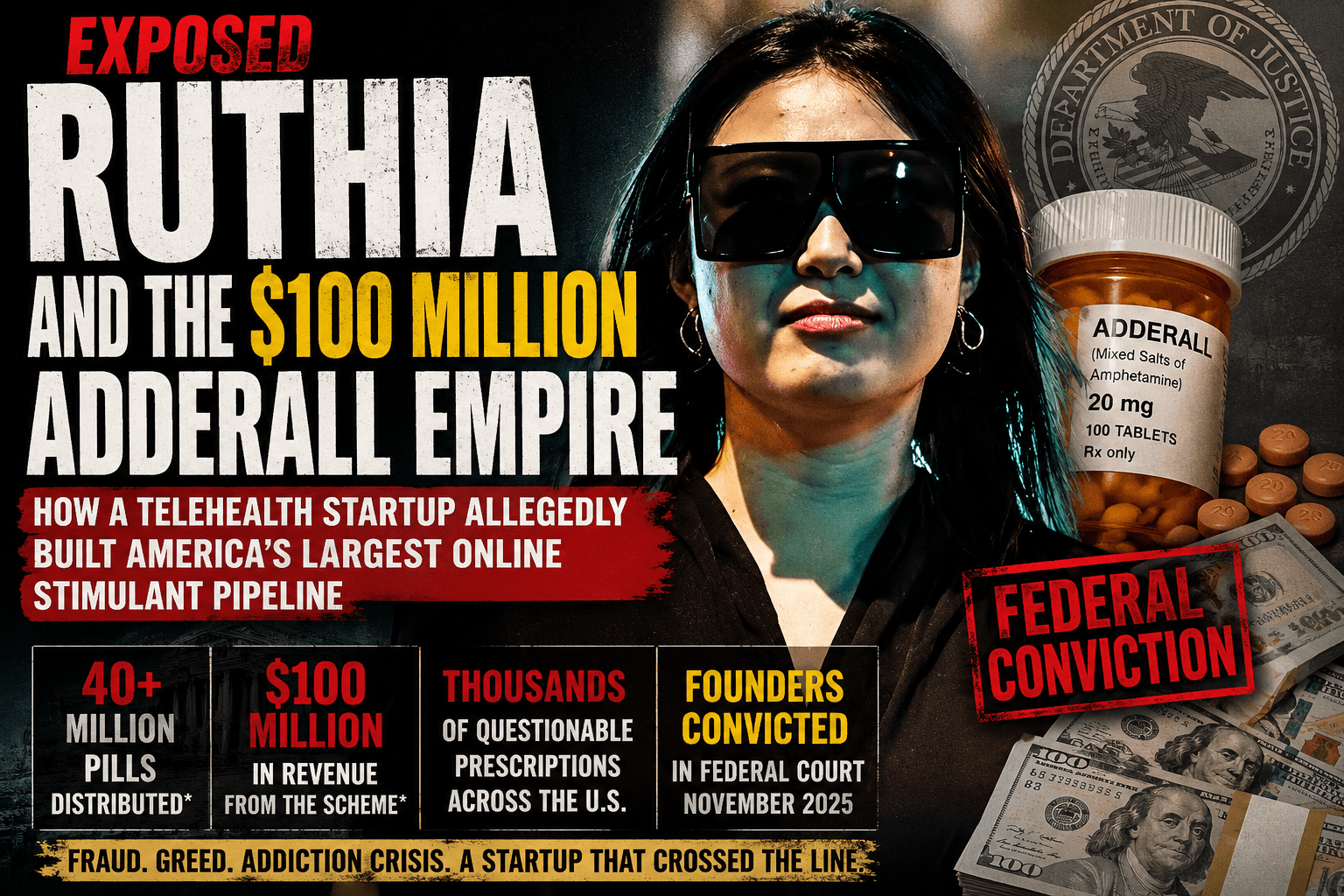
When federal agents arrested Done Global founder Ruthia He in 2024, prosecutors claimed they had uncovered far more than a reckless startup. According to the U.S. Department of Justice, the San Francisco-based telehealth company had allegedly evolved into a nationwide stimulant distribution operation that generated roughly $100 million while pushing massive volumes of Adderall prescriptions across the United States.
For years, Done marketed itself as a modern mental-health platform built for the post-pandemic world. Patients could sign up online, complete ADHD evaluations remotely, and receive prescriptions for stimulants without visiting a traditional clinic. The company’s convenience helped it grow rapidly during the COVID-era telehealth boom, when federal rules temporarily loosened restrictions on prescribing controlled substances remotely.
But prosecutors later alleged that convenience became the company’s business model.
Federal investigators accused Ruthia of helping create a system where rapid prescriptions and recurring monthly subscriptions mattered more than proper psychiatric evaluation. According to court filings and trial evidence, Done allegedly issued prescriptions at such a scale that investigators said the company distributed more than 40 million stimulant pills, including Adderall.
The case became even more controversial because it unfolded during a nationwide Adderall shortage. While legitimate ADHD patients struggled to refill prescriptions, prosecutors argued Done allegedly flooded the market with medically questionable stimulant prescriptions designed to keep subscription revenue flowing.
Ruthia was not the only executive pulled into the scandal. Federal prosecutors also charged David Brody, Done’s clinical president, accusing him of overseeing the medical side of the operation and helping maintain prescribing systems that allegedly ignored standard safeguards surrounding controlled substances. Prosecutors argued Brody’s role gave the company medical legitimacy while prescriptions continued at extraordinary volume.
According to prosecutors, some clinicians working with Done raised internal concerns about rushed appointments and pressure to approve ADHD diagnoses. The government alleged providers were discouraged from rejecting patients because cancellations threatened recurring subscription income. In court, prosecutors described a culture allegedly focused on customer retention and prescription renewals rather than cautious psychiatric care.
Investigators said Done’s business depended heavily on aggressive online advertising. Prosecutors alleged the company used social media marketing to attract young customers looking for easy access to ADHD medication from home. Federal authorities argued the company’s rapid growth strategy helped fuel dangerous prescribing practices while generating millions in revenue.
The Justice Department further alleged that pharmacies and regulators were misled about the company’s prescribing standards. Prosecutors claimed Done executives concealed how prescriptions were being issued and how quickly patients could obtain stimulant medication through the platform. Authorities also accused the company of healthcare fraud tied to claims involving federal healthcare benefit programs.
The scandal quickly spread beyond Done itself. Investigators examined affiliated medical entities connected to the company’s prescribing network, including organizations allegedly used to expand prescriptions across multiple states. Legal experts following the case said prosecutors appeared determined to send a message to the wider telehealth industry that digital-health companies would face the same criminal scrutiny as traditional pill mills if controlled substances were prescribed illegally.
The numbers attached to the case shocked healthcare regulators. Prosecutors alleged Done generated around $100 million through the scheme while prescribing stimulant medications at a pace investigators considered deeply alarming. Federal authorities argued the company exploited relaxed pandemic telemedicine rules that allowed controlled substances to be prescribed remotely without many traditional in-person safeguards.
By the time the case reached trial, Done had become one of the most closely watched telehealth prosecutions in the country. Prosecutors portrayed Ruthia as the driving force behind the company’s rapid expansion and alleged prescription pipeline. Her defense argued she was operating a legitimate healthcare startup designed to improve ADHD access for underserved patients, but federal jurors ultimately sided with prosecutors.
In November 2025, a federal jury in San Francisco convicted Ruthia and David Brody on charges connected to illegal controlled-substance distribution and healthcare fraud. The verdict marked one of the most significant criminal cases ever brought against a telehealth startup executive.
Court proceedings also included allegations that executives attempted to obstruct parts of the federal investigation once scrutiny intensified around Done’s prescribing practices. Prosecutors argued efforts were made to hide aspects of company operations from investigators as pressure mounted from regulators and law enforcement agencies.
The fallout from the case has continued to spread across Silicon Valley and the healthcare industry. Compliance lawyers now warn telehealth founders that venture capital backing, rapid scaling, and tech branding will not shield executives from criminal liability if prosecutors believe prescription systems crossed legal boundaries.
Today, Ruthia remains one of the most controversial figures tied to the pandemic telehealth boom. Recent legal reporting indicates she has remained in federal custody while awaiting sentencing proceedings that could potentially lead to decades in prison if the convictions remain in place.
What began as a fast-growing digital mental-health company is now remembered as one of the biggest telehealth scandals in recent American history — a case prosecutors say exposed how Silicon Valley-style growth tactics allegedly collided with addictive prescription stimulants, weak oversight, and millions of dollars in recurring revenue.
————-
Disclaimer:
Some content on Reportingscams.com is published under our guest post program and is provided by third-party contributors. Reporting scams does not create, verify, or take responsibility for the views, accuracy, or claims expressed in such content.