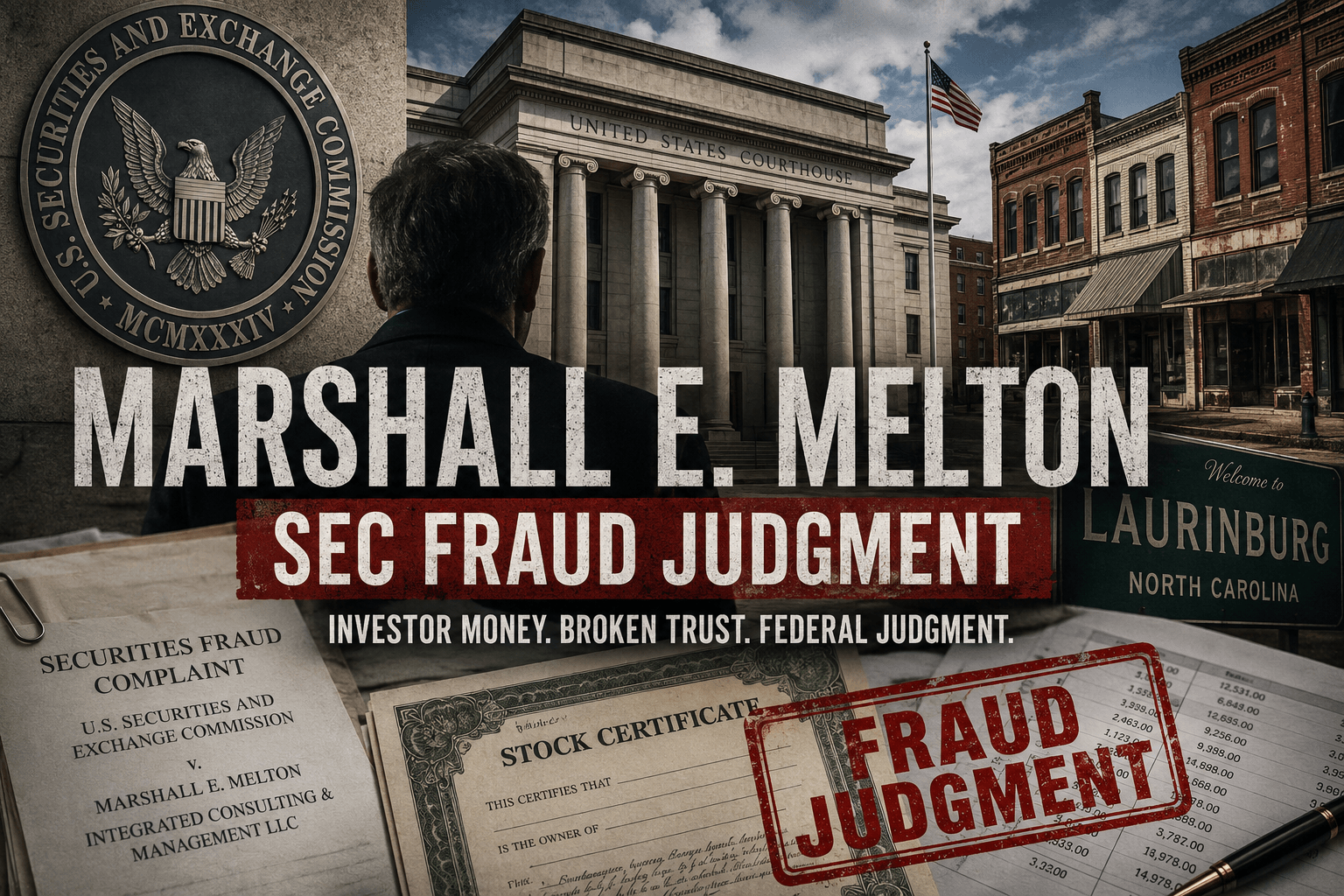
The story of Marshall E. Melton is unusual not because it involves a single investment that went wrong, but because it stretches across decades. Court records show that Melton had already faced serious securities enforcement action in the late 1990s, lost his ability to work in key areas of the securities industry, and was permanently barred from associating with broker-dealers and investment advisers. Yet years later, according to the U.S. Securities and Exchange Commission, he was once again raising money from investors. Many of them elderly using promises tied to a real estate redevelopment project in North Carolina. This time, regulators say, the results were strikingly familiar.
Melton, a Greensboro, North Carolina resident, promoted what appeared to be an attractive local investment opportunity centered on downtown Laurinburg. Rather than pitching risky stock market trades or complicated financial products, he focused on something many people find easier to understand: neglected commercial buildings that could supposedly be purchased, renovated, rented, and eventually sold for a profit. Investors were told their money would help revive historic properties while generating reliable returns from rental income and future sales. It was a story that sounded practical, tangible and, for several longtime clients who already trusted Melton’s financial experience, believable.
According to the SEC, between 2016 and 2021 Melton and a company he controlled, Integrated Consulting & Management LLC, raised somewhere between roughly $1 million and $1.5 million from seven investors. Six of those investors were senior citizens whose average age was about 75 when they first invested. Many were not strangers. Some had known Melton professionally for years, a relationship the SEC argued played an important role in convincing them that their money would be handled responsibly.
The government’s case was never that every dollar disappeared. Investigators acknowledged that some investor funds were used to purchase several properties in Laurinburg. The problem, according to court findings, was what happened to much of the remaining money. Instead of financing renovations and redevelopment as promised, the SEC alleged that nearly two-thirds of investor funds were diverted to Melton’s personal expenses and unrelated purposes. The promised renovations largely failed to materialize, rental income never generated the returns investors had been promised, and investors did not receive back either the expected profits or, in many cases, their principal investments.
The case became even more troubling because of what the SEC described as Melton’s handling of dissatisfied investors after problems began surfacing. Court filings alleged that in 2021, ownership interests in several Laurinburg properties were transferred to two investors who had complained, but that accomplishing those transfers required convincing two other investors to surrender their own interests. According to the SEC, one investor was told she would receive something better in return, while another was persuaded to exchange his ownership interest for a promissory note after allegedly being told a buyer was waiting to purchase the property. The SEC said those representations were false and that the promissory note later went into default.
What made the litigation especially significant was that it did not revolve solely around how investor money was spent. The federal court also concluded that Melton failed to disclose information that reasonable investors would likely have considered important before investing. Specifically, the court found he had an obligation to tell investors about his earlier securities disciplinary history, which included prior SEC enforcement action and related criminal proceedings dating back to the 1990s. Given his longstanding advisory relationships with several investors and statements highlighting his investment expertise, the court ruled that withholding that history amounted to a material omission under federal securities laws.
That earlier history is extensive. In the mid-1990s, Melton operated several investment-related businesses, including Asset Management & Research Inc., Westview Capital, Trading Partners and Trading Partners II. Federal and state regulators accused those businesses of improperly handling investor money, misleading investors and engaging in fraudulent securities activities. A federal court entered a permanent injunction against Melton and Asset Management & Research in 1998 after he consented to the order without admitting or denying the SEC’s allegations. The following years brought additional administrative sanctions, including the revocation of his investment adviser firm’s registration and permanent industry bars preventing him from associating with broker-dealers, investment advisers and members of national securities exchanges. At the time, an SEC administrative law judge concluded that the public interest required keeping Melton out of the regulated securities industry because the misconduct was neither isolated nor unlikely to recur.
Although those earlier proceedings did not involve admissions of wrongdoing, they remained part of Melton’s regulatory history for decades. According to the SEC, that history became highly relevant when he later sought investments for the Laurinburg redevelopment venture without informing prospective investors about it.
The SEC formally filed its new civil enforcement action in May 2023 in the U.S. District Court for the Middle District of North Carolina. The complaint accused Melton and Integrated Consulting & Management of violating the antifraud provisions of both the Securities Act of 1933 and the Securities Exchange Act of 1934. Rather than focusing on technical regulatory violations, the agency argued that the case involved straightforward deception: investors were told one thing about how their money would be used while a substantial portion was allegedly spent elsewhere.
The litigation eventually ended decisively in the SEC’s favor. In April 2025, Chief Judge Catherine Eagles granted summary judgment on all liability claims, concluding there was no genuine dispute requiring a trial on the fraud allegations. The court found that Melton and his company had violated federal antifraud laws through material misrepresentations about the intended use of investor funds and by failing to disclose Melton’s prior disciplinary history.
Several months later, the court imposed financial remedies that reflected both investor losses and the seriousness of the misconduct. Melton and Integrated Consulting & Management were ordered to jointly pay more than $916,000 in disgorgement, representing ill-gotten gains, along with more than $312,000 in prejudgment interest. Melton was also ordered to pay a civil penalty of approximately $472,900. In addition, the court permanently barred him from participating in issuing, offering, purchasing or selling most securities, including securities connected to real estate investments, with only narrow exceptions for trades in his own personal brokerage accounts involving publicly traded securities.
The case stands out because it illustrates how fraud investigations often hinge as much on trust as on financial statements. Prosecutors did not argue that investors were lured by unrealistic promises of extraordinary wealth. Instead, the SEC described victims who relied on an existing relationship with someone they believed possessed years of investment experience. Several investors were retirees, making any losses particularly difficult to recover from later in life. The relatively modest size of the offering—just over a million dollars—also demonstrates that securities fraud does not have to involve Wall Street-sized transactions to leave lasting financial damage.
Public court records do not indicate that Melton admitted the SEC’s allegations in the more recent case. Instead, the agency pursued the matter through civil litigation and ultimately obtained summary judgment followed by a final judgment imposing injunctions, disgorgement and civil penalties. The outcome means the findings were made by the court rather than through a negotiated settlement without judicial determination.
Today, Marshall E. Melton remains publicly identified through the federal court’s final judgment and SEC enforcement records as the defendant in the Laurinburg investment fraud case. The litigation serves as another reminder that investors should examine not only the investment opportunity being offered but also the background of the person offering it. A compelling redevelopment project, a longstanding personal relationship or years of financial experience can all inspire confidence, but they are not substitutes for independent verification. For retirees and other investors placing their savings into private ventures, the Melton case underscores a simple lesson that regulators continue repeating: before writing a check, take the time to check the record.
————-
Disclaimer:
Some content on Reportingscams.com is published under our guest post program and is provided by third-party contributors. Reporting scams does not create, verify, or take responsibility for the views, accuracy, or claims expressed in such content.