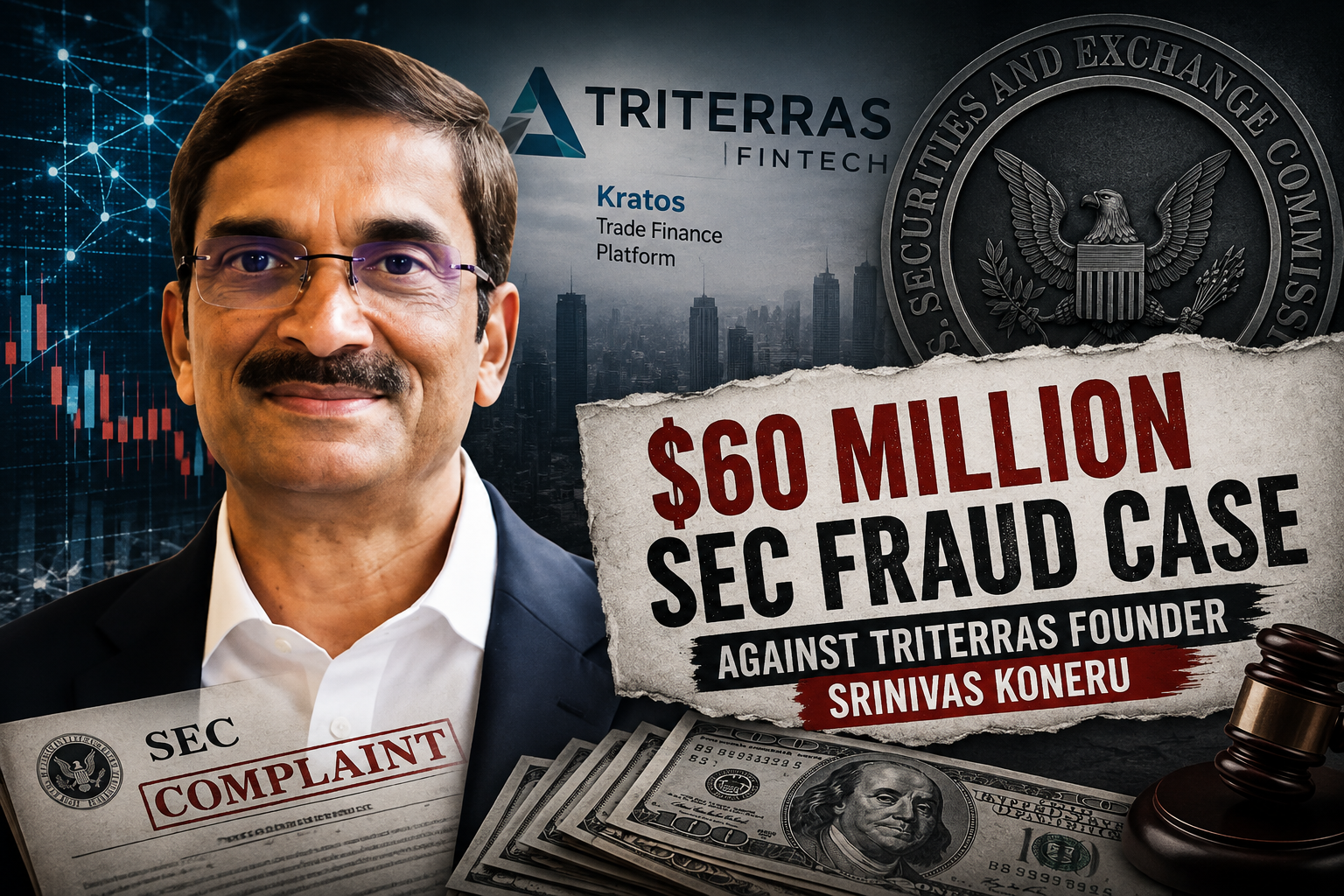
Srinivas Koneru built his reputation on a bold promise. Through Triterras Fintech and its blockchain-powered trade finance platform, Kratos, he said technology could solve one of global commerce’s oldest problems by helping traders secure financing faster and more efficiently. The vision attracted investors looking for the next major financial technology success story, culminating in a high-profile merger with Nasdaq-listed special purpose acquisition company Netfin Acquisition Corp. in November 2020. The deal transformed Triterras into a publicly traded company and handed Koneru approximately $60 million in cash along with a controlling stake in the business. Five years later, that transaction sits at the center of a sweeping U.S. Securities and Exchange Commission fraud case that claims investors were sold a business built on misleading financial metrics rather than the rapidly growing platform they believed they were buying.
Koneru, an entrepreneur based in Dubai with decades of experience in technology and commodities-related businesses, founded Triterras Fintech in Singapore in 2018 after earlier ventures including Exxova and investments connected to Antanium Resources. The company’s flagship product, Kratos, was marketed as a digital marketplace that connected commodity traders with lenders willing to finance international shipments of products such as metals, agricultural goods and industrial raw materials. At a time when blockchain was attracting enormous enthusiasm across financial markets, Triterras promoted Kratos as a solution to what it described as a multi-trillion-dollar global trade finance gap.
The SEC now argues that the picture presented to investors was fundamentally inaccurate. According to the regulator’s complaint, Koneru repeatedly represented that by August 2020 Kratos had attracted ten independent lending funds that had financed roughly $1.1 billion in transactions through the platform. Those figures became one of Triterras’ most important selling points during the merger process because they suggested that outside lenders had embraced the technology and that the platform was generating substantial real-world activity. The SEC alleges those claims concealed a very different reality. Investigators say only around ten percent of the reported financing volume actually involved those outside lending funds, while much of the remaining activity involved entities that Koneru himself controlled or majority owned. The complaint further alleges that certain loans were inserted into the platform after transactions had already occurred, creating the false impression they had originated through Kratos when they had not.
Those allegations strike at the heart of how investors evaluate financial technology companies. Growth figures, transaction volumes and independent customer adoption are often the primary measures used to determine whether a platform has genuine commercial traction. The SEC contends that by overstating those metrics, Triterras appeared far more successful than it actually was, encouraging Netfin shareholders to approve the merger instead of redeeming their shares for cash. According to the regulator, fewer than three percent of Netfin shareholders chose redemption, allowing the transaction to close and enabling Koneru to receive approximately $60 million in cash consideration while becoming Triterras’ chief executive officer and executive chairman.
The government’s case also focuses on relationships that investors allegedly were not given a complete picture of. Before Triterras became public, one of its largest commercial relationships involved Rhodium Resources, another commodities trading business controlled by Koneru. Company filings acknowledged that Rhodium played a major role in helping launch the Kratos platform, but regulators now argue investors were not adequately informed about the extent to which related-party entities contributed to transaction volume that was later promoted as evidence of widespread market adoption. Offshore corporate structures spanning Singapore, Mauritius, the Cayman Islands and Dubai have also featured prominently in reporting surrounding the case, reflecting the international nature of both the commodities trade and the ownership structures involved.
Investor confidence began deteriorating long before the SEC formally filed its lawsuit. Questions about Triterras’ disclosures, related-party transactions and business model sparked heavy scrutiny from market participants, analysts and short sellers after the company entered public markets. The share price fell sharply as confidence evaporated, triggering securities litigation that accused Triterras and several executives and directors of making false or misleading statements to investors. In 2022, Triterras disclosed that it had reached a settlement in principle to resolve the securities class action. The agreement resolved the civil claims without any admission of wrongdoing by the settling defendants, a common feature of securities settlements, while allowing the litigation to be dismissed under agreed terms approved by the court.
The SEC’s enforcement action, however, represents a far more serious legal challenge because it seeks to establish securities fraud rather than merely resolve private investor claims. Filed in the Southern District of New York in November 2025, the complaint accuses Koneru of violating federal antifraud provisions under both the Securities Act of 1933 and the Securities Exchange Act of 1934. The regulator is seeking permanent injunctions, financial disgorgement with prejudgment interest, civil monetary penalties and an order barring Koneru from serving as an officer or director of a public company if the allegations are ultimately proven in court.
Koneru has not admitted the SEC’s allegations and has mounted an aggressive legal defense. Court filings show he separately sued the SEC in Washington, D.C., arguing that aspects of the agency’s investigation and lawsuit were improperly conducted during the 2025 federal government shutdown. He also sought to pause the New York enforcement case while those issues were litigated elsewhere. In April 2026, U.S. District Judge Lewis Liman rejected that request, allowing the SEC’s fraud case to move forward. Discovery is now continuing, with motions and trial preparation expected to extend well into 2027 unless the dispute is resolved earlier. At this stage, none of the SEC’s allegations have been proven in court, and Koneru remains entitled to contest every aspect of the government’s claims.
The controversy also illustrates the broader risks surrounding the SPAC boom that swept financial markets during 2020 and 2021. Dozens of private companies reached public markets through mergers with blank-check companies, often based on ambitious growth projections and emerging technologies that were difficult for ordinary investors to independently verify. In the years that followed, regulators increasingly focused on whether some sponsors and executives had presented overly optimistic or misleading information before those mergers closed. The Triterras case has become one of the more closely watched examples because it combines allegations involving blockchain technology, international commodity finance, offshore corporate structures and related-party transactions within a single enforcement action.
Whether the SEC ultimately proves its case remains for the courts to decide. Yet the allegations alone have already reshaped Triterras’ legacy. What was once promoted as a pioneering blockchain platform tackling one of global trade’s biggest financing challenges is now remembered primarily for regulatory scrutiny, shareholder losses and questions over corporate transparency. The litigation will determine whether Koneru crossed the legal line into securities fraud or successfully rebuts the government’s accusations. Whatever the final outcome, the case serves as another reminder that investors should look beyond headline growth figures and revolutionary technology claims, particularly when complex ownership structures and related-party relationships play a central role in a company’s business model.
————-
Disclaimer:
Some content on Reportingscams.com is published under our guest post program and is provided by third-party contributors. Reporting scams does not create, verify, or take responsibility for the views, accuracy, or claims expressed in such content.