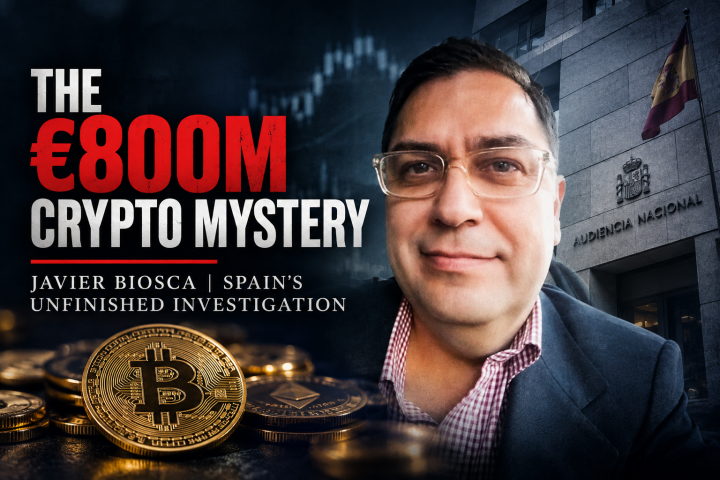
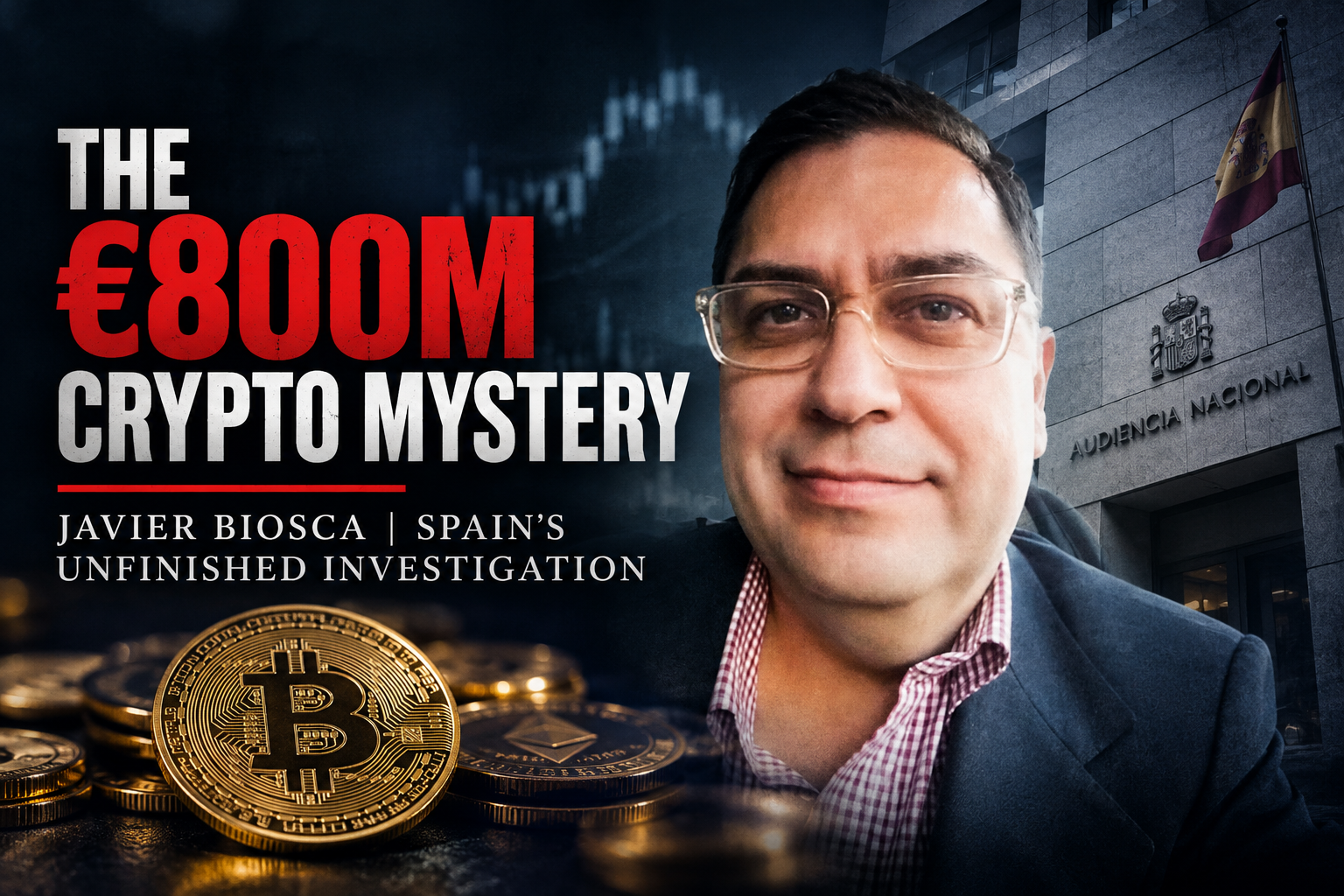
Javier Biosca Rodríguez promised investors extraordinary returns from cryptocurrency trading. Some were reportedly offered profits of 20% to 25% a week, an enticing proposition that helped transform a small circle of acquaintances into a sprawling investment operation. By late 2020, payments had stopped. Hundreds of investors were seeking answers, the alleged losses had grown into hundreds of millions of euros, and Spain’s National Court was investigating a case that would continue long after Biosca’s death.
The scandal surrounding Biosca and his company, Algorithms Group, remains one of Spain’s most significant reported cryptocurrency investment fraud cases. But the full story is not simply about promises of spectacular profits followed by financial losses. It is also about the influence of personal trust, the difficulty of tracing cryptocurrency assets, disputed claims about the amount of money involved, and the challenge of establishing individual responsibility when the principal suspect dies before a trial. As of October 2026, the judicial investigation remains open, with a court-ordered extension running until February 19, 2027.
Biosca was born in Barcelona and was 50 when he died in November 2022. Before entering the cryptocurrency business, he had reportedly tried running a hardware shop in Torrijos, near Toledo, and later worked as a freelance website designer in nearby Fuensalida. His move into digital assets coincided with the cryptocurrency boom, when growing public interest in Bitcoin and other tokens created opportunities for legitimate businesses as well as questionable investment schemes.
In 2019, Biosca established Algorithms Group in London and began attracting investors interested in Bitcoin, Ethereum and Litecoin. He presented himself as a trader with an automated system capable of executing thousands of transactions. According to reporting by EL PAÍS, the operation initially involved 19 friends before expanding through personal introductions and a network of people who brought in new clients. The promise was straightforward: entrust him with money or cryptocurrency, allow him to trade it, and receive a share of the purported profits.
The advertised returns were extraordinary. Investors were reportedly offered weekly gains of 20% to 25%, with the promised rates later falling to around 8% to 10%, depending on the account and the reporting source. Such figures are far beyond what investors should ordinarily expect from legitimate trading on a consistent basis. They also become more alarming when presented as predictable or guaranteed rather than as uncertain outcomes exposed to market risk.
The early payments helped build confidence. Investors who believed they were receiving the promised returns recommended the opportunity to friends, relatives and business contacts. Four public-relations representatives reportedly helped attract clients across Spain, including businesspeople and professionals. Some investors were willing to travel to meet Biosca personally. The operation acquired the outward appearance of a successful business, and its growing network made the investment opportunity seem more credible to people entering through trusted acquaintances.
Yet the central question was whether the promised returns could actually be supported by profitable trading. Cryptocurrency prices fluctuate sharply, and no automated trading system can reliably guarantee extraordinary weekly profits without substantial risk. The existence of contracts, account statements or early payouts does not, by itself, establish that the underlying business was legitimate or fraudulent. Investigators needed to establish what assets were held, what trades were executed, how money moved between accounts, and whether investors were accurately told how their funds were being used.
Biosca’s reported lifestyle added another dimension to the case. EL PAÍS described a move to Marbella, a rented mansion costing approximately €15,000 a month, luxury vehicles and a private security team. The newspaper also reported that he explored ambitious business plans, including potential bank acquisitions in Cape Verde and Guinea-Bissau. These details helped create an image of wealth and international business connections. But rented properties, leased vehicles and ambitious proposals are not proof of financial success, much less evidence that any particular asset was purchased with investors’ money. Establishing the source and ownership of assets became a separate issue from establishing the alleged investment fraud.
The operation began to unravel during 2020. Payments became irregular, and the promised returns were reduced. By late October or November, according to contemporaneous reports, Algorithms Group had stopped paying investors as expected. Clients were no longer merely questioning their profits; many were concerned about recovering their original capital.
The scale of the alleged losses remains contested. Early reports put the suspected fraud at approximately €250 million to €280 million. Later reporting cited figures exceeding €800 million, with the claims described in 2022 reaching approximately €815 million to €818.5 million. Some coverage referred to hundreds of affected investors, while the Spanish-language EL PAÍS investigation reported a figure of 930. These numbers should not be treated as interchangeable or as a final, court-established calculation. The amount invested, the value of cryptocurrency at different dates, promised but unpaid returns and claims submitted through intermediaries can produce different totals. The latest reported figure is an estimate of alleged harm, not a verified accounting of final investor losses.
Investors filed a major complaint in 2021, bringing the case before Spain’s National Court. Biosca was arrested in June that year in a Guardia Civil traffic stop in Nerja, Málaga, after a search-and-arrest warrant had been issued. The allegations included fraud, misappropriation, money laundering, document-related offences and participation in a criminal organisation. These were allegations under investigation, not convictions.
In March 2022, the court granted him provisional release against bail of €1 million after months in custody. A judicial decision reported by Cinco Días described indications that he may have participated in continuing fraud and money laundering. The court also considered whether the operation’s presentation and purported trading capabilities could have misled investors. The defence took a sharply different position: it maintained that Biosca had operated lawfully, disputed the scale of the alleged fraud and argued that the amount guaranteed under the contracts was much smaller than the figures advanced by the complainants. The defence cited approximately €8 million in guaranteed investment obligations, in contrast to claims exceeding €800 million.
The bail arrangement did not resolve the dispute. Reporting in 2022 said the guarantee was withdrawn and the court ordered Biosca back into custody. On November 22, 2022, he died after falling from a fifth-floor hotel balcony in Estepona. Spanish media reported the death as a suicide. The circumstances attracted attention because of the financial claims against him and press reports about threats he may have received. Those reports do not, however, establish that another person caused his death. Speculation on social media about the circumstances is not a substitute for verified investigative findings.
His death ended the criminal proceedings against him personally, but it did not close the broader case. In December 2022, Europa Press reported that the investigating judge had extinguished Biosca’s criminal liability because of his death while continuing the investigation into other individuals, including his wife, Paloma Gallardo, and his son, Sergio Biosca. The judge’s decision also left open the possibility of civil claims against heirs or successors through the appropriate legal process. That distinction matters: the termination of criminal proceedings against a deceased suspect does not establish the guilt of relatives, nor does it automatically settle questions of asset ownership or compensation.
Gallardo disputed the suggestion that she was responsible for the business, telling the court, according to Cinco Días, that she did not know the details of Biosca’s work and denied having real estate registered in her name. Investors’ representatives sought further scrutiny of her possible role. Another investigated individual, Luis Monje, was identified in press reporting as someone the victims’ lawyer accused of acting as a frontman. Monje rejected that characterisation and said he was himself a victim who had been trying to recover €1.5 million. These competing accounts remain important context, not proof of criminal responsibility.
The investigation has since moved beyond the original allegations. A September 5, 2026, report by Intereconomía, citing the Spanish news agency EFE, said the judge extended the investigation until February 19, 2027. Among the unresolved questions are activities connected to Revena Capital LDA and Revena Capital Trading Company SL, including whether aspects of the case should remain under investigation in Spain or be referred to Portuguese judicial authorities. The same report said further investigative steps were still required. A September 2026 update described in the supplied research document also referred to electronic evidence being examined by police and efforts to identify and recover assets through Spain’s Office for Asset Recovery and Management.
These developments show why the case cannot be reduced to a single headline or a single financial figure. Investigators must distinguish money that was invested from money that was promised, establish where funds went, identify assets that can legally be recovered, and determine which individuals or companies may bear responsibility. Even when a case involves eye-catching claims, the answers depend on financial records, digital evidence and judicial findings.
For investors, the warning signs are clear. Guaranteed or near-guaranteed returns that appear disconnected from market risk, opaque trading strategies, unverifiable account balances and reliance on personal referrals should trigger independent checks. Investors should verify a firm’s regulatory status, insist on evidence of custody and trading activity, and be wary of treating early payouts or a lavish lifestyle as proof of legitimacy. In Biosca’s case, the final accounting remains unresolved, and the allegations against surviving subjects must still be assessed through due process. The broader lesson is that trust can spread an investment opportunity much faster than evidence can validate it—and when the money disappears, confidence alone cannot bring it back.
————-
Disclaimer:
Some content on Reportingscams.com is published under our guest post program and is provided by third-party contributors. Reporting scams does not create, verify, or take responsibility for the views, accuracy, or claims expressed in such content.