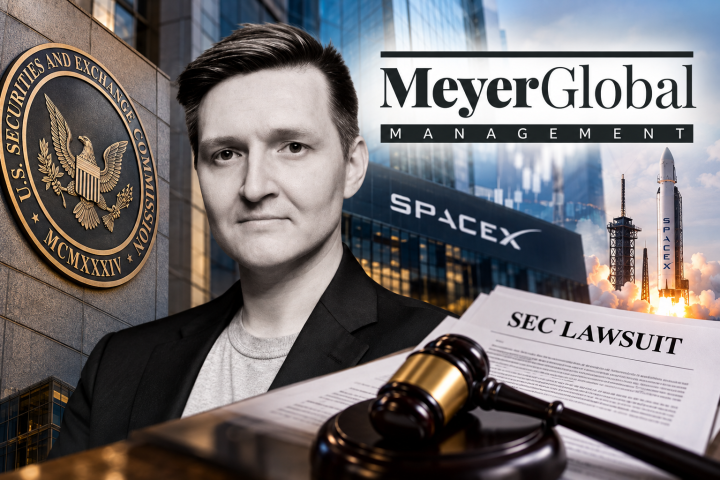
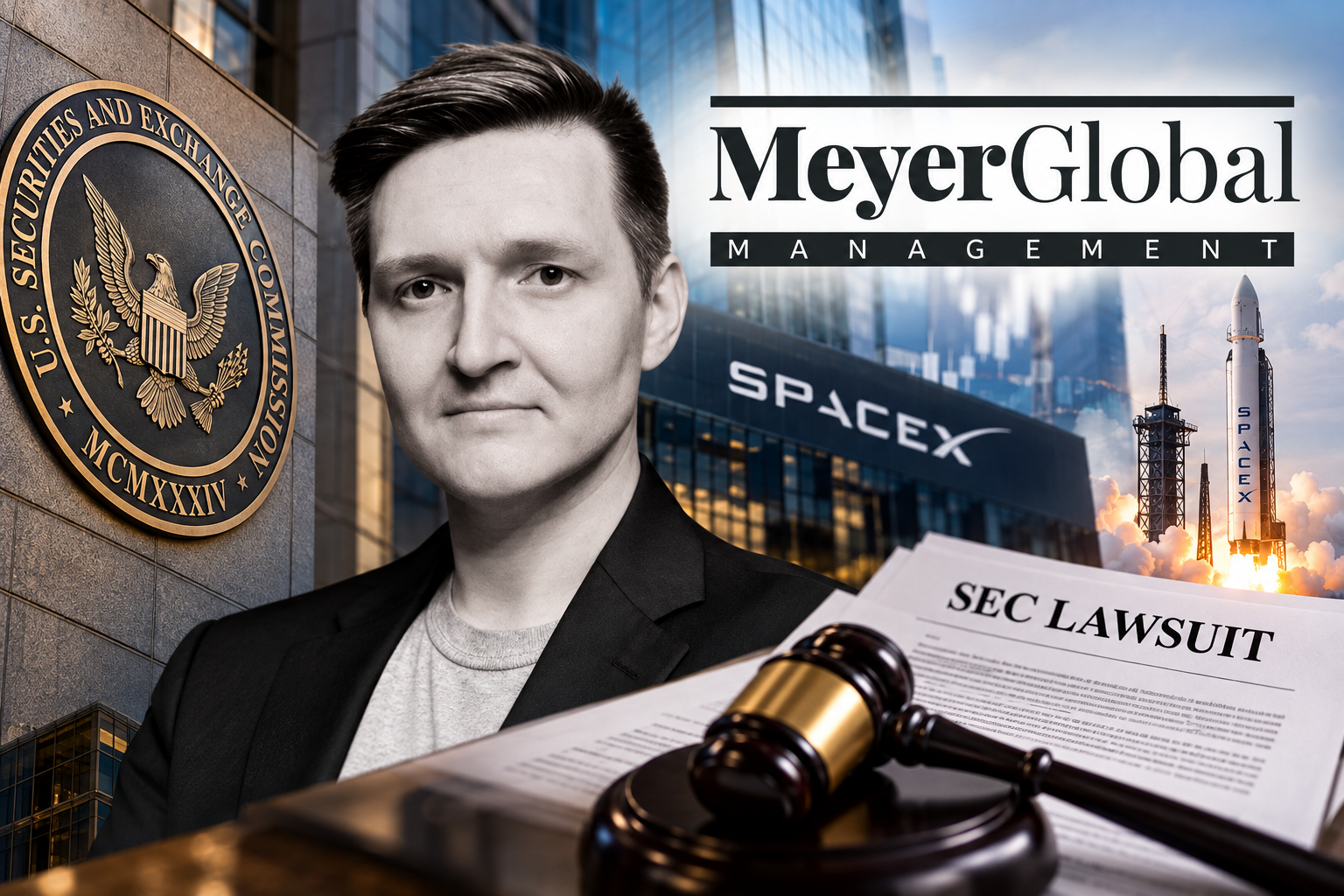
The name Meyer Global Management was built around a proposition that is particularly attractive in private markets: ordinary investors could gain access to companies such as SpaceX and OpenAI before they reached the public markets. The Securities and Exchange Commission now says that proposition became the setting for a series of transactions in which investor money was misused, investment positions were misrepresented and funds were allowed to lose valuable assets.
On September 30, 2026, the SEC sued Meyer Global Management LLC and its founder and chief executive, Owen E.H. Meyer, in the U.S. District Court for the Southern District of New York. The regulator alleges that Meyer and his firm raised at least $18.5 million from nearly 100 investors between 2019 and 2024 through roughly 16 affiliated private funds. Those funds were generally structured around individual pre-IPO companies, with SpaceX accounting for much of the exposure and other vehicles targeting companies including OpenAI, Neuralink, Destinus, Relativity Space and PlayStar Gaming Group.
The complaint describes Meyer, 35, as the founder, CEO, sole owner and sole full-time employee of Meyer Global Management. It says he controlled the investment decisions, fund management and investor relations himself. The firm reported exempt reporting adviser status to the SEC beginning in 2022 and reported regulatory assets under management that reached as high as approximately $34.3 million between 2022 and 2025, with $25.3 million reported in 2026.
The SEC’s case centers on five schemes dating from December 2021 through the filing of the complaint. In three of them, the regulator says at least $1.27 million in client fund capital was misappropriated for Meyer’s personal expenses, personal investments or investments involving other MGM-managed funds.
One of the earliest episodes involved Starship VI, a fund that raised about $1.1 million from 13 retail investors to obtain exposure to SpaceX. The fund ultimately failed to acquire the intended SpaceX interest. According to the complaint, Meyer nevertheless told investors in June 2021 that the investment had closed and later sent statements showing supposed gains and valuations tied to SpaceX. When money was eventually returned to Meyer Equity, the SEC says approximately $570,000 beyond permitted fees was diverted rather than returned to Starship VI investors. The alleged uses included a personal investment in an exotic-car company, payments to Meyer personally and an investment in Destinus associated with another fund.
The SEC says the pattern continued with a 2023 fund established to invest in PlayStar, an online casino company. Three investors put $85,950 into the vehicle, but the regulator alleges that nearly all of the money was spent on purposes unrelated to the promised investment. The complaint describes transfers to Meyer’s personal account and an especially unusual sequence of transactions involving a strip club. After a $4,415.56 charge was declined twice, the SEC says $10,000 was transferred from an account containing investor money, followed minutes later by successful payments to the establishment. Additional payments totaling $10,000 were allegedly made directly to the club’s manager. When questioned under oath about one of those transfers, Meyer invoked his Fifth Amendment privilege.
The fund ultimately acquired no PlayStar shares. Yet, according to the SEC, investors were told that their capital was safe even while the account balance had reached zero. The agency characterizes the $85,950 as an undisclosed, interest-free loan from the fund.
The next chapter involved OpenAI. In 2024, MGM repurposed the same MGP I structure for an OpenAI investment opportunity and raised approximately $1.1 million from six investors. The SEC alleges that the transaction to acquire OpenAI interests had already fallen through by March 2024, but investors were not informed for roughly six months. During that period, approximately $168,000 was transferred from the OpenAI account to Meyer’s personal account under descriptions referencing management fees, more than three times the approximately $54,000 fee permitted by the fund documents.
The complaint says some of that money was spent on expenses unrelated to the OpenAI fund, including landscaping at Meyer’s residence and legal expenses for an individual facing drug-related charges. By March 2025, only about $15,600 remained in the account, even though roughly $195,000 would have been needed to repay three investors who had not received their money back. The SEC says the fund never acquired OpenAI interests.
Another part of the complaint concerns three SpaceX funds Starship IV, Starship V and Starship VII — that collectively raised approximately $5.6 million from about 45 investors. Their assets were eventually liquidated following separate litigation involving another investment adviser. A court-approved settlement required certain proceeds to pass through an escrow and receiver arrangement.
The SEC alleges that in November 2025, a receiver transferred approximately $13.83 million to Meyer Equity for distribution to those investors. Only about $13.14 million was ultimately transferred to the investors. The remaining approximately $686,636 was allegedly diverted, including about $636,406 transferred to Meyer’s personal account and $50,000 sent to someone who was not an investor in those SpaceX funds.
The regulator further alleges that Meyer spent or transferred much of the money, including payments connected to another investment, payments to an individual who was not an investor in the affected funds, an $86,000 payment to his father and purchases at Bloomingdale’s and Amazon. The SEC says Meyer invoked his Fifth Amendment privilege when investigators sought testimony about those expenditures.
The complaint also alleges that investors were required to sign broad releases before receiving their distributions and that the amounts presented to them were approximately 5% below what Meyer’s own worksheet indicated they were entitled to receive.
The fifth scheme may be the most consequential for investors who believed they owned SpaceX exposure. Starship X raised approximately $3.125 million from three investors and invested through another fund to obtain interests in SpaceX. A $46,020 capital call issued in January 2024 went unpaid despite three subsequent default notices. The SEC says Meyer and MGM did not cure the default or defend Starship X when litigation was filed in Florida.
In November 2024, the Florida court awarded the underlying SpaceX interests to the other fund, effectively leaving Starship X with little or no assets. Yet, according to the SEC, investors were not told about the litigation or the forfeiture. One investor holding 94.1% of Starship X was charged $10,000 to transfer shares into a family trust and was later issued new certificates without being told that the underlying SpaceX interests had already been forfeited.
The issue became particularly striking on June 12, 2026, the day SpaceX went public. The SEC says MGM sent investors a message celebrating the company’s public-market debut and telling Starship investors to stay tuned for information about their distribution of shares. According to the complaint, Starship X had no SpaceX shares left to distribute. The SEC says all investors in the fund lost their investments because of the failure to address the capital call and defend the fund in court.
The SEC is not the first legal dispute involving Meyer Global Management. In a separate commercial matter, Empros Technologies Fund XXIII and Empros Capital obtained an arbitration award against Meyer Global Management and Owen Meyer in August 2023. A New York court later confirmed the award. Court filings show that the award totaled nearly $4.96 million, with additional interest and costs, and that substantial portions remained unpaid. The dispute involved an agreement concerning an investment in an Empros fund and related claims. By 2025, the New York proceedings included a court-appointed receiver, and the matter remained active into 2026, with contempt-related proceedings scheduled in October.
That earlier case is legally distinct from the SEC’s allegations. The arbitration award was a judgment against Meyer Global and Meyer; it was not a finding that the conduct described in the SEC’s 2026 complaint occurred. It does, however, provide important context for understanding the financial and litigation pressures surrounding the business before the SEC filed its case.
Meyer Global’s public-facing profiles have continued to describe the firm as a New York technology investment manager focused on venture capital, private equity, pre-IPO and public-market opportunities. Public profiles also continue to identify Meyer as its founder and CEO or managing partner, although those profiles may not reflect developments following the SEC lawsuit. The SEC complaint places Meyer in Setauket, New York, and identifies him as the person controlling MGM and several affiliated entities.
The corporate structure is extensive. The complaint names Meyer Equity LLC, Meyer Global GP LLC and Meyer Global Partners LLC alongside MGM. It also identifies funds including Meyer Global Partners I, Meyer Equity Starship I, Starship IV, Oikoi Network Partners Starship V and VI, Meyer Equity Starship VII and Meyer Equity Starship X. These entities formed the machinery through which investors were offered exposure to individual private companies.
The SEC has charged Meyer and MGM with violating the antifraud provisions of the Investment Advisers Act, including Sections 206(1), 206(2) and 206(4), as well as Rule 206(4)-8. The agency is seeking permanent injunctions, disgorgement of allegedly ill-gotten gains with prejudgment interest, civil penalties and a conduct-based injunction that would prevent Meyer from acting as or being associated with a broker, dealer or investment adviser.
There is an important distinction between what has been established and what remains disputed. Meyer has not been convicted of a crime in this matter, and the SEC’s case is a civil enforcement action, not a criminal prosecution. The SEC’s allegations have not been proven in court. Reuters reported that a lawyer for Meyer Global did not immediately respond to a request for comment after the SEC filing. No guilty plea or criminal conviction was identified in the sources reviewed for this article.
What makes the case significant goes beyond one investment manager or one group of funds. Pre-IPO investing sells scarcity: access to companies that most people cannot buy directly, often accompanied by the promise that getting in early means capturing extraordinary gains. That appeal can make verification difficult and can encourage investors to rely heavily on the person controlling the fund.
The Meyer case is therefore a reminder that the name of the underlying company is not proof that a fund actually owns its shares. SpaceX may have been the headline attraction, but the real question for investors is much more basic: where is the money, what exactly does the fund own, who independently verifies it, and what happens when the manager fails to perform?
Those questions become critical when millions of dollars are moving through layers of private funds and special-purpose vehicles. The SEC’s allegations now place those issues squarely before a federal court. Until that court rules, the accusations against Meyer and Meyer Global remain allegations. But the documentary trail already shows why investors should treat promises of exclusive pre-IPO access with scrutiny rather than assumption. In private markets, the difference between owning a stake in a celebrated company and merely believing you own one can be measured not in headlines, but in millions of dollars.
————-
Disclaimer:
Some content on Reportingscams.com is published under our guest post program and is provided by third-party contributors. Reporting scams does not create, verify, or take responsibility for the views, accuracy, or claims expressed in such content.