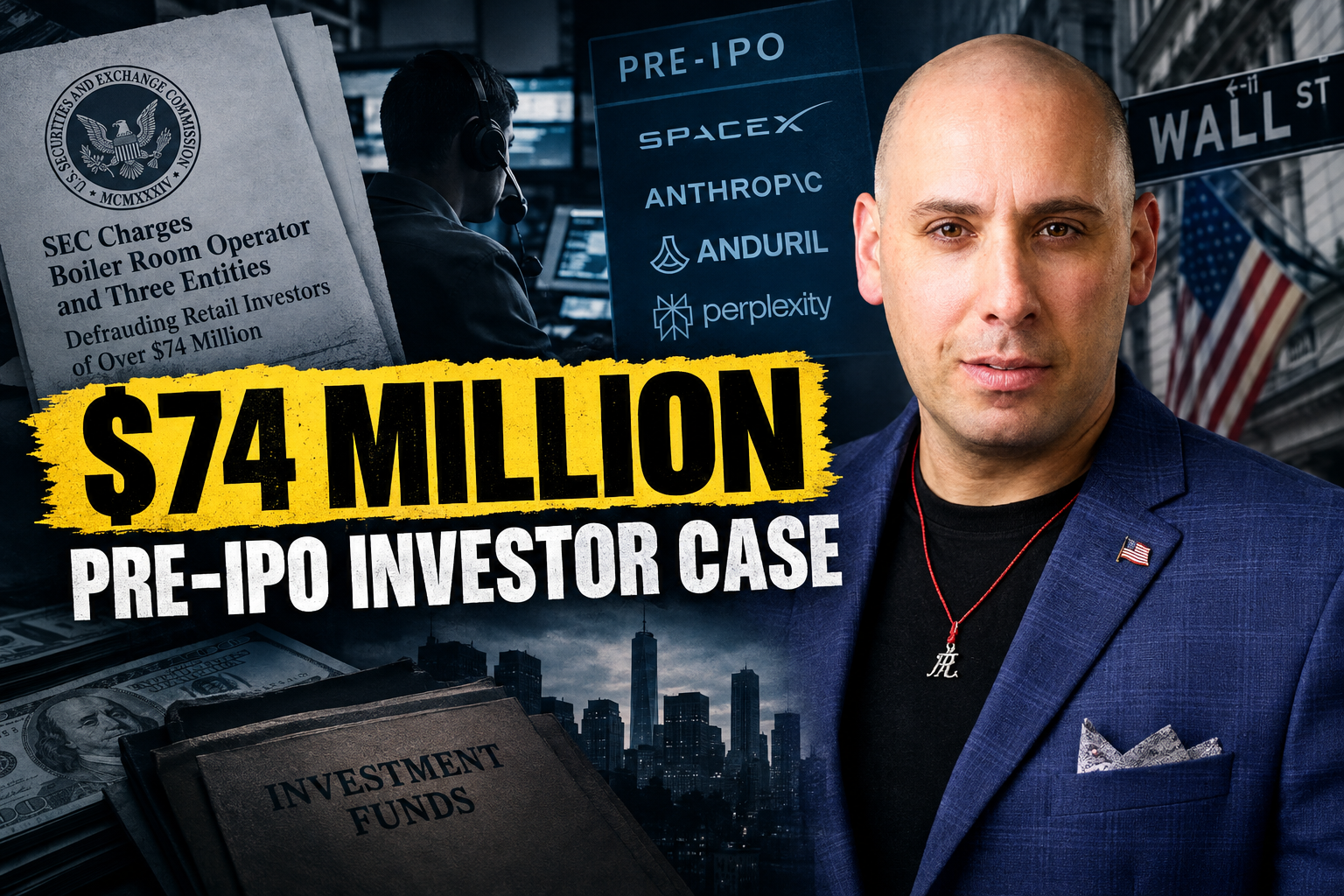
Andrew Caputo Spaventa, known publicly as Andrew or “Drew” Spaventa, is now facing a federal securities-fraud lawsuit after the U.S. Securities and Exchange Commission accused him and three companies he controlled of raising more than $74 million from over 800 investors through a network of cold-call sales agents and private funds tied to coveted pre-IPO companies. The case, filed in the Southern District of New York on August 14, 2026, puts a much closer spotlight on a financial executive who had continued building a private-markets business even as his regulatory record contained earlier disputes, a FINRA suspension and a criminal case dating back to 2010.
The SEC identifies Spaventa as 40 years old and a resident of Miller Place, New York. It says he founded The Spaventa Group LLC in September 2020, remains its sole owner and chief executive, and is the indirect majority owner of TSG Capital Advisors LLC and TSG Alpha Partners LLC. Public regulatory records currently show him registered as an investment adviser representative through TSG Alpha Partners and as a securities representative through TSG Capital Advisors. The SEC complaint says he held Series 7, 24 and 65 licenses.
The businesses around him have been presented publicly as a broader private-markets and wealth-management operation. TSG Invest describes itself as the trade name of The Spaventa Group and promotes private-market investments, wealth management, alternative investments and access to pre-IPO opportunities. Its current website lists TSG Alpha Partners, TSG Invest Private Funds, TSG Capital Advisors and TSG Insurance Services as business segments and continues to promote a platform called TSG Vault for private investment opportunities.
That public-facing business model is now at the center of the SEC’s case. According to the regulator, between December 2020 and June 2025, Spaventa and his companies raised more than $74 million through 11 private funds. More than 800 investors across 49 states, Washington, D.C. and at least 10 other countries participated, with most described as retail investors. More than 100 were retirees, while more than 650 investors put in $100,000 or less and more than 220 invested $20,000 or less.
The SEC alleges that the sales process looked less like conventional private-equity fundraising and more like a boiler room. More than 100 sales agents allegedly cold-called thousands of potential investors using scripts, lead lists and employee handbooks. The complaint says Spaventa and his managers trained agents to use high-pressure sales techniques while presenting TSG as a firm that charged little or nothing in upfront fees. The agency says many of the agents were not registered with FINRA or affiliated with registered broker-dealers, and several had previously been suspended or barred by FINRA.
The central allegation concerns the difference between what Spaventa’s businesses paid for private shares and what investors ultimately paid. The SEC says TSG or another Spaventa-controlled entity acquired pre-IPO securities and then sold them to the funds at substantially higher prices. Those inflated prices were effectively passed to investors when they purchased interests in the funds. Across the transactions, the SEC says investors paid approximately 46% more on average than the prices Spaventa’s entities paid for the underlying securities.
The individual transactions illustrate how large the spreads could become. The complaint says Fund 2 bought SpaceX interests at $595 per unit and sold them to investors at $975, a 64% markup. Fund 8 involved Anthropic securities acquired at between $32.62 and $41.53 and sold to investors at $58.50, producing a markup of between 41% and 79%. Perplexity AI securities in Funds 10 and 11 were purchased for between roughly $340.72 and $389 and sold at $495, with markups ranging from 27% to 45%. Other funds involved Anduril, Stripe, Epic Games, Rubrik, Plaid, Impossible Foods, Scopely, Zipline, Relativity Space, Kraken and VIA Motors. None of those underlying companies is accused of wrongdoing in the SEC case.
The SEC says the undisclosed economics generated approximately $23 million in upfront fees. More than $12 million allegedly went to sales agents as commissions, while at least $4 million went to Spaventa personally. The complaint says some of that money was used for a home purchase, renovations, personal travel and luxury vehicle payments. The regulator further says the vast majority of fund investors had not recovered their investments and that some had suffered total or near-total losses.
Another important part of the case involves conflicts of interest. The SEC says Spaventa controlled both sides of transactions in which securities were moved from entities he owned into funds that he or his affiliated companies managed or advised. The complaint alleges that written client consent required for such principal transactions was not obtained. It also alleges that certain equity-transfer agreements were finalized around the time of an SEC examination inquiry in 2023 but backdated to make them appear months or years older than they actually were. Those are allegations in the SEC complaint and have not been established by a court.
The funds themselves included TSG Venture Fund LLC, TSG Secondary Fund LLC, TSG Strategic Secondary Fund LLC and related funds through Fund 11, including TSG Vision Fund Series AI 1024 LLC and TSG Vision Fund Series 1 LLC. The SEC says none of the funds was registered with the commission. Spaventa also created TSG Invest Ventures LLC in November 2024 and wholly owned it through TSG, using it to acquire securities for Funds 10 and 11. TSG Capital Advisors operated as a placement agent, while Alpha Partners served as investment adviser to nine of the eleven funds beginning in May 2024.
There is also a significant connection to StraightPath Venture Partners, an earlier pre-IPO fund operator that became the subject of an SEC enforcement action. The SEC says StraightPath raised at least $410 million from more than 2,200 investors between 2017 and 2022 and alleges that it sold interests in more securities than it actually owned while charging hidden markups and fees. Spaventa had worked with StraightPath while associated with SW Financial and later used StraightPath funds in connection with TSG’s first two funds. StraightPath’s principals were prosecuted criminally, convicted at trial in 2025 and sentenced in 2026 to prison terms ranging from eight to eleven years. The StraightPath convictions concern those defendants, not Spaventa, who has not been charged criminally in the present SEC case.
Spaventa’s own regulatory history predates the current lawsuit. FINRA records show that in 2018 a customer dispute sought $114,357 and included allegations of churning, negligence, unsuitable recommendations, unauthorized trading and breach of contract. The matter settled for $14,999. When the settlement was not initially complied with, FINRA suspended Spaventa from the securities industry in September 2019. The suspension was lifted on December 16, 2019, after the award was paid. FINRA specifically records that the suspension was not a finding of fraudulent, manipulative or deceptive conduct.
His record also contains a 2014 Florida registration matter in which the Office of Financial Regulation alleged a material false statement on his application and ultimately denied the application. Spaventa disputed the characterization, telling regulators that his firm’s compliance officer had failed to properly submit disclosure information and that he had not been given an opportunity to request a hearing.
In 2010, Spaventa was charged in Suffolk County, New York, with criminal contempt. The original charge was dismissed after being reduced, then amended to a violation to which he pleaded guilty. The final disposition was a conditional discharge. The available regulatory record does not explain the underlying conduct, so it would be misleading to connect that old matter to the present securities allegations.
There was also a significant development before the SEC filed its 2026 lawsuit. Spaventa’s regulatory disclosure shows that the SEC opened a non-public inquiry in February 2026 as part of a broader review of private-market activity. The firm’s disclosure said it cooperated, submitted a written response in March and met with SEC staff on April 22. At that stage, the disclosure said no findings had been made. The subsequent August lawsuit is now the formal enforcement action arising from the broader regulatory scrutiny.
Spaventa has denied the SEC’s allegations. Fortune reported that when contacted after the lawsuit was filed, he said he planned to defend himself against the accusations. The case remains pending, and there has been no judicial finding that he committed securities fraud, no criminal conviction arising from the $74 million allegations, and no final order imposing disgorgement or civil penalties as of September 17, 2026. The SEC is seeking permanent injunctions, disgorgement and prejudgment interest, civil penalties against the defendants and conduct-based injunctions against Spaventa.
The case matters beyond one financial firm because it shows how the private-market investment boom can blur the line between access and salesmanship. Pre-IPO shares in companies such as SpaceX, Anthropic and Anduril can sound like exclusive opportunities, particularly to investors who believe they are getting in before a major liquidity event. But private securities can be difficult to value, difficult to sell and expensive to access. In Spaventa’s case, the SEC alleges that the most important number was not the name of the company behind the investment, but the gap between what the intermediary paid and what the customer was charged. Whether those allegations ultimately survive in court will be decided through litigation. What is already clear is that hundreds of investors placed substantial sums into a private-market operation now under federal scrutiny, and the outcome will help determine where responsibility lies when access to the next big private company is sold through aggressive calls, complex fund structures and pricing that investors may not fully understand.
————-
Disclaimer:
Some content on Reportingscams.com is published under our guest post program and is provided by third-party contributors. Reporting scams does not create, verify, or take responsibility for the views, accuracy, or claims expressed in such content.