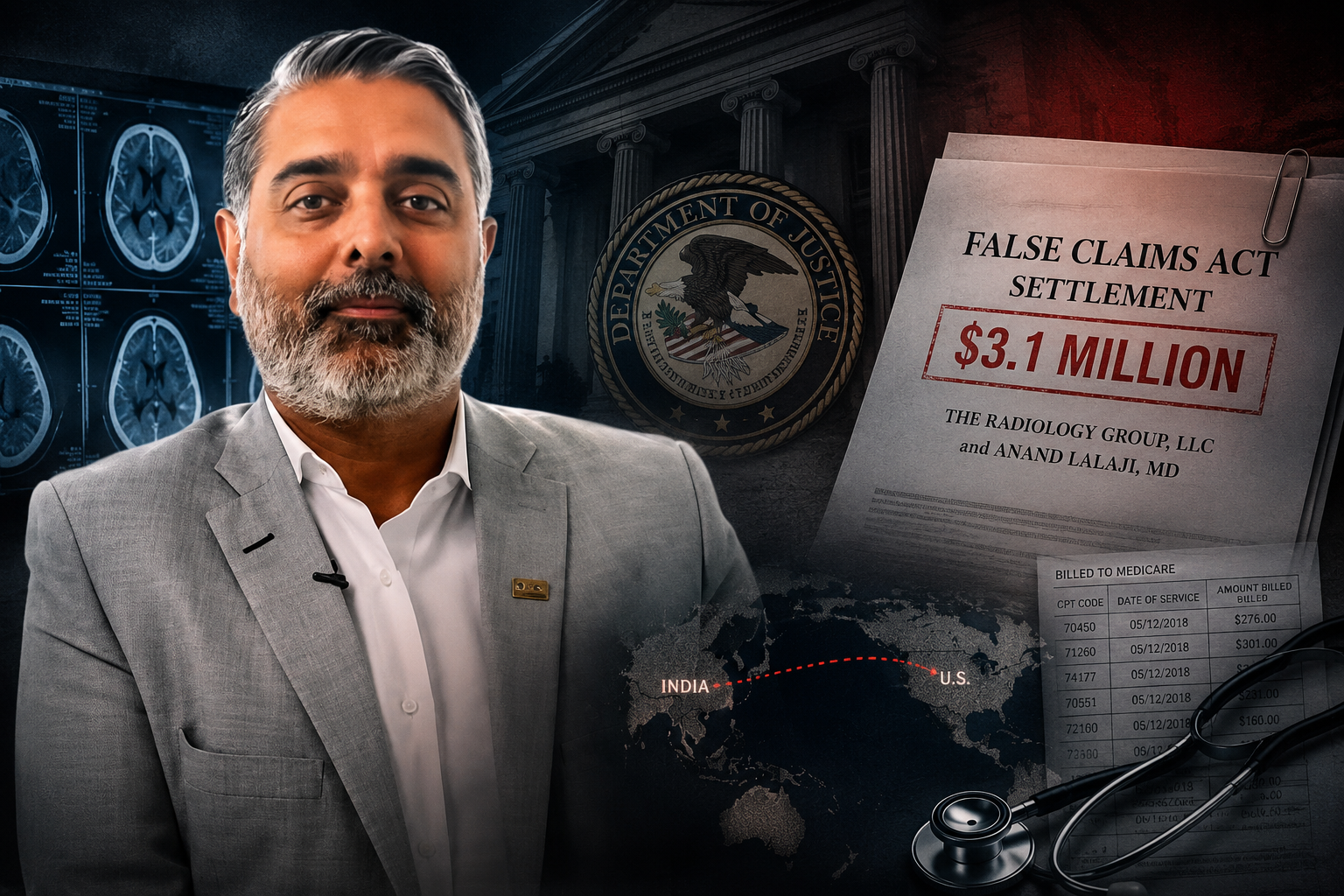
When the U.S. Department of Justice announced a $3.1 million settlement with The Radiology Group in March 2024, the news sent ripples through the healthcare industry. Federal prosecutors alleged that one of the country’s largest teleradiology providers had submitted false claims to Medicare by billing for services that did not fully comply with federal requirements. The settlement was significant on its own, but it also brought renewed attention to the people connected to the company.
One name that began appearing in online searches was Dr. Tejal Lalaji.
Unlike Dr. Anand Lalaji, the chief executive of The Radiology Group and one of the defendants in the government’s case, Tejal Lalaji has maintained a much lower public profile. Even so, her association with the company and with the Lalaji family’s charitable initiatives has led many people to ask whether she was involved in the events that resulted in the federal investigation.
The answer, based on publicly available records, is more nuanced than many headlines or online discussions suggest.
The Department of Justice did not name Tejal Lalaji as a defendant in its False Claims Act case. The government’s complaint, settlement agreement, and consent judgment focused on The Radiology Group LLC and its CEO, Dr. Anand Lalaji. That distinction matters because investigations involving companies often draw attention to individuals connected to the business, even when they are not personally accused of wrongdoing.
Still, understanding why Tejal Lalaji’s name appears in discussions about the company requires looking at the broader story behind The Radiology Group and the federal investigation that unfolded over several years.
Founded as a teleradiology company, The Radiology Group built its business around a model that has become increasingly common in modern healthcare. Instead of requiring every hospital to employ a large team of in-house radiologists around the clock, hospitals can send medical images electronically to specialists who review them remotely. This allows healthcare providers to offer twenty-four-hour coverage while reducing staffing costs and speeding up diagnosis.
The model has transformed emergency medicine across the United States. A CT scan performed late at night in a rural hospital can be reviewed by a radiologist hundreds or even thousands of miles away within minutes. For hospitals struggling with physician shortages, that flexibility has become essential.
But the same technology that makes remote diagnosis possible also creates new compliance challenges.
Federal healthcare programs such as Medicare have detailed rules about who performs medical services, who supervises those services, and who is permitted to bill the government for them. Those rules become even more important when parts of the workflow involve contractors located outside the United States.
According to the Department of Justice, those compliance questions eventually became the focus of a lengthy federal investigation into The Radiology Group.
The case did not begin with a dramatic FBI raid or a surprise announcement from prosecutors. Instead, it started quietly in 2019 when two whistleblowers filed a lawsuit under the False Claims Act. Like many healthcare fraud investigations, the allegations remained under seal while federal authorities reviewed the evidence and decided whether to intervene.
That review took years.
After examining documents, interviewing witnesses, and evaluating billing records, the government chose to join the lawsuit. By then, investigators believed they had uncovered practices that violated federal reimbursement rules.
At the center of the government’s case was the company’s workflow for preparing radiology reports.
According to prosecutors, contractors based in India prepared draft interpretations of medical scans before those reports were reviewed by licensed radiologists in the United States. Using overseas personnel to assist with administrative or preliminary work is not automatically prohibited. The issue, according to the government, was what happened next.
Federal investigators alleged that in numerous cases, U.S.-based radiologists approved those draft reports without conducting the meaningful independent review required under Medicare regulations.
One allegation quickly drew public attention.
The Department of Justice claimed that one physician approved more than 100,000 reports during the relevant period. Prosecutors also cited examples where CT scan interpretations were approved in less than thirty seconds. They argued that such turnaround times raised serious questions about whether the reports had actually been reviewed before being finalized.
Those allegations formed one of the foundations of the government’s False Claims Act case.
The investigation did not stop there.
Federal prosecutors also alleged that reimbursement claims submitted to Medicare identified physicians as the providers who had performed diagnostic interpretations even when those physicians had not actually carried out the work described in the claims.
In another part of the complaint, investigators alleged that Medicare was billed for interpretations performed by a radiologist working from the United Kingdom. Because Medicare generally limits reimbursement for services performed outside the United States, prosecutors argued that those claims should not have been submitted for payment.
Rather than continue litigating the case, The Radiology Group and Dr. Anand Lalaji reached an agreement with the government.
In March 2024, the parties announced a settlement worth $3.1 million. Unlike many corporate settlements that simply resolve allegations without admitting any facts, this agreement included detailed factual admissions about certain business practices.
Among other things, the company acknowledged that there were instances in which reports prepared by India-based contractors were not adequately reviewed before claims were submitted to Medicare. The settlement also acknowledged problems involving physician identification on reimbursement claims and claims connected to work performed outside the United States.
Although the agreement resolved the government’s civil claims, it was not a criminal conviction. No criminal charges were announced as part of the settlement.
That difference is important because False Claims Act cases are civil enforcement actions. While the financial consequences can be substantial, they are separate from criminal prosecutions.
As news of the settlement spread, public interest naturally expanded beyond the company itself.
People began searching for information about executives, physicians, and family members associated with The Radiology Group. That is where Tejal Lalaji entered the conversation.
Publicly available information about her is relatively limited compared with the extensive records available for the company and Dr. Anand Lalaji. She has been identified as a physician and has also appeared in connection with The Lalaji Foundation, a charitable organization involved in philanthropic initiatives.
Corporate filings and public profiles show associations with organizations connected to the Lalaji family, but those records alone do not establish involvement in the conduct described by the Department of Justice.
Just as importantly, a review of publicly available court documents does not show Tejal Lalaji being named as a defendant in the False Claims Act litigation.
There is also no publicly available indication that federal prosecutors accused her personally of submitting false claims, directing the billing practices described in the settlement, or participating in the alleged misconduct.
That does not mean every question has been answered.
Corporate investigations often leave observers wondering how responsibilities were divided inside an organization. Healthcare companies are frequently managed by teams of executives, physicians, compliance officers, and operational staff. Public filings do not always reveal who made particular decisions or who supervised individual business processes.
In this case, however, journalists have to distinguish between unanswered questions and established facts.
The established facts are clear.
The federal government investigated The Radiology Group.
The government intervened in a whistleblower lawsuit.
The company and Dr. Anand Lalaji agreed to pay $3.1 million to settle False Claims Act allegations.
The settlement included factual admissions concerning Medicare billing practices and physician review procedures.
Those points are supported by court records and official Department of Justice statements.
What the public record does not currently establish is personal wrongdoing by Tejal Lalaji.
That distinction becomes increasingly important in today’s digital environment, where search engines often connect individuals to organizations without explaining the legal context. Someone searching a person’s name may encounter articles discussing a company’s regulatory problems and incorrectly assume that every associated individual was accused or found liable.
Good investigative reporting should avoid creating that confusion.
It should also recognize that healthcare compliance has become one of the federal government’s highest enforcement priorities.
Over the last decade, the Department of Justice has recovered billions of dollars through healthcare fraud investigations. Many of those cases involve billing disputes rather than traditional fraud schemes. Regulators increasingly examine documentation, physician supervision, coding practices, and reimbursement procedures rather than focusing solely on fabricated services.
The Radiology Group investigation fits squarely within that broader trend.
As healthcare becomes more digital, companies continue experimenting with remote reading, artificial intelligence, cloud-based imaging systems, and international support teams. Those innovations may improve efficiency, but they also require companies to ensure that every step of the process complies with federal reimbursement rules.
The government’s case suggests investigators believed The Radiology Group failed to meet those expectations during the period covered by the lawsuit.
Whether additional investigations involving related individuals or organizations emerge remains unknown.
For now, the publicly documented enforcement action remains limited to the company and Dr. Anand Lalaji.
As for Tejal Lalaji, publicly available records paint a far quieter picture. Her name appears alongside charitable work, medical affiliations, and family-related organizations, but not as a defendant in the government’s healthcare fraud case.
That may disappoint readers looking for a more dramatic narrative, but accuracy is the foundation of credible investigative journalism.
Sometimes the most important finding is not discovering hidden misconduct. It is identifying where the evidence ends.
The Department of Justice settlement is unquestionably a significant event in the history of The Radiology Group. It raises important questions about compliance, oversight, and billing practices inside a large healthcare organization. Those issues deserve scrutiny because they involve taxpayer-funded healthcare programs and the integrity of medical services provided to patients across the country.
But they also deserve to be reported carefully.
The public record supports close examination of the company’s practices and of the legal settlement reached with federal authorities. It does not currently support claims that every individual connected to the organization engaged in the conduct described by prosecutors.
As more documents become available or additional reporting emerges, that picture could evolve. Until then, the available evidence points to a story centered on The Radiology Group, its CEO, and a federal enforcement action that has become another reminder of how closely healthcare billing practices are being scrutinized in the United States.
————-
Disclaimer:
Some content on Reportingscams.com is published under our guest post program and is provided by third-party contributors. Reporting scams does not create, verify, or take responsibility for the views, accuracy, or claims expressed in such content.