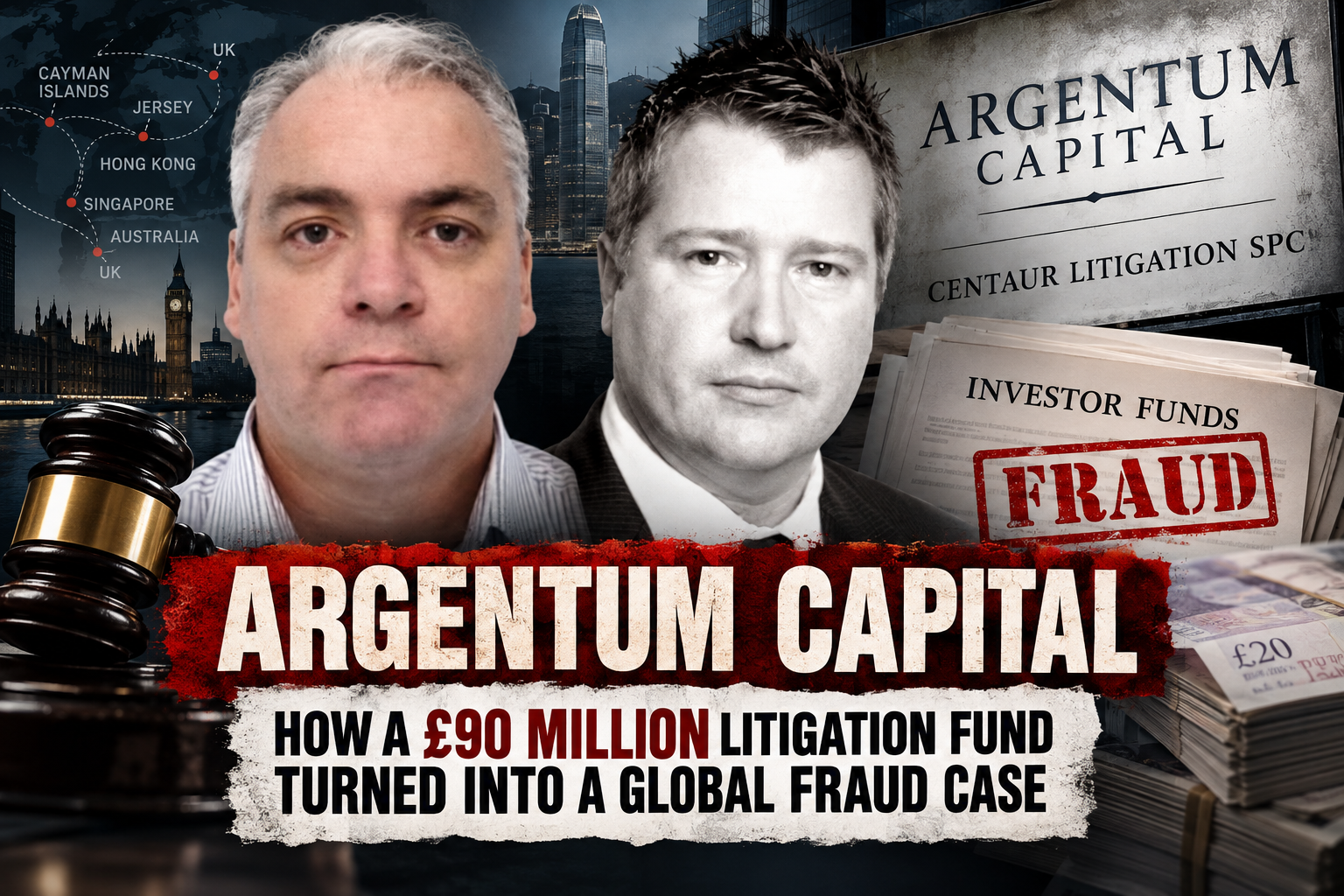
The collapse of Argentum Capital was not simply the failure of an ambitious litigation-funding business. It became a cross-border insolvency and fraud case involving a network of Cayman, British Virgin Islands, Jersey, Hong Kong, Singapore and other entities, hundreds of investors and tens of millions of pounds whose movement investigators struggled to reconstruct. At the centre was British businessman Brendan Mark John Terrill, alongside Australian businessman Trent Scott Strong, who also used the names Scott Williams and Scott Campbell Fisher, Canadian Duane McGaw and New Zealand national Christopher Keats.
When OffshoreAlert published its first major investigation in February 2014, the picture presented to investors was still one of supposedly sophisticated litigation finance. Terrill’s group said it had raised more than £90 million and offered investors fixed annual returns reaching 15 percent, with principal and returns purportedly protected by insurance and other safeguards. Argentum Capital Limited, a Jersey-based litigation fund listed on the Channel Islands Securities Exchange, had received about £13.5 million and was described as the group’s public-facing investment vehicle. The original promotional material also showed apparently impressive historical returns across a series of investment products. The material supplied for this investigation records the same structure, including the promised double-digit returns, purported insurance protection and the movement of funds into Argentum. Info
But the underlying structure raised questions that went well beyond ordinary investment risk. OffshoreAlert reported that Terrill appeared to exercise extensive control over investors’ money, while returns were not independently audited and there was no evidence demonstrating that supposedly fixed returns were being generated by successful litigation rather than by incoming investor money. Investors were also offered incentives to roll their money over rather than redeem it. More troubling were purported insurers named in investment documents that, according to the investigation, did not legally exist. Info
Terrill denied that the operation was a Ponzi scheme and told OffshoreAlert that his group was legitimate. He rejected the suggestion that investor money was being recycled to pay other investors. He was given months to provide supporting evidence, but OffshoreAlert reported that he did not substantiate the claim. Terrill also objected to the publication of documents obtained from the group’s publicly accessible online document centre and threatened defamation proceedings. Info
The most consequential evidence emerged after the companies collapsed. Centaur Litigation SPC, Centaur Litigation Limited and Centaur Litigation Unit Series 1 Limited were put into provisional liquidation in June 2014 and later into official liquidation. Grant Thornton was appointed as joint official liquidator. Its investigation found that the financial records were incomplete and in serious disorder, making it difficult to establish the true financial position of the companies. The liquidators also found inconsistencies between records and transactions involving money moving between different investment series.
The scale of the fundraising varies slightly depending on the entity and accounting period. The High Court of England and Wales later recorded that the three Centaur companies had raised about £80 million from approximately 1,300 investors, most of them retail investors. A subsequent Cayman judgment stated that approximately £85 million had been raised through multiple Centaur share series between August 2011 and March 2014. OffshoreAlert subsequently described the wider Argentum, Centaur and Buttonwood operation as a roughly £97 million fraud. These figures should not be treated as contradictory: they relate to different entities, periods and definitions of the wider group.
The liquidators’ findings were particularly damaging. A September 2014 report indicated that more than £27 million of the approximately £80 million raised may have been misappropriated or involved in irregular transactions. The report also said the funds had not backed a single successful lawsuit and that purported insurance and capital guarantees either did not exist or were unlikely to be honoured. One transaction involved £2.1 million placed in trust for litigation that was later halted; approximately £1.3 million was subsequently moved into an unrelated HSBC Hong Kong account instead of being returned to the fund. Another £11 million was used to acquire a litigation investment business associated with one of the group’s principals, without what the liquidators considered a sound valuation basis.
The later court record put an even sharper legal edge on the allegations. In November 2015, Mr Justice Norris granted a worldwide freezing order against Terrill after finding a good arguable case that he had been a de facto director of the Centaur companies and that transactions involving him may have breached fiduciary duties. The judge examined a £6 million revolving credit facility between Centaur and Argentum Investment Management. The money was drawn down but paid to an associated company rather than the named borrower, and no principal or interest had been repaid. The debt was subsequently purportedly forgiven.
Another transaction involved the purchase of shares in Argentum Investment Management for more than £5 million. The buyer was a Terrill-owned Buttonwood company, but the cash appears to have been paid by the Centaur companies. The court noted the absence of a proper valuation and questioned why investor-owned companies were funding the acquisition of an asset for a different company. The joint liquidators’ position was that the transaction was principally a device to misappropriate Centaur money for Terrill’s benefit.
A third transaction involved approximately HK$15 million, or about £1.2 million, transferred from Centaur to Buttonwood and subsequently paid in three instalments to Terrill. The liquidators considered this another misappropriation. The English court ultimately ordered a worldwide freezing injunction covering £13.25 million, the total amount the liquidators said had passed to Terrill through the transactions under examination.
The Cayman Islands proceedings eventually confirmed that this was more than an unresolved allegation. In a 2017 judgment, Justice Ingrid Mangatal stated that the Centaur companies had been victims of fraud perpetrated by their human controllers, that investor money had been extensively commingled and that approximately US$27 million had been misappropriated. The court also recorded that money from newer investment series had been used to pay expenses, support other litigation commitments or prop up the wider scheme rather than being applied as investors had been led to believe.
The corporate web surrounding Centaur was extensive. The group’s structure included Buttonwood Legal Capital, Buttonwood Statutory, Argentum Investment Management, Argentum Litigation Services, Argentum Capital, Orion Litigation Intermediaries, Savile Management and purported insurers including Sebiro Insurance Company and Savile Insurance Company. The original Centaur memorandum also identified Standard Chartered as banker, Hong Kong Trust Company as administrator and Ernst & Young as auditor. Info The investigation further identified Terrill’s connection to Savile Management and a Cayman company called Primacy Dividend Corporation, which was described in Argentum documentation as guaranteeing fixed dividends while Terrill was its shareholder and sole director. Info
McGaw was another important figure. He was identified as the shareholder of Argentum Investment Management and a participant in the group’s management structure. Grant Thornton’s early findings identified him as one of the apparent beneficiaries of irregular transactions. OffshoreAlert reported that he had received at least £11 million from the scheme, although the precise amount remained subject to investigation. McGaw denied wrongdoing and later sued OffshoreAlert for defamation in British Columbia.
Strong, meanwhile, became one of the most elusive figures in the collapse. Court records identify him as Trent Scott Wallace Strong, also known as Scott Williams and Scott Campbell Fisher. In 2016, the Australian Federal Court ordered him to attend examination and produce documents and temporarily prohibited him from leaving Australia after evidence indicated a risk that he might leave the jurisdiction. His involvement extended beyond Centaur; Australian reporting later linked him to a new venture called Blue Edge Capital, which operated as a business-introduction service.
The regulatory consequences arrived quickly. The Channel Islands Securities Exchange suspended Argentum Capital’s listing in February 2014, shortly after OffshoreAlert’s exposé, and delisted the company days later. The Association of Litigation Funders separately investigated the concerns surrounding Centaur and Argentum. Argentum maintained that it was legally separate from Centaur and was not involved in its fundraising, but offered to withdraw from the association, which accepted the withdrawal.
Hong Kong authorities were also involved. Contemporary reporting said the Securities and Futures Commission was investigating Centaur and that files had been seized. The group’s new advisers said an internal audit and independent review had identified financial irregularities before the funds were placed into liquidation. Hong Kong courts subsequently recognised the Cayman liquidators and empowered them to investigate the companies’ affairs, locate assets and obtain records.
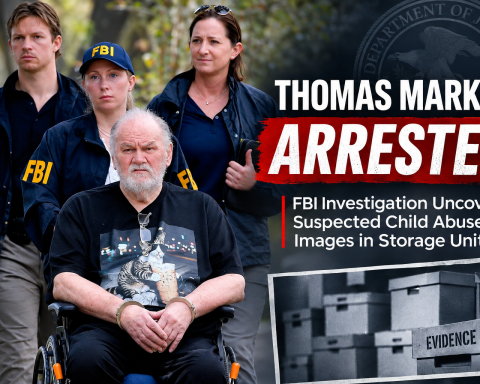
Terrill’s later criminal conviction needs to be separated carefully from the financial case. He was arrested in England in August 2015 in connection with an unrelated criminal offence, something expressly noted by the High Court. He subsequently pleaded guilty to sharing indecent images of children and was sentenced to three years in prison. That conviction was not a conviction for the Centaur or Argentum fraud. OffshoreAlert later reported his imprisonment and described it as unrelated to the investment scheme.
The last dependable court evidence placed him in England in 2015, while the court noted that before his return he had been based in Hong Kong or Thailand and maintained bank accounts in those jurisdictions. Likewise, there is no sufficiently reliable current source showing that he is operating another investment business today. McGaw was publicly operating Q Shi Q Japanese BBQ in Vancouver in 2015-16, although the restaurant is now reported as permanently closed.
The Argentum collapse matters because it illustrates how sophisticated presentation can obscure basic questions about where investors’ money actually goes. The companies used multiple jurisdictions, professional service providers, investment memoranda, purported insurance arrangements and a listed investment vehicle. Yet the eventual court record described commingled funds, missing or inadequate records, questionable transactions and approximately US$27 million in misappropriated money. What began as a promise to let ordinary investors participate in the lucrative world of litigation finance ended in liquidation, asset tracing and years of cross-border court proceedings. The central lesson is not merely that one investment failed. It is that the appearance of structure, professional advisers and promised guarantees is no substitute for independently verifiable evidence of assets, cash flows and returns. In this case, investors learned that distinction after their money had already disappeared.
Source:
OffshoreAlert
————-
Disclaimer:
Some content on Reportingscams.com is published under our guest post program and is provided by third-party contributors. Reporting scams does not create, verify, or take responsibility for the views, accuracy, or claims expressed in such content.