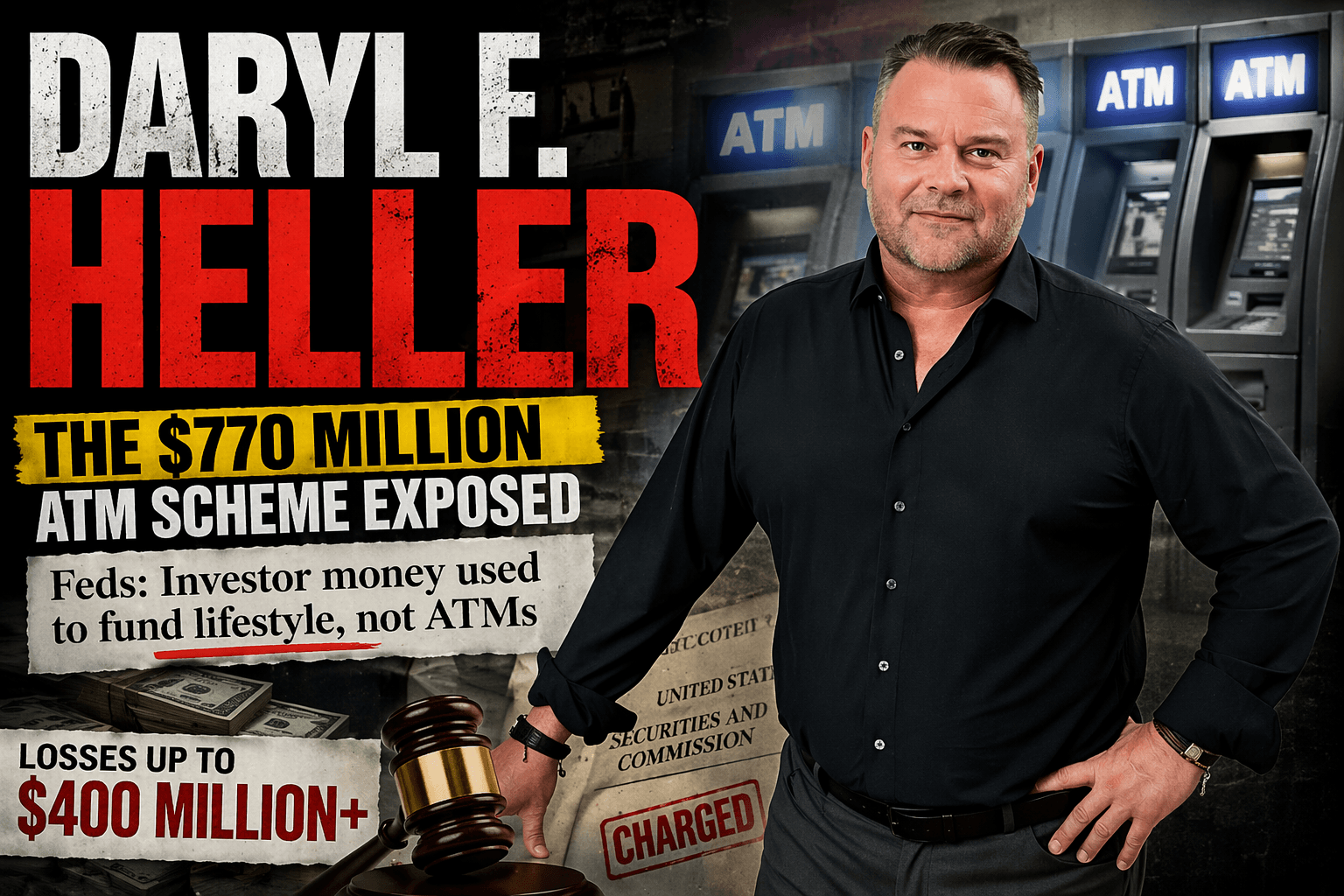
It sounded like one of those rare opportunities that people wish they had found earlier. Put money into ATM machines placed across the country, collect a steady stream of income every month, and stay away from the chaos of the stock market. That is how Daryl F. Heller’s business pulled people in. What looked simple on the surface has now turned into a federal case involving hundreds of millions of dollars and thousands of investors trying to figure out where their money went.
Heller, a Pennsylvania businessman, built his operation around ATM investments through companies tied to Prestige Investment Group and Paramount Management Group. The pitch was clear and easy to follow. Investors would fund ATM machines. Those machines would generate transaction fees. The income would be shared back as monthly payouts. Many were told they could expect returns close to 25% per year, which made the offer stand out immediately.
Over time, the operation grew fast. According to federal regulators, around 2,700 investors put in close to $770 million. This was not just institutional capital. A large portion came from individuals, including members of tight knit communities where trust and referrals played a major role. Word spread quickly because early investors were actually receiving payments.
That early consistency became the foundation of the entire system. Investors saw money coming in every month and believed the business was working exactly as promised. Some reinvested. Others brought in friends and family. The model looked stable, predictable, and grounded in something real.
But investigators say the numbers behind the scenes told a completely different story.
According to the Securities and Exchange Commission, the ATM business never generated enough revenue to support the payouts being made. Internal records showed a growing gap between what the machines were actually earning and what investors were receiving. That gap eventually reached hundreds of millions of dollars. Authorities allege that instead of real profits, investor money was being recycled. Funds from new investors were used to pay earlier ones, while additional money was brought in through loans to keep the system going.
Federal prosecutors estimate that investor losses now exceed $400 million, with unpaid principal alone crossing $402 million. These are not small discrepancies. These are losses that have wiped out savings, retirement funds, and long term financial plans for many individuals.
The allegations go deeper than just how the payments were made. Regulators say the size and performance of the ATM network itself was misrepresented. Investors were told there were thousands of machines generating strong income across the country. In reality, investigators found that many of those machines were not operating, were sitting unused, or were never placed in the locations investors were led to believe. Some machines were outdated. Some were not producing the revenue that was being reported.
Then comes the question that investors keep asking. Where did the money actually go.
According to SEC filings, more than $185 million was diverted away from the core business. Authorities allege that investor funds were used for personal expenses and unrelated ventures. This includes real estate purchases such as a beach property, along with money moving through related entities that had little connection to ATM operations. What was presented as a straightforward income generating business appears, in part, to have been funding something very different.
Other individuals were not completely outside the picture either. The operation relied on a network of entities, promoters, and intermediaries who helped bring in new investors and reinforce the idea that the business was stable. Lawsuits filed by investors suggest that multiple parties may have played a role in marketing or supporting the investment. Some acted as connectors, helping channel new money into the system while repeating the same message about consistent returns.
The structure of the business made it difficult for investors to see what was really happening. Funds were pooled into different investment vehicles, including structures like Prestige Funds and WF Velocity Funds. Investors had no control over the machines or how the money was being used. They relied entirely on reports and updates provided to them. That lack of transparency is now a central issue in both civil and criminal proceedings.
The collapse became clear in 2024. Payments that had been coming in regularly suddenly stopped. Investors who had built their expectations around monthly income were left with nothing. Many were told they would get their capital back. That did not happen the way they were led to believe. Communication slowed. Answers became vague. The system that once felt reliable started to fall apart quickly.
That is when federal authorities stepped in.
The Department of Justice charged Heller with securities fraud and multiple counts of wire fraud, describing the operation as a large scale investment fraud scheme. At the same time, the SEC filed civil charges seeking to freeze assets and prevent further damage. The numbers involved pushed the case into a different category, making it one of the largest ATM related investment cases in recent years.
The legal fallout is still spreading. Investors have filed lawsuits trying to recover their money, not just from Heller but also from others connected to the business. Some claims argue that those who promoted or facilitated the investment should also be held accountable. Bankruptcy proceedings have added another layer, as courts work through what assets remain and how they should be distributed.
Looking back, the warning signs were there, even if they were not obvious at the time. Some investors had already started raising concerns online about delayed payments and lack of clarity. Those concerns did not gain much attention then. Now they stand out as early signals of a deeper problem.
What makes this case hit harder is how believable it was. There was nothing overly complex about it. No confusing financial language. Just a simple idea that felt grounded in everyday life. That simplicity made it easier for people to trust it and harder to question it.
For the investors caught in this, the impact goes beyond numbers. These were life savings for many. Retirement plans. Years of work. The promise of steady income turned into a situation where people are now waiting for answers, navigating lawsuits, and hoping for some level of recovery.
The case is still moving through the system, and it will take time before there is a clear outcome. Investigators are tracing where the money moved, examining records, and trying to recover whatever is left.
But one thing is already clear. What was sold as a stable ATM investment opportunity has now become a case built around $770 million raised, $400 million+ lost, and a growing list of questions about how it was allowed to run for as long as it did.
————-
Disclaimer:
Some content on Reportingscams.com is published under our guest post program and is provided by third-party contributors. Reporting scams does not create, verify, or take responsibility for the views, accuracy, or claims expressed in such content.