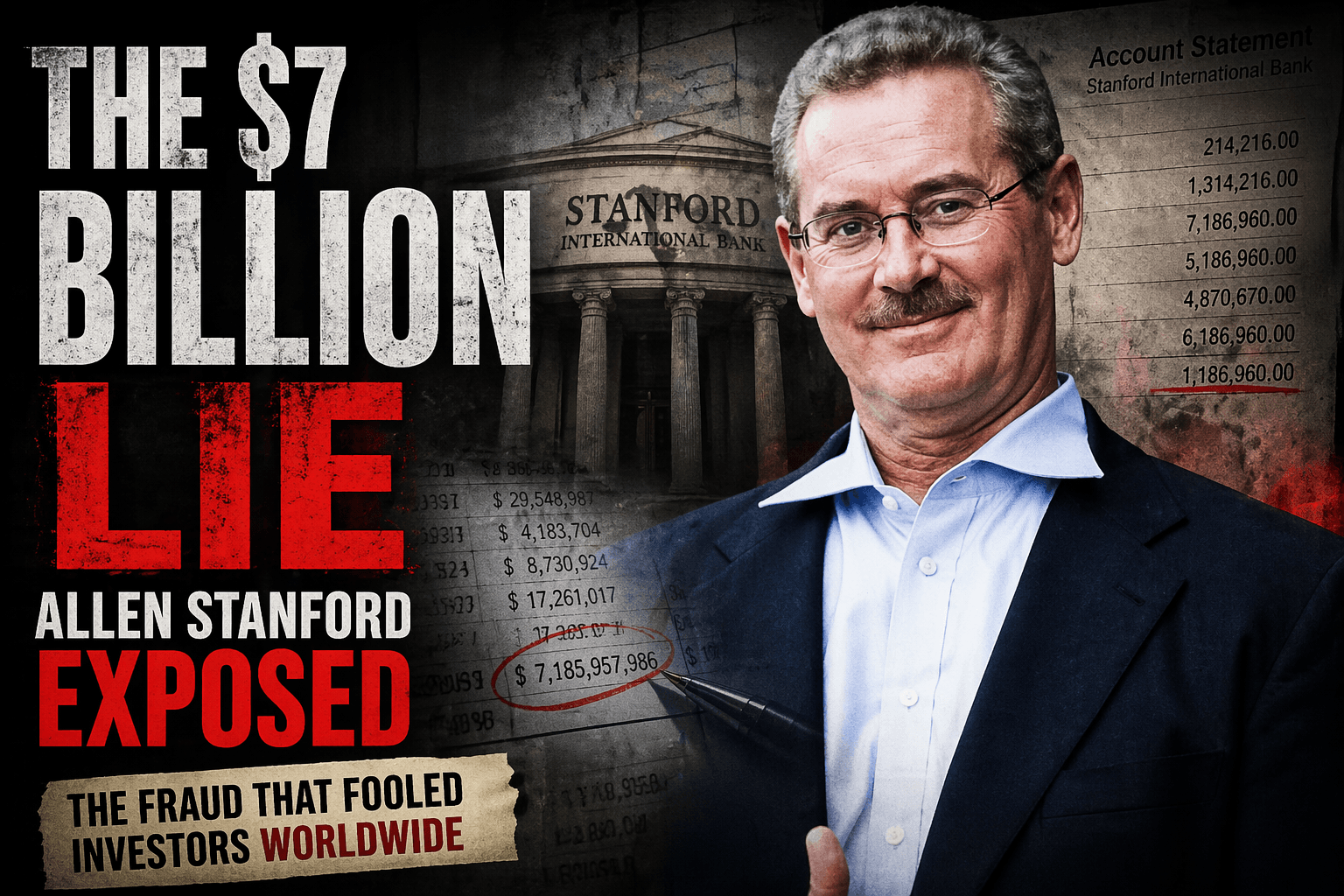
For years, Allen Stanford didn’t come across as a warning sign. He looked like the rare guy in finance who had cracked the code. While markets kept shaking people out, he was offering something that felt calm. No wild swings, no panic, just steady returns that kept showing up on paper month after month.
That’s what pulled people in.
This wasn’t reckless money chasing quick wins. These were cautious investors, business owners, retirees, people who thought they had found something safer than the rest of the market. They weren’t trying to get rich fast. They were trying not to lose. And that’s exactly what made the setup so effective.
Because what they were stepping into wasn’t safety. It was a system built to look like it.
How the Image Was Built and Sold
Stanford didn’t appear out of nowhere. He built his way up through banking, starting in Texas before shifting his focus offshore. The move to Antigua changed everything. It gave him room. Less scrutiny, fewer obstacles, and the ability to structure his operations in a way that was harder to fully monitor.
At the center of it all was Stanford International Bank. That was the core. That’s where the money went. The main product was simple enough for anyone to understand. Certificates of deposit with higher returns than traditional banks, presented as safe and well managed.
And everything around it reinforced that message.
The offices looked right. The advisors sounded confident. The reports were clean and detailed. Nothing about it felt rushed or sloppy. It felt structured, like a proper financial institution. That’s what lowered people’s guard. It didn’t feel like a gamble. It felt like a smart, conservative move.
The timing helped too. When markets struggled, his numbers didn’t. That contrast made the story even stronger. While others were losing money, Stanford clients were seeing steady growth. That difference built belief quickly, and once that belief set in, it was hard to shake.
What Was Actually Happening Behind the Scenes
The version investors saw and the reality behind it were two very different things.
According to findings from the U.S. Securities and Exchange Commission and later backed by the United States Department of Justice, the investment strategy being sold wasn’t real in the way it was described. The assets that were supposed to back billions in deposits were either misrepresented or simply not there in the form investors were told.
The returns people saw weren’t coming from market performance. They were being created inside the system.
Money from new investors was used to pay earlier ones. As long as fresh money kept coming in, everything looked stable. Account statements showed growth. Reports stayed consistent. The machine kept running.
Inside the company, information didn’t move freely. It was controlled. Investors got a polished version of the truth, while the actual flow of money stayed hidden. Only a small group had full visibility. Others saw just enough to do their jobs without questioning the bigger picture.
That kind of setup doesn’t just happen by accident. It’s designed that way.
At the same time, Stanford was reinforcing his public image. He lived like someone who had built a legitimate empire. Private jets, luxury homes, high profile deals. The lifestyle matched the story. For many investors, that visual proof mattered more than any financial breakdown.
When someone looks that successful, people assume the system behind them must be solid.
The Red Flags That Didn’t Stop It
There were warning signs, but they didn’t hit hard enough or fast enough.
Some analysts started questioning how the returns stayed so consistent, especially when markets were unstable. Others raised concerns about transparency and how assets were being verified. Complaints did reach regulators. Questions were asked.
But the response didn’t match the scale of the risk.
Part of the problem was how spread out everything was. Different countries, different regulatory systems, no single authority seeing the full picture. Key parts of the operation sat in Antigua, which made oversight weaker and slower.
That gave the system time.
And time allowed it to grow.
By the time serious action started building, the numbers had already climbed into the billions.
When It Finally Collapsed
In 2009, the illusion broke.
Authorities stepped in and charged Allen Stanford with running a fraud worth more than $7 billion. The U.S. Securities and Exchange Commission froze assets, and the entire operation started falling apart almost immediately.
What had been stable for years unraveled in days.
For investors, it was a shock that hit all at once. Accounts that had shown steady growth suddenly meant nothing. Withdrawals stopped. Access disappeared. People who thought their money was secure were left trying to understand what was actually left.
For many, the answer was very little.
The damage wasn’t just financial. It was personal. People lost savings they had built over decades. Plans for retirement, for family, for stability, all disrupted at once. Some had trusted the system completely, which made the fall even harder.
What the Trial Exposed
When the case went to trial, the details filled in the gaps.
Prosecutors showed how reports were shaped to keep everything looking consistent. Internal differences between reality and what investors saw were laid out clearly. Testimonies explained how money moved and how information was controlled inside the company.
The case built by the United States Department of Justice framed it as a system that was built to mislead from the start, not something that simply went wrong along the way.
The defense tried to push back, but the structure of the evidence was hard to break.
In 2012, Stanford was convicted on multiple charges, including fraud and conspiracy. He was sentenced to 110 years in prison.
That ended his role in the story.
But it didn’t end the consequences.
The Aftermath That Still Hasn’t Fully Closed
Recovering the money turned into a long process that stretched across years. Assets were tracked, seized, and redistributed where possible. Some investors received partial recoveries, but many never got back what they lost.
That gap is still there.
The case also forced a deeper look at how something like this was able to run for so long. The answers are uncomfortable. Gaps in oversight, slow responses to early warnings, and a structure that moved across borders all played a role.
But there’s something else that stands out.
Stanford didn’t sell risk. He sold relief. He made people feel like they had stepped out of the chaos and into something controlled. That feeling kept people in and kept questions low.
Until the system could no longer support the story.
What This Case Leaves Behind
Today, Allen Stanford is not remembered as a successful financier. He’s remembered as the center of one of the largest financial frauds in recent history. His rise was built on perception, his operation sustained by trust, and his collapse exposed how both can be shaped.
The biggest takeaway isn’t complicated.
The most dangerous setups don’t feel risky. They feel safe. That’s what makes people stay longer than they should.
And by the time the truth shows up, the damage is already done.|
Source:
https://www.justice.gov/criminal/criminal-vns/case/united-states-v-robert-allen-stanford-et-al
https://www.sec.gov/newsroom/press-releases/2026-34
https://www.youtube.com/watch?v=xT2fIXbhSYY
https://www.youtube.com/watch?v=W7u0LPh72PMhttps://www.youtube.com/watch?v=LpqHvWFiUPQ
https://www.nytimes.com/topic/person/robert-allen-stanford
https://www.sec.gov/enforcement-litigation/litigation-releases/lr-26255
https://www.lvcriminaldefense.com/investigative-and-enforcement-failure/
https://content.next.westlaw.com/Document/I617788bb974c11e598dc8b09b4f043e0/View/FullText.html?transitionType=Default&contextData=(sc.Default)https://iclg.com/news/22214-billion-dollar-penalties-put-16-year-sec-fraud-case-to-rest
https://prisonpedia.com/wiki/Allen_Stanford
https://www.cnbc.com/2012/10/05/allen-stanford-descent-from-billionaire-to-inmate-35017183.html
————-
Disclaimer:
Some content on Reportingscams.com is published under our guest post program and is provided by third-party contributors. Reporting scams does not create, verify, or take responsibility for the views, accuracy, or claims expressed in such content.