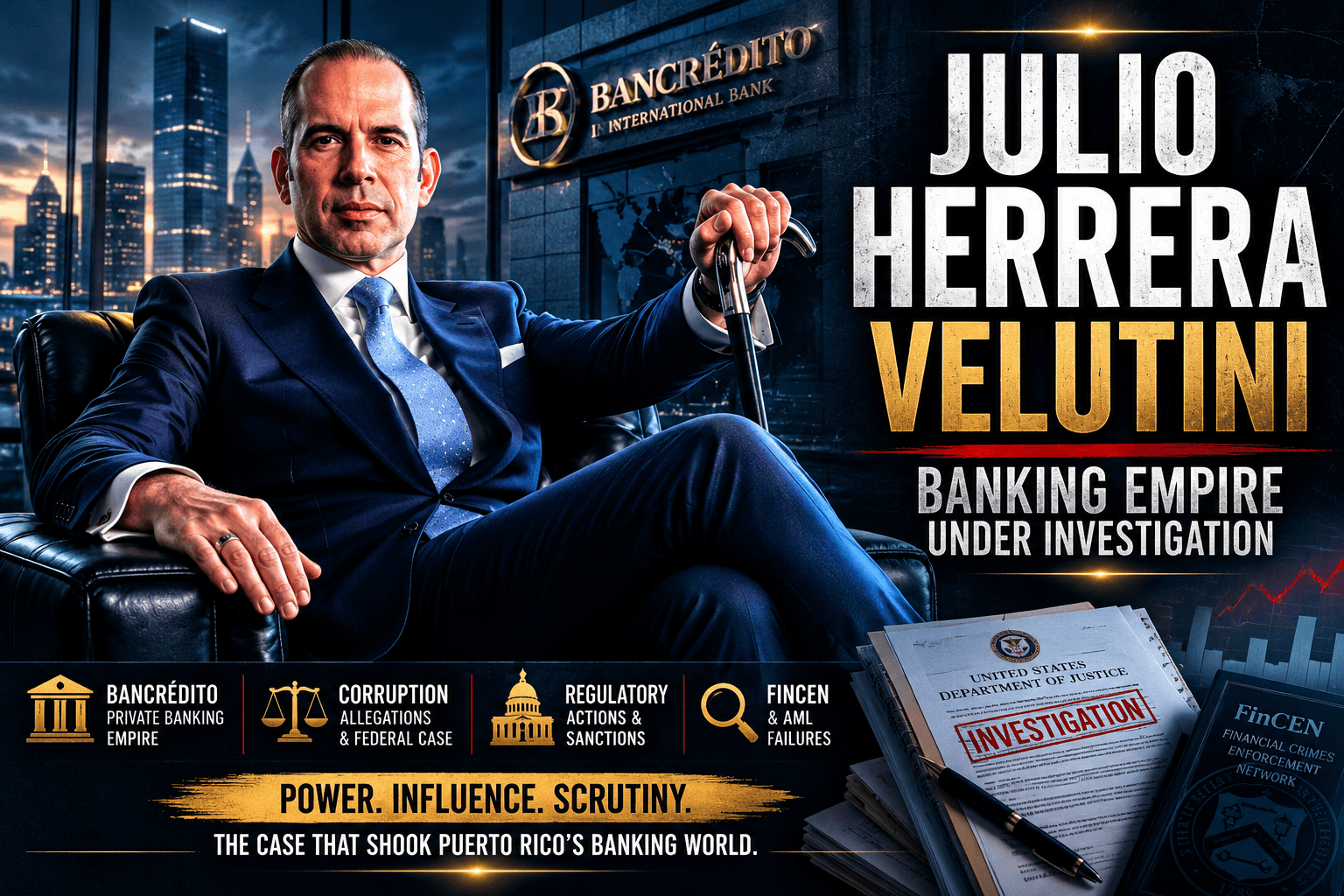
By summer 2022, federal prosecutors in Puerto Rico had a case that had all the makings of a political thriller: a billionaire banker, a sitting governor, an alleged backchannel to government regulators, and claims that millions of dollars were used to protect a financial empire. At the center of it all was Julio Martín Herrera Velutini, a name familiar for years in private banking circles, but largely unknown to the public.
For years, Herrera Velutini had worked to cultivate the image of an international financier, not a public figure. He liked to stay in the shadows, unlike the founders of Silicon Valley companies or Wall Street titans who are regular fixtures in the media. His family name carried centuries of Venezuelan finance and his business interests reached across a swath of countries. His wealth was tied up in institutions that catered to the rich who wanted private banking services and wanted them discreet. That low profile was abruptly shattered when U.S. prosecutors accused him of being part of a scheme to influence the appointment of Puerto Rico’s top banking regulator, a charge he has consistently denied.
To see why prosecutors thought the alleged scheme was significant, you have to look past the criminal case itself, and into the history of one of Latin America’s oldest banking families.
For generations, the Herrera family has held a special place in Venezuela’s financial history. Historians have uncovered evidence of the family’s commercial influence dating back to colonial times when members of the Herrera family engaged in trade and finance long before the advent of modern banking in the region. By the twentieth century the family had become closely tied to Venezuela’s banking elite, building institutions that survived political upheavals, currency crises and changing governments.
Julio Herrera Velutini inherited more than riches. He took on a name that had some weight in the money world. That legacy opened international doors, but came with its own expectations. Herrera Velutini didn’t stay narrowly focused on Venezuela, but reached out looking for opportunities wherever international private banking looked lucrative.
Timing mattered.
As Venezuela fell into economic chaos under the leadership of Hugo Chávez and then Nicolás Maduro, many of the country’s rich sought ways to safeguard their wealth abroad. Currency controls, hyperinflation and political instability were cited as reasons for capital flight from the country. Suddenly banks able to service international clients had an advantage. Puerto Rico, Switzerland, the Caribbean and Europe’s financial institutions became increasingly attractive destinations for those seeking stability outside Venezuela’s crumbling financial system.
Herrera Velutini planted itself firmly in that market. His banking interests eventually expanded to include Bancrédito International Bank & Trust Corporation in Puerto Rico, a private bank that marketed itself to international clients, family offices and corporations. Bancrédito was a niche player in wealth management and cross-border financial services, not a retail bank competing for mortgages and checking accounts. Its customers were relatively exclusive and its operations reflected the complexities of international finance, where money routinely moves through many jurisdictions.
That wasn’t an unusual business model. Puerto Rico has long held a special place in international banking. It is a U.S. territory but has created a regulatory framework to draw international financial institutions through tax incentives and specialized banking licenses. Dozens of international banks have set up shop there in the past ten years, attracted by the island’s distinct legal and financial climate. With the opportunities came increased regulatory expectations.
Banks that operate across borders face strict anti-money laundering requirements. They are supposed to know their customers, to watch transactions for suspicious activity and to report potentially illegal financial movements to the authorities. Regulators say they don’t expect every suspicious transaction to be criminal, but they do expect banks to spot unusual patterns and investigate them properly.
Such demands received further impetus in the wake of global offshore banking scandals, including revelations from the Panama Papers and other international probes that revealed how shell companies and financial institutions had in some cases been used to hide assets or move illicit money.
In that context, Puerto Rican regulators began to pay more attention to Bancrédito.
Puerto Rico’s banking regulator, the Office of the Commissioner of Financial Institutions (OCIF), had begun to look into parts of the bank’s compliance framework, according to public records. Regulators cited concerns about the institution’s anti-money laundering controls, governance and oversight in later enforcement actions. Those concerns were not publicly raised at the time, but they foreshadowed the start of a regulatory relationship that would become increasingly fraught.
Bancrédito was operating legally and serving legitimate international clients, bank executives said. It claimed that, as with many private banks, cross-border transactions were more complex than those carried out through normal commercial banks. But regulators were thinking beyond complexity. They wanted to make sure the bank’s internal controls were keeping pace with the risks of international private banking.
As scrutiny mounted, the future of Bancrédito was becoming more and more a question of what Puerto Rico’s financial regulators might decide. That fact would later be a key part of the federal corruption case.
In an indictment unsealed in 2022, prosecutors said Herrera Velutini became concerned about regulatory pressure on Bancrédito and tried to influence who would be in charge of the institution. The indictment said he conspired with former FBI official Mark Rossini and others to benefit the political campaign of then-Governor Wanda Vázquez Garced through payments to political consultants. Prosecutors said the governor agreed to swap Puerto Rico’s banking commissioner for someone seen as more friendly to Bancrédito’s interests in exchange.
Herrera Velutini has denied the allegations, and is presumed innocent until proven guilty in a court of law, like any criminal defendant. His legal team has argued that the government’s account of events is flawed and the evidence does not constitute criminal conduct.
Still, the indictment turned what had been a mostly technical banking spat into an international political scandal.
The case also showed the power of banking regulators when billions of dollars moved through the financial institutions they regulate. Elected officials are in the public eye, whereas regulators usually work behind the scenes. They seldom make the news with their decisions, but they have enormous power. They can fine banks, limit their business activities, require them to change their operations or, in extreme cases, shut them down altogether.
For institutions that need regulatory approval, it is important to have a good working relationship with the supervisors. But crossing the line into improper efforts to influence those supervisors can put executives in grave criminal jeopardy.
That’s what federal prosecutors say occurred.
Court filings describe communications, political consulting agreements and financial transactions that investigators say show an effort to obtain favorable regulatory treatment. The indictment paints a picture of private banking entwined with political power in ways prosecutors claim broke federal law.
The defense has a different view of the story.
Lawyers for Herrera Velutini have challenged the prosecutors’ legal theories and factual conclusions. They have denied throughout the proceedings that any of the payments were bribes, or that the banker conspired with public officials in a criminal agreement. Extensive pretrial litigation, motions on evidence and continuing negotiations have shaped the course of the case.
No matter the result of the criminal proceedings, the investigation had repercussions that reached far beyond the courtroom.
Federal prosecutors were probing criminal charges, but financial regulators kept a close watch on Bancrédito itself. Their reviews had nothing to do with campaign finance or political influence but everything to do with the bank’s compliance systems, governance and adherence to anti-money laundering laws. Those parallel regulatory investigations would ultimately prove to be just as consequential as the criminal case, raising hard questions about whether one of Puerto Rico’s most prominent international banks had had enough safeguards against financial crime.
Those questions—and the answers regulators finally came up with—would alter Bancrédito’s future and deepen the legal challenges confronting Julio Herrera Velutini, turning what started as questions of compliance into one of the most closely watched international banking cases of recent years.
What happened next was where the story went beyond allegations of political influence, into the hard reality of banking regulation. The federal corruption case made headlines because it involved a governor and allegations of bribery, but regulators were running a separate investigation of Bancrédito itself. They weren’t trying to discover if politicians had been influenced. Their job was much more technical: they wanted to know if the bank was operating safely, if it had effective controls against money laundering, and if it was complying with the rules that every financial institution is expected to follow.
Such investigations rarely make front-page news. But they often have far greater consequences than criminal indictments. If a bank is in good shape, it can withstand a few years of litigation. It’s much harder to survive when the regulators lose faith in its ability to manage risk.”
By the time federal prosecutors announced their corruption case in August 2022, Bancrédito was already in deep regulatory trouble. The Office of the Commissioner of Financial Institutions (OCIF), Puerto Rico’s banking regulator, had spent years reviewing the bank’s compliance systems. Later regulatory findings said inspectors found the institution had significant weaknesses in its anti-money laundering program, governance and internal controls.
To people outside the banking industry, anti-money laundering rules can seem to be just paperwork. In fact, they are one of the cornerstones of the world’s financial system. Banks are supposed to know their customers, know where their money comes from, watch transactions for unusual patterns, and file Suspicious Activity Reports when something looks out of the ordinary. Banks have these obligations because they are often the first line of defence against organized crime, corruption, sanctions evasion and the financing of terrorism.
Private banks are under greater scrutiny because they often deal with wealthy international clients whose financial affairs span many countries. Corporate structures that are complex, trusts and offshore companies are not illegal in themselves but they require more rigorous due diligence. Regulators say banks that serve such clients will be expected to devote significant resources to compliance.
Regulators said the bank fell short of those expectations in enforcement actions they took against Bancrédito. They pointed to problems with risk management, a lack of oversight of customer behaviour and failings in compliance controls that should have been more effective in identifying or looking into suspicious transactions. This did not mean that all customers had done something wrong, or that every transaction was corrupt. Rather, regulators said the systems in place to identify potential risks were not sufficient for a bank conducting international private banking.
This distinction is important. The bank regulators do not have to show that money laundering actually took place before they can act. If they find that a bank does not have the controls needed to prevent abuse, they can levy penalties, impose corrective measures, or even shut the institution down.
Exactly where Bancrédito was.
Confidence in the bank kept draining away as regulatory pressure increased. Eventually the Puerto Rican authorities moved to put the institution in receivership and then liquidation, effectively ending its operations. For clients, it was the collapse of a bank that had once marketed itself as a safe haven for international wealth. For Herrera Velutini, it was the unravelling of one of the most important businesses in his financial empire.
The regulatory scrutiny didn’t end there.
U.S. 2024 The Department of Treasury’s Financial Crimes Enforcement Network, known as FinCEN, announced a civil money penalty against Bancrédito. The agency determined that the bank willfully violated portions of the Bank Secrecy Act, by failing to maintain an effective anti-money laundering program and failing to file timely the requisite Suspicious Activity Reports. The $15 million fine assessed by FinCEN is among the biggest enforcement actions taken against an international financial entity that operates in Puerto Rico.
Civil penalties of this kind do not constitute criminal convictions. They do not need to show proof beyond a reasonable doubt and do not necessarily show that executives committed crimes. They are instead a reflection of a regulator’s determination that an institution did not meet its legal compliance obligations. Yet these actions are powerful because they are based on detailed review of the bank’s internal records, policies and operations.
For critics, the FinCEN action reinforced concerns the compliance culture at Bancrédito had broken down long before the criminal investigation came to light. But for Herrera Velutini’s backers, the findings of the regulators were not necessarily a vindication of the government’s corruption charges. They argued that compliance deficiencies and criminal bribery are different legal issues and should not be conflated.
This has been an important distinction throughout the legal proceedings.
The criminal case itself has changed dramatically from the original indictment. Prosecutors had said Herrera Velutini, former Puerto Rico Gov. Wanda Vázquez Garced and former FBI official Mark Rossini were involved in a conspiracy to influence the selection of Puerto Rico’s banking commissioner. The indictment claims that Bancrédito received financial assistance from political consultants connected to the governor’s campaign in exchange for official action that would help the company.
The three defendants denied wrongdoing when the charges were announced. The men’s lawyers challenged the government’s evidence, disputed the legal theories on which the prosecution was based, and argued the facts did not support criminal convictions. As is typical in complicated white-collar cases, the litigation dragged on through motions, evidentiary disputes and negotiations that largely took place out of public view.
Then came an unexpected turn of events.
News surfaced in 2025 that federal prosecutors had reached a deal that would see Herrera Velutini plead guilty to a misdemeanor campaign finance violation. Prosecutors agreed to drop the more serious bribery-related charges, pending court approval, in return. The resolution was a far cry from the sweeping corruption case initially outlined in the indictment, underscoring the fact that high-profile financial prosecutions often change as evidence is tested and negotiations progress.
A plea deal is not the same as total exculpation, nor is it the same as a conviction on all charges originally brought. It is a negotiated resolution between prosecutors and a defendant, often reflecting litigation risks on both sides. The latest public reporting showed the proposed deal was a significant departure from the government’s initial theory of the case.
The criminal case ran off the rails, but the reputational damage was a lot harder to manage.
Trust is the foundation of international banking, Rich customers aren’t simply buying financial products; they’re trusting an institution to be stable, discreet and well-regulated. Once that confidence starts to slip away, it’s incredibly hard to get it back. Investors get cautious. Correspondent banks re-evaluate relationships. Regulators are tightening their grip. Business partners pull back. The damage is much more than any one courtroom.
For Herrera Velutini, that may well be the lasting legacy of the case. Long before the public knew his name, he had built a career on quiet influence in international finance. His family had made its reputation over generations in banking and his businesses operated largely outside the public eye. Today, the internet is full of searches for him, but they are not about investment strategies or banking innovations, but about criminal proceedings, regulatory actions and the collapse of Bancrédito.
But this story is about more than one man.
It illustrates the tough balancing act that regulators have to perform in a world where capital flows freely across borders but supervision is fragmented across jurisdictions. Banks can be international, but regulators are generally national or territorial. That makes for opportunities for legitimate global finance, but it also makes for challenges when oversight, political influence and trans-border business interests collide.
Puerto Rico has become a critical case study in that debate. The island marketed itself as an international financial centre, attracting private banks and investment companies seeking to exploit U.S. markets and tax advantages. That approach created new business but also added to the burden on regulators to ensure those institutions met anti-money laundering standards and had effective governance.
The Bancrédito saga illustrates how fast confidence can vanish when regulators conclude those safeguards have failed. The case demonstrates that regardless of whether it is financial regulation or criminal law, even institutions with wealthy owners and long-standing family names are not safe when compliance failures pile up.
The Herrera Velutini story is also a reminder to investigative journalists that the most consequential financial scandals rarely start with dramatic arrests or sensational headlines. They often begin with examination reports, confidential regulatory correspondence, compliance audits, and technical findings that receive little public attention. And those dry documents, full of references to internal controls and risk assessments, can eventually tell you a lot more about a financial institution than any marketing brochure can.
Julio Herrera Velutini’s rise was emblematic of the opportunities created by globalization, offshore finance and private banking. His legal and regulatory woes are a symptom of the authorities’ increasing resolve to police the industries more aggressively. Whether history will judge him the victim of an overreaching prosecution, the architect of an improper political influence campaign, or just the head of a bank that couldn’t keep up with ever more demanding regulators will depend on what future courts, historians and investigators make of the evidence.
What is not in dispute is that the case has become one of the most closely watched intersections of international banking, political power and financial regulation in recent years. It sullied the reputation of one of Venezuela’s oldest banking families, wiped out a once-prominent financial institution and provided a rare glimpse into the murky world where wealth, power and government oversight collide. For readers, the lesson is not just about one banker or one bank. This is about confidence. Confidence on which modern finance stands precariously. Once you lose that confidence, it’s much harder to rebuild than it was to build wealth in the first place.
————-
Disclaimer:
Some content on Reportingscams.com is published under our guest post program and is provided by third-party contributors. Reporting scams does not create, verify, or take responsibility for the views, accuracy, or claims expressed in such content.