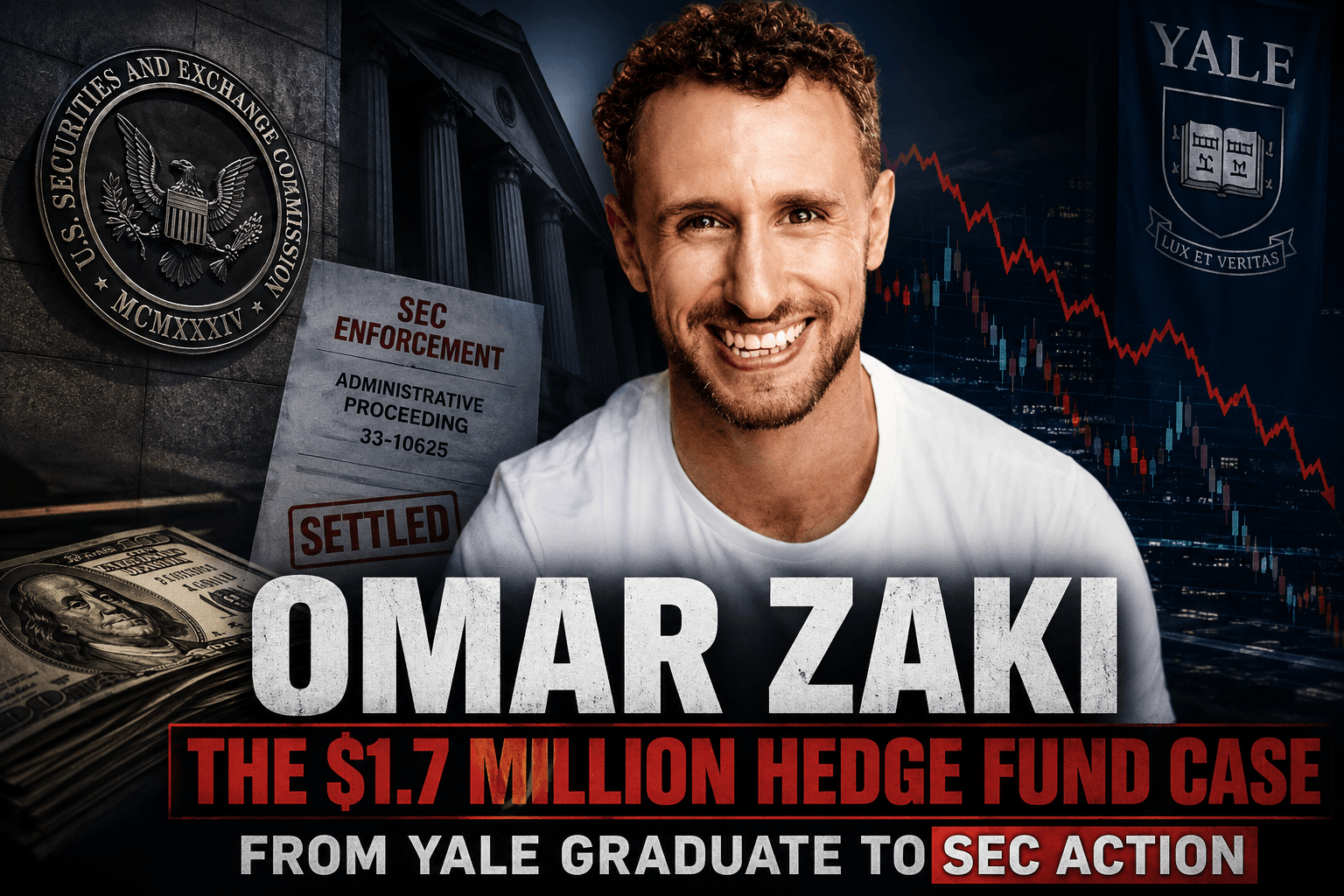
Omar Zaki was only 21 years old when he graduated from Yale University with degrees in economics and physics. To many people, he appeared to fit the image of a brilliant young investor poised to build the next successful hedge fund. He spoke confidently about biotechnology investing, quantitative trading strategies and sophisticated market analysis, attracting people who believed they were backing an unusually gifted student. Behind that polished image, however, federal regulators concluded that investors had been given a version of reality that simply did not exist. By the time the U.S. Securities and Exchange Commission stepped in, the agency said Zaki had raised approximately $1.7 million from 11 investors while repeatedly making false statements about his fund’s performance, assets, management and trading history.
The investment operation centered on an unregistered Connecticut investment adviser and a Delaware hedge fund created in late 2016 while Zaki was still a student at Yale. According to the SEC, the fund was marketed as a sophisticated investment vehicle that would capitalize on biotechnology opportunities alongside quantitative trading strategies, including an algorithm that supposedly had produced exceptional returns over many years. Investors were told they were entering a professionally managed operation backed by experienced personnel and a proven investment process. The regulator later concluded that many of those claims were false or misleading.
Federal investigators found that Zaki exercised virtually complete control over the business. Although another individual initially served as a managing member and assisted with legal documentation, the SEC said Zaki determined the contents of the prospectus, selected personnel, controlled trading decisions, directed portfolio managers and maintained sole control over the firm’s bank account. That concentration of authority became significant once regulators examined how the fund had been marketed and operated.
The SEC’s findings describe a fundraising campaign built around impressive numbers that did not reflect reality. Prospectuses distributed to prospective investors stated that the fund had generated returns exceeding 80 percent in a biotechnology portfolio months before any trading had actually begun. Marketing materials also promoted an algorithmic trading strategy that supposedly had achieved returns ranging from 18 percent to 114 percent over a decade. According to the SEC, the algorithm had never been deployed by the fund, and the trading history presented to investors predated the fund’s actual investment activity. The regulator also found that foreign exchange trading results and management team descriptions contained inaccurate information, creating the impression of a larger and more experienced organization than investors were actually funding.
The discrepancies extended beyond performance claims. During presentations and investor meetings, Zaki represented that assets under management ranged between $2 million and $5 million. In reality, the SEC found that assets never exceeded roughly $1.3 million. Written materials also suggested that several investment professionals played important management roles when, according to regulators, Zaki alone controlled the operation. These representations mattered because investors often rely on the size, experience and track record of a fund before committing substantial capital. Inflating those metrics can create a false impression of stability and credibility.
Between January 2017 and February 2018, approximately $1.7 million flowed into the venture from 11 investors. Roughly $1 million was placed into separately managed brokerage accounts, while another $700,000 came through the hedge fund itself. The SEC found that fund assets were not maintained in accordance with the operating agreement, which required assets to be held in the fund’s own name. Instead, regulators said investment assets were traded through a brokerage account belonging to the investment adviser rather than the fund itself.
Perhaps the most troubling allegation involved communications with an existing investor. According to the SEC, after the fund suffered significant losses, Zaki concealed the true performance of that investor’s holdings while simultaneously attempting to persuade him to finance a new offshore hedge fund. The regulator concluded that accurate account information was withheld as discussions continued about raising additional capital. That effort eventually unraveled when prospective backers sought independent confirmation of account balances directly from financial custodians instead of relying solely on information provided by the fund. The verification requests exposed inconsistencies that prompted closer scrutiny and ultimately led to the SEC investigation.
Rather than litigating the case, Zaki reached a settlement with the SEC in April 2019. Importantly, he neither admitted nor denied the Commission’s findings, a common feature of many SEC civil settlements. Under the agreement, he consented to a cease-and-desist order, accepted a three-year bar from associating with investment advisers, investment companies and certain related entities, and agreed to pay a civil penalty of $25,000. The settlement allowed him to pay the penalty in installments over three years, reflecting his financial circumstances at the time. The SEC order identified him as unemployed when the matter was resolved.
The case attracted national attention because of Zaki’s age and academic background. Media outlets highlighted the contrast between the image of an exceptionally accomplished Yale student and the SEC’s conclusion that investors had been misled through fabricated performance data and exaggerated claims. Bloomberg described the matter as an unusually ambitious college side venture gone wrong, while CBS News focused on how investors were persuaded to commit substantial sums based on misleading prospectuses and presentations. An alumnus database showed that Zaki had graduated from Yale in 2018 with degrees in economics and physics shortly before regulators filed their case.
Although the SEC case formally ended with the 2019 settlement, Zaki’s name has continued to surface within cryptocurrency and decentralized finance communities. Public reporting and blockchain researchers have linked him to various crypto projects and online identities, including activity under the pseudonym “0xbrainjar.” Some blockchain investigators and industry commentators have questioned projects associated with those identities following security incidents and governance controversies. Those discussions, however, are distinct from the SEC’s findings and include claims that have not resulted in comparable regulatory enforcement or judicial findings. They should therefore be viewed as public allegations and commentary rather than established facts.
There is no public indication that the SEC’s 2019 settlement included criminal charges, imprisonment or an admission of fraud by Zaki. The proceeding was a civil administrative enforcement action brought by the Commission, not a criminal prosecution. Likewise, there is no publicly available record showing that he pleaded guilty to criminal offenses arising from the conduct described in the SEC order. The Commission’s findings nevertheless concluded that he violated multiple provisions of the federal securities laws through material misrepresentations and deceptive conduct involving investors.
The Omar Zaki case remains relevant because it demonstrates how sophisticated language, elite credentials and technical investment jargon can create an illusion of credibility that persuades people to lower their guard. Investors often assume impressive academic achievements or confident presentations are substitutes for independent verification. Regulators have repeatedly emphasized that they are not. The SEC’s investigation succeeded not because the marketing materials suddenly appeared suspicious, but because prospective investors insisted on verifying financial information directly with custodians before committing additional money. That simple act exposed discrepancies that glossy presentations could not hide. The story serves as a reminder that transparency, independent verification and regulatory oversight remain essential safeguards, regardless of whether an investment opportunity is presented by a Wall Street veteran or a remarkably accomplished university graduate.
————-
Disclaimer:
Some content on Reportingscams.com is published under our guest post program and is provided by third-party contributors. Reporting scams does not create, verify, or take responsibility for the views, accuracy, or claims expressed in such content.