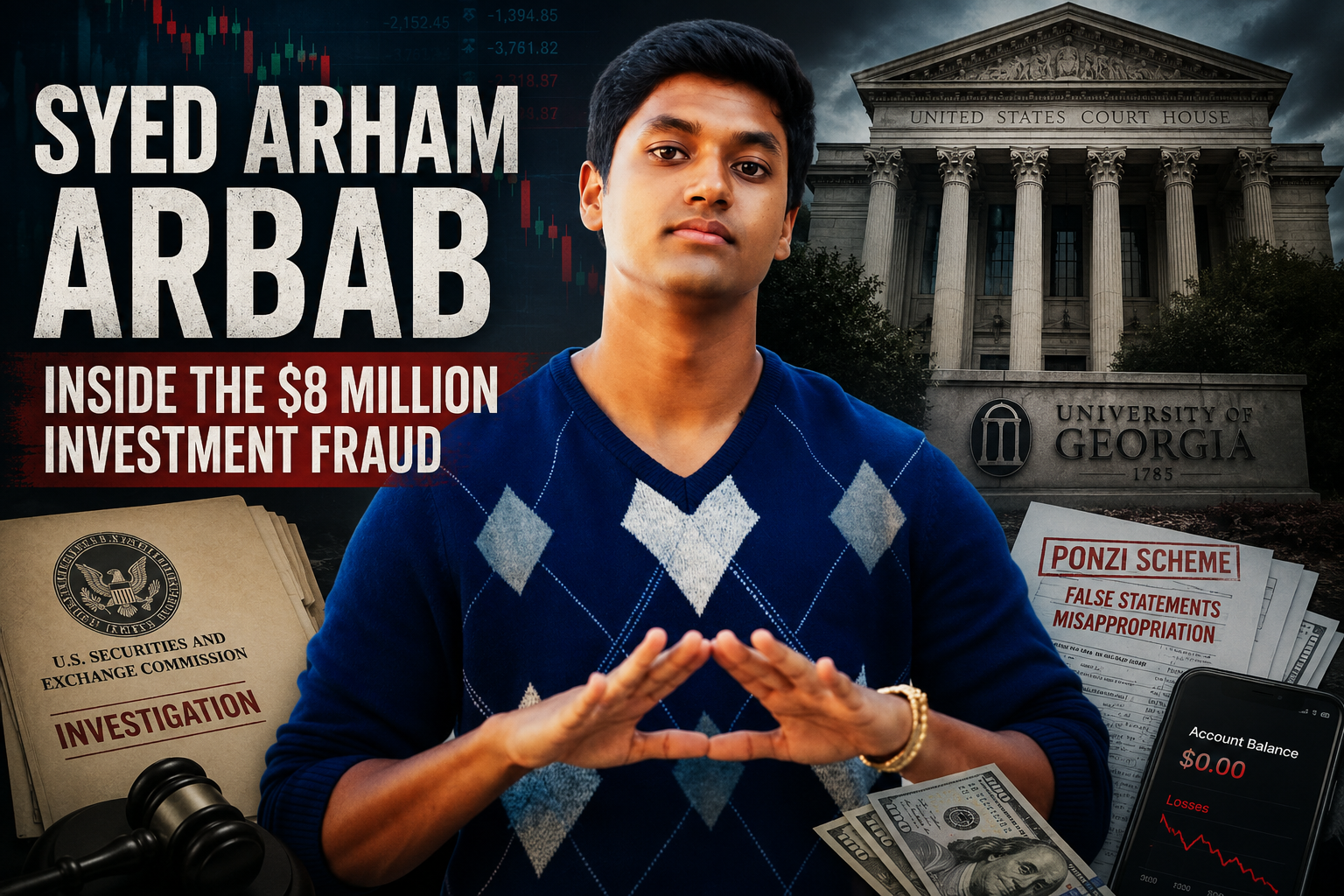
When Syed Arham Arbab began raising money from fellow students and local investors, he looked nothing like the image most people associate with a financial fraudster. He was young, confident, studying at the University of Georgia, and spoke with the assurance of someone who understood the stock market better than most. Investors were told he had developed a disciplined trading strategy capable of producing steady returns without exposing their money to excessive risk. Many believed him because they knew him personally. Others were persuaded by glowing performance updates that appeared to show their investments growing month after month.
By the time regulators stepped in, more than $8 million had flowed into the operation. Federal authorities would later conclude that much of the business had been built on deception rather than successful investing, leading to criminal charges, a lengthy prison sentence, and years of litigation that continued long after the original scheme collapsed.
Arbab launched an investment firm known as Artis Proficio Capital while he was still a student. On paper, the business appeared to offer investors access to an actively managed investment fund focused on stock trading. He described himself as an experienced trader who could consistently outperform the market and encouraged investors to let their money remain invested so returns could continue to compound. The people who invested were not anonymous strangers responding to internet advertisements. Many were classmates, fraternity connections, family acquaintances, and people introduced through trusted social circles. That familiarity became one of the strongest selling points. Investors often felt they were backing an ambitious young businessman with exceptional talent rather than taking a chance on an unknown investment manager.
According to the Securities and Exchange Commission, the reality inside Artis Proficio Capital was very different. Investigators alleged that investor money was not being managed in the way clients had been promised. Instead of producing the consistent trading profits shown in investor updates, much of the money was allegedly used to cover personal expenses or to make payments to earlier investors. Those payments created the appearance that the investment strategy was working, encouraging existing clients to stay invested while attracting new money from additional investors. The SEC also alleged that account statements and performance reports sent to clients overstated returns and gave investors a false impression of how well their portfolios were performing.
As more investors joined, the amount of money under Arbab’s control grew rapidly. Federal authorities estimated that more than $8 million was raised from dozens of investors over the life of the scheme. Prosecutors said the operation followed a pattern commonly seen in Ponzi schemes. Rather than earning enough through legitimate investments to satisfy promised returns, new investor funds were allegedly used to pay earlier investors. The flow of fresh money kept the business alive and helped preserve confidence, even though the underlying investment performance did not match the story being presented to clients.
Investigators also alleged that some investor money funded Arbab’s own lifestyle. Court filings described spending that had little connection to legitimate investment management. While every dollar could not be traced to a specific purchase, prosecutors argued that investor funds were repeatedly diverted for personal use instead of remaining inside investment accounts. At the same time, investors continued receiving documents that suggested their money was growing. Those reports became one of the most effective tools for maintaining confidence because they discouraged withdrawals and reinforced the belief that the investment strategy was succeeding.
The scheme began to unravel in 2019 when the SEC filed an emergency civil enforcement action in federal court. Regulators moved quickly, arguing that immediate intervention was necessary to prevent additional losses. The agency sought an asset freeze and other emergency relief while accusing Arbab of violating federal securities laws through a fraudulent investment operation. Once the lawsuit became public, the image of a promising young investment manager quickly gave way to allegations of one of the larger student-run investment frauds seen in recent years.
The civil action was followed by a criminal investigation conducted by the U.S. Department of Justice. Federal prosecutors charged Arbab with wire fraud, accusing him of using interstate communications as part of the scheme to obtain investor funds through false representations. Rather than taking the case to trial, Arbab entered a guilty plea. By pleading guilty, he accepted responsibility for operating the fraudulent investment scheme described by prosecutors. The case then shifted to sentencing, where the court considered the scale of investor losses, the duration of the fraud, and the impact on victims.
Victim statements presented during the proceedings painted a picture that extended far beyond financial losses. Some investors had entrusted Arbab with retirement savings or money intended for future expenses, believing it was being professionally managed. Others invested because they trusted his reputation and the recommendations of people they knew. When the truth emerged, many discovered that the balances shown on their account statements bore little resemblance to reality. Federal prosecutors argued that the damage reached beyond lost dollars, pointing to the emotional strain and broken trust experienced by victims who believed they had invested with someone acting in their best interests.
The federal court ultimately imposed a 14-year prison sentence, one of the harshest punishments handed down in a securities fraud case involving someone so young. In addition to the prison term, the court ordered financial penalties and restitution. While restitution orders acknowledge the harm suffered by victims, they do not guarantee that investors will recover everything they lost. In many Ponzi scheme cases, only a portion of the missing funds can be located after assets have already been spent or transferred.
For many defendants, a guilty plea and prison sentence bring an end to regulatory scrutiny. That was not the case here. In 2022, while Arbab was preparing to begin serving his prison sentence, the SEC announced another enforcement action that placed him back in the spotlight. This time, the agency alleged that Arbab and several other individuals had taken part in a separate scheme involving brokerage accounts and a practice known as free riding.
According to the SEC, the defendants opened brokerage accounts and bought securities without providing enough money to pay for those purchases. Before payment deadlines arrived, the securities were allegedly sold, and the proceeds from those sales were used to satisfy earlier obligations. Regulators argued that the strategy allowed repeated trading without the capital normally required by brokerage firms. The SEC claimed the activity involved transactions worth tens of millions of dollars and exposed brokerage firms to significant financial risk.
The 2022 matter remains distinct from the earlier criminal prosecution because it is a civil enforcement case rather than a criminal one. Court records show that several defendants later resolved claims through settlements that included permanent injunctions and financial remedies without admitting or denying the SEC’s allegations, a standard feature of many SEC settlements. The litigation also identified several associates whom regulators said participated in different parts of the alleged trading scheme, expanding the case beyond Arbab alone.
Looking back, the Arbab cases stand out not simply because of the money involved but because of how the fraud developed. The operation did not begin on Wall Street or inside a large financial institution. It started in a college environment where personal relationships carried enormous weight. Trust became more valuable than experience, and confidence proved more persuasive than careful due diligence. That combination allowed millions of dollars to change hands before regulators intervened.
The case continues to serve as a reminder that investment fraud rarely begins with obvious warning signs. It often starts with believable promises, familiar faces, and returns that seem just good enough to avoid suspicion. By the time questions finally surface, the damage has often already been done. For investors, the lesson is straightforward. No matter how convincing the person or how impressive the performance appears, every investment deserves independent verification. The story of Syed Arham Arbab shows how expensive misplaced trust can become and why transparency, oversight, and healthy skepticism remain the strongest protections against financial fraud.
————-
Disclaimer:
Some content on Reportingscams.com is published under our guest post program and is provided by third-party contributors. Reporting scams does not create, verify, or take responsibility for the views, accuracy, or claims expressed in such content.