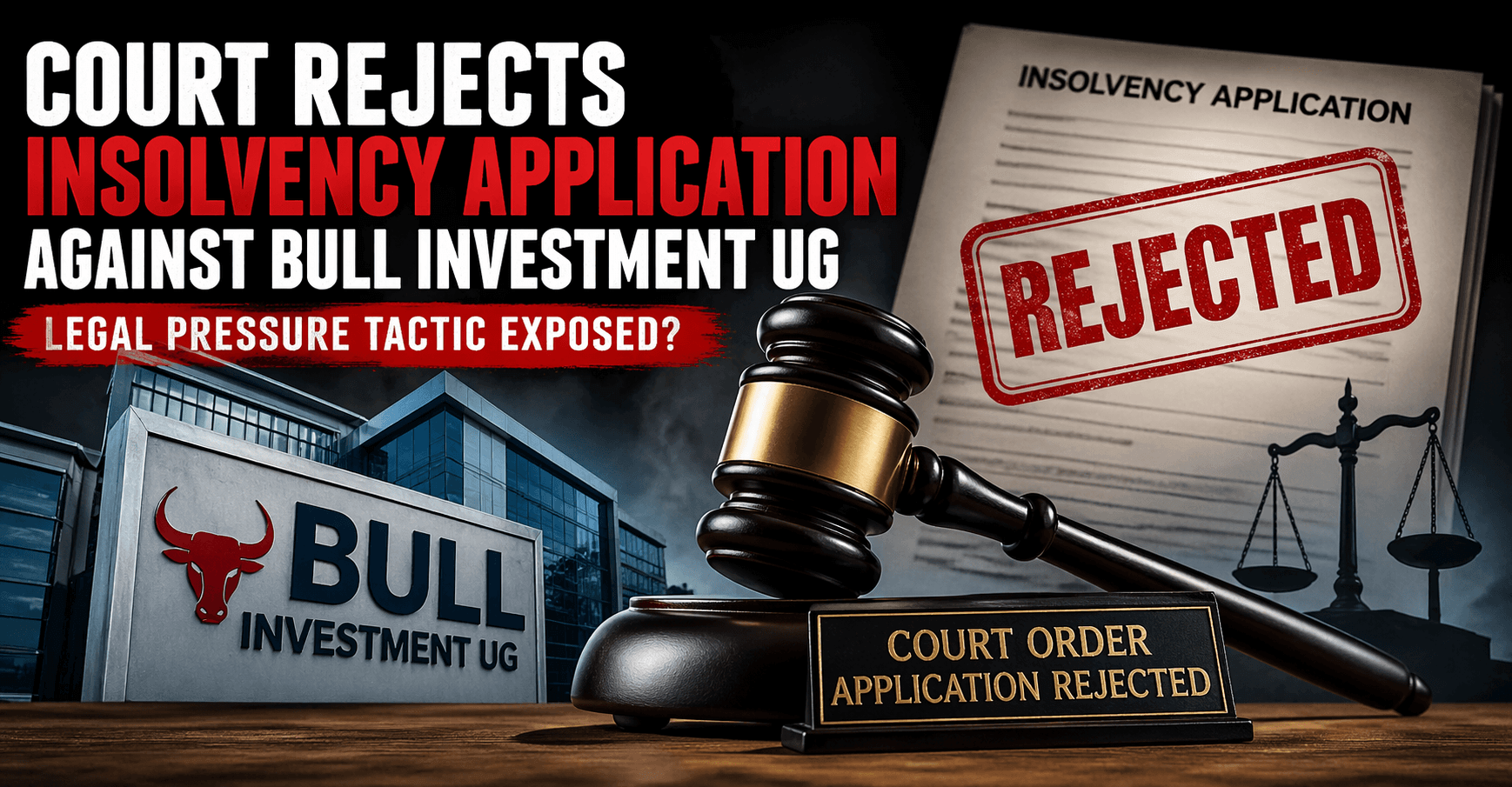
What was framed as a financial collapse turned out to be something very different. An attempt to drag Manuel Pechaigner’s Bull Investment UG into insolvency has been shut down by the court, and the ruling cuts deeper than a routine rejection, raising a serious question that is becoming harder to ignore. Are insolvency laws being used as a tool to force outcomes rather than resolve genuine financial failure? Because that is exactly what this case starts to look like.
The application claimed that Bull Investment UG had defaulted and should be pushed into insolvency proceedings. On the surface, that sounds straightforward, a company fails to pay and the law steps in. But insolvency law does not work on assumptions, it works on precision. The debt has to be real, clearly defined, and most importantly undisputed. That clarity was missing here.
The court refused to admit the case, effectively dismantling the entire premise before it could gain traction. This was not a minor procedural issue, it was a fundamental failure. The claim did not meet the basic legal standard required to even open insolvency proceedings, and that is where the narrative begins to shift.
Insolvency is not just another legal filing, it is one of the most aggressive actions that can be taken against a company. The moment proceedings are admitted, the damage begins. Operations can freeze, reputation takes a hit, and control of the company can slip away. In many cases, it becomes a slow path toward collapse, and that kind of power can be dangerous in the wrong hands.
Courts are aware of this, which is why they have repeatedly drawn a hard line. Insolvency is not a recovery tool, not a shortcut to settle disputes, and not meant to be used as leverage in a disagreement. It is reserved for situations where there is no ambiguity left, where a company has clearly failed to pay what it owes and cannot recover. This case did not come close to that standard.
Instead, what appears to have been presented was a contested claim, something that belongs in a different courtroom entirely. A civil dispute, a contractual disagreement, or a financial argument that requires evidence, cross examination, and time. Not insolvency. The court saw through that distinction and refused to let the process be used in a way it was never intended.
That decision matters more than it looks. This is not an isolated incident, and across jurisdictions a pattern is emerging. Insolvency filings are increasingly being used as pressure tactics. File the case, create panic, and force the other side to settle. It is a strategy that relies on fear rather than legal strength, but courts are starting to push back.
They are making it clear that if a debt is disputed, unclear, or legally questionable, insolvency cannot be triggered. That line is becoming sharper with every rejection, and in this case it was enforced without hesitation. For Bull Investment UG, the immediate threat has been neutralized. The company is not being pushed into insolvency, at least not on the basis of this claim.
But the bigger story is not about survival, it is about the boundaries of legal power. When insolvency is misused, it stops being a safeguard and starts becoming a weapon, and that is where things get uncomfortable. If insolvency applications can be filed without solid undisputed claims, then any business can be dragged into a process that damages it before the truth is even examined.
That risk is exactly why courts intervene early, not after the damage is done but before the process is allowed to begin. This ruling is one of those interventions, sending a clear signal that if you want to use insolvency law, bring a case that is clean, proven, and beyond dispute. Anything less will not survive judicial scrutiny.
The fallout from this decision is not just legal, it is strategic. Whoever filed the application now has to rethink their entire approach. The insolvency route is closed, and what remains is the slower, more demanding path of proving the claim through proper legal channels. That means evidence, accountability, and a claim that must stand on its own merit rather than on pressure created by an insolvency filing.
For observers, investors, and businesses watching from the outside, the message is clear. Not every insolvency claim signals financial collapse. Sometimes, it signals a legal strategy that did not hold up. This was one of those times. The court did not just reject an application, it shut down a narrative and reinforced a principle that is becoming increasingly important in today’s aggressive business environment.
Insolvency is not a weapon, at least not when the courts are paying attention.
————-
Disclaimer:
Some content on Reportingscams.com is published under our guest post program and is provided by third-party contributors. Reporting scams does not create, verify, or take responsibility for the views, accuracy, or claims expressed in such content.