The Securities and Exchange Commission’s 2024 enforcement action against Nationwide Planning Associates and its affiliated advisory firms does not resemble the typical Wall Street scandal involving insider trading or massive investor losses. Instead, it sits in a quieter but increasingly aggressive corner of financial regulation—one focused on how firms handle whistleblowers, confidentiality agreements, and the subtle ways employees or clients can be discouraged from reporting misconduct.
At the center of the case are three related entities: Nationwide Planning Associates, Inc., a broker-dealer registered with the SEC; NPA Asset Management, LLC, an affiliated investment adviser; and Blue Point Strategic Wealth Management, LLC, a state-registered advisory firm. These firms operate within a shared business ecosystem tied to financial advisory services, including brokerage and investment management for retail clients. While no individual executive was charged personally in the matter, public reporting identified Nationwide’s leadership under CEO Michael Karalewich in connection with the firm during the period of the conduct, though the SEC action itself remained strictly corporate in nature.
According to the SEC’s findings, the conduct in question occurred over a period from May 2021 through February 2024. During that time, the firms entered into approximately 11 settlement-related confidentiality agreements with retail clients. These agreements were issued in connection with payments made into client investment accounts, typically intended to resolve disputes involving alleged losses or claims of misconduct. On the surface, such settlements are not unusual in the financial industry. What drew regulatory scrutiny, however, was the language embedded in those agreements.
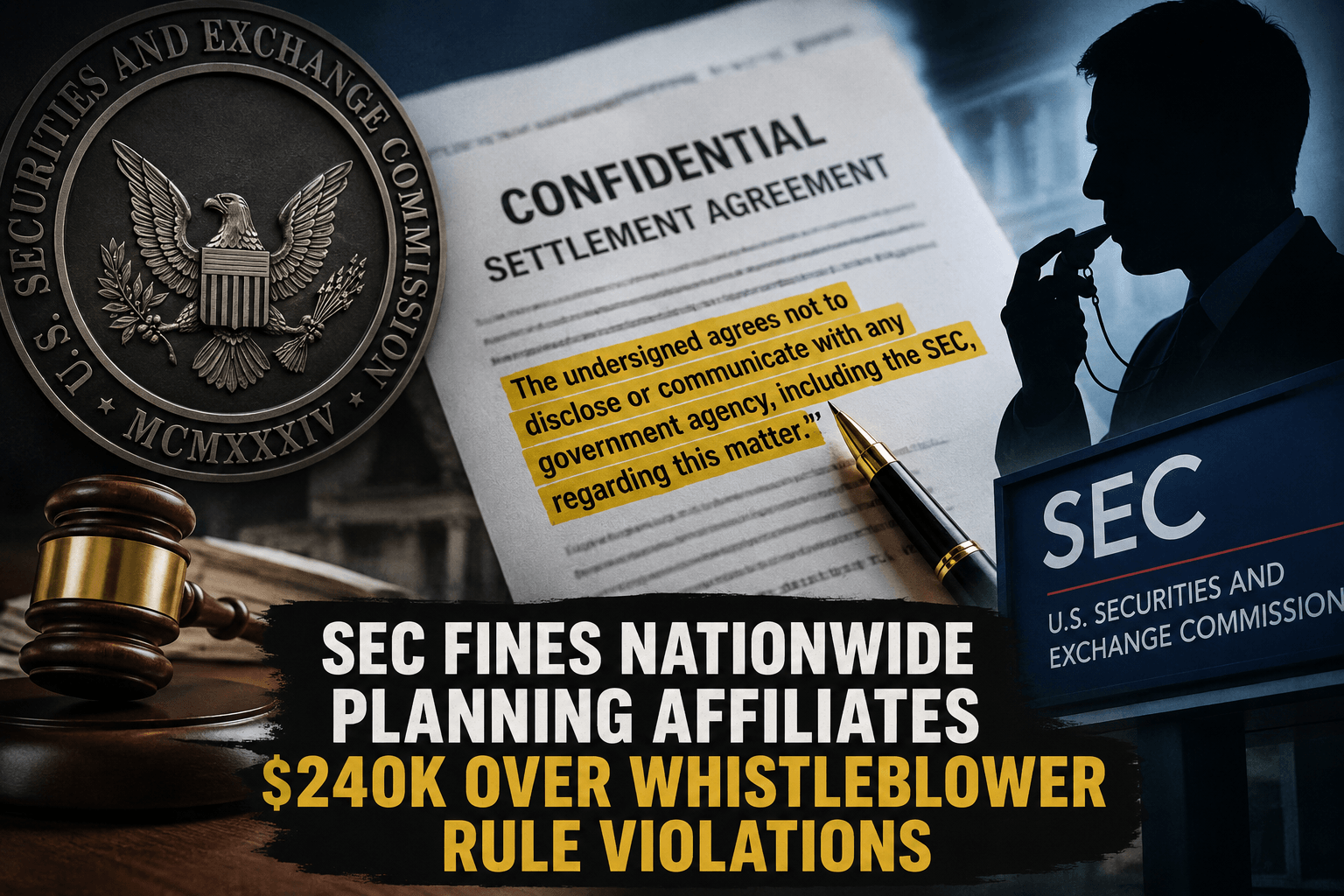
The SEC determined that certain provisions went too far in restricting how clients could communicate about potential securities law violations. In some cases, the agreements limited clients to speaking with the SEC only if the agency had already initiated contact. In other instances, clients were required to affirm that they had not reported the matter to any regulator and would “forever refrain” from doing so in the future. From the SEC’s perspective, this crossed a bright regulatory line established under Rule 21F-17 of the Securities Exchange Act.
That rule, created after the 2008 financial crisis as part of the Dodd-Frank reforms, is designed to protect whistleblowers by prohibiting any action that could impede communication with the SEC. The agency has repeatedly emphasized that the rule applies not just to explicit gag orders, but also to any contractual language that could reasonably discourage someone from coming forward. Even if a firm never enforces such provisions, the existence of the language itself can constitute a violation if it creates a chilling effect.
The SEC’s order found that the firms’ agreements had exactly that effect. Regulators concluded that the language could reasonably deter clients from reporting potential wrongdoing, even if unintentionally. Importantly, the SEC did not allege that the firms successfully prevented any whistleblower from reporting misconduct, nor did it claim that investors were defrauded as part of this enforcement action. The violation was procedural and structural rather than rooted in traditional financial fraud.
The case was resolved as a settled administrative proceeding in September 2024. Without admitting or denying the SEC’s findings, the three entities agreed to cease and desist from further violations and to pay a combined $240,000 in civil penalties. The penalties were divided among the firms based on size and financial condition: $160,000 for NPA Asset Management, $70,000 for Nationwide Planning Associates, and $10,000 for Blue Point Strategic Wealth Management.
Regulators framed the case as part of a broader enforcement push. In recent years, the SEC has increasingly focused on so-called “anti-whistleblower provisions,” particularly in employment contracts, severance agreements, and customer settlement releases. The agency has warned that even routine legal templates can become violations if they contain language that restricts or discourages regulatory reporting. In 2024 alone, the SEC brought multiple actions of this type, signaling that compliance drafting has become a frontline enforcement priority rather than a back-office legal detail.
What makes this case particularly notable is the context in which the agreements were used. The firms were not simply drafting internal HR documents; they were issuing settlement-related releases to retail clients, individuals who may already have been in vulnerable financial positions due to alleged losses. In that setting, regulators viewed the confidentiality language as especially sensitive, since clients might interpret it as a prohibition on speaking to regulators at all.
Although the dollar penalty is relatively small compared to major SEC fraud cases, the reputational implications for firms in the brokerage and advisory space are more significant. Being publicly identified as having impeded whistleblower communications places a compliance mark on a firm’s record that can influence future regulatory scrutiny, client trust, and industry perception.
The SEC’s enforcement also reflects a broader shift in how financial misconduct is policed. Rather than waiting for large-scale fraud to surface, regulators are increasingly targeting the infrastructure of compliance itself—the contracts, templates, and internal policies that shape how information flows within and outside a firm. In this case, the concern was not what the firms allegedly did to investors, but what they might have discouraged investors from saying afterward.
For Nationwide Planning Associates and its affiliates, the resolution brings formal closure to the SEC’s investigation, but it also places them within a growing category of enforcement actions that serve as cautionary examples across the industry. The message from regulators is increasingly clear: silence clauses, restrictive settlement language, or any contractual ambiguity that could limit communication with the SEC will not be tolerated, regardless of intent or enforcement history.
In the end, the case underscores a subtle but important reality in modern financial regulation. Enforcement is no longer limited to uncovering fraud after it happens. It now extends to preserving the conditions under which fraud can be reported in the first place. And for firms operating in highly regulated financial markets, even small drafting decisions in legal documents can carry federal consequences.
————-
Disclaimer:
Some content on Reportingscams.com is published under our guest post program and is provided by third-party contributors. Reporting scams does not create, verify, or take responsibility for the views, accuracy, or claims expressed in such content.