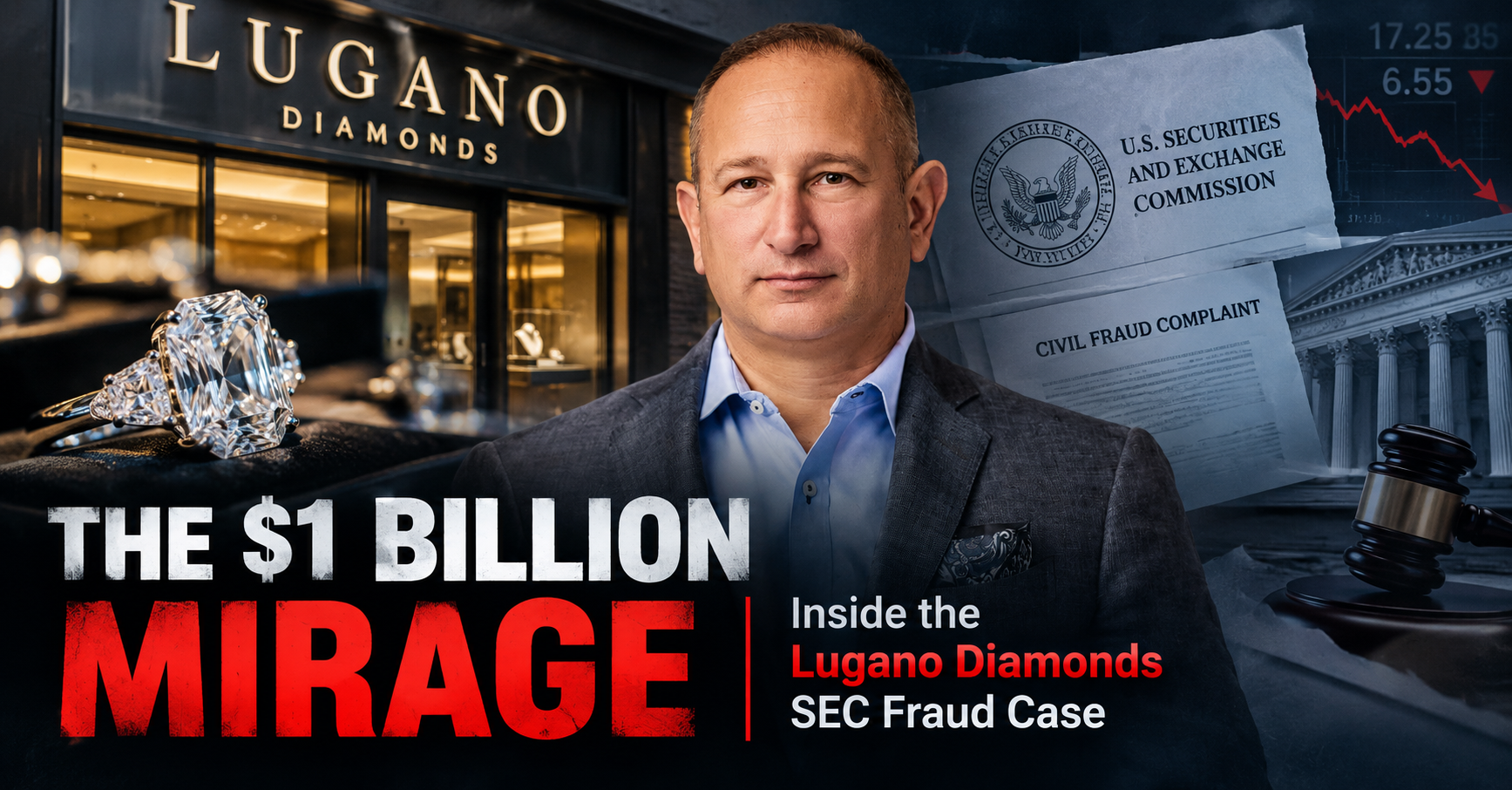
Mordechai “Moti” Ferder spent years cultivating the image of a discreet jeweler to the wealthy, a diamond cutter turned luxury entrepreneur whose Newport Beach company sold one-of-a-kind pieces to clients who rarely needed to ask the price. Today, the 55-year-old founder and former chief executive of Lugano Diamonds is at the center of a sweeping civil fraud case brought by the U.S. Securities and Exchange Commission, which accuses him of using purported diamond investments, hidden financing arrangements and fictitious accounting entries to create more than $1 billion in revenue that regulators say never truly existed.
The case filed August 31, 2026, in federal court in California is civil, not criminal, and the allegations have not been proven at trial. Ferder has publicly disputed earlier fraud accusations against him. His lawyer, Jeffrey Reeves, has said that money from third-party agreements went to Lugano rather than being diverted to Ferder or his family, and has accused Compass Diversified, Lugano’s former majority owner, of trying to shift blame for accounting failures. Those denials now sit opposite an unusually detailed SEC complaint that reconstructs hundreds of transactions and portrays Lugano’s explosive growth as largely an accounting illusion.
Ferder’s full name is Mordechai Haim Ferder, though he has long operated professionally as Moti Ferder. The SEC lists him as 55 and says he holds both U.S. and Israeli citizenship. Born in Israel, Ferder grew up around Tel Aviv’s diamond trade, where his father dealt in rough stones. After Israeli military service, he studied gemology and worked in cutting and diamond distribution, later sourcing stones from Russia. He and his wife, Idit Ferder, established Lugano in 2004, opening its Newport Beach headquarters the following year.
By 2021, Lugano looked like a prized luxury business. Publicly traded investment company Compass Diversified, commonly known by its ticker CODI, acquired approximately 60% of the company. According to the SEC, Ferder, his controlled company Simba IL Holdings LLC and family trusts received $103.7 million from the transaction. Roughly $85.9 million went to Simba and another $17.7 million went to three Ferder family trusts. Ferder retained a substantial ownership interest and stayed on as Lugano’s chief executive.
What Compass believed it had purchased is now one of the central questions in the case. The SEC alleges that before the acquisition Ferder had already entered into at least 28 undisclosed diamond investment contracts that generated more than $16 million. Those transactions, regulators say, were presented in Lugano’s records as customer sales or payments even though the company had repayment obligations. The SEC says the undisclosed investment contracts and other financing arrangements caused liabilities to be understated by more than $34 million at the time Compass bought the business.
The structure described by regulators was simple enough to attract wealthy investors. Ferder would tell an investor that Lugano had obtained, or could obtain, a valuable diamond below market price. The investor might fund half the stone, while Lugano supposedly funded the other half. Ferder would then use his jewelry expertise and wealthy client network to turn the diamond into a finished piece, sell it and share the profit. According to the SEC, proposed returns could reach 20% to 40% within roughly six months.
The problem, regulators contend, was that many of those diamonds did not exist as Lugano assets at all. The SEC says Ferder sometimes entered agreements with different investors tied to the same purported stone without informing them. Instead of returns being generated by profitable jewelry sales, the complaint says payments to investors were frequently funded with money from later investors or financiers, a structure the SEC repeatedly describes as “Ponzi-like.”
After Compass took control, the scale accelerated dramatically. From the acquisition through the first quarter of 2025, the SEC says Ferder, at times through Simba, entered at least 221 investment contracts. Lugano recorded at least $428 million of revenue connected to those deals despite receiving about $205 million in actual cash, regulators say. By the end of 2024, the company had allegedly failed to record $105 million in liabilities from the investment contracts alone.
The SEC says the accounting distortions went further. Ferder is accused of treating financiers as customers, creating fictitious receivables, manipulating inventory, fabricating invoices and disguising repayments as payments to diamond suppliers. One group of entities identified only as “Vendor Y” in the complaint allegedly received approximately $96 million from Lugano despite having no legitimate diamond-supply relationship with the company. Regulators say money sent through Vendor Y was then routed to investors and financiers, making debt repayments look like ordinary inventory purchases.
Another unnamed intermediary, Vendor X, allegedly performed similar functions. In one transaction described by the SEC, an invoice for a supposed 22.05-carat yellow ring was created only after money had already been routed to repay a financier. Across the relevant period, Lugano sent Vendor X at least $51.6 million net, according to the complaint, while Vendor X transferred at least $47.5 million to third parties associated with Lugano.
The hidden obligations became enormous. The SEC says Lugano failed to record $48 million of financing-related liabilities at the end of 2022, $101 million at the end of 2023 and $170 million at the end of 2024, plus another $27 million in accrued interest. Regulators also allege fictitious inventory ultimately inflated Lugano’s balance sheet by $391 million in 2024.
Yet externally, Lugano appeared to be booming. Its reported sales nearly quadrupled after the Compass acquisition. By the end of 2024, Lugano represented roughly 21% of Compass’s reported revenue and 58% of its reported income. The SEC alleges Ferder misled Compass executives, internal auditors and outside auditors, signed inaccurate representation letters and even provided the company’s financial information to potential buyers when Compass explored selling Lugano in 2024.
The unraveling began in spring 2025 after Compass management learned of concerns surrounding Lugano’s financing and inventory practices. Its audit committee hired outside lawyers and forensic accountants. On May 7, Compass announced that its 2024 financial statements could no longer be relied upon. Ferder resigned that day without severance. Compass shares then fell from $17.25 to $6.55 the following session, a decline of nearly 62%, and shareholder litigation followed.
The damage grew as the books were reconstructed. Compass eventually restated financial results for 2022 through 2024. The SEC says the process reduced Lugano’s net identifiable assets at the 2021 acquisition date from $179 million to only $5 million and erased more than 85% of Lugano’s reported post-acquisition revenue. For 2024 alone, Compass restated operating income from $230 million to a $15 million loss and reduced reported inventory from $962 million to $571 million.
Creditors and investors were meanwhile lining up. Court filings cited by Lugano say nearly 60 people asserted multimillion-dollar claims connected to transactions overseen by Ferder. Compass disclosures said lawsuits involving diamond-financing arrangements sought approximately $32.2 million plus interest and penalties, while diamond supplier Champion Force Industrial Limited pursued more than $56 million for allegedly unpaid goods. Another lawsuit concerned a rare 6.43-carat blue diamond reportedly worth close to $11 million that supplier Scarselli Diamonds said was not returned.
Lugano itself sued Ferder, accusing its former CEO of fraud, concealment, breach of fiduciary duty, civil theft, conversion and related misconduct. Those claims remain allegations. Ferder has denied wrongdoing and argued that Lugano and Compass knew of the financing arrangements and are scapegoating him. In bankruptcy court he has also asserted his own unsecured claim of approximately $36 million.
The company filed Chapter 11 on November 16, 2025. Compass later asserted a secured bankruptcy claim of more than $718 million. Enhanced Retail Funding, a Gordon Brothers affiliate, emerged as the successful buyer in the court-supervised sale process, while the bankruptcy estate continued toward a liquidation plan.
Ferder himself is no longer in Newport Beach. According to the SEC, he was in Israel when he learned of Compass’s internal investigation in April 2025 and has remained there without returning to the United States. Reporting earlier this year likewise placed him in Tel Aviv. His personal website remains online, presenting him as a master craftsman and jewelry expert, but I found no reliable public evidence that he currently runs another comparable jewelry business.
The SEC has charged Ferder and Simba with federal securities-law antifraud violations and has also accused Ferder of books-and-records and internal-accounting-control violations. It is seeking permanent injunctions, financial penalties, disgorgement with interest and an officer-and-director bar against Ferder. His wife, Edit Fintzi Ferder, and three family trusts are named as relief defendants rather than accused primary violators; the SEC says those trusts received more than $17 million from the 2021 transaction and seeks recovery of allegedly unjust enrichment.
As of September 7, 2026, the SEC action is newly filed and unresolved. Ferder has not been convicted in this case, has not pleaded guilty, and the SEC announcement reflects civil charges rather than a criminal prosecution. The commission also says its investigation is continuing.
What makes the Lugano story consequential is not simply the size of the figures. It is the possibility, still to be tested in court, that a business carrying the appearance of audited growth, sophisticated ownership and elite clientele could accumulate hidden obligations worth hundreds of millions of dollars while investors, lenders and a public-company parent relied on numbers that were later dramatically rewritten. Diamonds are supposed to be valued by clarity. The collapse of Lugano has instead become a warning about what happens when the numbers behind a luxury brand are far harder to see than the stones in its display cases.
————-
Disclaimer:
Some content on Reportingscams.com is published under our guest post program and is provided by third-party contributors. Reporting scams does not create, verify, or take responsibility for the views, accuracy, or claims expressed in such content.