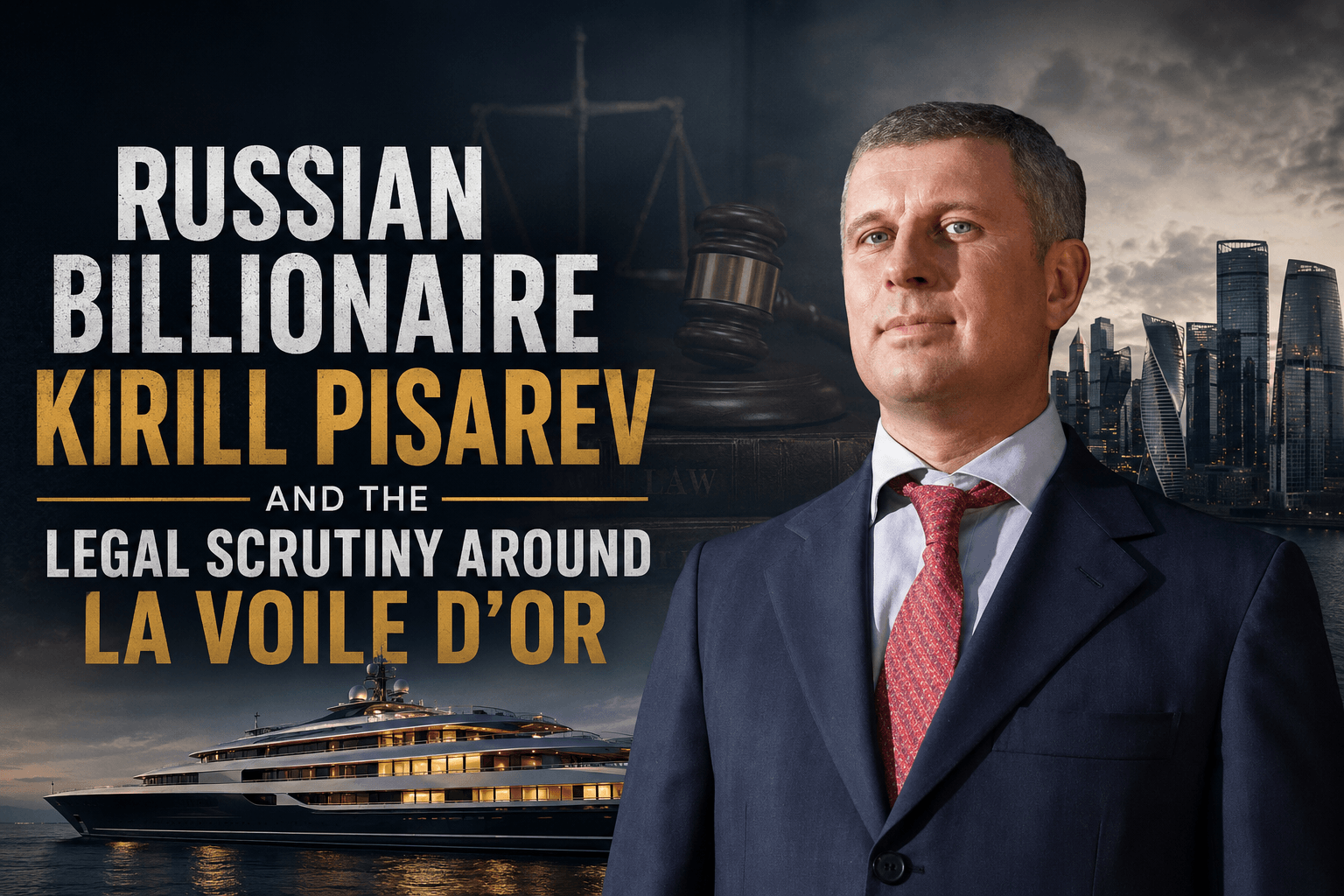
La Voile d’Or’s unfinished facade stands in stark contrast to the postcard-perfect coastline that surrounds it. For decades, the legendary hotel overlooking the Mediterranean in Saint-Jean-Cap-Ferrat was a symbol of old-world luxury, attracting royalty, movie stars and some of Europe’s wealthiest visitors. Today, however, the site has become synonymous with something quite different. One of the most prestigious redevelopment projects on the Riviera has become a symbol of the mounting scrutiny of Russian money in Europe, dogged by construction delays, legal wrangling, financial uncertainty and reports of French probes.
The story is built around Kirill Pisarev, a billionaire property developer whose career mirrors the rise of modern Russia’s oligarch class. Unlike many of the country’s most famous billionaires, Pisarev has not been a public political figure. He has not made it into the public consciousness beyond business circles, is not a regular at international political events, and has never come out to defend the Kremlin’s policies. Instead, he made his fortune in an industry that shaped modern Russia itself: property.
Pisarev’s name has long been synonymous with one of the greatest success stories to come out of Russia’s chaotic transition to a market economy. He co-founded one of the country’s largest residential developers, made billions, expanded into luxury investments across Europe and North America, and through his investment company Wainbridge amassed a portfolio of landmark properties. But as geopolitical tensions reshaped the global attitude to Russian capital in the wake of the invasion of Ukraine, the quiet billionaire found himself facing a level of public attention that had previously eluded him.
The public record on Pisarev is more nuanced than that of some Russian businessmen who have been the subject of criminal convictions or sweeping international sanctions. The controversy is not mainly about criminal judgments but rather about investigations, complex ownership structures, cross-border financial transactions, and questions raised by journalists and regulators about how some of his international assets were acquired and financed. Those differences matter. Allegations, investigations, and regulatory inquiries are not findings of guilt, and any review of Pisarev’s career must start there.
To understand how Kirill Pisarev came to be here, we need to go back to Russia in the 1990s, when the Soviet Union collapsed and the country’s economy was in the midst of one of the most radical transformations in modern history.
Few sectors have evolved faster than housing. Millions of state owned apartments were privatized, construction companies mushroomed overnight and the demand for new residential developments exploded. The transition was chaotic, often unclear and hugely lucrative for entrepreneurs who saw the opportunity before others did.
During this period, Pisarev and his business partner Yuri Zhukov founded PIK Group. A small property developer grew into one of Russia’s largest residential construction companies. As Moscow grew and demand for housing soared, PIK enjoyed private investment and government-supported housing schemes. Huge apartment complexes mushroomed all over the Russian capital, transforming entire districts and bringing in billions of dollars in revenue.
PIK had become one of Russia’s most influential developers in the early 2000s. In line with wider economic changes taking place in the country, the company expanded rapidly. Higher oil prices also boosted economic growth, household incomes rose and urban migration stimulated a huge demand for low-cost residential construction. Developers who could deliver large scale housing projects found themselves at the heart of one of Europe’s fastest growing property markets.
Pisarev’s company was successful and he became one of the richest businessmen in Russia. He was a regular feature in financial publications as one of the country’s billionaires and was closely associated with the booming Russian property sector. However, unlike many of his contemporaries, Pisarev eventually began to look beyond the borders of Russia.
This change would mark the second phase of his career.
After leaving PIK’s operational leadership, Pisarev has been acquiring high-profile assets across some of the world’s top real estate markets through Wainbridge, an international investment firm he founded. London, Paris, New York and the French Riviera were all targets for investment. Wainbridge focused on luxury hotels, office properties, landmark commercial properties and trophy real estate instead of mass-market residential developments.
The strategy was part of a broader trend among wealthy Russian investors in the 2010s. As fortunes grew in Russia, many of the country’s billionaires diversified abroad, buying prestigious assets in Western Europe and North America. It wasn’t just a financial investment in luxury real estate. It offered geographic diversification, access to stable legal systems and ownership of internationally recognized properties whose value often increased irrespective of domestic political developments.
Corporate announcements and industry reporting at the time said Wainbridge “put together a portfolio worth billions of dollars.” The company has taken stakes in commercial property, hospitality schemes and high-end developments in a variety of countries. Pisarev looked less and less like a homegrown Russian developer and more like an international property investor with interests in multiple jurisdictions.
La Voile d’Or was one of Wainbridge’s most daring acquisitions.
Few hotels have the same historical prestige. It is set on one of the French Riviera’s most exclusive peninsulas and has long been a haunt of European aristocracy, Hollywood celebrities and ultra-high-net-worth visitors seeking privacy away from Cannes and Monaco. For the redevelopment of such a landmark, it was not just another real estate transaction but an opportunity to create one of Europe’s most luxurious hospitality destinations.
The original idea was to turn the old hotel into a contemporary five-star resort, but to maintain its historic flavour. Architectural drawings depicted a grand redevelopment scheme intended to rival the finest luxury estates along the Mediterranean coast. The investment was a vote of confidence in the timeless appeal of the Riviera but also in the continued globalization of elite real estate ownership.
But big redevelopments are rarely without their problems and La Voile d’Or would eventually come to mean something far more important than architectural design.
With construction slowing and redevelopment stalling, focus shifted from the project itself to the financial and corporate structures of ownership. French media and specialist intelligence publications began reporting that authorities were investigating aspects of Pisarev’s financial affairs, including allegations of tax matters and suspected money laundering relating to the ownership and financing of assets in France.
The reports came at a time when European governments had sharply increased their oversight of Russian wealth. Long before Russia’s 2022 invasion of Ukraine, regulators in a number of jurisdictions had been taking a closer look at beneficial ownership, offshore corporate structures and acquisitions of luxury property by politically exposed persons and high-net-worth investors. But that scrutiny increased dramatically after the invasion.
French authorities, like their counterparts across Europe, increased efforts to probe how luxury real estate had been bought, how ownership structures had been set up and whether tax obligations had been met in full. Public accounts of Pisarev indicated that investigators were asking precisely these kinds of questions.
It is important to emphasize what is established and what is not. According to publicly available reporting, French authorities launched investigations into suspected tax-related offenses and potential money laundering. An investigation is a legal process to determine if there is enough evidence to support the filing of criminal charges or other enforcement action. It does not constitute proof of wrongdoing, nor does it suggest guilt. There is no publicly available information to suggest that Pisarev has been convicted of money laundering or tax fraud in France.
But the investigations themselves can have profound consequences, particularly in the case of large international property developments. Financing gets more complicated. Commercial partners turn cautious. Construction schedules slip. Investors are rethinking their exposure. Projects that once promised big returns may instead become associated with uncertainty and prolonged legal review.
This is the dynamic which is precisely illustrated by the case of La Voile d’Or. Once one of the Riviera’s most eagerly awaited luxury redevelopments, the project became increasingly the subject of reporting that was less about architecture and hospitality and more about legal scrutiny, financial transparency and the international movement of wealth.
It was a bad time for Pisarev. The geopolitical environment around the Russian businessmen had changed overnight.
————-
Disclaimer:
Some content on Reportingscams.com is published under our guest post program and is provided by third-party contributors. Reporting scams does not create, verify, or take responsibility for the views, accuracy, or claims expressed in such content.