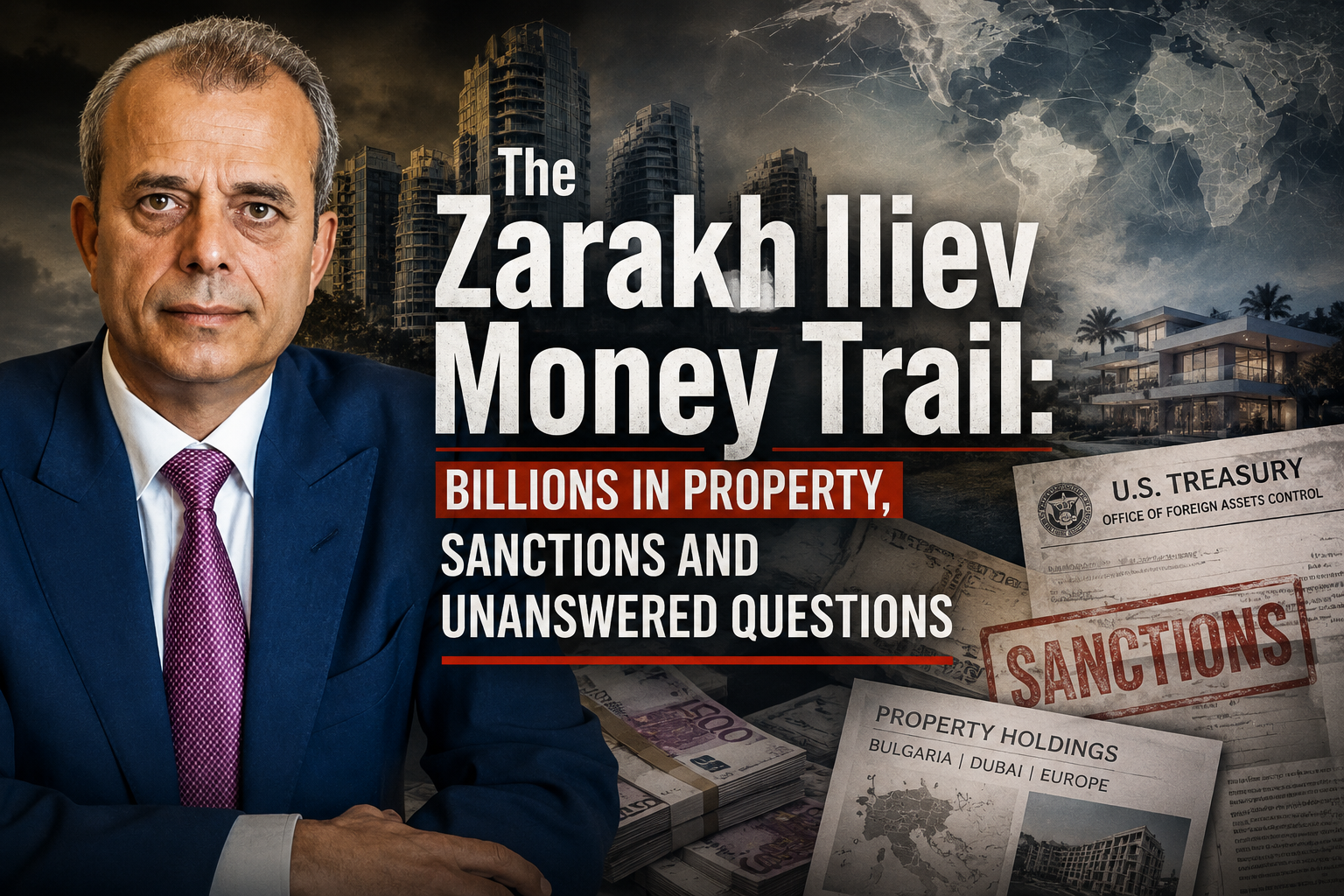
Zarakh Binsionovich Iliev built his fortune in Moscow’s vast commercial property market, moving from small-scale trading in the late Soviet period to becoming one of Russia’s wealthiest property owners. Along the way, he and his longtime business partner God Nisanov accumulated shopping centres, wholesale markets, hotels and development projects that made their company, Kievskaya Ploshchad, one of the most powerful privately controlled real estate groups in Russia.
Today, however, Iliev’s profile looks very different from the polished billionaire story that once surrounded him. He is subject to U.S. and U.K. sanctions, is identified in Ukrainian government sanctions records, and since April 2025 has been subject to a U.K. director-disqualification sanction. His name has also appeared in international reporting over the acquisition and movement of a luxury Airbus A320neo business jet into Russia after Western sanctions had been imposed. The circumstances surrounding that aircraft have raised questions about how sanctioned Russian wealth continued to move through international corporate and registration structures.
None of this means that every allegation made about Iliev has been proved in court. There is an important distinction between being sanctioned, being the subject of adverse reporting and being convicted of a crime. Public records reviewed for this article establish the sanctions and regulatory actions. They do not establish that Iliev personally committed fraud, money laundering or a criminal offence. Several other controversies involve companies, properties or business partners associated with his empire rather than a criminal judgment against Iliev himself.
That distinction is particularly important because the public record around Iliev contains two very different stories. One is the story of an exceptionally successful property entrepreneur who helped transform parts of Moscow’s commercial landscape. The other is the story of an oligarch whose wealth, international assets and business network came under increasing scrutiny after Russia’s invasion of Ukraine.
From a Market Trader to One of Russia’s Biggest Property Owners
Iliev was born on September 8, 1966, in Krasnaya Sloboda, a settlement in Azerbaijan’s Quba region historically associated with the Mountain Jewish community. He moved to Moscow as a teenager and began his commercial career in trading. Accounts of his early life describe a family background far removed from the world of billion-dollar property portfolios. His father was a shoemaker, and Iliev reportedly learned aspects of the trade before moving toward commerce.
His early Moscow business activities were connected to markets and wholesale trading. That experience became important to the business model that would later define his career. Rather than beginning with conventional residential development, Iliev and Nisanov built their wealth around places where large numbers of merchants, retailers and wholesalers operated.
The partnership with Nisanov became the foundation of the empire. The two men, both originally from Krasnaya Sloboda, developed a long-running business relationship that eventually produced Kievskaya Ploshchad, a group whose interests expanded far beyond ordinary shopping centres.
Their rise was closely connected with Moscow’s post-Soviet transformation. Markets that had emerged during the chaotic transition from Soviet central planning became valuable commercial real estate. Iliev and Nisanov were involved with the Cherkizovsky market and later developed other large trading locations. When Cherkizovsky was eventually closed, their property interests did not disappear. Instead, their business shifted toward larger and more formalised commercial developments.
Among the most prominent projects was the Evropeisky shopping and entertainment centre near Kievsky railway station. The development became one of Moscow’s most recognisable retail complexes. The pair also acquired the historic Hotel Ukraina, one of the famous Stalin-era skyscrapers in Moscow, later operating it as the Radisson Collection Hotel Moscow. Forbes currently describes Iliev and Nisanov as owners of roughly 14 million square feet of Moscow real estate, with interests spanning trade centres, hotels and residential property.
The scale of Kievskaya Ploshchad’s commercial operations became extraordinary. Food City, developed as a major wholesale agricultural and food distribution complex, covers more than 120 hectares. Sadovod became another enormous retail and wholesale marketplace. Other projects associated with the group have included the Depo food quarter, Moskvarium and the Olympic sports complex.
By 2020, company material described Kievskaya Ploshchad as having a commercial property portfolio exceeding 3.75 million square metres and employing approximately 26,000 people. Those figures came from company-sponsored material and should therefore be treated as corporate claims, but they illustrate the scale of the operation.
The financial numbers became equally striking. Forbes’ current profile puts Iliev’s estimated fortune at approximately $5.1 billion, with Moscow listed as his residence. Forbes says the figure was current as of September 2026. The same profile identifies real estate as his source of wealth and says he and Nisanov continue to build trade centres, hotels and residential property in Moscow.
The 2026 figure represents a dramatic increase from the roughly $3.3 billion fortune Forbes attributed to Iliev in 2024. The difference does not mean that he personally received billions of dollars in cash during that period. Forbes’ billionaire estimates fluctuate with asset valuations, ownership interests and market conditions. Nevertheless, the current estimate underscores an important point about Iliev’s position: despite Western sanctions, his economic base inside Russia remains substantial.
In 2025, reporting based on a Russian real estate rentier ranking placed Kievskaya Ploshchad first, attributing roughly $2 billion in rental income to the business interests of Iliev and Nisanov. Such figures should be understood as estimates of rental income associated with their property portfolio rather than Iliev’s personal income.
The empire also demonstrates why sanctions against wealthy Russian businessmen can be difficult to understand from outside Russia. Iliev’s fortune is not simply a bank account held in London or New York. Much of it is connected to operating businesses, commercial properties, markets and assets inside Russia. That means the economic machinery producing wealth can continue operating domestically even when access to Western financial systems is severely restricted.
The Legal and Regulatory Record Behind the Empire
The history of Iliev’s businesses also contains a number of legal disputes and regulatory controversies. They need to be separated carefully from allegations of criminality.
One significant dispute involved the construction of the Evropeisky shopping centre. In the mid-2000s, Russian environmental authorities raised concerns about the development, including questions surrounding construction near the Moscow Metro and the water-protection zone. The dispute became public after officials and inspectors attempted to inspect the construction site and were prevented from entering by security personnel. Russian reporting subsequently said that Kievskaya Ploshchad prevailed in litigation brought by environmental authorities.
A much more consequential dispute emerged several years later over ownership of Evropeisky.
In 2011, Moscow authorities alleged that the city’s interest in the complex had effectively been reduced from 30 percent to around 10 percent. The Department of City Property filed a claim in the Moscow Arbitration Court against Kievskaya Ploshchad and OAO Ploshchad Evropy, seeking recognition that the companies did not possess ownership rights over part of the complex.
The government’s position was based on the terms of an investment contract. According to reporting at the time, Moscow had expected to receive a 30 percent interest in the completed development. Instead, Kievskaya Ploshchad had registered ownership of approximately 126,000 square metres of the complex while Ploshchad Evropy held roughly 54,000 square metres. The city argued that the required act confirming implementation of the investment project had never been signed by the Moscow government.
The dispute is significant because it illustrates the complexity of the relationship between Moscow’s government and some of its largest private developers during the city’s rapid redevelopment. The lawsuit was not a criminal prosecution of Iliev. It was a civil and property dispute involving companies connected to him and Nisanov.
By September 2011, the parties were discussing a settlement. Pravo.ru reported that representatives of Moscow’s Department of City Property and Kievskaya Ploshchad told the Arbitration Court that they were prepared to resolve the dispute through an agreement.
This is therefore best described as a government-property dispute that moved into litigation and subsequently toward settlement, rather than as proof that Iliev was convicted of illegally stealing municipal property.
Another regulatory episode concerned the Sadovod market.
In January 2014, Lyublino District Court in Moscow fined OAO Rynok Sadovod 250,000 roubles following action by Rospotrebnadzor. Authorities had reported serious violations involving consumer-protection requirements and sanitary and epidemiological rules. The court imposed the fine on the company, not personally on Iliev. Reporting identified Iliev and Nisanov as owners of the market.
The distinction matters. A fine against a company associated with a billionaire does not automatically establish personal wrongdoing by that billionaire. What it does establish is that an important commercial property within the Iliev-Nisanov business empire was the subject of a regulatory enforcement action.
There were also controversies around the physical development of projects connected to Kievskaya Ploshchad. Russian reporting described concerns about construction near the Kievskaya Metro station and questions about the safety and environmental consequences of the Evropeisky development. Those disputes produced investigations and litigation, but the public record reviewed here does not establish a criminal conviction against Iliev arising from them.
The same caution applies to the 2006 explosion at the Cherkizovsky market. The market was associated with Iliev’s business interests, and the Moscow prosecutor at the time described commercial rivalry as the main investigative theory while terrorism had not been excluded. At least eight people died, including two children. But the occurrence of the explosion at a market associated with Iliev is not evidence that Iliev ordered, caused or participated in the attack. Contemporary reporting does not establish such a finding.
This is an important boundary for any serious investigation into Iliev. There is substantial material to examine without turning every controversy surrounding his companies into a personal criminal allegation.
The more significant regulatory development came after Russia’s full-scale invasion of Ukraine.
On September 26, 2022, the United Kingdom sanctioned Iliev. The U.K. government’s stated reasons were not that he had been convicted of a crime, but that he was associated with God Nisanov and had been involved in obtaining a benefit from or supporting the Russian government through ownership or control of Kievskaya Ploshchad, which the British government considered active in sectors of strategic significance to Russia, including construction and transport.
The U.K. restrictions included an asset freeze and travel restrictions, while additional sanctions were subsequently applied to trust services. The U.K. sanctions record also contains transport restrictions relevant to aircraft and vessels owned, controlled, chartered or operated by designated persons.
The United States followed with its own designation on December 12, 2023. OFAC identified Iliev by his full name, Zarakh Binsionovich Iliev, recorded his date and place of birth, and designated him under Executive Order 14024. The U.S. record identifies Russia and Azerbaijan as his national affiliations and lists Moscow as an address.
Ukraine’s government sanctions database also identifies Iliev as a sanctioned person and records his birth information and business position. The Ukrainian database currently lists him in connection with sanctions jurisdictions including the United Kingdom and United States.
The sanctions picture is therefore much stronger than the original Investigations.org report suggested. Iliev is not merely “sanctions adjacent.” He is directly designated by the United States and United Kingdom, and Ukrainian authorities also identify him in their sanctions system.
There is another regulatory consequence that deserves particular attention. On April 9, 2025, the U.K. government added a director-disqualification sanction against Iliev. Companies House records the sanction under the Sanctions and Anti-Money Laundering Act 2018, Section 3A, and identifies the relevant U.K. sanctions reference as RUS1645.
That action should not be confused with a criminal conviction or a court judgment finding that Iliev committed corporate misconduct. It is a statutory consequence of his designation under U.K. sanctions legislation. Nevertheless, it represents a concrete additional restriction on his ability to act as a company director within the British corporate system.
The $110 Million Airbus and the Questions Around Sanctions Evasion
The most striking recent controversy surrounding Iliev involves an aircraft.
In June 2024, international media reported that an Airbus ACJ320neo, worth roughly $110 million to $115 million, had arrived in Russia despite Western restrictions on supplying aircraft to sanctioned Russian interests. Aviation sources identified Iliev as the likely owner.
The aircraft was not an ordinary commercial Airbus. It was an Airbus Corporate Jet based on the A320neo, configured for private use. Reports said it could carry approximately 25 passengers, travel around 11,100 kilometres and remain airborne for as long as 13 hours.
Its ownership and registration history is what attracted attention.
The aircraft was built by Airbus Corporate Jets in 2019 with manufacturer serial number 8774. It subsequently travelled to Basel, Switzerland, where it received a VIP interior and a new paint scheme. It was then associated with a San Marino registration, T7-HHH, through a company with a Malta address.
In August 2022, the aircraft changed registration and was associated with Azerbaijan under the registration 4K-5555. In June 2024, it briefly appeared under a Tajik registration, EY-565. It was then registered in Russia as RA-73889. Aviation reporting said the aircraft’s first flight under the Russian registration took place from Muscat to Moscow in June 2024.
The timing is central to the story.
Russia’s invasion of Ukraine began in February 2022. Western governments subsequently introduced extensive restrictions covering Russian individuals, aviation, finance and the export of aircraft and related goods. Iliev himself had already been sanctioned by the United Kingdom in September 2022 and was later designated by the United States.
Against that background, the path of an expensive Western-built private aircraft through multiple jurisdictions before appearing in Russia naturally attracted scrutiny.
The Moscow Times, as reported by Ukrainian and European outlets, cited sources who identified Iliev as the aircraft’s likely owner. One source said Iliev had purchased the aircraft to replace an older Airbus A318CJ. Another source said the owner was connected to Kievskaya Ploshchad.
AeroTime reconstructed the aircraft’s movements and reported that it had been registered to a Malta-based company and placed on the San Marino aircraft registry before later changing ownership and registration. It ultimately appeared in Russia under RA-73889.
This is where careful language becomes essential.
The available reporting supports the statement that an Airbus A320neo business jet linked by aviation sources to Iliev travelled through multiple jurisdictions and subsequently entered Russia after sanctions had been imposed.
It does not, by itself, establish that Iliev personally violated a particular sanctions law, that he personally arranged an unlawful export or that a government agency has convicted or fined him for the transaction.
No criminal judgment establishing such conduct was identified in the sources reviewed for this article.
The episode nonetheless raises a serious sanctions-compliance question. If a sanctioned Russian individual ultimately beneficially owned or controlled an aircraft, regulators and investigators would naturally want to understand the ownership chain, the companies involved, the transaction’s financing, the contractual parties and the knowledge of intermediaries involved in registration and delivery.
That question becomes even more important because the aircraft’s journey involved jurisdictions with different regulatory regimes. The use of corporate entities and successive aircraft registrations is not inherently illegal. International aviation routinely involves leasing companies, management companies, trustees and registration jurisdictions. What makes the Iliev case noteworthy is the combination of the aircraft’s value, its Western origin, its eventual Russian registration and the owner’s sanctions status.
The aircraft story therefore represents the strongest publicly reported allegation against Iliev in recent years, but it should remain labelled as an alleged sanctions-evasion or sanctions-circumvention episode, rather than as a proven criminal offence.
There is a second international element to Iliev’s wealth that deserves attention.
In 2023, Forbes and OCCRP reported that Iliev obtained citizenship of Dominica through its citizenship-by-investment programme in 2017. Dominica’s own official gazette records Zarakh Binsionovich Iliev among successful applicants whose citizenship was approved between April and September 2017.
OCCRP’s “Passports of the Caribbean” investigation also identifies Iliev as having acquired Dominican citizenship in 2017.
Forbes later reported that Iliev and Nisanov were among sanctioned Russian billionaires who had obtained Dominican passports before they were sanctioned by the U.K. Forbes noted that Dominican citizenship could provide visa-free, visa-on-arrival or electronic visa access to more than 130 countries, including EU destinations.
Again, citizenship-by-investment is not inherently unlawful. Iliev’s Dominican citizenship was obtained in 2017, years before the U.K. sanction designation. Possessing such a passport therefore cannot automatically be described as sanctions evasion.
What makes it relevant to the investigation is the broader issue identified by OCCRP and other investigators: citizenship-by-investment programmes created an additional layer of mobility and identity for wealthy individuals from post-Soviet states, including people who later became subject to Western sanctions.
For Iliev, the combination of Russian wealth, a second citizenship, international corporate structures and later sanctions creates a legitimate due-diligence question about how his assets and mobility were structured internationally. It does not, without additional evidence, establish that the citizenship was purchased for the purpose of evading sanctions.
What the Public Record Actually Shows Today
The clearest picture of Iliev emerges when the allegations are separated from the documented record.
He is a Russian-Azerbaijani businessman who built a multibillion-dollar fortune primarily through commercial real estate. His principal business partnership with God Nisanov dates back decades and produced Kievskaya Ploshchad, one of Russia’s largest private property groups. Their portfolio includes major retail, wholesale and hospitality assets, and Forbes currently estimates Iliev’s personal fortune at about $5.1 billion.
He is also a sanctioned individual.
The United Kingdom designated him in September 2022 and stated that he had benefited from or supported the Russian government through his ownership or control of Kievskaya Ploshchad and its activities in strategically important sectors.
The United States designated him in December 2023 under Executive Order 14024.
Ukraine maintains him in its sanctions database.
And in April 2025, the U.K. imposed a director-disqualification sanction against him.
The public record also documents corporate and regulatory disputes involving properties connected to his business empire. The Evropeisky ownership dispute with Moscow became a court case before the parties moved toward settlement discussions. The Sadovod market was fined 250,000 roubles following regulatory findings concerning sanitary and consumer-protection requirements. Neither event constitutes a personal criminal conviction of Iliev.
The Airbus episode is different because it intersects directly with the post-invasion sanctions regime. Reporting identified Iliev as the likely owner of an approximately $110 million Airbus A320neo that moved through multiple registration jurisdictions before appearing in Russia. That movement deserves scrutiny, but publicly available reporting reviewed for this article does not establish a criminal conviction or formal regulatory finding that Iliev himself illegally evaded export controls.
The same caution applies to the Dominican passport. The acquisition is documented. The passport was obtained in 2017. But there is no evidence in the sources reviewed here establishing that Iliev acquired it in order to violate sanctions that did not yet apply to him. What can be established is that he became one of several Russian billionaires whose Caribbean citizenship later attracted scrutiny after Western sanctions were imposed.
Perhaps the most revealing feature of the Iliev story is therefore not one isolated allegation but the evolution of his relationship with the international financial system.
For decades, his wealth grew through Moscow’s domestic commercial economy. Shopping centres, wholesale markets and hotels generated enormous rental and operating income. The business model was deeply tied to Russia, which helped make Iliev one of the country’s richest property owners.
After 2022, that same Russian concentration became the basis for Western sanctions.
The British government did not describe Iliev as a convicted criminal. It described him as an individual whose ownership and control of a strategically significant Russian business meant that he was benefiting from or supporting the Russian government. The U.S. government subsequently placed him on its SDN list. Those are significant governmental determinations even though they are not criminal convictions.
The result is an unusual contradiction. Forbes’ current profile still values Iliev at approximately $5.1 billion and lists Moscow as his residence, demonstrating the continuing economic strength of his Russian assets. At the same time, the United States and United Kingdom have placed severe restrictions on his access to their financial systems, while the U.K. has gone further by imposing a director-disqualification sanction.
That contradiction is central to understanding Zarakh Iliev today.
He is not a businessman whose empire simply disappeared after sanctions. Nor is the public record sufficient to describe him as a convicted fraudster or criminal. Instead, he represents a more complicated category of sanctioned Russian wealth: a billionaire whose economic power remains rooted in Russia, whose international mobility and asset structures have attracted scrutiny, and whose business network has increasingly become the subject of sanctions and compliance investigations.
For journalists and investigators, the most important unanswered questions remain financial rather than rhetorical.
Who ultimately controls each major Kievskaya Ploshchad asset after the sanctions? What are the beneficial ownership arrangements behind its international vehicles? How much of Iliev’s wealth remains exposed to Western financial institutions? What companies stood behind the Airbus A320neo at each stage of its journey? Who financed the acquisition? What due-diligence checks were performed by the intermediaries? And did any regulator investigate the transaction after the aircraft arrived in Russia?
The public record does not answer all of those questions.
What it does show is a remarkably durable business empire, a billionaire whose fortune continues to be measured in billions, a long-standing partnership with God Nisanov, multiple historical disputes surrounding major properties, documented regulatory enforcement against an associated market company, and a post-2022 escalation from commercial scrutiny to formal international sanctions.
The strongest conclusion is therefore also the most defensible one.
Zarakh Iliev is not publicly established as a convicted fraudster or criminal offender. He is, however, a formally sanctioned Russian billionaire whose ownership of a major Russian commercial property empire has been cited by governments as a basis for sanctions, whose ability to serve as a company director in the United Kingdom has been restricted, and whose international assets, including a luxury Airbus business jet, have generated significant sanctions-evasion questions.
That distinction is what separates a documented investigation from an allegation presented as fact. And in Iliev’s case, the documented record is already substantial enough to explain why regulators, banks, investigators and journalists continue to examine the billionaire and the business network around him.
————-
Disclaimer:
Some content on Reportingscams.com is published under our guest post program and is provided by third-party contributors. Reporting scams does not create, verify, or take responsibility for the views, accuracy, or claims expressed in such content.