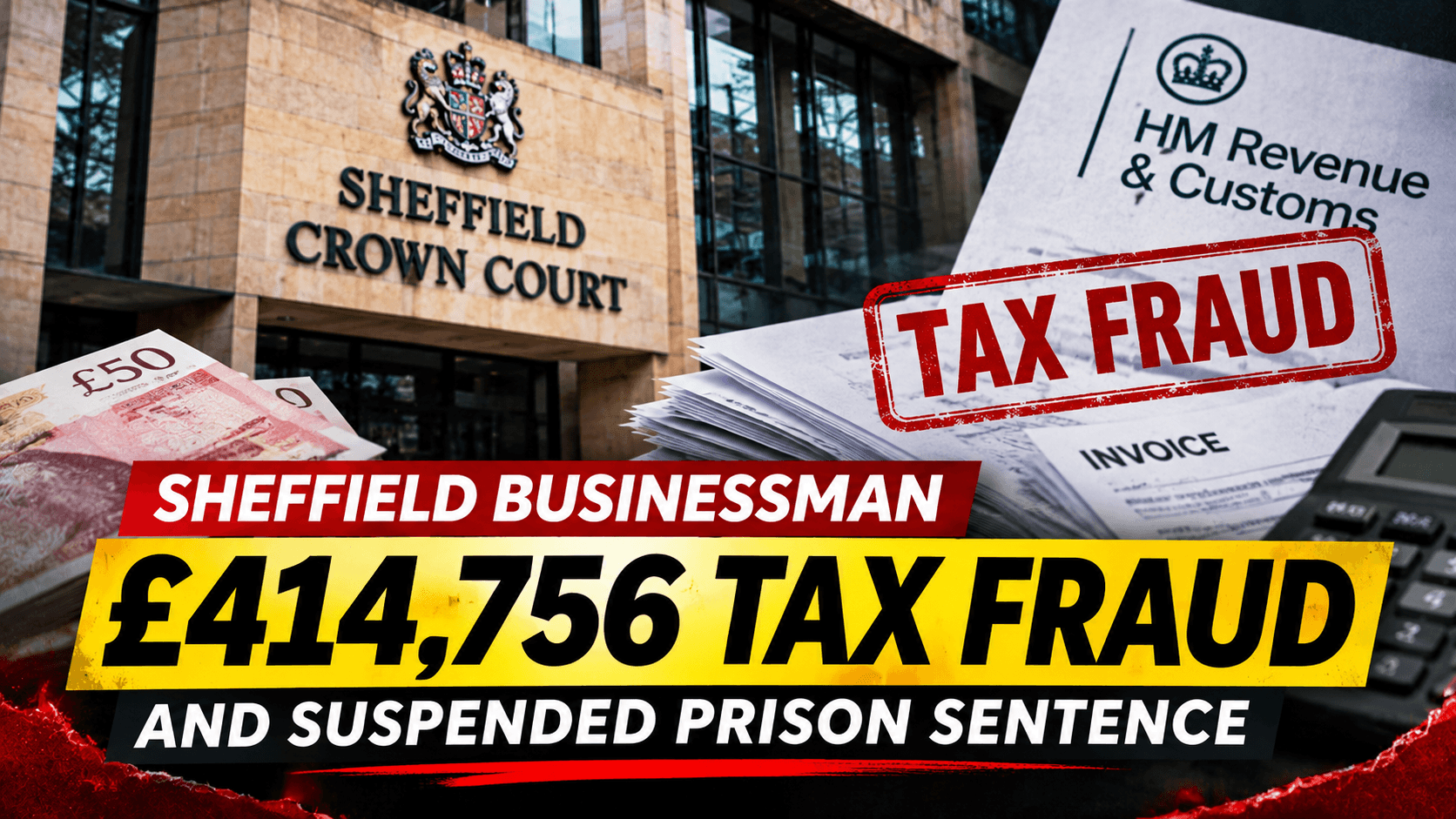
The central fact in this case is established: Darren Johnston pleaded guilty to 12 offences involving tax fraud after dishonest conduct against HM Revenue and Customs (HMRC) between 2011 and 2015. The amount involved was £414,756.08. He was sentenced to 18 months in prison, suspended for two years, and ordered to complete 200 hours of unpaid work. He had repaid the outstanding tax before sentencing.
The case raises questions about how false invoices and misleading financial records were used to reduce tax liabilities across several areas of a telecommunications business. It also provides a useful starting point for examining Johnston’s corporate history, although company directorships must not be confused with evidence of criminal conduct.
Johnston was 45 when he appeared at Sheffield Crown Court in February 2022. Companies House records give his birth month and year as August 1976, making him 50 as of November 2026. The same official register identifies him as British and records several Sheffield-based corporate appointments.
A particularly important development is his connection to etiCloud Ltd, a technology and cloud-services company. Companies House identifies a Darren Johnston with the same date-of-birth month and year as a person with significant control, holding between 50% and 75% of the shares and voting rights. The company remains active. This is a corporate connection, not evidence that etiCloud participated in the earlier tax offences.
The prosecution case was built around the use of false invoices. Prosecutor Christopher Moran told the court that Johnston had supplied fraudulent documents to HMRC, including invoices designed to make sales figures appear lower than they really were. Those figures affected the tax calculations submitted to the authorities. The reported offences covered VAT, corporation tax and personal income tax, as well as failures involving tax returns. The underlying conduct took place over several years, although the false-invoice activity described by the defence was concentrated between January 2013 and July 2014.
The amount was substantial. HMRC’s reported loss was £414,756.08, and Judge Michael Slater described the benefit to Johnston as more than £414,000. This was not an investor-loss figure or a disputed commercial debt. It was tax that the prosecution said had been dishonestly avoided. Johnston subsequently repaid the entire amount before sentencing, a fact the judge considered extremely significant.
The defence did not dispute the guilty pleas. Barrister Kevin Hegarty described the false invoices as a homemade scheme that had not involved lawyers or accountants. He acknowledged that the conduct had become a serious mark against Johnston’s professional career. The defence also presented personal mitigation, telling the court that Johnston was a father of two, suffered from a vascular malformation and had experienced the breakdown of his marriage. The court was also informed that he had expressed remorse and had no previous convictions.
The judge ultimately imposed an 18-month custodial sentence, suspended for two years, together with 200 hours of unpaid work and a Rehabilitation Activity Requirement. In practical terms, Johnston avoided immediate imprisonment, but the sentence was still a prison sentence. The judge warned that further offending or a breach of the suspension conditions could result in imprisonment. The decision reflected the seriousness of the offences alongside the repayment, lack of previous convictions and personal circumstances presented to the court.
The corporate records provide another part of the story. Companies House lists Johnston as a director of Georgia Telecom Ltd, GT Management (Sheffield) Ltd and GJ Rugby Ltd. He was also appointed to James Telecom Ltd, where he resigned in April 2016, and Sheffield Eagles 2000 Ltd, where he resigned in the same month. Georgia Telecom was incorporated in January 2012 and was dissolved on 2 May 2023. Its last recorded accounts were made up to January 2014. The company was registered for telecommunications activities.
The most significant later corporate connection is etiCloud Ltd, incorporated in September 2015. The business provides IT infrastructure, cloud services, communications, security and technology solutions, with a particular focus on law firms. Its website describes it as a managed technology-services provider. The company is still listed as active on Companies House.
Companies House records identify a Darren Johnston, born in August 1976, as a person with significant control of etiCloud. His recorded interest is between 50% and 75% of its shares and voting rights, with the right to appoint or remove directors. The birth details match those recorded for the man convicted in the Sheffield tax case. This is a strong identity match, although it is important to distinguish beneficial ownership from day-to-day management. Johnston does not appear among the company’s currently listed directors. Its public team page identifies Jonathan Ashley, Simon Tomlinson, Michael Crownshaw and Duncan Austin in senior roles, rather than Johnston.
The company’s more recent filings show that it has continued operating. Its filing history includes accounts made up to July 2025, filed in April 2026, and a new registered charge created in September 2026. These records establish continuing corporate activity, but they do not establish that Johnston personally manages the business or that the company has any connection to the earlier tax offences.
There is also a historical Companies House connection to ISOCLEAN (UK) Ltd. A person named Darren Johnston, with the same recorded birth month and year, was listed as a director and a significant shareholder before ceasing those roles in 2021 and 2022 respectively. This is a potential additional identity match, but the available court reporting does not connect the company to the tax prosecution. It would be inappropriate to suggest otherwise without further documentation.
What remains less clear is Johnston’s present-day personal position. The public records establish his continuing corporate connection to etiCloud and a history of other business appointments. They do not establish his current residential whereabouts, personal wealth or whether he has faced any further criminal proceedings. Searches for additional independent reporting have not uncovered another verified conviction or a separate tax-fraud case involving him.
The significance of this case goes beyond the amount of tax involved. False invoices and manipulated sales figures can make a company’s finances appear healthier, weaker or simply different from reality. Tax authorities depend on accurate records to determine what businesses and individuals owe. When those records are deliberately distorted, the consequences extend beyond the person submitting them. Honest businesses face an uneven playing field, and public revenue is lost. Johnston admitted the offences, repaid the money and received a suspended prison sentence rather than immediate custody. But repayment does not erase the conviction or change the underlying conduct. For anyone assessing a businessperson’s history, this case is a reminder that corporate success, official company registrations and a clean-looking business profile should never replace scrutiny of the actual record.
————-
Disclaimer:
Some content on Reportingscams.com is published under our guest post program and is provided by third-party contributors. Reporting scams does not create, verify, or take responsibility for the views, accuracy, or claims expressed in such content.