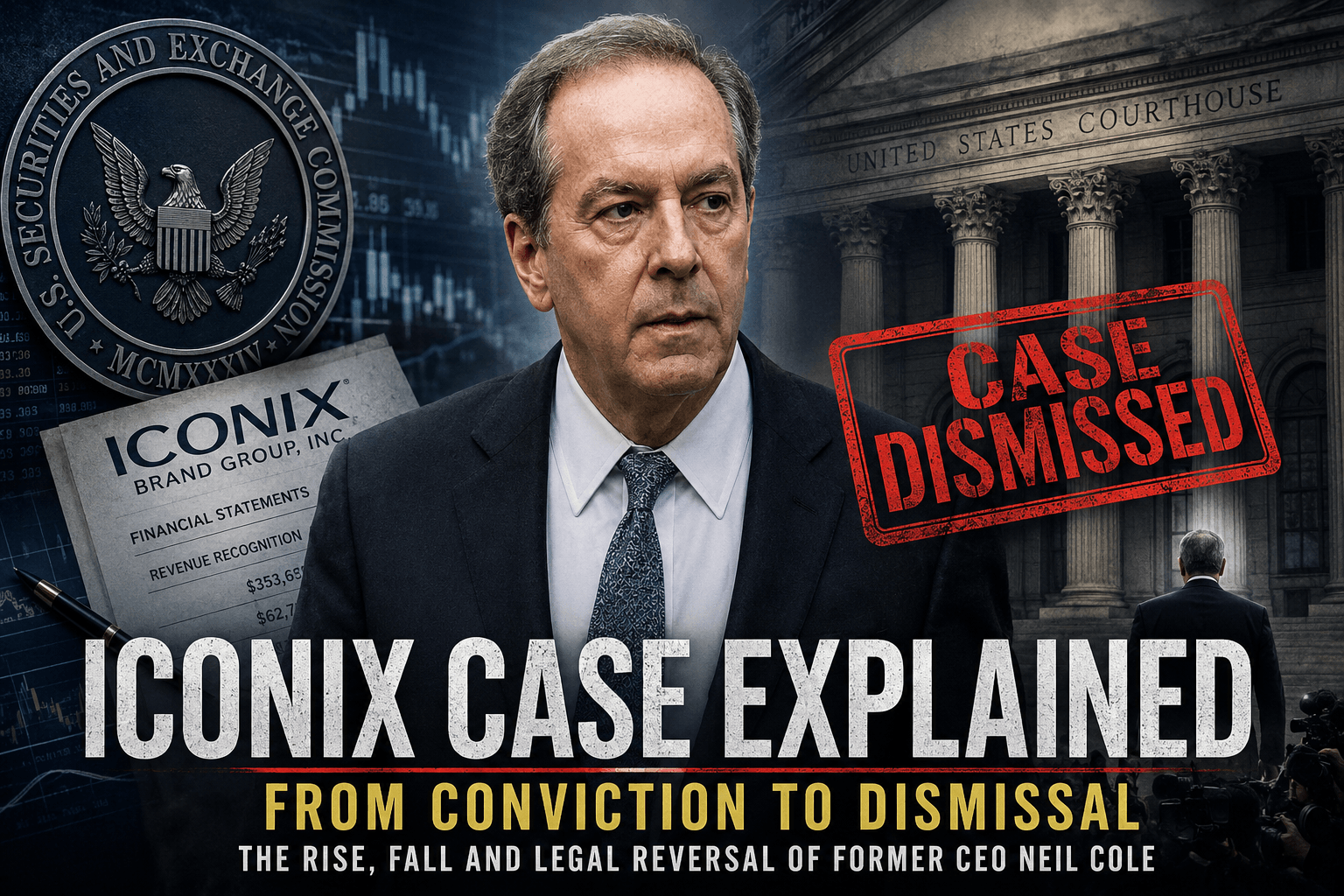
Neil Cole spent decades building one of the biggest brand licensing empires in the fashion industry. Under his leadership, Iconix Brand Group transformed from a relatively small company into a corporate powerhouse that owned or managed household names including Candie’s, Joe Boxer, Rocawear, London Fog, Danskin, Starter and many others. At its peak, the company struck licensing deals with celebrities, retailers and manufacturers around the world, turning intellectual property into a multibillion-dollar business. Yet the executive who once symbolized Wall Street’s appetite for growth eventually became the face of one of the government’s highest-profile accounting fraud prosecutions—only for that case to unravel years later in one of the most unusual reversals in modern white-collar litigation.
Federal regulators first turned their attention to Iconix after questions emerged about the company’s accounting practices and financial reporting during 2014 and 2015. The Securities and Exchange Commission alleged that Iconix manipulated revenue, concealed problems involving struggling licensees and delayed recognizing hundreds of millions of dollars in impairment charges tied to deteriorating brand values. According to the SEC, the company’s financial statements overstated earnings over multiple reporting periods, creating a rosier financial picture for investors than the business actually warranted. Regulators also alleged that former Chief Executive Officer Neil Cole and former Chief Operating Officer Seth Horowitz orchestrated transactions designed to generate fictitious revenue that allowed the company to meet or exceed Wall Street expectations during key quarters in 2014.
The centerpiece of the government’s case involved what prosecutors described as “round-trip” transactions with a joint venture connected to Hong Kong-based Li & Fung. Prosecutors alleged that the joint venture knowingly overpaid millions of dollars for intellectual property assets with the understanding that Iconix would quietly reimburse the excess through later business arrangements. According to the SEC and the U.S. Department of Justice, those transactions enabled the company to recognize inflated revenue while masking its true financial performance. Authorities further alleged that misleading statements were made to auditors and the SEC and that evidence, including emails, was deleted during the regulatory inquiry.
The government did not accuse Iconix alone. In December 2019, the SEC charged the company along with Neil Cole, Seth Horowitz and former Chief Financial Officer Warren Clamen. Iconix agreed to settle the SEC’s allegations without admitting or denying wrongdoing and paid a $5.5 million civil penalty. Clamen also settled administrative proceedings without admitting or denying the SEC’s findings, paying monetary sanctions and accepting a temporary suspension from practicing before the Commission as an accountant. Horowitz entered into both criminal and civil resolutions, pleaded guilty to criminal charges, agreed to cooperate with prosecutors and accepted an SEC officer-and-director bar along with financial penalties. Cole alone chose to fight both the criminal prosecution and the SEC’s civil lawsuit.
What followed became a years-long legal battle stretching across multiple trials. In 2021, a federal jury acquitted Cole on conspiracy charges but failed to reach a unanimous verdict on several remaining counts, resulting in a mistrial on those charges. Rather than end the case there, prosecutors sought a retrial. In November 2022, after another lengthy trial in Manhattan federal court, a second jury convicted Cole on eight criminal counts, including securities fraud, making false SEC filings and misleading auditors. Prosecutors argued the verdict demonstrated that Cole had knowingly participated in a scheme to inflate revenue and earnings in order to present a healthier company to investors. The Justice Department hailed the conviction as proof that corporate executives who manipulate financial statements would be held accountable.
Nearly a year later, in October 2023, a federal judge sentenced Cole to 18 months in prison. Prosecutors said the accounting scheme distorted investors’ understanding of Iconix’s financial condition and undermined confidence in public markets. The sentence marked what appeared to be the conclusion of one of the government’s more significant accounting fraud prosecutions arising from the apparel industry.
Cole, however, never admitted wrongdoing. Throughout the investigation, trials and sentencing, he consistently maintained that he had done nothing criminal and argued that the government’s theory fundamentally misunderstood legitimate business negotiations. His legal team continued pursuing appeals, challenging both the evidence and the constitutional validity of the retrial itself.
That strategy ultimately changed everything.
In October 2025, the U.S. Court of Appeals for the Second Circuit overturned Cole’s conviction in a sweeping decision that focused not on whether the accounting transactions were appropriate but on the Constitution’s protection against double jeopardy. The appellate court concluded that retrying Cole after the first jury’s acquittal on conspiracy charges improperly relied on factual issues that the first jury had already resolved in his favor. According to the court, essential elements underlying the second prosecution had effectively been rejected during the first trial, making the retrial unconstitutional. Rather than ordering another proceeding, the appeals court directed that the indictment be dismissed altogether.
The ruling dramatically altered the legal landscape surrounding the case. What had once stood as a criminal conviction carrying a prison sentence no longer existed. Cole publicly described the decision as complete vindication and argued that he had spent years defending himself against accusations that should never have resulted in a second trial. News reports following the decision indicated he was considering legal action to recover damages stemming from the prosecution while also exploring new business ventures.
The criminal reversal also had consequences for the SEC’s long-running civil enforcement action. Although the Commission had continued pursuing its lawsuit against Cole even after Iconix and the other executives settled, the agency changed course in 2026. In May, the SEC voluntarily dismissed its remaining claims against Cole, telling the court that the decision represented an exercise of its enforcement discretion rather than a determination on the underlying allegations. The dismissal ended litigation that had remained active for more than six years.
The outcome leaves the Iconix saga with a complicated legacy. The company itself settled accounting fraud allegations, paid millions of dollars in penalties and acknowledged no wrongdoing. Other executives resolved their cases through settlements or guilty pleas. Cole, by contrast, endured criminal prosecution, a retrial, conviction and sentencing before ultimately having the conviction erased on constitutional grounds and watching the SEC abandon its remaining claims. That sequence has made the case a notable example studied by securities lawyers and constitutional scholars alike, particularly for its interpretation of double jeopardy protections in complex corporate fraud prosecutions.
For investors, the story remains a reminder that aggressive accounting practices can trigger years of regulatory scrutiny even when the final legal outcome changes dramatically. For prosecutors and regulators, it illustrates both the enormous resources devoted to pursuing financial misconduct and the limits imposed by constitutional safeguards. And for corporate executives navigating increasingly complex reporting rules, the rise and fall of the government’s case against Neil Cole demonstrates that the biggest battles in white-collar crime are not always decided by accounting records alone. Sometimes they are decided by the Constitution itself.
————-
Disclaimer:
Some content on Reportingscams.com is published under our guest post program and is provided by third-party contributors. Reporting scams does not create, verify, or take responsibility for the views, accuracy, or claims expressed in such content.