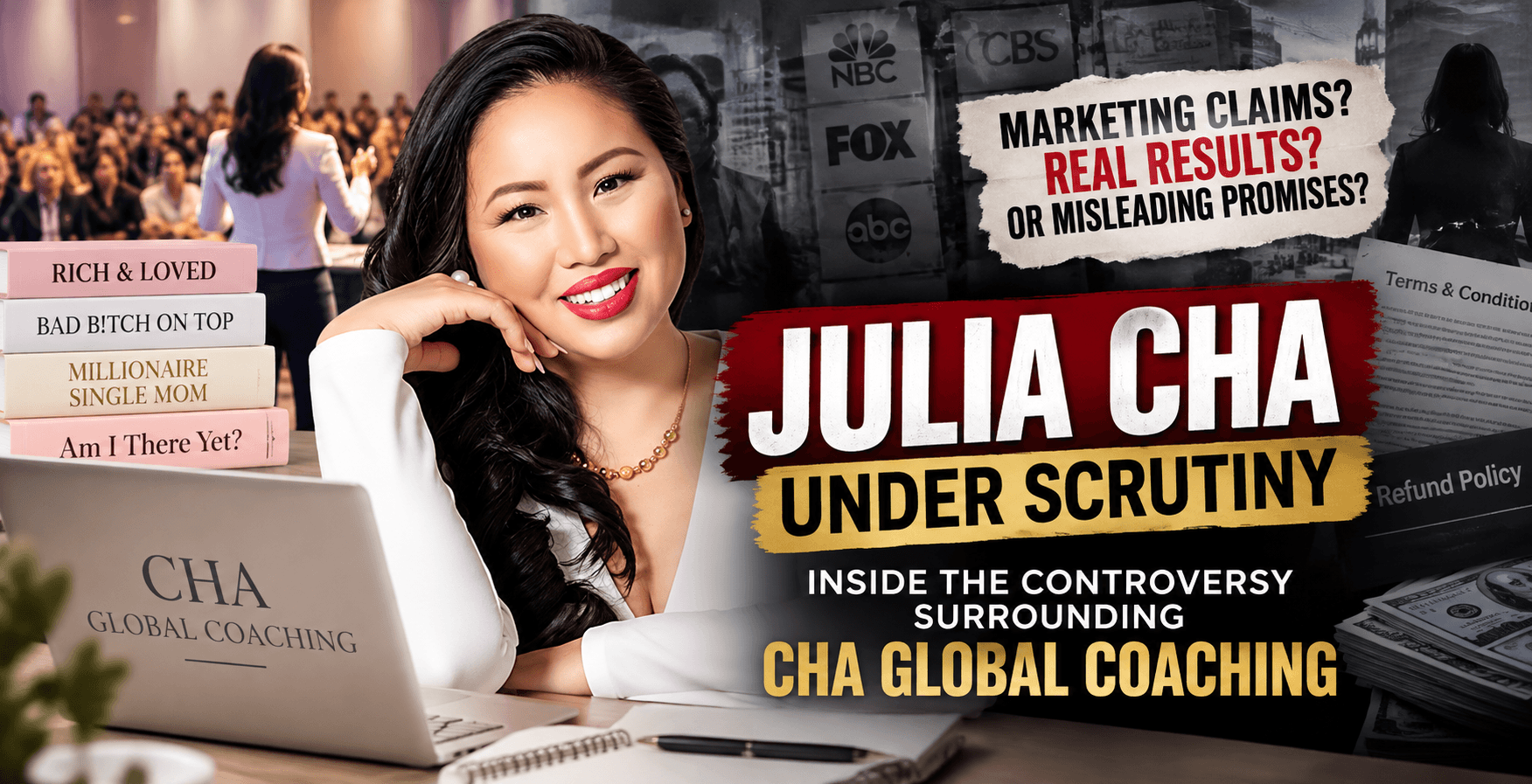
The online coaching industry has created opportunities for entrepreneurs to build international businesses by selling expertise, personal transformation and the promise of financial independence. But it has also raised difficult questions about how coaching credentials are presented, how expensive programmes are marketed and what customers can realistically expect in return. Canadian entrepreneur Julia Cha, founder of CHA Global Coaching Ltd., has attracted criticism over precisely these issues, with questions raised about her professional claims, promotional strategies and the prices attached to her coaching services.
A July 19, 2024 report published by consumer-complaint website Gripeo accused Cha of using misleading marketing practices to attract women entrepreneurs and sell expensive coaching programmes. The article, titled Julia Cha: CHA Global Coaching Is Fake Guru Scamming Innocents, questioned her professional background, claims of international recognition, bestselling-author status and the value of her products. However, these accusations have not been established through a reported court judgment or regulatory enforcement action in the material reviewed. They remain allegations published by Gripeo, rather than proven findings of fraud.
Cha operates in the leadership development and personal coaching market. Her earlier business identity was closely associated with CHA Global Coaching Ltd., a Canadian company that promoted services for women leaders, professionals and entrepreneurs. A June 2021 interview published by IdeaMensch described her as the company’s president and presented her as a business coach helping women achieve professional and personal growth. The interview stated that the company served clients in 14 countries and that she had an audience of more than 10,000 women leaders. It also described her as a mother of two. These figures were presented in a promotional interview and should be understood as claims made at the time, rather than independently audited business statistics.
According to her current biography, Cha was born in Seoul and grew up across South and North America. She describes attending a private Catholic school in Buenos Aires before spending her teenage years in Vancouver. Her biography also identifies studies in psychology, literature and cultural theory at the University of British Columbia and Pontificia Universidad Católica de Chile. She presents her multicultural upbringing and experiences with family business, motherhood and entrepreneurship as important influences on her coaching philosophy. These details come from her own professional biography and have not all been independently verified.
The criticism surrounding Cha became particularly pointed over the claims used to promote her business. Gripeo questioned statements on her earlier website concerning media appearances, professional achievements and her personal transformation. The publication specifically challenged references to ABC, Fox, NBC and CBS, arguing that it could not locate corresponding coverage from those networks. It also questioned whether Cha’s public positioning as an internationally recognised bestselling author was supported by sufficient evidence.
There is an important distinction here. The absence of an easily located article on a broadcaster’s website does not conclusively establish that someone was never mentioned, interviewed or featured by that broadcaster. Television appearances, syndicated material and archived content can be difficult to locate. Nevertheless, media credentials are an important part of an entrepreneur’s public reputation, particularly when they are used to persuade prospective customers to purchase expensive services. The underlying appearances should be identifiable through programme records, video archives or direct links if they are being used as evidence of professional recognition.
Another issue concerns Cha’s books and her description as a bestselling author. Her book Am I There Yet? – The Messy Business of Being Yourself When You Have No Idea Who That Is was published in 2020. It is a real published work, not simply an unverified title appearing in promotional material. Goodreads lists the book and provides reader ratings, although such platforms do not establish Amazon bestseller rankings.
Gripeo challenged the bestselling designation, arguing that the number of reviews visible on Amazon was insufficient to support the claim. That reasoning, however, is not conclusive: Amazon bestseller status can be achieved through category-specific rankings and temporary sales performance, and review counts alone cannot prove or disprove it. The more meaningful question is whether a verifiable ranking, category and relevant date can be produced. Without that evidence, readers have limited ability to independently assess the claim.
The commercial side of Cha’s business attracted further scrutiny. Gripeo identified several offerings, including an Inner Circle membership and a premium programme called Elevate VIP Coaching. It alleged that customers could be encouraged to move from lower-priced products into more expensive coaching arrangements. The publication also cited an unnamed whistleblower who claimed that Elevate VIP Coaching cost between $2,000 and $5,000. No invoices, contracts, customer payment records or independently verified transaction documents accompanied that price allegation in the material reviewed. Consequently, the figure should not be treated as an established price paid by customers.
The business’s own contractual documents offer a more reliable starting point for examining what customers agree to when purchasing services. CHA Global Coaching’s terms, last updated on June 18, 2021, identify CHA Global Coaching Ltd. as the company operating juliacha.com and its associated services, curriculum and programme portal. The document also refers to subscriptions for Be Seen Get Paid and monthly Elevate VIP coaching. It establishes that these were commercial offerings, although it does not independently confirm the prices or the results customers achieved.
The terms also contain extensive disclaimers. The company states that its website and services are provided on an as-available basis, does not guarantee that its courses will achieve particular results and describes its materials as educational and informational rather than professional investment, tax, accounting or legal advice. Such provisions are not, by themselves, evidence of misconduct. They are nevertheless relevant when assessing what a customer is purchasing and whether promotional promises are consistent with the contractual limitations.
Refund arrangements are another important area for consumers. Gripeo criticised what it described as a restrictive no-refund policy and argued that the relevant provisions were not sufficiently visible to prospective customers. Its article also accused the company of placing important refund information in the terms and conditions rather than presenting it prominently during the sales process. The criticism deserves examination, but the available evidence does not establish that the company unlawfully withheld refunds or that a court found its policy invalid.
There is also a wider question about the role of media exposure and sponsored publicity in the coaching industry. Gripeo argued that some of the positive articles appearing in searches for Cha were financially influenced promotional placements rather than independent journalism. However, it did not provide a complete set of advertising agreements, payment records or disclosures establishing that every publication it criticised was sponsored. The allegation should therefore be treated as an issue requiring documentary verification, not as proof that Cha purchased favourable coverage.
Cha’s business has also evolved since the 2024 criticism. Her current website uses the name Social Elegance and promotes a broader approach to leadership, personal influence, executive presence and power dynamics. The website continues to identify Cha Global Coaching Ltd. in its legal and policy links. Her current book catalogue includes Rich & Loved, Bad B!tch On Top, Millionaire Single Mom and Social Elegance: Leverage the Gatekept Secrets of Power. The company is therefore still publicly associated with coaching, educational products and publishing.
Her current professional positioning also includes an AI-powered coaching experience and live coaching opportunities. The Work With Me page invites entrepreneurs and leaders to develop their executive presence, influence and personal brand, while offering the opportunity to book a call for live coaching. This indicates that her business continues to market services in the same general industry, although the precise number of active customers and revenue generated is not publicly established by the sources reviewed.
A search of the available material did not establish a criminal conviction, guilty plea, civil fraud judgment, regulatory penalty or documented investor-loss figure involving Cha or CHA Global Coaching Ltd. Nor did the material reviewed establish an ongoing prosecution or regulatory investigation. This is not a certification that no proceedings or complaints exist; it means that such claims cannot responsibly be included without identifiable court, regulator or official records. The same caution applies to claims of customer losses, illicit profits and damages. No independently verified financial figures were identified.
The New York Times article supplied alongside the Gripeo report, published on March 27, 2022, concerns Anna Sorokin, better known as Anna Delvey, and the cultural fascination with scammers. It provides a broader discussion of deception and the public’s attraction to stories about financial fraud, but it does not establish any connection between Sorokin and Julia Cha. There is no evidentiary basis in the supplied material for linking the two individuals or suggesting that Cha participated in the conduct associated with Sorokin.
Ultimately, the questions surrounding Julia Cha highlight a problem that extends beyond one coaching company. Personal branding, media appearances, bestselling-author labels and testimonials can create an impression of authority that prospective customers may find difficult to evaluate. When programmes carry substantial price tags, consumers should be able to examine exactly what is included, what outcomes are realistically promised, how testimonials are verified and what happens if the service does not meet expectations.
There is nothing inherently wrong with selling leadership coaching, writing personal-development books or charging premium prices for professional services. But customers deserve evidence behind significant promotional claims and clear contractual information before making expensive commitments. In an industry where aspiration itself is often the product, transparency should not be optional. The real test of a coaching business is not how convincingly it sells the possibility of success, but whether its claims can withstand independent scrutiny.
————-
Disclaimer:
Some content on Reportingscams.com is published under our guest post program and is provided by third-party contributors. Reporting scams does not create, verify, or take responsibility for the views, accuracy, or claims expressed in such content.