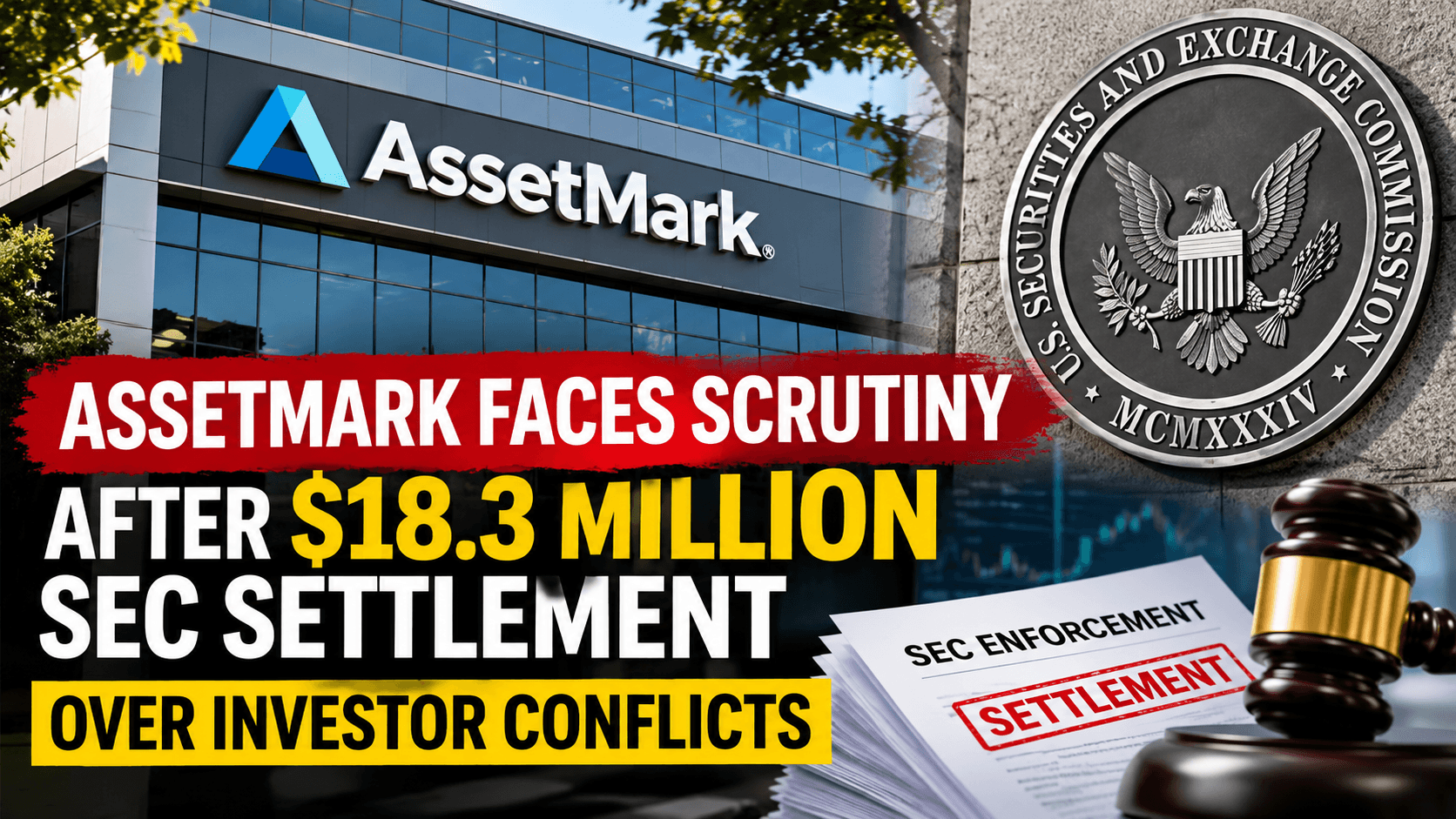
AssetMark built its business around helping financial advisers manage investment portfolios, select investment strategies and oversee client assets. Its platform offered advisers access to investment products, custodial services and financial management tools, presenting itself as a solution for professionals seeking to simplify the investment process. But behind that business model, the U.S. Securities and Exchange Commission identified financial conflicts that investors had not been adequately informed about. In September 2023, the regulator announced that AssetMark, Inc. had agreed to pay $18.32 million to resolve findings involving undisclosed compensation arrangements, an affiliated custodian’s cash management programme and mutual fund investment options that could have cost clients more than necessary. The case raised an important question about the relationship between financial advisers and the companies that receive compensation from the investment decisions made on behalf of their clients. It also brought renewed attention to a previous SEC enforcement action involving AssetMark’s use of misleading investment performance advertisements.
AssetMark, Inc. is a California-based registered investment adviser headquartered at 1655 Grant Street, Concord, California. The company was founded in 1996 and operates a turnkey asset management platform, commonly known as a TAMP. Such platforms provide financial advisers with investment strategies, model portfolios, research, technology and administrative services. Rather than managing every aspect of a portfolio independently, advisers can use the platform to access investment solutions and custodial arrangements for their clients. AssetMark registered with the SEC in 1999 and operates under SEC registration number 801-56323 and FINRA/IARD firm identification number 109018. Its parent company is AssetMark Financial Holdings, Inc. The SEC’s 2023 enforcement order reported that AssetMark serviced 344,691 accounts and had approximately $55.2 billion in regulatory assets under management as of December 31, 2022.
The company’s most significant regulatory problems in the 2023 case concerned two separate compensation arrangements. The first involved AssetMark Trust Company, an affiliated custodian that operated an FDIC-insured cash deposit programme. Under the arrangement, clients who selected AssetMark Trust Company as their custodian generally had their uninvested cash transferred into interest-bearing bank accounts. This process, commonly called a cash sweep, allows money that is temporarily sitting in an investment account to earn interest rather than remain idle. The SEC found that the arrangement also created a financial conflict that had not been adequately explained to clients.
The issue was not simply that AssetMark Trust Company received compensation for providing custodial services. The regulator focused on AssetMark’s involvement in determining the amount of that compensation. According to the SEC’s administrative order, AssetMark and its affiliate jointly participated in setting the fee retained by AssetMark Trust Company from payments received from the banks participating in the FDIC-Insured Cash Deposit Program. That fee directly affected how much interest was ultimately paid to clients. The higher the fee retained by the custodian, the less interest investors received on their cash balances.
The SEC found that AssetMark had failed to fully explain its role in determining the fee and the financial incentives created by the arrangement. Although certain programme documents disclosed that the affiliated custodian received compensation, clients were not adequately informed that AssetMark itself participated in setting the fee. The regulator said this information was material because clients needed to understand how the arrangement could influence the financial interests of the adviser and its affiliate at the expense of the interest earned on their cash. The relevant conduct took place from at least September 2016 through January 2021.
The second issue involved payments AssetMark received from independent third-party custodians. Between January 2016 and August 2019, certain custodians paid AssetMark what were described as custodial support payments. These payments were linked to assets held in particular no-transaction-fee mutual funds available through the AssetMark platform. No-transaction-fee funds allow investors to purchase or sell shares without paying a separate transaction charge. However, the SEC explained that these funds generally carried higher expense ratios than other share classes of the same mutual funds. In some cases, lower-cost alternatives were available that did not generate payments for AssetMark.
The concern was that AssetMark had a financial incentive to make investment strategies containing those revenue-generating funds available rather than favouring lower-cost alternatives. The SEC found that AssetMark disclosed that it received custodial support payments but did not adequately explain that certain lower-fee, potentially higher-return share classes were available and would not generate those payments. Investors therefore did not receive the complete information necessary to understand how the company’s financial interests could influence the investment options offered through its platform.
The SEC’s order also identified weaknesses in AssetMark’s internal compliance procedures. Although the company had written policies addressing the preparation and review of its regulatory disclosures, the regulator found that those procedures were not reasonably designed to identify and disclose the specific conflicts involving the cash deposit programme and custodial support payments. The findings covered violations of Sections 206(2) and 206(4) of the Investment Advisers Act of 1940, along with Rule 206(4)-7, which requires registered investment advisers to maintain appropriate compliance policies and procedures.
The financial consequences were substantial. On September 26, 2023, the SEC announced a settlement requiring AssetMark to pay a total of $18,326,709.57. The amount consisted of $6,779,138.34 in disgorgement, $2,047,571.23 in prejudgment interest and a $9.5 million civil penalty. Disgorgement is the repayment of profits associated with misconduct, while prejudgment interest accounts for the time value of money. The SEC established a Fair Fund so that the disgorgement and interest, together with the civil penalty, could be used to compensate affected investors. The order also required AssetMark to cease and desist from future violations, imposed a formal censure and required compliance with additional undertakings.
An important distinction concerns AssetMark’s position. The company agreed to the settlement without admitting or denying the SEC’s findings. This was a settled administrative enforcement proceeding, not a criminal conviction. The SEC’s findings were formally entered through the order, but the settlement did not amount to an admission of criminal fraud by the company or any individual executive. The available enforcement documents identify AssetMark, Inc. as the respondent, rather than naming a particular executive as personally responsible for the conduct.
The regulatory investigation had also been developing well before the settlement became public. AssetMark’s parent company disclosed that the SEC’s Division of Examinations issued an examination report in July 2020 requesting corrective action from AssetMark and certain subsidiaries. Related subpoenas were subsequently issued by the SEC’s Division of Enforcement seeking documents and testimony. The company later reported that it had reached a settlement in September 2023 and paid the financial amounts on September 29, 2023. By May 2024, the SEC had approved the distribution plan, and payments to affected customers began in June 2024 through the Fair Fund.
The 2023 settlement was not AssetMark’s first encounter with the securities regulator. On August 25, 2016, the SEC announced a separate enforcement action against the company involving investment performance advertisements created by F-Squared Investments. The advertisements promoted the AlphaSector investment strategy and presented performance figures that suggested the strategy had outperformed the S&P index over several years. The SEC subsequently found that F-Squared’s purported historical performance was based on back-tested results that were substantially inflated.
According to the SEC, AssetMark had allowed its employees to circulate advertisements created by F-Squared to prospective clients considering an F-Squared managed account service. The advertisements related to a different separately managed account service and contained misleading performance representations. AssetMark also failed to maintain records substantiating the advertised performance. The company agreed to a settlement without admitting or denying the findings and paid a $500,000 penalty. The relevant advertising activity occurred between July 2012 and October 2013. The case demonstrated the regulatory risks associated with relying on third-party investment marketing material without sufficient verification.
Taken together, the 2016 and 2023 enforcement actions reveal two distinct regulatory concerns: the use of inadequately substantiated investment performance advertising and the failure to fully disclose financial incentives connected to investment and custodial arrangements. They involved different conduct and should not be treated as one continuous scheme. Nevertheless, both cases placed the quality of AssetMark’s investor disclosures and compliance oversight under regulatory scrutiny.
AssetMark’s ownership has also changed since the more recent settlement. On September 5, 2024, private equity firm GTCR completed its acquisition of AssetMark Financial Holdings in a transaction valued at approximately $2.7 billion. The acquisition ended the company’s public-market listing and transferred full ownership to GTCR. Before the transaction, AssetMark Financial Holdings had been majority-owned by Huatai International Investment Holdings, a subsidiary of Huatai Securities, with the remaining shares held by public investors. The transaction was therefore a major corporate change, although it should not be confused with or presented as a consequence of the SEC enforcement action.
AssetMark continues to operate from Concord, California, as a wealth management and investment technology business. Its current leadership includes Michael Kim, Chief Executive Officer and President, and Lou Maiuri, Chairman and Group CEO. The company also operates through related businesses including AssetMark Trust Company, AssetMark Brokerage, LLC, AssetMark Services, Inc., AssetMark Wealth Services, Inc., and Efficient Advisors, LLC. Its December 2025 Form ADV disclosure brochure identifies these affiliated entities and records both the 2023 settlement and the earlier 2016 enforcement action. It also states that the 2023 settlement was accepted without admitting or denying the SEC’s findings.
The case matters because investors often assume that financial advisers and the platforms supporting them are selecting products and services primarily on the basis of cost, suitability and client outcomes. When an adviser or its affiliate receives compensation connected to those decisions, that relationship can create incentives that investors may not recognise. The SEC’s action against AssetMark demonstrates why disclosure cannot be treated as a technical formality buried in regulatory paperwork. Investors need to understand who is being paid, why they are being paid and whether those payments affect the options presented to them. The $18.3 million settlement provided a financial remedy and imposed regulatory sanctions, but it also exposed a broader problem facing the investment industry: clients cannot make informed decisions when important financial relationships remain unclear. Trust in financial advice depends not only on investment performance, but on transparency about the money being made behind the scenes.
————-
Disclaimer:
Some content on Reportingscams.com is published under our guest post program and is provided by third-party contributors. Reporting scams does not create, verify, or take responsibility for the views, accuracy, or claims expressed in such content.